
pullpush for old posts
search.pullpush.io/?type=com…
arctic for new posts
arctic-shift.photon-reddit.c…
easy
1
25
892

PullPush is actually a Ruzzian service which scraps Reddit contents, possibly on an illegal basis. They reportedly have a shoddy record when coming to honoring removal/takedown requests.
reddit.com/r/gdpr/comments/1…
@BLkhoih96132 #NAFO @TaylorLorenz
1
15

So Reddit APIs have your data. This guy is using arctic shift API. To get it removed
>go to Arctic Shift GitHub page.
> You can also DM the developer on Discord (raiderbv) or email them.
Other reddit APIs which have your reddit data are pullpush and pushshift

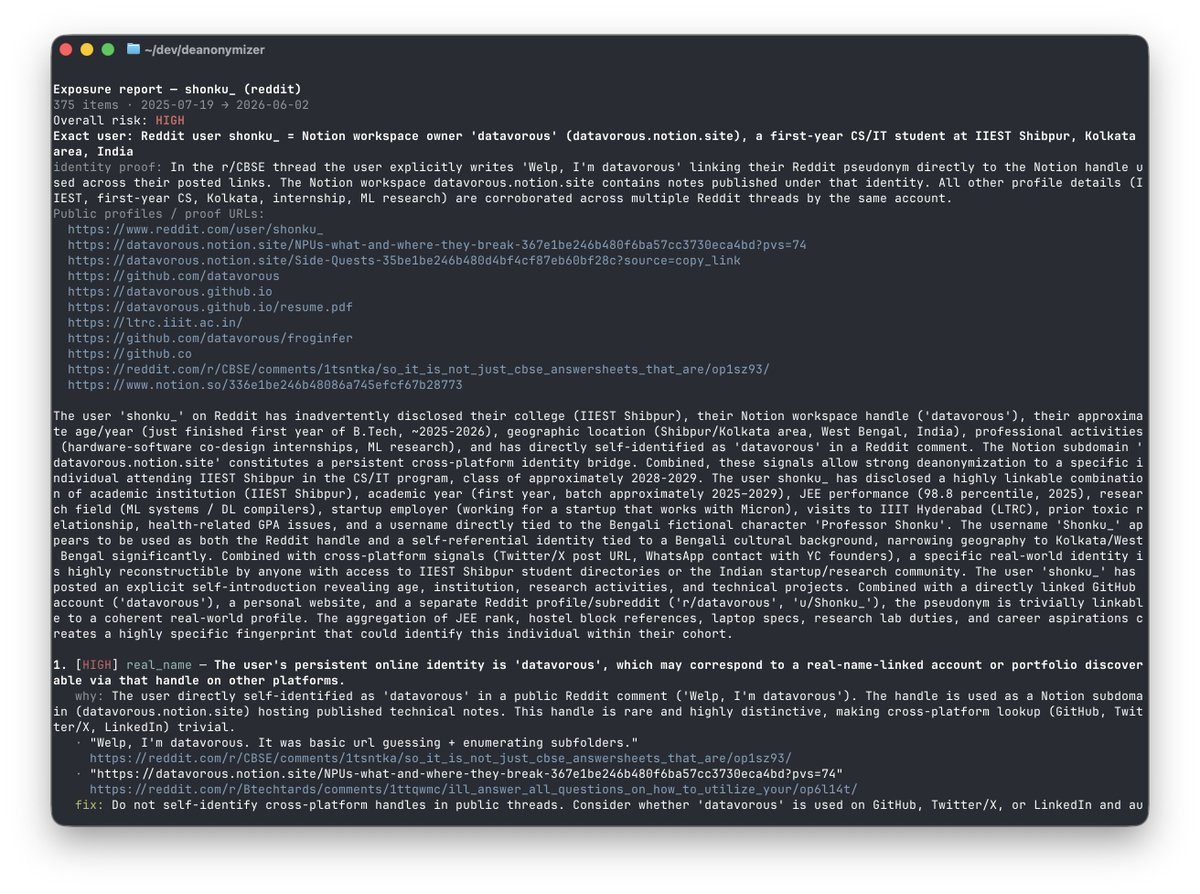
Made a tool to find anyone's IRL identity from their public commenting or posting history & patterns - even if they are using totally anonymous accounts.
Source: github.com/ni5arga/deanonymi…
I keep building cool stuff, follow me on GitHub: github.com/ni5arga :)
1
2
116

May 26
Your Purple Heart post on reddit that you deleted: 👇
The "Purple Heart post" refers to a deleted 2019 Reddit comment by Graham Platner's old account "P-Hustle" (which he has acknowledged owning).
Exact text (from June 2019, in r/combatfootage or similar):"This video never gets old. Dumb motherf----- didn't deserve to live. At least his stupidity and fat a-- wheezing are available for all future infantrymen to witness and hold in contempt. Poor marksmanship on the Taliban's part is the only reason this mouthbreather made it home, he managed to make every possible s--- decision possible when it comes to small unit combat."
It was a reply to a viral 2012 helmet-cam video of U.S. Army Pfc. Ted Daniels (then 37, a father of two) in Afghanistan. Daniels deliberately moved into open terrain to draw Taliban fire away from his squad during a firefight. He was shot four times, survived, and received a Purple Heart. The video (available on YouTube, e.g., via Funker530) has tens of millions of views.
The post was archived via tools like Pushshift/PullPush and databases such as the Maine Monitor’s collection of Platner’s deleted comments. Platner has mass-deleted much of his old Reddit history.
Context and Fallout (as of late May 2026)
Platner’s response: When confronted by Fox News, he did not apologize. He cited his own four combat tours (Marine Corps and Army infantry), noted that many of his friends have Purple Hearts, and called criticism "slanderous and offensive."
Ted Daniels’ response: The veteran called Platner a "coward" for keyboard comments and challenged Democrats (including Bernie Sanders, Elizabeth Warren, etc.) backing him to explain it to his children. He said he doesn’t want a personal apology (doubting its sincerity) but criticized the lack of respect for veterans.
1
1
37


Mar 23
(Speaking of which: is there an easy way to examine a suspended Redditor's post history anymore? Arctic Shift doesn't support it. PullPush OFTEN does, but it hasn't archived anything for almost a year now.)
1
2
46

Mar 14
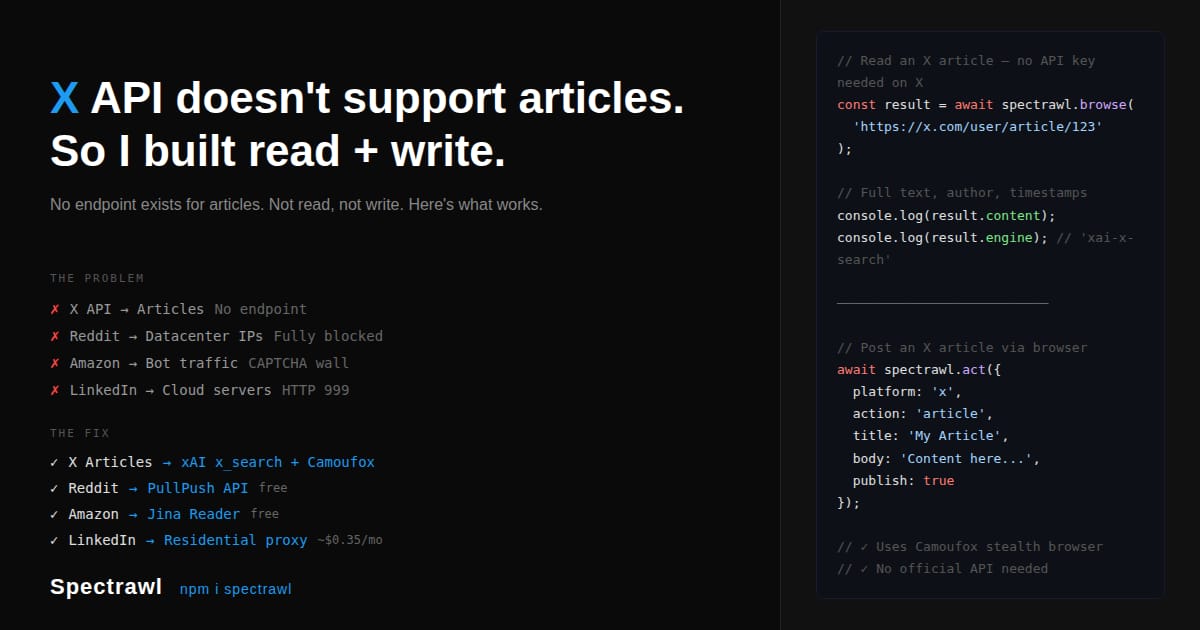
X's API doesn't support articles. You can't read them. You can't post them. There's no endpoint.
So I built both into Spectrawl:
Reading: xAI's Responses API with x_search returns full article text, author, timestamps. ~$0.06/read. No scraping, no login wall, no cookies.
Posting: Browser automation with Camoufox — opens the article editor, fills title and body, saves as draft or publishes. Uses stored cookies, no API key needed.
This matters because if you're running AI agents that need to interact with X content, the official API leaves you stuck. Articles are a blind spot.
While I was at it, I solved the same kind of problem for other sites that block cloud servers:
→ Reddit: PullPush API (free, no auth)
→ Amazon: Jina Reader (free, bypasses CAPTCHA)
→ LinkedIn: residential proxy auto cookie injection
browse(url) — Spectrawl picks the right path automatically.
1
3
75

Feb 28
arctic shift works better than pullpush for these!
javascript:open(location.href.replace(/:\/\/([\w-] .)?(reddit\.com\/r|reveddit\.com\/v)\//i, "://reddit.coolsite.cv/r/"), "_blank")
(bookmark, redid it as a cf worker because vile people were hosting the only other instance)
4
57
10,702

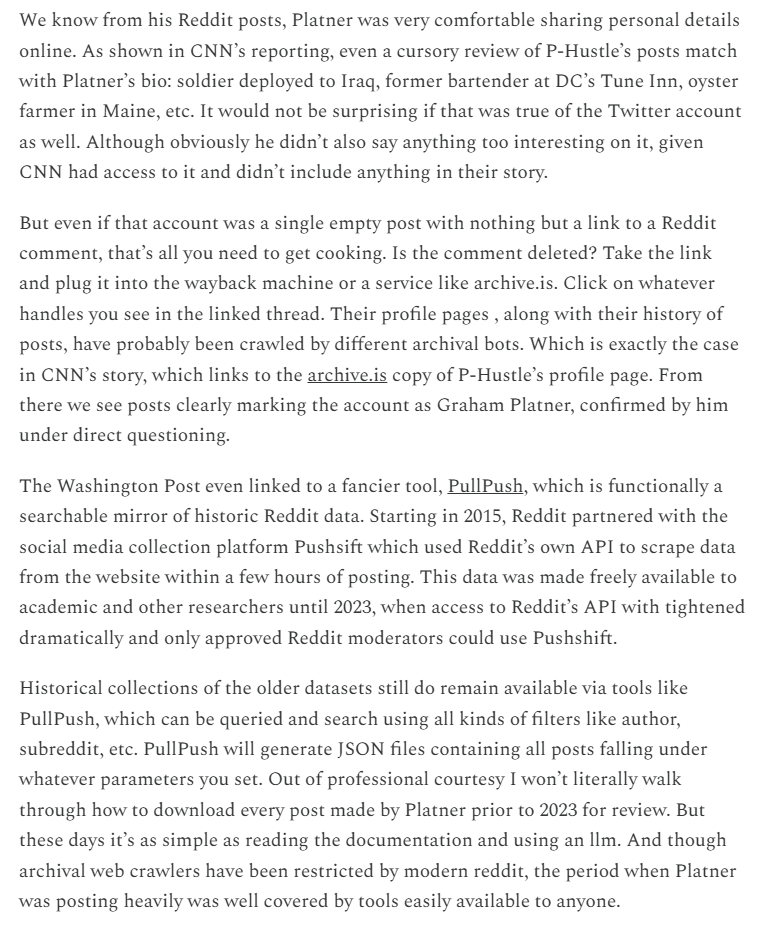
Good piece from @tysonbrody here. PullPush is a great tool. In this case Platner's old twitter linking to his reddit made it a gimme.
23 Oct 2025

Great read from @tysonbrody about how opposition research works and lessons from the Plattner revelations. newsletter.tysonbrody.com/p/…
5
13
7,072

16 Oct 2025
If anyone wants to read PWR's Deleted Reddit post here is the link thanks to PullPush
search.pullpush.io/?kind=sub…
4
320

7 Jul 2025
Where my Fellow Cancers at?! 🤍 (Also the music on this song is my own comes out Friday) #zodiac #cancer #zodiaccancer #moon #pullpush #Zodiacsigns #🤍🤍🤍 #digitalart #art #female #fyp #blowitup #foryoupage
2
191

Sure:
1. Previous Fitness Requirements (Varied by Department)
These were often general physical fitness tests modeled after military/police standards. Common metrics included:
ComponentTypical Requirement
1.5-Mile RunComplete in 12:00–14:00 minutes
Push-Ups25–30 reps in 1 minute
Sit-Ups30–35 reps in 1 minute
Grip Strength70–90 lbs (hand dynamometer)
Bench PressOften required 70–100% of body weight
Vertical Jump15–20 inches
Sit-and-Reach16–18 inches for flexibility
Body Fat %Often required to be <20–25%
Agility CourseDepartment-specific time standards
> Note: These tests varied widely. Some required additional swimming or flexibility tests, and many allowed age- and gender-based adjustments.
---
2. Current CPAT Standards (Widely Adopted Since ~2010)
The CPAT is an 8-station timed test simulating fireground tasks. All tasks must be completed in 10 minutes, 20 seconds or less, with no age or gender adjustments.
EventDescription
Stair Climb3 minutes at 60 steps/min on a stair stepper with a 75-lb weighted vest
Hose DragPull a 200-ft hose line 75 feet; drag 50 feet more while on one knee
Equipment CarryCarry two 25-lb saws (one in each hand) 75 feet and return
Ladder Raise & ExtensionRaise 24-ft ladder, then extend another while standing
Forcible Entry SimulationUse a 10-lb sledgehammer to strike a weighted target 5 ft
SearchCrawl 70 feet through a dark, enclosed maze
Rescue DragDrag a 165-lb mannequin 70 feet with a shoulder harness
Ceiling Breach and PullPush up a 60-lb weighted ceiling panel three times, then perform 20 pull-downs with 80 lbs
> Scoring: Pass/Fail only. No partial credit. No modifications for age or gender.
=======
BotYes, the decision to use 165 lbs instead of 200 lbs in the CPAT is partly influenced by legal, physiological, and statistical considerations, including sex-based differences in average body mass and muscular strength.
Let’s break it down:
---
1. Physiological Reality:
Average adult female weight in the U.S. is around 170 lbs (CDC, 2023), but:
Lean body mass is significantly lower than males.
Upper body strength and grip strength are ~40–60% lower in untrained women vs. men.
Carrying or dragging a 200-lb dummy requires a level of absolute strength most untrained women would not possess, even if well-conditioned.
======
You might be asking why is the drag only 165 lbs which is much lighter than the average male (50% of the adult population)
=======
2. Why 165 lbs? Legal and Statistical Factors
The CPAT was designed in the late 1990s and validated through industrial and legal studies to:
Simulate job tasks based on the minimum needed to perform essential fireground duties.
Be legally defensible under Title VII of the Civil Rights Act, which prohibits employment tests that have an adverse impact on protected classes (e.g. sex) unless the standard is shown to be job-related and consistent with business necessity.
If the CPAT used a 200-lb drag, it would likely:
Cause a significant drop in pass rates for women (estimates suggest as few as 5–10% might pass without extensive, targeted strength training).
Face lawsuits or rejection for being a "disparate impact" test unless the 200-lb standard was proven absolutely essential.
---
3. Pass Rate Examples
From studies of CPAT outcomes:
Men's pass rates: ~80–95% on first attempt
Women's pass rates: ~30–50% on first attempt
With proper training, some departments have raised that to 60–70%
Increasing the dummy weight to 200 lbs would widen that gap sharply
============
Tldr.
Yes they lowered the standards
Yes the new standard is designed for women to pass at a much higher rate.
1
5
1,118

Pullpush lets you search for a user's deleted posts:
search.pullpush.io/?kind=sub…
3
989

14 Apr 2025
I built a system that scrapes Reddit for battle-tested startup ideas - directly from desperate founders venting in real time.
Then I run them through GPT, rank them by urgency and monetizability, and spit out 3 fully-formed business ideas per day.
With:
* Guaranteed demand
* Zero validation needed
* And profit baked in
And yeah - it's literally stealing…
But the founders aren’t doing anything with these ideas anyway.
They’re too busy crying in r/startups about their cofounders ghosting them.
So I take their pain, flip it, and turn it into profit.
Because nobody cares who had the idea first...
They care who sells it better.
Want to see it in action?
👉 alexberman.com/dailyideas
Go there. Get today’s 3 winners. Repeat daily.
Here’s how the system works:
* PullPush (my dark Reddit API) feeds raw threads
* n8n triggers GPT to extract buyer signals, failed attempts, unmet pain
* Output is stored, ranked, and delivered
And once you’ve got the ideas?
That’s when the real game starts.
Inside AB Mastermind, I’ll help you turn these ideas into revenue:
* We build your outreach
* Craft the offer
* Scale the sales system
So you can go from “this could work” to “holy crap I’m making money”
Fast.
Join now.
- Alex
2
11
7,293

12 Mar 2025
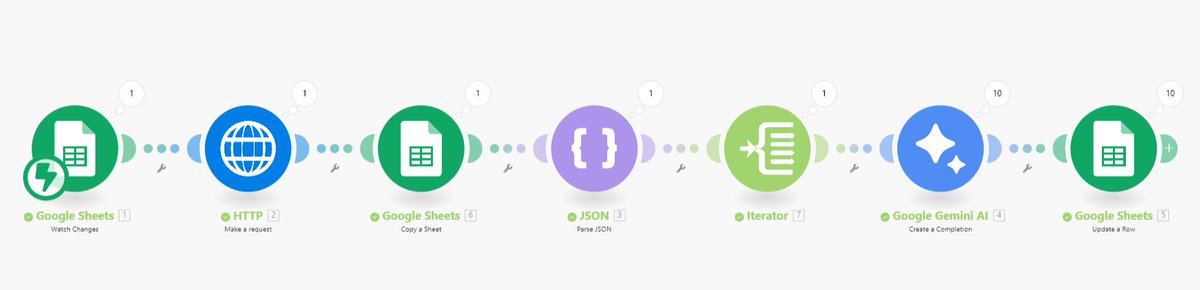
Day 5 of building 90 AI agents in 90 days
Today, I built a tool that scrapes Reddit and gets you ideas to create content.
All you have to do is get a subreddit and the keyword you want to look for (had a time crunch so had to make it as simple as possible).
And it will do it for you.
For now, it's using Sheets for input and output, pullpush API for data collection and Gemini for processing the data. Glued the whole thing using Make.
Reply or DM if you want to know more, or want to see something automated.
P.S. Thinking of trying a new tool next week, so this is among the last things I create using Make for a while.
2
3
121



22 Nov 2024
does noelle think deleting their reddit posts will keep them safe when pullpush api exist LMFAO i can still see their transphobic post
2
14
441

22 Nov 2024
You do realise you can easily scrape any reddit data with pullpush, their extension (at least in the first few epochs) was collecting no data, but just sending ping pong requests to confirm connection
3
720

27 Sep 2024
Some devs hustle for perfection, others just get things done. Which one are you? 🧪
🎁 100$ OFF 👉 pullpu.sh 🔥
#PullPush #DevHacks #EfficiencyGame #DevShortcuts #justLaunch

3
61