
May 1
🚀 ICML 2026 — PyHealth 2.0
What if clinical AI didn’t require a remote GPU cluster to get anything done?
PyHealth 2.0 flips the default:
• 💻 Run locally on a 16GB laptop — no heavyweight infra required
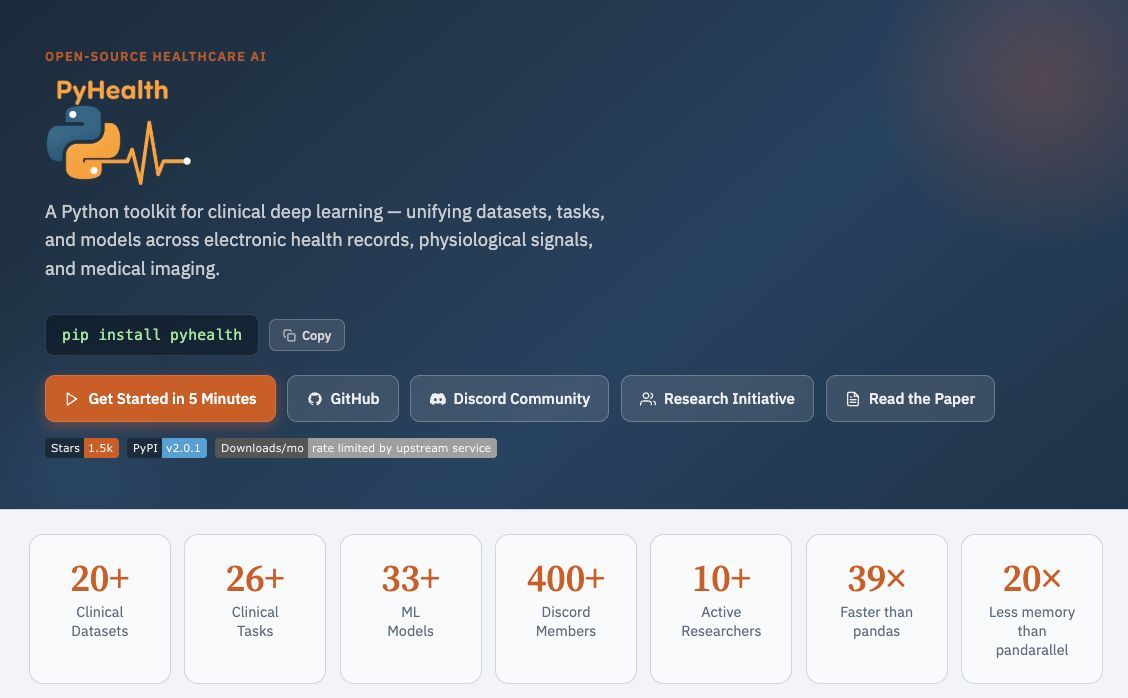
• ⚡ Up to 39× faster, 20× lower memory vs prior pipelines
• 🔄 Same workflows scale seamlessly to large remote servers when needed
This isn’t just efficiency — it’s a shift in who can actually do clinical AI:
→ Prototype, debug, and iterate locally
→ Reproduce results without expensive compute
→ Scale to production only when necessary
Under the hood, still a full-stack toolkit:
• 15 datasets, 20 tasks, 25 models
• Multimodal (EHR, imaging, signals)
• Interpretability uncertainty (incl. conformal prediction)
• 400 open-source contributors
Bottom line: Clinical AI shouldn’t start with a cluster request. It should start on your laptop.
👏 Huge congrats to all my students and collaborators on this work — proud of what you’ve built. openreview.net/pdf?id=gMLVFN…
Check out Pyhealth pyhealth.dev/
#ICML2026 #HealthcareAI #EfficientAI #OpenSource #Reproducibility #MachineLearning
4
31
159
10,140
22 Dec 2025
🚀 PyHealth for Industry Practitioners: Clinical Predictive Modeling, Finally Practical
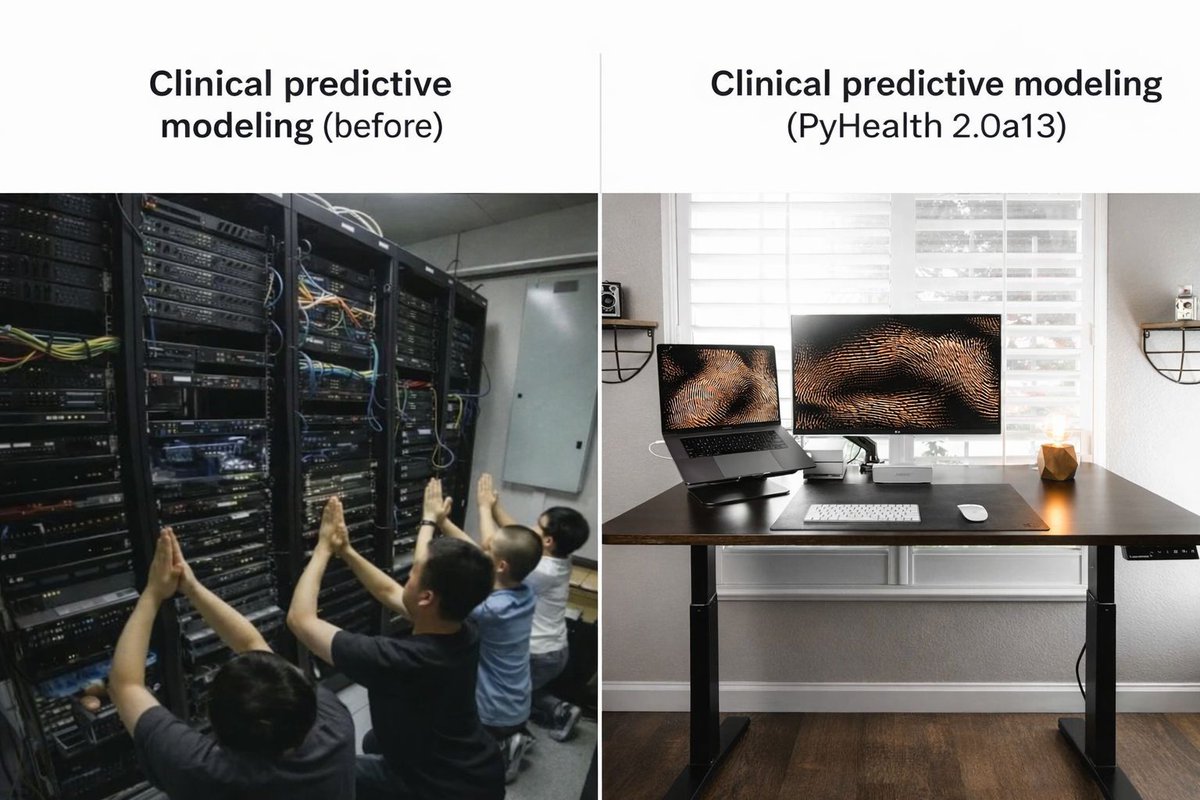
We’re excited to announce PyHealth 2.0a13, a major step toward making efficient, interpretable, and cutting-edge clinical predictive modeling accessible to industry teams.
With a new backend memory optimization, PyHealth now reduces RAM requirements from ~385GB to ~16GB when working with large-scale EHR datasets such as MIMIC-IV—a 24× reduction. This means many real-world clinical prediction workflows can now run on consumer hardware or laptops, not just large compute clusters.
If you work in healthcare, life sciences, or clinical AI and care about:
- Practical deployment (not just benchmarks)
- Model transparency and interpretability
- Rapid experimentation on real EHR data
PyHealth is built for you.
📖 Technical details: lnkd.in/gfhUY5xN
💬 Feedback & testing: lnkd.in/gAuh7nGF
TL;DR: Clinical predictive modeling on a laptop is now realistic—and we’d love your help testing the new backend.
linkedin.com/posts/john-wu-c…
2
248
24 Oct 2024
🚀 Join the Sunlab PyHealth Hackathon 2024!
Are you passionate about Healthcare AI and open-source development? Here's your chance to make a real impact! 🏥💻
Ready to innovate? Sign up now! 👇
📝 Registration Form: forms.gle/bU8z3ih1rD2orZMq7
🔗Event link github.com/sunlabuiuc/PyHeal…
We're excited to announce a week-long hackathon focused on PyHealth - an open-source framework that's revolutionizing healthcare AI development. Whether you're a seasoned ML engineer or a prospective graduate student, there's a place for you!
🗓️ Key Dates:
• Oct 28: Kickoff & Tutorial (9AM-12PM CT)
• Oct 29: Project Formation
• Oct 30-31: Project Development
• Nov 1: Final Presentations
✨ What you'll get:
• Hands-on experience with PyHealth
• Mentorship from healthcare AI experts
• Opportunity to contribute to meaningful healthcare solutions
• Collaboration with like-minded innovators
• Guidance from Dr. Jimeng Sun and the Sunlab team
🎯 Project Tracks:
1. Framework Updates: Perfect for quick, impactful contributions
2. Research Paper Implementation: Dive deep into cutting-edge healthcare AI
🌟 Expert Mentors:
• Zhenbang Wu - PhD researcher, Healthcare Foundation Models
• John Wu - PhD researcher, Explainable Healthcare AI
• Dr. Jimeng Sun - Health Innovation Professor, UIUC
#HealthcareAI #OpenSource #Hackathon #PyHealth #MachineLearning #HealthTech #UIUC
Want to learn more? Check out:
📚 Documentation: pyhealth.readthedocs.io
🔗 GitHub: github.com/sunlabuiuc/PyHeal…
2
7
919


21 Apr 2023
PyHealth:ヘルスケアデータに対する予測モデルを提供するPythonライブラリ。データ前処理、予測モデリング、評価の3つのモジュールで構成。オススメのポイントは、①scikit-learnに似せたデザイン。②30以上の機械学習モデルを提供。③画像データやテキストデータにも対応。 arxiv.org/abs/2101.04209
10
858

3 Feb 2022
#PyHealth is a free python package for healthcare predictive modeling. It supports step-wise building of predictive models, testing and evaluating each model step by step!
Learn more here: bit.ly/3sfOxzl via @analyticsindiamag
#deeplearning #datascience #ai #python
1
3

21 Jan 2021
PyHealth: A Python Library for Health Predictive Models. Check this new python library specialised in AI in Healthcare. buff.ly/3svdLJH
#machinelearning #pyhealth
4
6
5 Oct 2020
Check out our PyHealth a deep learning library for building clinical predictive models over electronic health records. @caoxiao_danica @yzhao062 @AiLucasg
2
18


PyHealth: A Python Library for Healthcare AI github.com/yzhao062/PyHealth #Python
2
2

27 Nov 2018
1
6