
Thanks to Matt Olson for coauthoring, and @UWproteindesign for their great work on the RFDiffusion and RoseTTAFold models!
1
4

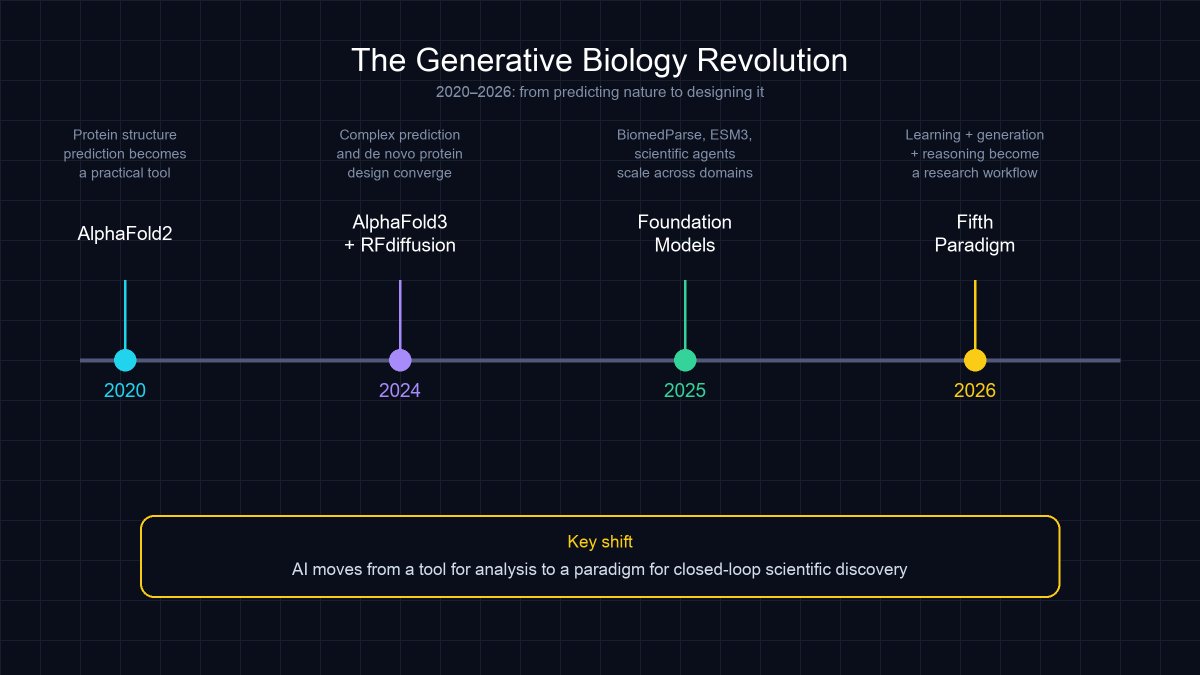
🧠 FORCE 2: Generative Design
AlphaFold3 RFdiffusion → de novo protein design in minutes. LLM Agents autonomously execute research pipelines. Foundation models generalize across experiments, species, and conditions.
🏥 FORCE 3: Bench to Bedside
Insilico rentosertib: first AI-discovered drug completing Phase IIa. 200 AI programs in development.
1
7
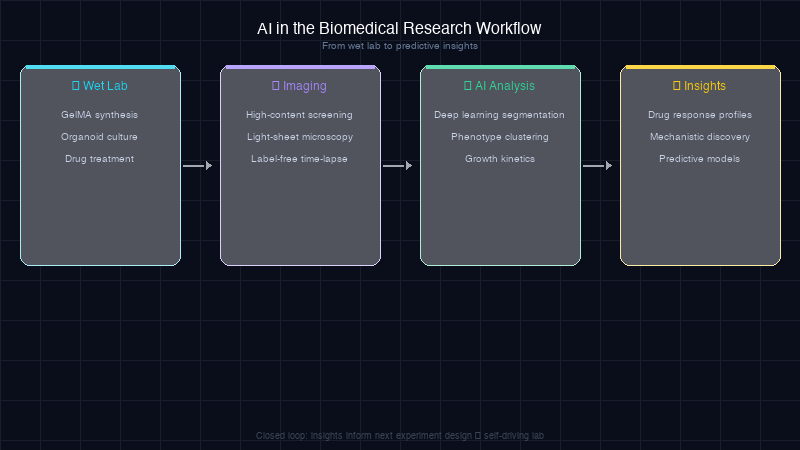
🔬🔬 FORCE 1: Pattern Recognition at Scale
Deep CNNs segment 3D organoids with Dice >0.95. BiomedParse unifies 9 imaging modalities with 6M image-mask-text pairs — enabling text-prompted analysis without manual annotation.
🧠 FORCE 2: Generative Design
AlphaFold3 RFdiffusion → de novo protein design in minutes. LLM Agents autonomously execute full research pipelines.
1
7

Why do you think the 2024 Nobel prize in chemistry was awarded to Hassabis, Jumper and Baker?
Other examples would be RFdiffusion and esmGFP. Good luck doing that without AI.
It costs you nothing to admit that it’s incredibly useful.
8
I don’t get it.
HalluDesign-NA is interesting, but it feels more like a pipeline remix than a new design breakthrough.
Take HalluDesign, swap in NA-MPNN, use AF3/Protenix as the scorer, then optimize pLDDT / pTM / ipTM.
That’s not RFdiffusion3 for nucleic acids.
RFdiffusion-style models generate structures.
This is more like using AF3 as a reverse-design heuristic.
Fine idea. But without experimental aptamer validation, a pretty predicted DNA/RNA structure is still just a pretty prediction.
Jun 12

HalluDesign-NA: Extending HalluDesign for De Novo Nucleic Acid Design biorxiv.org/content/10.64898…
1
37
WeiTing Lin(GR15🌴/Gitcoin Beta) retweeted

Jun 11
"BioPipelines combines >40 protein/ligand design tools (RFdiffusion, ProteinMPNN, AlphaFold, Boltz-2) into a single python package."
Jun 9

🔗BioPipelines: Accessible Computational Protein and Ligand Design for Chemical Biologists. doi.org/10.34133/csbj.0129
📚CSBJ - A Science Partner Journal: spj.science.org/journal/csbj
@CSB_Journal @SPJournals @aaas #ProteinEngineering #StructuralBiology #Bioinformatics #AlphaFold #AI
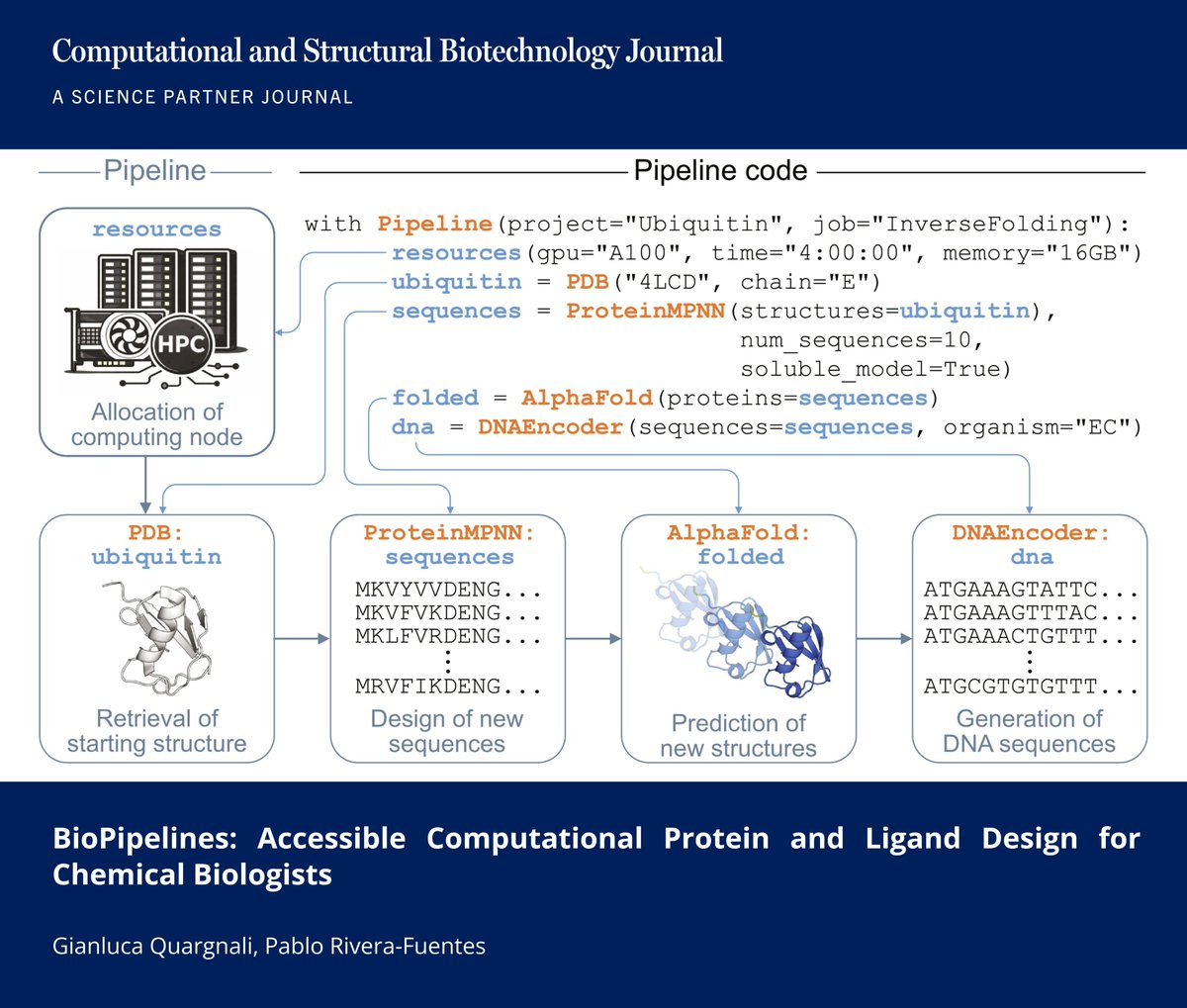
ALT 🔗 BioPipelines: Accessible Computational Protein and Ligand Design for Chemical Biologists. Computational and Structural Biotechnology Journal (CSBJ). DOI: https://doi.org/10.34133/csbj.0129 📚 CSBJ - A Science Partner Journal: https://spj.science.org/journal/csbj
1
19
80
8,012

Jun 10
MiMo Code @XiaomiMiMo @_LuoFuli just launched with a free MiMo V2.5 channel (1M context).
And I turned it into a bio agent: 1,676 biology SKILL.md files, one command to install.
735 skills run purely local (BioPython, scanpy, DESeq2 — no API key needed).
Protein design suite (AlphaFold, RFdiffusion) uses Modal GPU — $30/mo free tier.
github.com/BioTender-max/bio…

A strong model evolution needs a solid harness system, and vice versa. 14 days, 5 people, one vibe-coding journey — and MiMo Code was born. It's open source: github.com/XiaomiMiMo/MiMo-C…

1
2
212

Jun 10
8 things happening in AI × Bio that sound like sci-fi but are real in 2026 🧬:
1. Protein design & structure (the AlphaFold lineage)
AlphaFold3 and successors now predict not just protein folds but full complexes, proteins with DNA, RNA, ligands, and ions. Generative tools like RFdiffusion let you design novel proteins from scratch for a target function, rather than just predicting existing ones.
2. Biological foundation models / "virtual cells"
The push to build large models trained on massive omics data(single-cell RNA-seq, etc.) that can simulate how a cell responds to a perturbation, a drug, a gene knockout. Think "GPT for cell biology." Efforts like the Arc Institute's Virtual Cell and scGPT/Geneformer-style models are central here.
3. AI-driven drug discovery
End-to-end pipelines using ML for target identification, molecule generation, and ADMET/toxicity prediction. Generative chemistry models design candidate molecules; the bottleneck is increasingly validation (wet-lab clinical), not idea generation.
4. DNA / genomic language models
Models like Evo and Nucleotide Transformer treat the genome as a language, learning to predict and generate DNA sequences enabling design of regulatory elements, CRISPR guides, and even whole genomic systems.
5. Lab automation & self-driving labs
Closed-loop "AI scientist" systems that propose hypotheses, run experiments via robotics, read results, and iterate compressing the design-build-test-learn cycle dramatically.
6. Single-cell & spatial omics AI
Multimodal models integrating spatial transcriptomics, proteomics, and imaging to map tissues at cellular resolution building toward a true "Google Maps of the human body" (Human Cell Atlas).
7. AI for protein language & enzyme engineering
Protein language models (ESM lineage) used to engineer enzymes for industrial/therapeutic use, predict mutation effects, and design antibodies.
8. Biosecurity & safety
Growing concern that the same generative tools could design pathogens or toxins driving work on model safeguards, DNA-synthesis screening, and governance.
9
16
118
8,672