
SmartBear expands ReadyAPI with AI-powered API testing capabilities helpnetsecurity.com/2026/05/…
366

7 Nov 2025
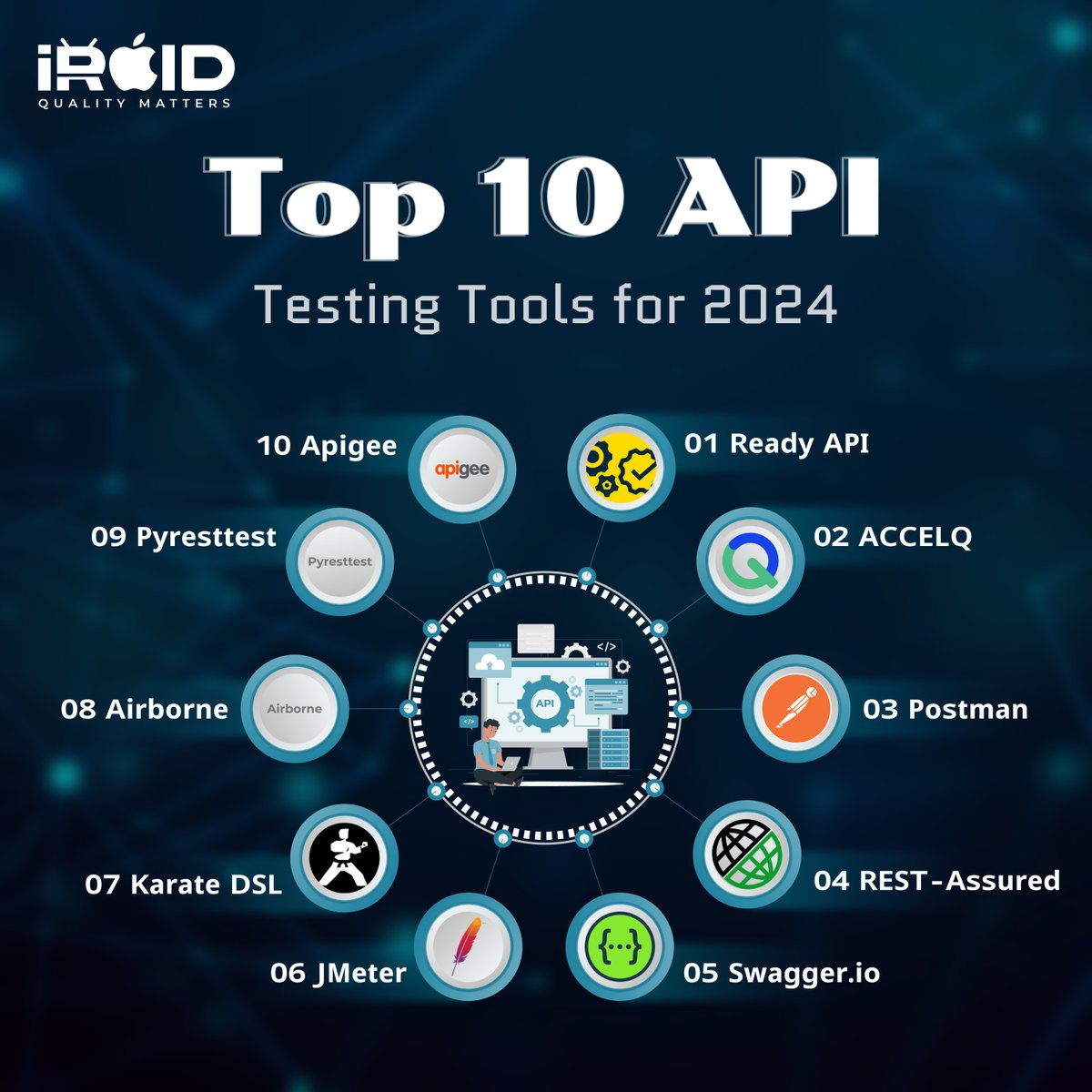
Not long ago, API testing meant slow processes and endless debugging. 🧩
Now, tools like Postman, ReadyAPI, and ACCELQ make it seamless, automated, and even AI-driven. 🚀
We’ve rounded up the Top 10 API Testing Tools for 2025 powering modern development teams. 💡
Which one’s your go-to tool? 👇
#APITesting #SoftwareTesting #DevTools #iRoidSolutions
5
8
201

31 Aug 2024
100 popular paid software and open-source alternatives 🌻
1. Hosting
Vercel ➡️ Coolify
Netlify ➡️ CapRover
Render ➡️ Railway
Heroku ➡️ Dokku
Firebase ➡️ Supabase
Platform.sh ➡️ Clever Cloud
AWS Amplify ➡️ Back4App
Google Cloud Run ➡️ OpenFaaS
Azure Static Web Apps ➡️ Surge
DigitalOcean App Platform ➡️ Fly.io
2. Repository
GitHub ➡️ GitLab
Bitbucket ➡️ Gitea
Beanstalk ➡️ Allura
Helix Core ➡️ Perforce
Assembla ➡️ RhodeCode
Plastic SCM ➡️ Fossil
GitLab (Paid) ➡️ Gogs
Azure Repos ➡️ SourceHut
AWS CodeCommit ➡️ Phabricator
Google Cloud Source Repositories ➡️ Kallithea
3. Containers
Docker ➡️ Podman
Nomad ➡️ HashiCorp Nomad
Rancher ➡️ K3s
Portainer ➡️ Yacht
AWS Fargate ➡️ Firecracker
VMware Tanzu ➡️ KubeSphere
Google Anthos ➡️ Knative
OpenShift (Paid) ➡️ OKD
Mirantis Kubernetes Engine ➡️ MicroK8s
Kubernetes (GKE, EKS, AKS) ➡️ OpenShift
4. CI/CD
Jenkins ➡️ GitLab CI/CD
CircleCI ➡️ Drone
Travis CI ➡️ Concourse CI
Bamboo ➡️ GoCD
TeamCity ➡️ Buddy
Semaphore ➡️ Screwdriver
Azure Pipelines ➡️ Tekton
GitLab CI (Paid) ➡️ Buildbot
Bitbucket Pipelines ➡️ Strider
GitHub Actions (Paid) ➡️ Woodpecker CI
5. Project Management
Jira ➡️ OpenProject
Aha! ➡️ Tuleap
Trello ➡️ Kanboard
Wrike ➡️ Orangescrum
Asana ➡️ Taiga
ClickUp ➡️ Focalboard
Basecamp ➡️ MyCollab
Smartsheet ➡️ LibrePlan
Monday.com ➡️ Wekan
Microsoft Project ➡️ ProjectLibre
6. Communication
Slack ➡️ Mattermost
Zoom ➡️ Jitsi Meet
Twist ➡️ Zulip
Flock ➡️ Riot
Discord ➡️ Mumble
BlueJeans ➡️
Google Meet ➡️ BigBlueButton
Cisco Webex ➡️ OpenMeetings
GoToMeeting ➡️ Nextcloud Talk
Microsoft Teams ➡️ Element
7. Analytics
Heap ➡️ PostHog
Pendo ➡️ Fathom Analytics
Hotjar ➡️ Heatmap
Woopra ➡️ Shynet
Mixpanel ➡️ Plausible
Crazy Egg ➡️ Open Web Analytics
Amplitude ➡️ Umami
Kissmetrics ➡️ Ackee
Adobe Analytics ➡️ Countly
Google Analytics ➡️ Matomo
8. API Testing
Paw ➡️ Thunder Client
LoadUI ➡️ k6
SoapUI ➡️ Insomnia
Tricentis ➡️ Citrus
Postman ➡️ Hoppscotch
ReadyAPI ➡️ Schemathesis
BlazeMeter ➡️ Apache JMeter
API Fortress ➡️ Newman
SwaggerHub ➡️ Swagger Editor
Katalon Studio ➡️ Karate
9. Productivity
Quip ➡️ CryptPad
Notion ➡️ Joplin
Evernote ➡️ Standard Notes
WPS Office ➡️ Apache OpenOffice
Apple iWork ➡️ Calligra Suite
Polaris Office ➡️ Feng Office
Dropbox Paper ➡️ Etherpad
Microsoft Office ➡️ LibreOffice
Zoho Office Suite ➡️ Collabora Online
Google Workspace ➡️ OnlyOffice
10. Graphics
Miro ➡️ Excalidraw
Figma ➡️ Penpot
Canva ➡️ Desygner
Sketch ➡️ Pencil
InVision ➡️ Wireflow
Adobe XD ➡️ Penpot
CorelDRAW ➡️ Karbon
Adobe Illustrator ➡️ Inkscape
Affinity Designer ➡️ Gravit Designer
Adobe Photoshop ➡️ GIMP
Add your own 👇
#buildinpublic #developers
2
6
14
6,519

5 Jun 2024
3
110

21 Mar 2024
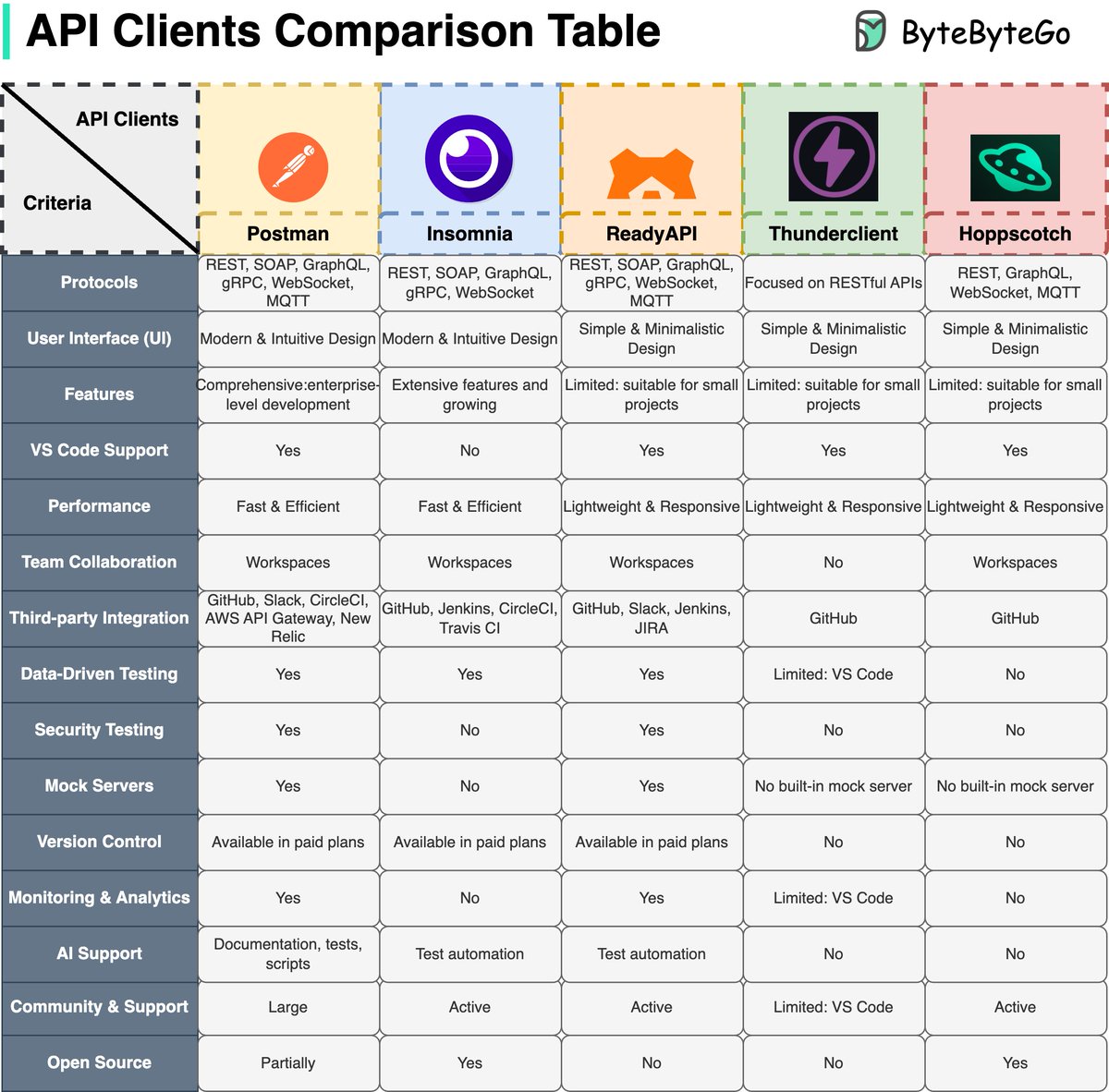
Comparing Different API Clients: Postman vs. Insomnia vs. ReadyAPI vs. Thunder Client vs. Hoppscotch
Postman is a widely used API lifecycle platform. It emerges as a comprehensive and versatile API client suitable for enterprise-level development. Its support for a wide range of protocols, robust feature set, and strong performance make it a top choice for complex projects. With an intuitive design, collaboration features, and a large community, Postman excels in scenarios requiring extensive functionality and community support.
Insomnia is a powerful API client with extensive features and being completely open-source makes it a good choice for developers seeking flexibility and continuous growth. Insomnia is suited for those who value an open-source environment and an active community.
ReadyAPI, with its simplicity and focus on smaller projects, is an ideal choice for scenarios where a lightweight and responsive tool is preferred. It provides essential features, making it suitable for projects with less complexity. However, it may not be the best fit for larger, more intricate endeavors that require extensive functionality.
ThunderClient, a VS Code plugin, is free and user-friendly, catering to developers who prefer an integrated testing environment. However, it lacks extensive features and community support, crucial for larger or complex projects, rendering it more appropriate for smaller teams with simpler requirements. Additionally, its reliance on Visual Studio Code may restrict its appeal to users who prefer alternative development environments. Experienced users accustomed to feature-rich tools may encounter a learning curve and might find ThunderClient lacking in certain functionalities.
Hoppscotch, a free and open-source tool, focuses on functionality over design, offering a lightweight web version with support for various protocols. While it lacks extensive documentation and community support, it provides a cost-effective solution for developers seeking simplicity.
Over to you: Which API client do you prefer?
–
Subscribe to our weekly newsletter to get a Free System Design PDF (158 pages): bit.ly/3KCnWXq
10
150
557
40,357


5 Oct 2023
Kubernetes Load Testing: Top 5 Tools & Methodologies
➤Speedscale
➤ Grafana K6
➤ Jmeter
➤ Gatling
➤ ReadyAPI
👀speedscale.com/blog/kubernet… #Kubernetes #DevOps #CloudNative
6
32
2,419

2 Aug 2023
➡️ @SmartBear, How To Hack An API And Get Away With It: A blog post that shows you how to hack an API using tools like Swagger and ReadyAPI
smartbear.com/blog/api-secur…
1
2
358

2 May 2023
Phew, migrated 2600 #readyAPI tests (history of some years) to #karate (Karate Labs), now we are more flexible, can execute our tests easily in parallel, can easily switch between different technologies in a single test. Uh oh, it’s #opensource
2
1
2
471
23 Apr 2023
The migration from #readyapi to @getkarate is almost done! Here a thread 🧵on why we migrated:
1
2
398

23 Apr 2023
🚀 API Security Testing Boot Camp: Master the Art of Penetration Testing for API-based Applications 🚀
thexssrat.podia.com/3-day-ap…
LIMITED SEATS ARE AVAILABLE!
⏰ Duration: 3 hours each day follow-up session (Total 11 hours)
🎯 Objective: This comprehensive boot camp will equip attendees with the knowledge and skills to effectively perform penetration tests on API-based applications. Gain in-depth understanding of API security testing methodologies, tools, and best practices.
🗓️ Day 1: Introduction to API Security and Pentesting
Introduction to APIs (30 minutes)
API Security and its Importance (30 minutes)
Setting Up the Pentesting Environment (1 hour)
Hands-on Exercise: API Enumeration (1 hour)
🗓️ Day 2: API Pentesting Methodologies and Techniques
Tools (1 hour)
Postman, Burp Suite, Selenium
OWASP API Top 10 (2 hours)
New RC 2023
Vulnerable API group practice: CrAPI, VamPI, Home-made
🗓️ Day 3: Advanced API Pentesting Techniques and Reporting
Deep dive into vulnerability scanners (1 hour)
ReadyAPI trial, BrightSec trial
API security (1 hour)
API firewalls, Installing our own API firewall configuration, Hacking it
Reporting and Remediation (1 hour)
Documenting and prioritizing findings, Communicating vulnerabilities effectively to developers, Suggested remediation strategies
📝 Q&A and wrap-up session
💪 By the end of this boot camp, you will have a strong foundation in API penetration testing methodologies, tools, and techniques. Learn to effectively identify and report API security vulnerabilities and propose practical remediation strategies. Join us and become an expert in API security testing!
1
13
38
6,551
3 Dec 2022
I had to use readyAPI (from @SmartBear ) for a fews days, now I’m really blessed that I -normally- use other tools!!! Damn what a slow tool is that… #testautomation
2
2

22 Nov 2022
Are you ready to build on existing knowledge to extend and advance tests within ReadyAPI? If so, check out the @SmartBear Academy expert-level API Testing Engineer course.
youtu.be/eTmNAIuAu5A
smartbear.com/academy/readya…

1
2
7 Sep 2022
Working through the API lifecycle can be tricky, which is why your team needs tools that work together seamlessly. Join the @SmartBear APAC team next week, September 14th, as they discuss how our native integration SwaggerHub & ReadyAPI can help.
bit.ly/3PNeH6t
1
3

23 Jul 2022
Ekta is currently employed at @cvent as a "Lead Software Development Engineer Test.". Her experience includes using HP Quality Center,CA LISA, Postman, ReadyApi, & PostgresSQL. In addition, she is skilled at virtualizing third-party responses with the CA LISA tool & Postman.
2
20 Jul 2022
Exciting news! Recently, @ReadyAPI was ranked as a Summer Top Performer with @G2dotcom in both the Automation Testing and Software Testing Tools categories. Congrats to the ReadyAPI team on all their hard work so far this year.

2
19 Jul 2022
How does service virtualization work within ReadyAPI? Join the @SmartBear team tomorrow for the final installment in our API Mocking webinar series as they discuss and conduct a live demo.
smartbear.com/resources/webi…
1
3

28 Feb 2022
HBO Max crashing on Euphoria season finale day??? Did you not run a load test with @SmartBear’s #ReadyAPI???
11