EstebanUribe retweeted

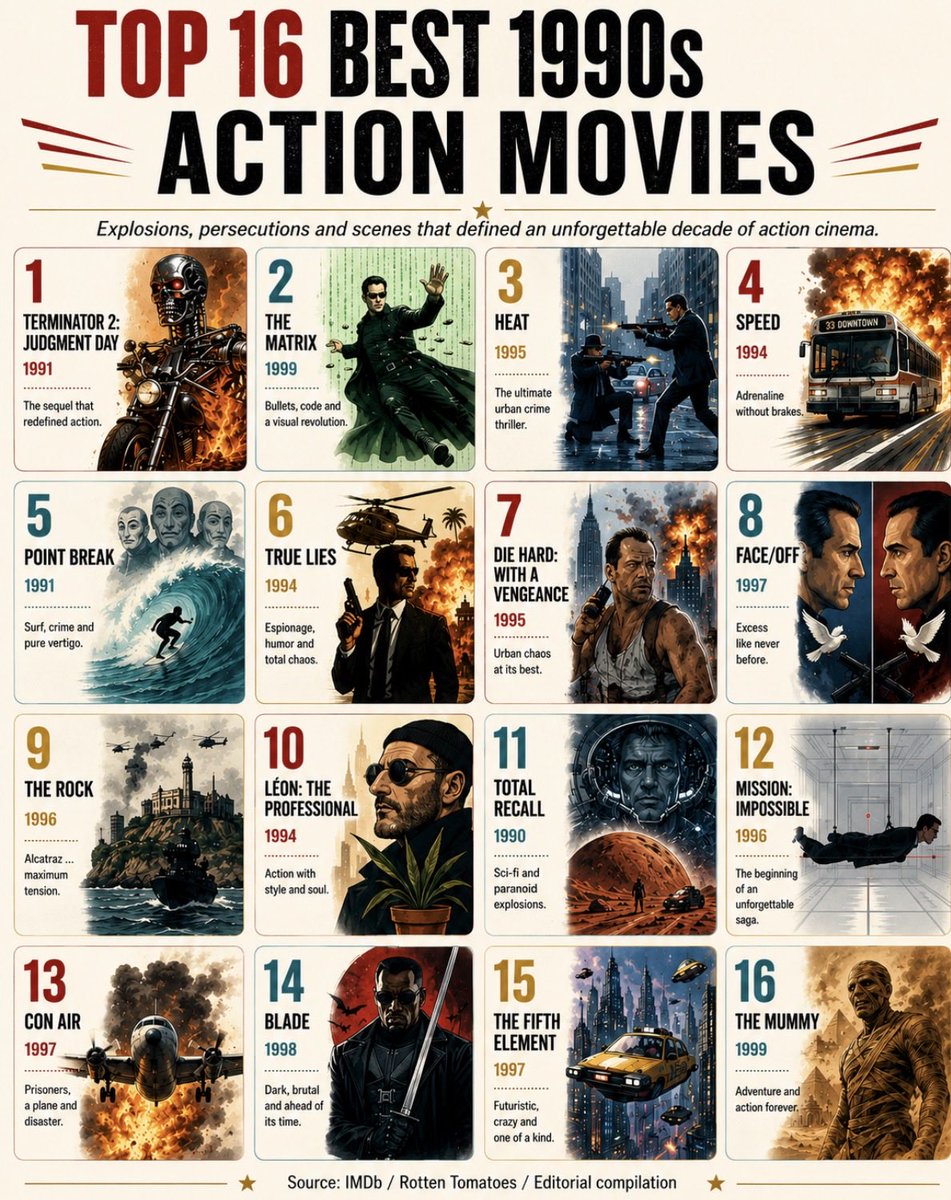
🎬 Top 16 Best Action Movies of the 90s
1. 🤖 Terminator 2: Judgment Day (1991) – The sequel that redefined action.
2. 🕶️ The Matrix (1999) – Bullets, code, and visual revolution.
3. 🔫 Heat (1995) – The most legendary urban shootout.
4. 🚍 Speed (1994) – Adrenaline with no brakes.
5. 🏄 Point Break (1991) – Surf, crime, and pure vertigo.
6. 🔫 True Lies (1994) – Espionage, humor, and total chaos.
7. 💥 Die Hard: With a Vengeance (1995) – Urban chaos at its best.
8. 👥 Face/Off (1997) – Unforgettable nineties excess.
9. 🏝️ The Rock (1996) – Alcatraz and maximum tension.
10. 🌿 Léon: The Professional (1994) – Action with style and soul.
11. 🪐 Total Recall (1990) – Explosive sci-fi and paranoia.
12. 🪂 Mission: Impossible (1996) – The start of an unmatched saga.
13. ✈️ Con Air (1997) – Prisoners, plane, and disaster.
14. 🗡️ Blade (1998) – Dark, brutal, and ahead of its time.
15. 🚕 The Fifth Element (1997) – Future, madness, and unique style.
16. 🧟 The Mummy (1999) – Adventure and action forever.
12
37
185
3,900

3m
To give credit to the 1920s feminists yes...but 100 years later it's definitely been construed over the years and redefined. Often by fellow feminists
3

If they could put out a feature length movie of the Christophsis arc, a feature film with the Umbara arc stitched together could have redefined The Clone Wars to the general public
1

The word ceasefire is being redefined in the same way the word sex was redefined by President Bill Clinton in the 90’s.
7

Bitcoin's resilience proves it's not just a trend; the future of finance is being redefined.
1

#SPX6900 #memecoinsupercycle #hypermemecoinization #PureBeliefAsset #PBA #TokenizedCommunities #Merton #RobertMerton
A «Self-Fulfilling Prophecy» by Robert K. Merton.
«A SOCIOLOGICAL PARABLE
It was the year 1932. The Last National Bank was a flourishing institution. A large part of its resources was liquid and had not been “watered down.” Cartwright Millingville had every reason to feel proud of the banking institution over which he presided. That is, until Black Wednesday. When he entered the bank, he noticed that business was brisker than usual. There was something odd about it, for the workers from A.M.O.K., the steel plant, and those from K.O.M.A., the mattress factory, were not normally paid until Saturday. Yet there they were—two dozen men, clearly factory workers—lining up in front of the tellers’ windows. As he entered his private office, the president thought with a touch of compassion: “Let’s hope they haven’t been laid off in the middle of the week. At this hour they should still be in the shop.”
But speculations of this sort have never helped a bank to prosper, and Millingville turned his attention to the pile of documents on his desk. After signing fewer than twenty papers with his usual precision, he became disturbed by the absence of something familiar and the intrusion of something strange. The low, discreet hum of normal banking activity had given way to the jarring noise of many agitated voices. A situation had been defined as real, and that was the beginning of what became Black Wednesday—the last Wednesday, as it turned out, in the history of the Last National Bank.
Cartwright had never heard of Thomas’s theorem, but he had no difficulty recognizing its operation. He knew that, despite the bank’s relatively liquid position, a rumor of insolvency, once believed by a sufficient number of depositors, would produce the very insolvency that had been rumored. And by the close of Black Wednesday—and the even Blacker Thursday that followed—when long lines of anxious depositors, each desperately trying to withdraw their savings, stretched into even longer lines of still more anxious depositors, the insolvency became a reality.
The bank’s previously stable financial structure had rested on a series of definitions of the situation: the shared belief in the validity of the interlocking system of economic expectations by which people live. Once the depositors redefined the situation, once they began to doubt that their expectations would be fulfilled, the consequences of this new and initially false definition proved to be all too real.
This is a familiar type of case, and one does not need Thomas’s theorem to understand how it happened—at least not if one is old enough to have voted for Franklin Roosevelt in 1932. With the help of the theorem, however, the tragic story of the Millingville bank can be turned into a sociological parable that helps us understand not only what happened to hundreds of banks during the 1930s, but also what continues to happen in relations between Blacks and whites, and between Protestants, Catholics, and Jews in our own time.
The parable tells us that public definitions of a situation (prophecies or predictions) become an integral part of the situation itself and, consequently, influence subsequent events. This is peculiar to human affairs. It does not occur in the natural world, untouched by human hands. Predictions concerning the return of Halley’s Comet do not affect its orbit. But the rumor of insolvency at the Millingville bank directly affected the actual outcome. The prophecy of bankruptcy brought about its own fulfillment.
[continues below 👇🏼]
2
15
Nick Arena retweeted

Vinyl, redefined as elegance✨
Do you like it? 😘😏😉
——————
Le vinyle, synonyme d'élégance ✨
Vous aimez ? 😘😏😉
#rt

28
19
222
2,301

13m
5/ The wild part: attention mechanisms were proposed in a 2017 paper called "Attention is All You Need" and completely redefined AI research. Sometimes a single insight changes everything. If you found this useful, share it with someone building AI products.
Leanne retweeted

Small kid, giant heart this little guy just redefined what real care looks like 💖

Even though he's so small, his heart is enormous.
During his hospital stay, he took a younger friend for a walk and reminded us that compassion knows no age.
3
18
97
5,210

Of course he should. He has redefined the entire game with a playing style that matches his personality and work ethic, and he spent years putting the pieces in place to make it work.
1
27

I don't really care what you do or don't think about what I did or didn't read. It doesn't matter. JS redefined God in the KFD. That is all that I need to know. He is a false prophet according to the Bible. You're just too scared to look in the mirror and admit you were duped.
1
9

every AI startup landing page in 2026:
→ black background
→ purple gradient
→ a glowing orb floating in the void
→ "Intelligence, redefined"
so i built the opposite. warm, light, actually looks like a product.
free Framer template, link below ↓
2
1
33

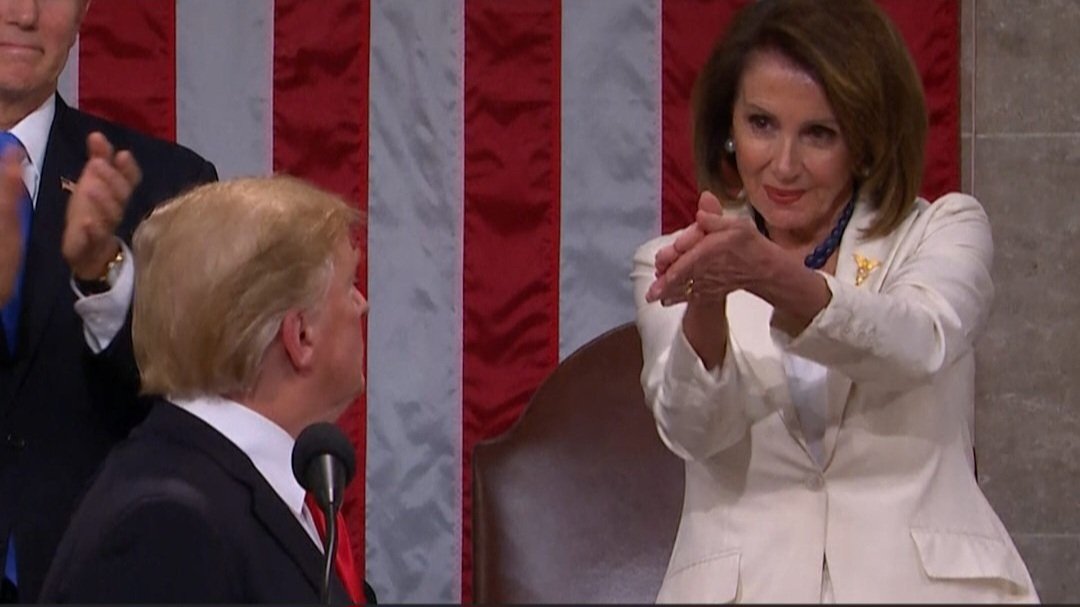
Democrats redefined how respect is given or not given during the first Trump administration. They can't cry "foul" now when it's directed at one of their own.
9

Your role is to safeguard your team’s time so they can focus on the most important things.
Is the meeting necessary? Or can it be discussed in an email or project thread? Or is it status quo and can be removed or redefined?
theceoffice.substack.com/p/y…

1
4