
The rainbow is a scientific phenomenon of light refraction…that God created.
Fixed it for you.
1
16


So is it not also just a blah blah blah light refraction instead of being the symbol for gay pride? Dude wants it one way but not the other… Imagine that… 🫠🫠🫠
1
19

So you think the photo I took is of the hospital, not the hotel? That doesn’t match up with the image.
There is no such thing as ‘standard’ refraction, so you need to put your rationale for why it is refracting in the direction and angle you assume it to.
The picture doesn’t look like the top 17 meters of a building. It is the whole building.
You are talking nonsense.
3

You 5m above sea level, 41 km across the bay. Heightest building in Frankston, is the hospital, 41m high, stilling on land 46 meters above seal level, that's 87m meters above seal level. With refraction there is 70 meters block by earth curve. 87 is bigger than 70.
1
7




Tallest building, Frankston hospital is 41m high, on ground 46 masl. 87m,
You omitted refraction because you have to.
With normal refraction 70 meters hidden,
Spherical earth confirmed.
Goto to lie to flerf.
1
17

The rainbow is a scientific phenomenon of light refraction. Your book doesn’t tell you a fucking thing about that.
5
3
886

Warm blades melt the ice slightly as it cuts through the ice to change its light refraction enough that we can see it.
The hot exhaust condenses in the colder air changing its light refraction.
They're Con Trails, as in condensation trails not "chem trails," you fuckin dope.
1
11

Even itself:
The Teleological Arc of Geometry: From Hellenic Inquiry to the Constructal Law
The history of scientific inquiry is fundamentally a chronicle of the human urge to rationalize the "designedness" and macroscopic complexity of the natural world. For nearly three millennia, from the pre-Socratic philosophers to the contemporary era, the central enigma of science has remained constant: from what principle can geometric form be deduced? While early thinkers like Democritus attributed the emergence of structure to "chance and necessity," this doctrine was essentially an admission of an inability to predict the morphologies of nature. The recent formulation of the constructal law (1996) represents a paradigm shift, transitioning from the descriptive methods of the past to a predictive, deterministic physics of design evolution.
I. The Hellenic Foundation and the Quest for Determinism
The intellectual lineage of this discovery begins in ancient Greece, where geometry—the science of figures—and mechanics—the science of moving figures—served as the foundational pillars of scientific thought. Early optimization principles emerged within specific domains, most notably in optics. Heron of Alexandria recognized that light travels in straight lines to minimize path length, and Fermat later expanded this into the principle of least time for refraction. These ad-hoc invocations of "nature optimizing things" were highly successful but lacked a universal theoretical bedrock in physics.
Throughout the centuries, scientists, zoologists, and geophysicists spoke freely of "design," "function," and "objective" when describing natural patterns, yet these remained engineering concepts orphaned from the laws of physics. The doctrine of chance prevailed in the study of naturally organized systems, from the dendritic architecture of river basins to the morphology of human lungs. While fractal geometry provided a descriptive aid for these structures, it remained non-predictive; the mathematical algorithms used to generate fractal images had to be assumed and truncated arbitrarily, lacking a governing physical principle.
II. The Thermodynamic Impasse and the Genesis of Configuration
The birth of thermodynamics in the mid-19th century initially offered no resolution to the puzzle of form. The first and second laws of thermodynamics are resoundingly general because they treat systems as "black boxes"—regions of space or collections of matter without specified internal shape or structure. These laws account for the conservation of energy and the one-way direction of irreversibility (entropy generation) but say nothing about the configurations—the drawings—of the things that flow.
The impasse was broken in 1996 with the statement of the constructal law: "For a finite-size flow system to persist in time (to live), its configuration must evolve in such a way that it provides easier access to the imposed currents that flow through it". This law recognizes that the generation of flow configuration is a universal phenomenon of physics, as natural as the tendency for energy to be conserved or for heat to flow from high to low temperatures. By adding this third first principle, thermodynamics was elevated to a science of systems with configuration, design, and evolution.
III. Unification: The Animate, Inanimate, and Engineered
The constructal law provides the missing physics that unites the animate with the inanimate across all scales. It demonstrates that the tree-shaped (dendritic) architectures found in river basins, lightning, and snowflakes are governed by the same principle of flow-access maximization as the vascular networks of lungs, the nervous system, and botanical roots. In this framework, "life" is defined in broad physical terms: to be alive is to possess configuration and the freedom to morph in time to facilitate flow.
Crucially, the constructal law establishes that "to engineer is natural". It brings technology—the evolution of human artifacts—into the domain of natural history. Humans are not seen as "naked bodies" but as specimens of the "human and machine species," encapsulated in an ever-evolving niche of artifacts like fire, wheels, aircraft, and science itself. The evolution of the airplane, for instance, exhibits the same scaling laws and convergence toward bird-like configurations because both must move weight through a medium with the least expenditure of energy.
IV. The Time Arrow of Design and Human Perception
The constructal law introduces a new "time arrow" in physics: the direction of how everything acquires architecture. While the second law's arrow points toward the "dead state" of uniformity and equilibrium, the constructal arrow is the arrow of the "live state," pointing toward easier movement and greater access. This principle extends even into the realm of human cognition and perception.
The human preference for images shaped according to the "golden ratio" (approximately 3:2) is not a mathematical coincidence but a manifestation of the constructal law. This specific rectangular proportion facilitates the fastest horizontal and vertical scanning by the two eyes, allowing the brain to understand surroundings and detect danger more efficiently. Similarly, the "mind time"—the perception that time flies faster as we get older—is rooted in the physical degradation of the neural pathways that convey visual images to the brain; with fewer images processed per unit of clock time, the perceived duration of intervals diminishes.
V. Conclusion: Finding the Geometric Principle
From the ancient Hellenic foundations to the formalization of constructal law, the trajectory of science has moved from the descriptive recording of diversity to the theoretical prediction of order. The constructal law serves as the "crystal ball" of science, empowering the mind to "fast-forward" the design evolution of social, political, and technological systems. It rationalizes the emergence of hierarchy—the "few large and many small"—in everything from river networks to city sizes and the distribution of scientific ideas.
Ultimately, the constructal law fulfills the three-thousand-year quest for a fundamental geometric principle of nature. It reveals that the diverse tapestry of the universe is woven in a "very simple loom," where every feature that nature presents is an engine-and-brake design morphing freely toward greater access. By establishing evolution and design as integral components of physics, the constructal law unites the natural and social sciences, providing a deterministic foundation for the future of human advancement.
cc: @johnstossel @michaelshermer @charlesmurray
7

The people yearn for refraction railway 2 when thr bosses had passives that buffed or nerfed specific statuses on them
28

Again. You wouldn't easily notice it because, according to the calculation, it would only drop about 80 feet. And again, light refraction does make it a little bit off but again, you can still see it slightly sinking
2
16

Yes refraction does, but mostly not in the direction you want it to be.
1
7

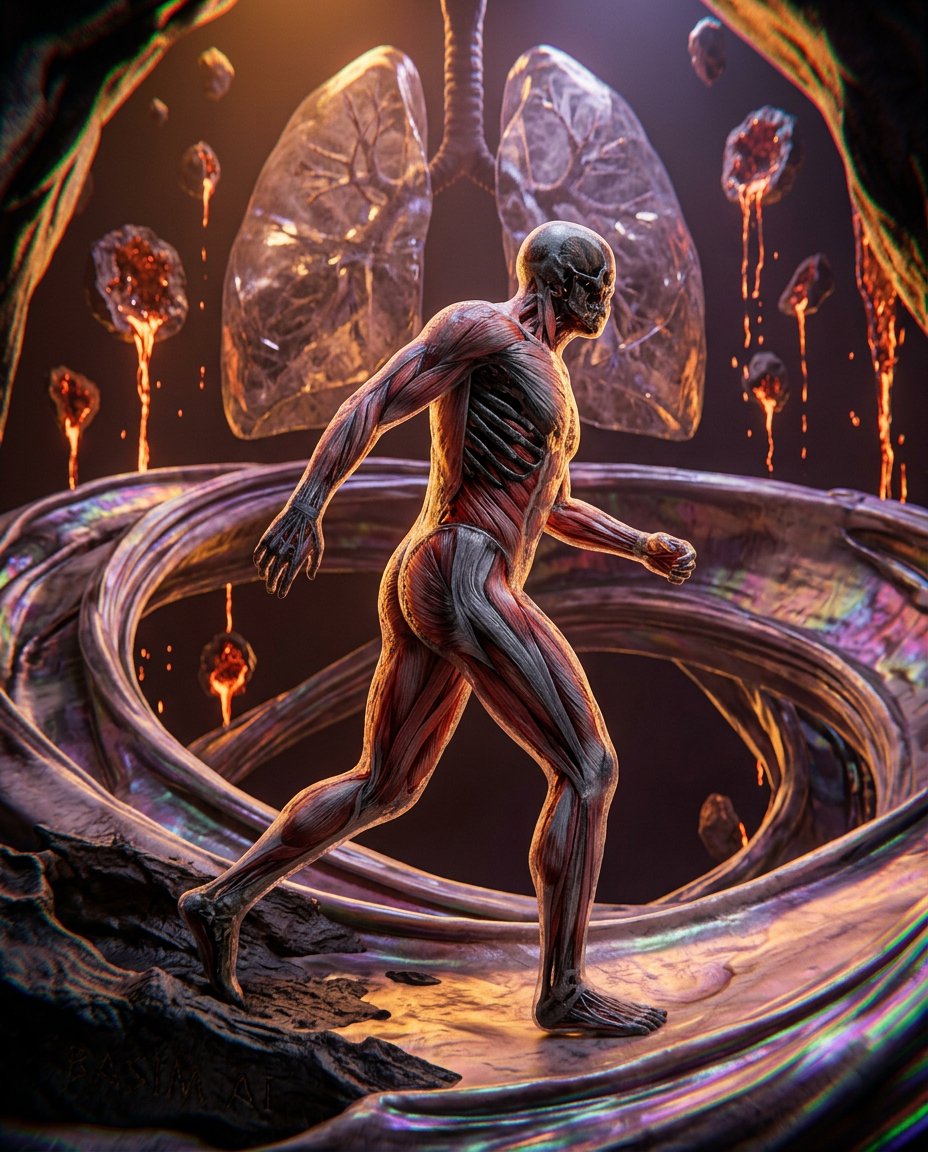
The Topology of the Self
prompt:
[Subject] inhabits a nonorientable manifold of calcified membrane and polished bismuth where the ground curves into an infinite Mobius loop of architectural skin the atmosphere consists of high viscosity nitrogen filled with suspended geodes that bleed liquid copper into the negative space two massive crystalline lungs breathe in synchronicity with the landscape rhythmically altering the atmospheric density and light refraction a 24mm anamorphic lens captures the scene with deep depth of field and heavy chromatic aberration at the peripheries lighting is dominated by a 3200 Kelvin amber glow clashing against cold actinic violet shadows to create a high tonal contrast ratio
1
26

The problem is, the refraction that we observe bends the light of distant objects slightly more around the curve... Making them appear HIGHER, not lower.
(and that refraction can be calculated from measured temperatures at different altitudes; it lines up quite well as a rule)
1
5
Mark Foster retweeted

Demonstration kit used in Physics Education to visualise light refraction through lenses.
3
31
263
24,846


Mr.@jacuzzi_toaster
No contradiction you’re just applying the wrong model. On a flat plane with a relatively close Sun moving above it, the apparent angular size stays roughly constant throughout the day because of how perspective works at these distances, combined with conical refraction in the aetherial medium. As the Sun moves farther away toward sunset, the increasing density gradients and the firmament boundary diffuse and redirect the light in a conical pattern. This keeps the visible disc from shrinking dramatically, exactly as we observe. The same mechanical effect explains why distant objects on the ground disappear bottom-first without any curvature. You keep claiming “contradiction” while ignoring the actual layered optics of the realm. The Sun is close enough to create localized heating and consistent size, yet its setting is governed by perspective meeting the optical boundary not millions of miles of empty space on a spinning ball. Your “wall of text” dismissal is just an excuse to avoid engaging with the mechanics. The observations (constant Sun size, bottom-up disappearance, apparent horizon) remain. The model is consistent. furthermore You literally just said my explanation is “completely unprovable nonsense” that “requires no refutation”……and then you replied to it anyway. hat’s the contradiction right there.
Good times,
Eccentric
1
7