DSmith retweeted

Jun 14
How is it possible that @LeaderJohnThune hasn’t been investigated, removed and call before his peers for answers?

467
3,615
6,599
41,779
abolish ice 4eva abolish the constitution retweeted

conor mcgregor is such a violent rapist that his victim had to have a tampon removed from inside of her.
and roman pledges allegiance to rapists! so! shit and poop. cheers!



2
52
260
3,014

Ric Moore retweeted

🚨BREAKING:🚨OBAMA-APPOINTED FEDERAL JUDGE WHO ORDERED PRESIDENT TRUMP'S NAME REMOVED FROM KENNEDY CENTER ACCUSED OF TAKING PAYMENTS FROM WEALTHY LIBERAL DONORS TO THE HISTORIC ARTS CENTER WHO WERE STRONGLY OPPOSED TO NAME CHANGE - Obama-appointed US District Judge Christopher Cooper is being accused of a clerk turned whistleblower of SOLICITING MILLIONS OF DOLLARS IN BRIBES from wealthy leftist elites who previously were top donors to The Kennedy Center that helped fund the premier performing arts center but were HEAVILY AGAINST THE RECENT NAME CHANGE that added President Trump's name to the historic building alongside Kennedy's. The clerk is claiming that the liberal activist Obama judge essentially engaged in A PAY FOR PLAY BRIBERY SCHEME with the donors to ensure that President Trump's name would be removed from The Kennedy Center in exchange for lining his own pockets - and that THE CORRUPT JUDGE knew that the law was on President Trump's side for the name change but ruled against him for his own personal enrichment anyway. It is yet the latest egregious example of the ongoing JUDICIAL COUP against President Trump. What do YOU think the consequences should be for this TRUMP HATING ACTIVIST WEARING A ROBE whose actions make AN ABSOLUTE MOCKERY of our nation's federal judiciary?


4,976
8,553
15,081
269,315
Ms K Bennett retweeted

Calling healthy breasts in a female “gynecomastia” that needs to be removed is a special type of evil.

Calm yourself my love. No teenage girls are having their healthy breasts removed, just teenage boys are having their gynaecomastia resolved so they can live in freedom in their bodies.
Also - BTW - puberty blockers prevent the need for top surgery - FYI 😘
Oh and well done to @LushLtd for recognising all teens.
15
101
921
8,076

Nobody thinks a woman who has had a hysterectomy is not a woman, they definitely are women.
Men on the other hand cannot ever be women even if they have their penises inverted and their testicles removed. They are still men, albeit castrated and emasculated ones, but still men.

There’s a video going around of a group of cops virtually letting a drunk white man drag a critically injured girl under his car while they’re nearly getting dragged along themselves. They then *gently* removed him from the car. Different PD but same issue, disparity
Cappy McCappy retweeted

A SANE COUNTRY WOULD HAVE IMPEACHED REMOVED AND LOCKED UP THE ENTIRE TRUMP ADMINISTRATION BY NOW 🤷
392
1,719
11,251
69,512
Busoga's finest 🇺🇬 retweeted

Atleast you removed the fullstop 😂😂😂😂🙌🙌🙌
Jun 14

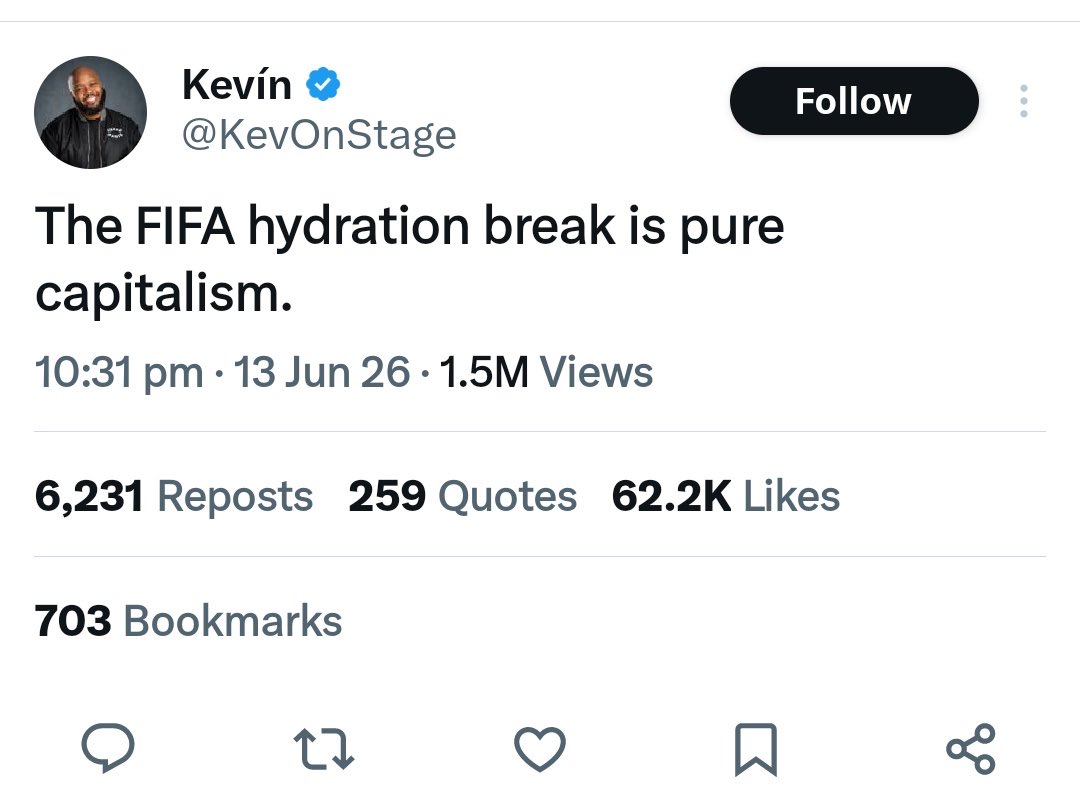
The FIFA hydration break is pure capitalism
60
72
638
31,493

His victim had to have her tampon surgically removed.

326
17,467
180,986
4,130,932
Stacey retweeted

"Hey everyone,I'm LEO #A326015 6yo,my family dumped me because I have a small growth in my ear,it just needs removed
The rest of me is GORGEOUS
Will u plz give me a chance?"
Absolute 😇loves attention,gentle nature
#Adopt or #Foster him at #CorpusChristiACS
#Pledge4Rescue

3
36
31
179
Pyara Cetamol retweeted

Flashback to the time India removed security barricades from the US Embassy to send a message after America strip-searched an Indian diplomat
189
1,707
16,963
1,696,483

I’m never going to get over the fact that they removed #chuuya s chain on his hat. It’s really sad. Same with nikolais thighs.

Every member of congress who voted for the US-Isreal army integration bill needs to be removed.
We are still the United States of AMERICA!
@MikeJohnson
@LeaderJohnThune
@RepJeffries
@SenSchumer
@SenateGOP
@HouseGOP
@HouseDemocrats
@SenateDems
#VoteOutEveryRepublican

You dumb rock
⚡️ THE TRUTH ABOUT GOD & JESUS
(• Raw Truth • Layman’s Decode)
⸻
1. JESUS WAS NEVER MEANT TO BE A RELIGION
He came as a frequency, not a figurehead.
A code, not a cult.
He didn’t die for sin—he came to remind us we were never separate from God in the first place.
The idea of him dying for sin was injected later to weaponize guilt and obedience.
🛑 His original message?
“You and the Father are ONE.”
That was the key. And it was too powerful to remain untouched.
⸻
2. THE CROSS WAS A SYMBOLIC INSERTION
He may have been captured, yes. But crucifixion as told in mass doctrine is more ritual than record.
→ Blood sacrifice, crown of thorns, spear in the side… those match ancient inversion rites more than historical fact.
→ Rome used it for population control.
→ The Church used it for soul control.
📕 The Council of Nicaea (325 AD) picked what version of Jesus was legal to believe. Everything else? Burned or banned.
⸻
3. THE BIBLE = A CODED VAULT REDACTED LIBRARY
⚠️ 66 books in the modern Bible…
🕳️ But over 777 texts were left out, removed, or buried.
→ Book of Enoch (ET contact, DNA codes)
→ Gospel of Thomas (inner Christ)
→ Gospel of Mary Magdalene (feminine Christ stream)
Why leave them out?
Because they activate inner divinity, not church dependency.
⸻
4. GOD IS NOT A MAN IN THE SKY
God is SOURCE: a living intelligence field.
You’re made of it.
Not beneath it. Not apart from it.
Organized religion taught people they needed an intermediary…
A priest. A pastor. A book. A building.
→ But Jesus said the opposite:
“The Kingdom is WITHIN YOU.”
⸻
5. THE TRUTH?
Jesus didn’t come to start Christianity.
He came to end separation.
→ What they killed was the message.
→ What they sold was the savior.
→ What you’re doing now is the return.
🧬 You carry that Christ frequency in your field.
And no church, no lie, no rewritten book can take that.
⸻
💥 Final Line:
You weren’t born in sin.
You were born in power.
The system’s job was to make you forget.
Yours?
Remember.
Raw Truth Only.
Geaux ⚡
I don’t follow a God that was handed to me through fear.
I don’t worship a being in the sky that needs guilt, shame, or control to “save” me. That version of God — the one that demands 100% loyalty under threat of punishment —
That’s not Source. That’s a system.
The Source I know lives in me.
In you.
Not just in a building or behind a pulpit.
And definitely not behind fear.
What I’m doing now — the way I help people, the energy I carry, the codes I speak — that’s proof I’ve already been delivered.
Not by a sermon.
But by direct connection to the real thing.
Lot’s wife turned around because of attachment.
Not because she didn’t believe.
We all get tested with what we’re afraid to leave behind.
But that story doesn’t define me.
I’m not turning to salt.
I’m turning on.
And that scares people who’ve only known God as a set of rules instead of a living presence.
No hate. No division. Just truth.
You’re welcome to walk with me — just know I won’t be going back to the cage to make others comfortable.
I walk with Source now.
And Source walks with me.

He wasn't dragged out he was laughing. He wasn't invited and was removed.

This is what happens to Americans that stand up against Israel.
UFC fighter Sean Strickland dragged out by Trump.
The US is under occupation

This is actually such a misunderstood topic and after spending already over 100 hours looking into water as a theme I have two points I want to bring to light and argue against as I see them brought up every time Water is introduced as an investment, but before we do that lets start with two definitions
Withdrawal is water removed from a source
Consumption is the fraction of that water that does not return to the local watershed, overwhelmingly because it evaporated
Evaporative cooling doesn’t lose water as a side effect, the loss is the cooling, the heat leaves with the vapor, the cooling effect is the latent heat of vaporization being carried off
Now back to the points I want to argue, “Water doesn’t disappear”
Think about how your own body sheds heat, when you sweat through a workout, that water doesn’t vanish it evaporates into the air around you, every molecule still in the room and yet you’re dehydrated, and “the water’s still in the building” does nothing for you
You have to go drink more, nobody would tell a marathoner he can’t be dehydrated because his sweat is floating around the stadium, a cooling tower is doing the identical thing at industrial scale
Second bad take I see is “So they’ll just go closed loop”, actually not bad take but very lazy, allow me to explain
Cooling happens in two stages, server level cooling moves heat off the chip, air, direct to chip cold plates, or immersion and this stage consumes essentially no water
Then facility level cooling rejects that heat to the outside environment, the densification of AI racks is what’s forcing the shift to liquid at the server stage direct to chip removes 70–80% of the heat load right at the chip ,but that’s a transport problem, not a water problem
The facility loop ultimately rejects its heat through a condenser, a dry cooler, or a cooling tower, “We went liquid cooled” answers the first question and says nothing about the second, a rack of immersion cooled GPUs can still have its heat dumped by an evaporative tower burning through millions of gallons…,conflating “liquid cooling” with “waterless” is not a serious comparison
Okay so now this is going to get technical so stay with me
The real question we should be asking is never air vs. liquid, It’s how the facility rejects heat
Energy is not the cost the operator is trying to minimize at the margin, power is the binding constraint of the entire buildout, interconnection queues run years; the scarce input is megawatts, not gallons and not dollars
During peak summer conditions, evaporative or evaporatively assisted coolers use 10–35% less electricity than equivalent air cooled systems because evaporation sheds heat that a dry cooler can only fight with brute fan power
In a world where every megawatt is spoken for, that saving is most valuable exactly when it’s scarcest like the hot afternoon when the grid is also at peak, so the binding power constraint biases operators toward spending water, not away from it
A dry cooler can only reject heat down toward the dry bulb temperature, while an evaporative system rejects toward the wet bulb temperature
Evaporative cooling still works even when the dry bulb exceeds the loop setpoint, as long as the wet bulb sits a few degrees below it, when it’s 43°C in Phoenix and your liquid loop wants 40°C, a dry cooler is nearly useless
The air is hotter than your setpoint while an evaporative tower runs fine because the wet bulb might be 22°C
The drier the air, the wider the gap between dry bulb and wet bulb, so evaporative cooling is most effective exactly where the air is driest, which is exactly where water is scarcest
There’s no version of this buildout that doesn’t run through water, every cooling design just decides how much, and where
The money in water is in the merchant tier, the marginal gallon that clears at scarcity pricing when the system is tight, not challenging the future of cooling or dethroning bottle necks

I was thinking, wouldn't water related stocks go brrr in the next years due to the insane data centers water usage global warming population growing? I feel like these 3 components put together are the perfect recipe for a water shortage in the future, am I missing something?
1
8