
1 Nov 2025
Field Metallographic Replication (Replica Testing) 🔬
Visit weldfabworld.com
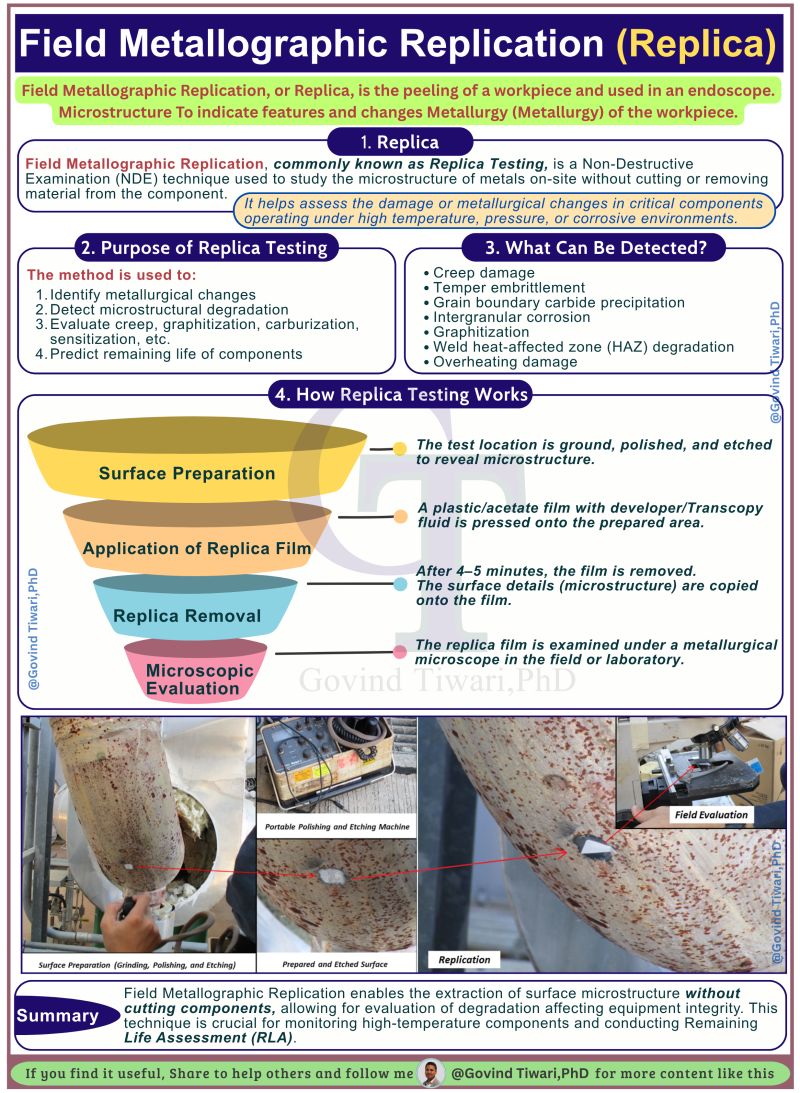
In high-temperature, high-pressure, or corrosive service environments, understanding the microstructural health of materials is essential for reliability and safety. That’s where Field Metallographic Replication (FMR) — or Replica Testing — comes in.
⚙️ What is Replica Testing?
A Non-Destructive Examination (NDE) technique that enables metallurgists to study the microstructure of metals on-site — without cutting or removing material from components.
It’s an essential diagnostic tool for condition monitoring and Remaining Life Assessment (RLA) of critical equipment.
🎯 Purpose of Replica Testing
Identify metallurgical changes
Detect microstructural degradation
Evaluate phenomena like creep, graphitization, carburization, sensitization
Predict the remaining life of high-temperature components
🔍 What Can It Detect?
Creep damage & void formation
Temper embrittlement
Grain boundary carbide precipitation
Intergranular corrosion
Graphitization
HAZ (Heat-Affected Zone) degradation
Overheating or microstructural instability
🧪 How It Works
Surface Preparation: Grind, polish, and etch the test area to reveal microstructure.
Replica Application: Apply acetate film with developer (Transcopy fluid).
Replication: After a few minutes, peel off the film — the surface details are now imprinted.
Microscopic Evaluation: Examine the replica under a metallurgical microscope, either on-site or in a lab.
⚠️ Key Challenges
Ensuring accurate surface preparation — even minor scratches can distort results.
Environmental conditions (temperature, humidity, dust) affecting replica quality.
Skill dependency — requires trained metallurgists for proper etching and interpretation.
Limited to surface-level assessment; subsurface defects may remain undetected.
💡 Key Takeaways
Replica testing bridges the gap between NDE and destructive metallurgical analysis.
Provides a real-time snapshot of material health without interrupting operation.
Essential for predictive maintenance, fitness-for-service assessments, and life extension programs.
🔗 Final Thought
Field Metallographic Replication is more than just a testing method — it’s a window into the material’s history and future. By understanding microstructural evolution, engineers can make data-driven decisions that ensure integrity, safety, and longevity.
💬 Have you used replica testing in your reliability or inspection programs?
Share your experience or challenges — let’s exchange insights that advance our industry.
=====
Follow me at Govind Tiwari,PhD
#FieldMetallography #ReplicaTesting #NDE #MaterialsEngineering #CreepAssessment #RLA #IntegrityManagement #Metallurgy #GovindTiwariPhD #qms #iso9001 #quality #fblifestyle
1
34