
30 Oct 2025
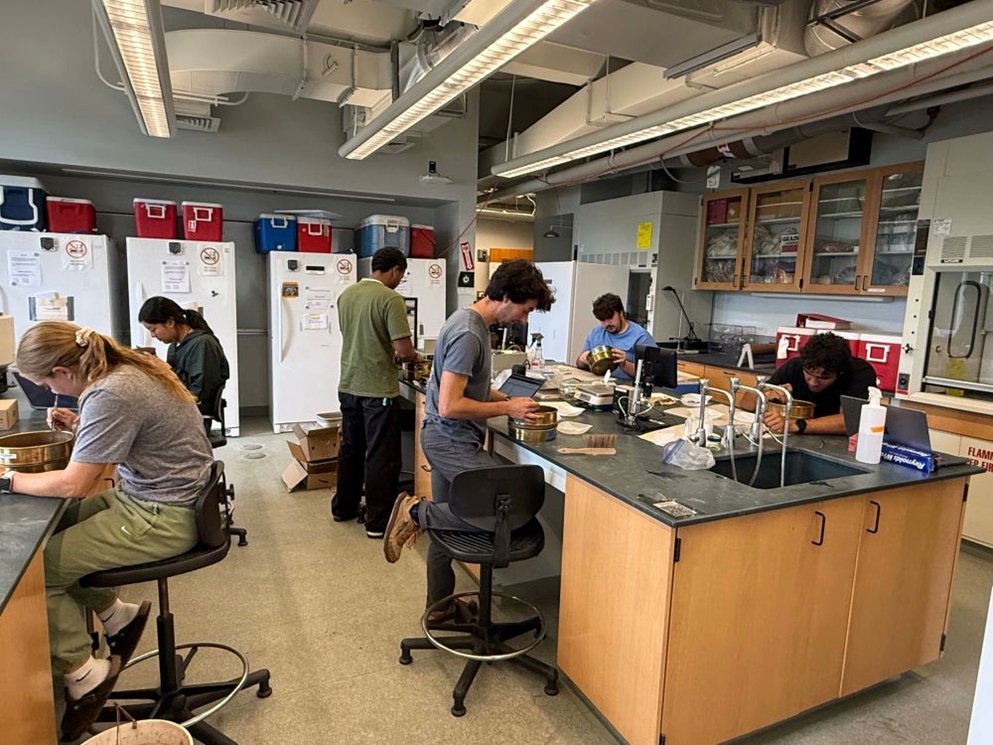
Studying the hidden half is messy—partial samples, broken roots, shifting soils. That’s exactly what students need to see. “In belowground science, perfection is impossible. Accuracy is not.” 🔍🌱
More ▶️1url.cz/DJIdJ
#GoBelowground #ExFuMo #RootID #ScienceTeaching
1
6
439

19 Aug 2025
Btw, I found that adding `rootId` (in addition to `parentId`) makes it much easier/faster to query for all threads of a root conversation, since you avoid recursive queries.
2
2
1,105

30 Mar 2025
options:2048 — A single satoshi (0.00000001) NFT token is created & has tokenized control of the root VerusID. Which means you can send the single satoshi token to other addresses and then they have control of the root VerusID.
There are two types of currencies that can be launched with the Verus Protocol. Basket currencies and simple token currencies. Both can be issued decentralized, or centralized (has minting and burning capabilities.)
Basket currencies are magical currencies that have reserves. If anyone has currency X or Y, they can convert to the basket currency, or convert from reserve to reserve. If anyone has the basket currency, they can go to currency X or Y. A basket currency can have 1 and up to 10 reserve currencies.
The basket currency supply is dynamic, depending on how much is converted to the basket currency (supply minted), or back to its reserve(s) (supply burned).
A basket currency can be 100% backed by its reserves, 5%, or anything in between. This is called the reserve ratio, or the weight. The lower the reserve ratio, the more volatile the currency is when people are converting into or out of the basket currency. The value of the basket currency is directly linked to what is in the reserves and what the reserve ratio is.
When a centralized version of this currency is created, the owner of the rootID can mint currencies into existence, while automatically lowering the reserve ratio. Or they can burn currencies and automatically raise the reserve ratio. Anyone can also just burn the currency at will without raising the reserve ratio.
The conversion fees are incredibly low, 0.025% when converting to and from a basket currency, and 0.05% when converting from reserve to reserve currency. These fees go directly to the worldwide miners and stakers of the protocol, and/or they are accrued into the reserves making the basket currency worth more.
Every(!) currency on the Verus network (also mapped ERC-20s!), can be used as reserves for basket currencies. As you might start to understand now — basket currencies are unique currencies that can not be found anywhere else and offer an enormous amount of opportunities for value creation. And anyone can launch them without needing any programming knowledge!
Simple token currencies are just currencies without any reserves. They are not as exciting as the basket currencies, yet still offer much value. With all the parameters that can be added, subIDs created and decentralized crowdfund mechanism, these currencies can support a lot of use cases that are difficult to do with alternative protocols.
The supply of this type of currency is static when it’s a decentralized version. When it’s a centralized version, the owner of the rootID can mint tokens into existence, and anyone can burn them.
And of course, a simple token currency can be one of the reserves in a basket currency.
There is more detail that we could share about how to set the parameters but will leave that for another day.
1
3
57
30 Mar 2025
Now for your second Questions - How do I launch my own currency? (How you want to implement your algo stable is your formulation I guess but we have considered it previously )
Why is it smarter to launch currencies on the Verus Protocol? The answer is simple, because all launched currencies are part of the consensus mechanism. On EVM-like and account-based protocols (Ethereum, BNB Chain, Polkadot, Cosmos, Avalanche) currencies are not part of consensus and thus easily exploitable by smart contract bugs and malicious developers. With Verus, a UTXO model, all currencies are accounted for, and verified by the worldwide miners and stakers of the protocol, making it as secure as sending BTC on Bitcoin. To make it simple — all features on the Verus Protocol are on the first layer, the consensus layer.
Launching currencies with Verus is also much faster and cheaper than with the alternatives. The magic here is that there is no coding involved. Anyone can launch a currency by just choosing the options and parameters they would like. It is as easy as typing in a command and the currency is ready to be used by the world within minutes. This process does not involve expensive Solidity developers or security audits, saving a lot of development costs.
Another big advantage is being able to export launched currencies to Ethereum as ERC-20. These currencies can then partake in the Ethereum ecosystem, yet have better security and cheaper DeFi transactions than when they are created on Ethereum itself. Each ERC-20 token can also be bridged to Verus. It’s all super easy thanks to the non-custodial Verus-Ethereum Bridge. (As described above)
This is not all some fantasy, this is all functional (the Verus-Ethereum Bridge is in testing), right now, on mainnet, on the Verus Protocol. As you now know, Verus is built fundamentally differently than any other protocol out there, and ushers in a new era for brands, communities, businesses, entrepreneurs and organizations to create value in a better and more secure way than ever before.
For ease of explaining, all PBaaS-chain launch options are omitted. Good to know — with Verus anyone can also launch fully interoperable, independent and customizable blockchains with all the same L1 features as the Verus blockchain. The focus of this response is on launching currencies only, on Verus or any other PBaaS-chain.
To launch a currency on Verus (and any other PBaaS-chain) a namespace is needed. That namespace is a VerusID. The namespace is the name of the currency (e.g. MyBrand@). That namespace can also have subIDs (e.g. product.MyBrand@, user.MyBrand@, more on this another time).
On Verus a VerusID registration costs between 20 and 100 VRSC, and the launch of a currency costs 200 VRSC. These costs are always paid in the chain’s native coin (to the worldwide miners and stakers). On other PBaaS-chains these costs can differ since the chain launcher can define its own costs for VerusID registrations and currency launches.
To define a currency, choose options. Then combine these options to whatever the currency needs to be. Just add the numbers together in the currency definition. The currency options are listed below.
options:1 — The currency has reserves, and can be converted to and from the reserves (option 32 needs to be added). Can have one currency as its reserves, or multiple with up to 10 currencies. Let’s call it a “Basket currency” — a currency with a basket of reserves. Such a currency can be launched centralized or decentralized.
options:2 — Only the controlling VerusID (the namespace of the currency, the rootID) can create subIDs.
options:8 — Referrals and discounts are enabled for subID creation.
options:16 — Referrals are required for subID creation.
options:32 — The currency is a simple token currency without any reserves. Such a currency can be launched centralized or decentralized. This option is also used for Ethereum ERC-20 mapped tokens.
Continued below
1
3
58

8 Jan 2025
Wycliffe Wednesday!
ID and translate:
Therfor as ye han takun Jhesu Crist oure Lord, walke ye in hym, and be ye rootid and bieldid aboue in hym, and confermyd in the bileue, as ye han lerud, aboundinge in hym in doynge of thankyngis.

4
2
13
645

25 Aug 2024
Store nodes with rootid and parentId, then reconstruct the tree later
2
117

5 Jun 2023
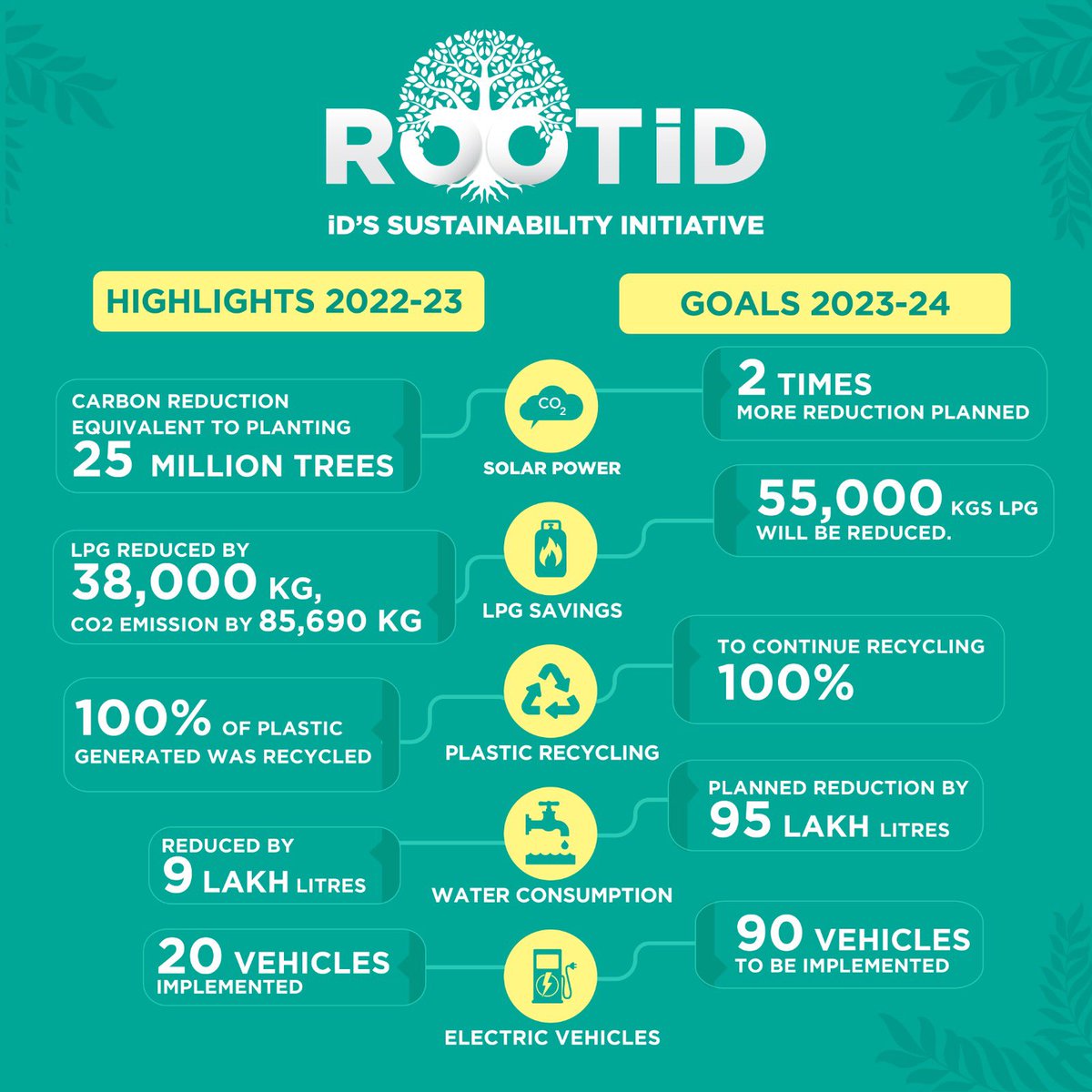
Today, on World Environment day, I’d like to present ROOTiD - our first ever sustainability initiative, as a company. As part of which, in its very first year, the carbon emission reduced has been equivalent to planting 25 million trees.
1
21
3,240

7 May 2023
1. We choose OpenSwoole. It is more performant then node.js, it uses PHP so we do not have to hire more devs and it supports both cooperative multi-threading (as node) as well as process forking. That means that we can squeeze out every resource from one instance until we need to spawn additional one. Major criteria was, of course, same tech stack - we can use existing workforce and knowledge base
There are several goals which we wanted to achieve:
1. Keep same tech stack, expand it as less as possible as pure necessity
2. Keep ALL business logic in one place
3. Adding new features MUST be equally simple as if we are working without real time updates
4. Security (of course)
5. Horizontal scaling
So, here is how we done it:
1. We choose OpenSwoole. It is more performant then node.js, it uses PHP so we do not have to hire more devs and it supports both cooperative multi-threading (as node) as well as process forking. That means that we can squeeze out every resource from one instance until we need to spawn additional one. Major criteria was, of course, same tech stack - we can use existing workforce and knowledge-base. Of course, cooperative multitasking/process forking is not something which is second nature of every PHP dev, however, our implementation abstracted that with event-based system, so additional features/maintenance should not be an issue.
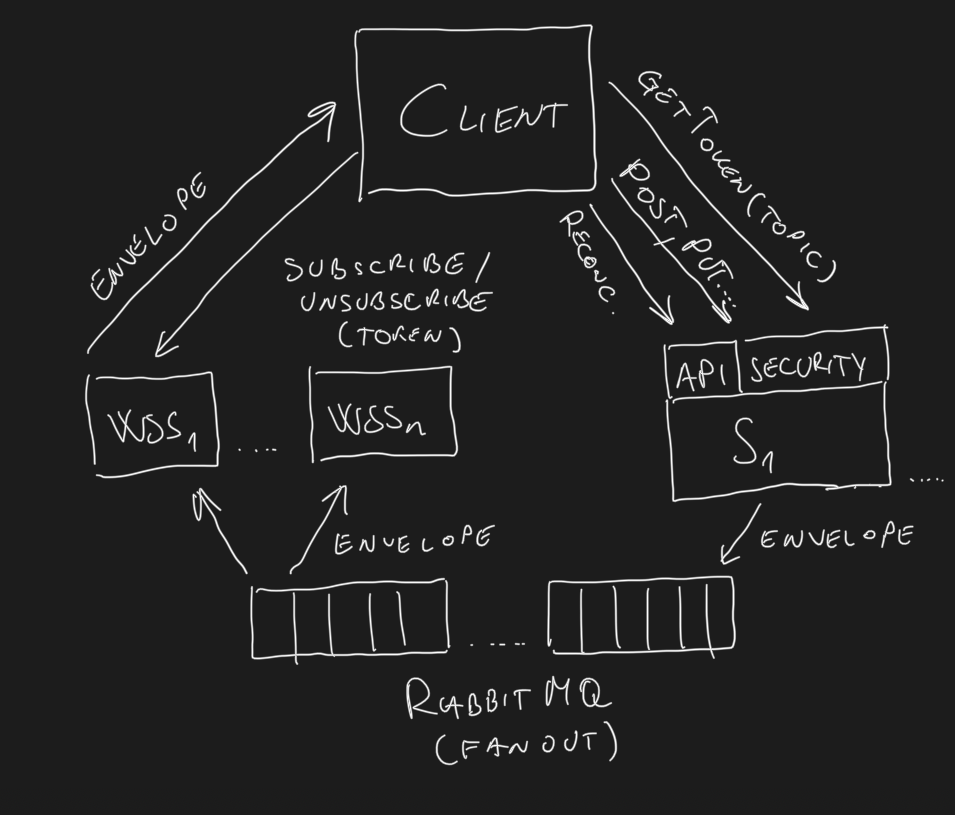
2. Web socket server does not do anything except message routing. It will accept subscription request, check token validity, and if it is fine, it will update subscription ledger. When message is received from queue, it will route it to recipients (clients). NO ADDITIONAL LOGIC! WSS is stupid, it has one simple task, and it can execute it FAST! Actually, 4 :-) but you get the idea (subscribe, unsubscribe, routing, ping/pong).
3. All business logic is in server application. API to accept request (save, edit, delete), store data into DB, security, validation, etc... You would add all logic as usual, except, if you want realtime-update, you would push that message to the queue. Recipient is topic or user. We don't use topic, we use aggregate ID from DDD. Per example, if some media is commented, or comment is replied, ID of media is used as topic, since media is root aggregate.
To achieve this, we have "envelope" interface. Envelope has various data, such as topic, timestamp... and payload. Payload varies depending on feature/type of message. New feature will require new contract for payload, of course. However, WSS is not subject of change, only client and server - which added new feature.
4. Security is, again, on server side. If client wants to subscribe to some "topic", it will send request for subscription to API requesting token. If token is received, client will send "subscribe" to WSS. WSS will decode token and if valid, subscribe it to topic.
Make sure that each token has TTL encoded.
You can see here with ease that new topic does not require any change on WSS side. Only business logic needs to implement auth checker which will decide if user can subscribe to topic.
5. Presented arch is scalable, to some extend which we do not know since WSS with OpenSSL can handle millions of clients and RabbitMQ millions of messages. We will not do perf. tests to determine that since we don't have any need for it. I do not have capacity info, sorry. But intuitively, you can imagine where are bottlenecks and how those can be handled if such need arise.
---------
So, Client sends POST, PUT, etc. request to server side where is business logic (POST comment, PATCH reply, etc..). Server does business logic and if all fine, creates ENVELOPE and puts it into queue (fan-out, all WSS will receive same envelope). WSS will receive envelope and check against subscription pool. If there is recipient/client with suitable subscription, message is delivered, otherwise, just dropped.
Client will display some page for some root aggregate (blog post). It will be interested for all notification for that root aggregate. Client sends "getToken(rootId)" to server, server will check security and issue token. Client will send "subscribe(rootId, token)" to WSS and receive all envelopes with "rootId" as destination.
We have one more thing, we store every envelope, server side, to DB/log. Client can, in case of websocket connection issue, to do reconciliation of all lost messages during connection downtime via API endpoint (of course, security is considered here as well).
2
2
19
1,905


8 Sep 2022
HAPPENING THIS FRIDAY SEPTEMBER 9TH!
#Rootid is continuing to elevate the conversations around what it means to show up for yourself and others.
Seating is limited - SIGN UP TODAY!
ow.ly/bcrB50KBfzt
3

30 May 2022
famk yuo fore yuore nowings ! mombe sayes thatt hate ov catte speaks iz rootid in golonialisms anmd zeenofobias , butte maybee thatz abit ov hyperbowling
18
12 May 2022
Happy 11th Anniversary Rootid!
What began as a journey to fill the communications needs of smaller budget nonprofits has grown into a vibrant organization that builds brands, capacity, and community through the lens of equity.
To read our origin story-
ow.ly/XoKj50J6QUQ

1
1
4
26 Apr 2022
National Record Store Day galvanized music lovers of all kinds.
In celebration of Record Store Day, a few members of team rootid shared their all-time favorite album covers and their significance.
#GetRootid #BuildingAnInclusiveWe
rootid.activehosted.com/inde…
2
26 Feb 2022
Looking for a good read/listen for #BlackHistoryMonth?
Team rootid has compiled a list of #podcasts & #books to share with you. These selections feature African American authors, artists & podcasters.
#RIPBellHooks
Check out our Full List Now!
email.rootid.com/social/0d0f…

5
24 Feb 2022
Tune In Thursdays! 🎧📚
Team rootid has compiled a list of #podcasts & #books to share with you for #BlackHistoryMonth. These selections feature African American authors, artists & podcasters.
#getrootid #nowplaying #bookclub
email.rootid.com/social/0d0f…

2
21 Feb 2022
Looking for a good read for #BlackHistoryMonth?
Team rootid has compiled a list of #podcasts & #books to share with you. These selections feature African American authors, artists & podcasters.
Check out our Full List Now!
email.rootid.com/social/0d0f…

5
17 Feb 2022
Looking for a good read/listen for #BlackHistoryMonth?
Team rootid has compiled a list of #podcasts & #books to share with you. These selections feature African American authors, artists & podcasters.
Check out our Full List Now!
email.rootid.com/social/0d0f…

1
2
14 Aug 2021
Join us today for @drupaldiversity Camp 2021! Our team is sharing our journey to include #equity at the personal, organizational and partnership levels at rootid. Join the conversation! buff.ly/3CJw0QI
2
13 Aug 2021
Excited to have our team sharing at @drupaldiversity Camp 2021 on Saturday! Our UX team will be sharing our journey to include #equity at the personal, organizational and partnership levels at rootid. Don't miss it! buff.ly/3CJw0QI
1
2
1 Jan 2021
Happy New Year! 2021 is filled with possibility and opportunity. The #nonprofit sector can shape the future of our communities, grounded in equity and social justice. Team rootid is excited to be a part of it! buff.ly/2KyqXw4
2
2