
May 2
4
28

May 1
Hello $AnChat a NewWorld where your privacy isn't held to ransom.
Debros = Freedom
#DeBros #AnChat #AnBuddy #RootWallet
6
22


Apr 28
✨The missing piece of the DeBros ecosystem is almost here.
RootWallet = Not just another wallet.
One seed phrase.
One source of truth.
✅Multi-chain self-custody (BTC, ETH, SOL, ORAMA)
✅Built-in decentralised password manager
✅SSH key vault
✅Optional Cross-device sync via Orama Vault (Shamir’s Secret Sharing)
✅Native desktop, mobile & CLI
👉NO browser extension (by design)
It’s the glue that connects everything:
AnChat, AnBuddy, and the entire privacy-first Web3 stack we’re building.
True self-custody. Zero compromises.
🔥Coming very soon. 🔥
Who’s ready to own their entire digital life in one secure root?
🥷Join the waitlist & follow updates 👇
rootwallet.io
#RootWallet #DeBros #Web3 #SelfCustody #OramaNetwork
32
11
38
1,325
Apr 25
3
19
Apr 25
We are a brotherhood of builders.
If you’re tired of fake partnerships, paid influencers, and empty hype welcome home.
Real utility. Real infrastructure. Real privacy.
Follow the progress:
✅@DeBrosOfficial
✅Join Telegram → t.me/debrosportal
The empire is being built in public.
Who’s ready?
#DeBros #OramaNetwork #AnChat #RootWallet #AnBuddy #Web3
1
8
297
Apr 25
Everything is connected.
👉RootWallet gives you safe, easy access to all apps.
👉AnChat becomes the private social home.
👉AnBuddy powers intelligent communities inside and outside AnChat.
👉All of it runs on Orama Network.
This is what happens when you build the foundation before the shiny apps.
1
7
25
Apr 25
This is the DeBros vision:
Infrastructure → Applications → Ecosystem
🔸Orama Network = The decentralized backbone
🔸RootWallet = The secure gateway to everything
🔸AnChat = The social & community layer
🔸AnBuddy = The intelligence & moderation layer
We’re not building hype.
We’re building an empire that actually works without trusting corporations.
1
7
26
Apr 25
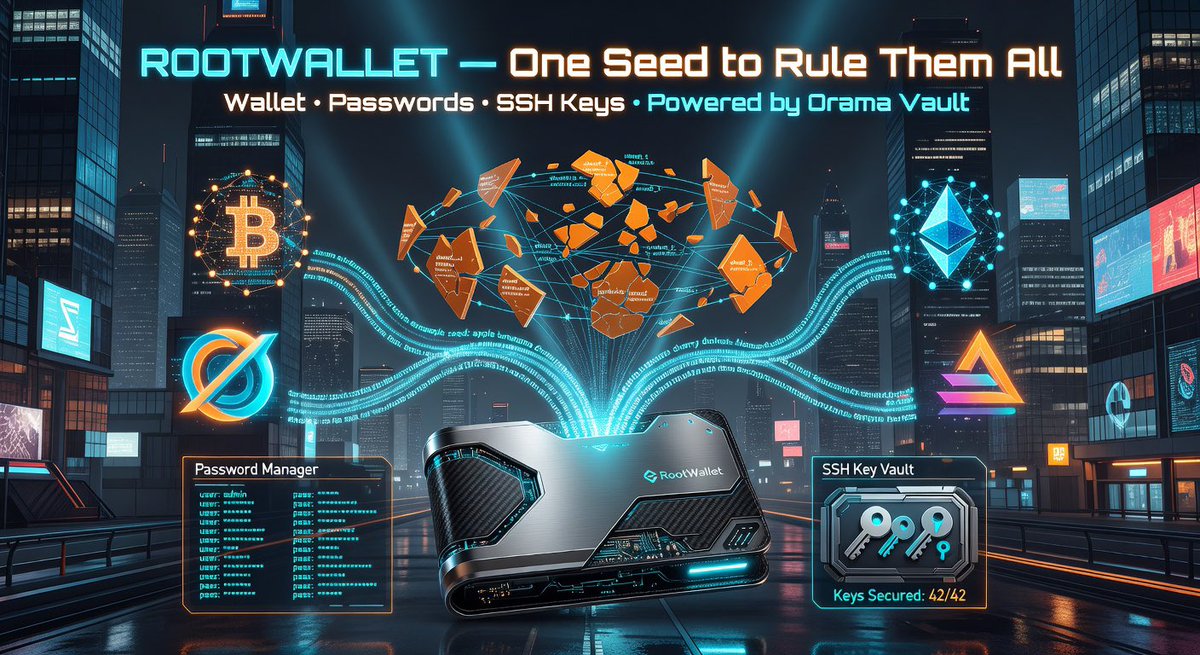
The glue that holds the entire ecosystem together: RootWallet
One seed phrase. Crypto wallet Password manager SSH key store.
☑️Multi-chain (BTC, ETH, SOL, ORAMA)
☑️Secrets split with Shamir’s Secret Sharing and distributed across Orama Vault
☑️No browser extension — native desktop, mobile & CLI
☑️Cross-device sync, fully self-custodial
RootWallet makes accessing every DeBros app seamless and secure.
rootwallet.io
1
8
68
Apr 20
Full ecosystem vision
It’s not just a token — it’s a stack
#DeBros #Orama #AnChat #AnBuddy #RootWallet
3
20
Apr 20
A NewWorld where your privacy isn't held to ransom.
Debros = Freedom
#DeBros #AnChat #AnBuddy #RootWallet
4
26
Apr 20
Bottom Line
In privacy: RootWallet > MetaMask ≈ Phantom (due to no-extension isolation Shamir distributed shares vs. local seed storage in shared browser/app contexts).
In dev connection ease: Depends on use case. MetaMask for broad EVM frontend dApps. Phantom for polished Solana experiences. RootWallet for power users, infrastructure devs, privacy-focused tooling, and scriptable/cross-device workflows.
If you value running isolated from the browser, managing one seed for crypto ops secrets, and connecting via standard WalletConnect without extension risks, RootWallet is worth watching closely post-audit and public launch.
Join their Telegram for updates: t.me/debrosportal
Docs: rootwallet.io/docs
What do you think ? is the no-extension Shamir Vault model the future for serious self-custody, or do the convenience trade-offs of MetaMask/Phantom win? 👇
1
8
302
Apr 20
Trade-offs & Current Limitations
RootWallet is early: closed access, unaudited, supports fewer chains today (though EVM-compatible via ETH derivation), and the Orama Vault network is new infrastructure (tied to their L1 token ORAMA).
MetaMask and Phantom are battle-tested at massive scale (tens of millions of users), have broader dApp compatibility out-of-the-box, mature mobile UIs, built-in swaps/staking/NFT galleries, and active development (Phantom’s recent finance platform push, MetaMask’s Snaps and institutional features).
RootWallet won’t replace them for average users yet.
But for technical users prioritizing isolation, unified multi-purpose key management (wallet passwords SSH), decentralized secret storage, and developer-friendly CLI/WalletConnect flows, it presents a compelling, more private architecture.
1
6
59
Apr 20
Ease of Connection for Developers
This is where RootWallet shines technically.
✅WalletConnect v2 support out of the box. dApps connect via standard WC pairing (QR code from mobile/desktop or deep linking). Your keys stay in the isolated native/CLI process the dApp never touches the browser context.
✅CLI-first design makes it highly scriptable. Commands like rw init, rw balance, rw password store, rw ssh generate allow seamless integration into devops, CI/CD, server management, or automated signing flows.
✅One seed manages BTC/ETH/SOL/ORAMA natively. Developers building cross-chain tools get unified key management without managing multiple mnemonics or derivation paths manually.
✅Native desktop daemon enables secure access for other tools (e.g., Orama CLI) without exposing secrets.
MetaMask remains the king for Ethereum/EVM dApp development. Its JavaScript provider (window.ethereum) is the de-facto standard — thousands of dApps assume its presence. Snaps extend functionality, and it has massive ecosystem support.
However, connecting from non-browser environments or servers is clunky (requires workarounds).
Phantom excels for Solana (native speed, deep SPL/NFT integration) and has expanded to EVM. Its provider is excellent for Solana dApps, with strong mobile experience. Like MetaMask, it’s primarily extension/mobile-first, making headless/server-side or CLI-heavy dev less seamless.
RootWallet’s WalletConnect-centric native/CLI approach is arguably easier for developers building:
🔸Backend services
🔸Automated agents
🔸Cross-chain infrastructure
🔸Privacy-sensitive tools
🔸SSH-integrated workflows
You avoid browser sandbox issues entirely. For pure frontend EVM dApps, MetaMask still wins on “just works” convenience. For Solana-heavy consumer apps, Phantom’s native feel is superior.
1
7
66
Apr 20
Privacy Advantages
RootWallet emphasizes zero single points of failure and censorship resistance.
No centralized cloud.
Only encrypted shares hit the network.
The Orama Vault replaces traditional backend storage with a global decentralized node network.
MetaMask (ConsenSys) and Phantom both claim strong privacy neither collects PII or tracks IPs aggressively (Phantom uses a privacy proxy for RPCs).
However, as browser/mobile apps with telemetry potential and reliance on RPC providers, they have larger attack surfaces for metadata leakage or compelled data requests.
RootWallet’s distributed Shamir model native apps (isolated from browser) CLI offers stronger plausible deniability and operational security for power users, privacy maximalists, or those in high-risk environments.
It also supports GrapheneOS, signaling a privacy-hardened mobile focus.
In short: RootWallet treats privacy as architectural (decentralized secret sharing isolation), while MetaMask/Phantom treat it as policy encryption.
1
6
57
Apr 20
Core Architecture & Security Model
RootWallet derives a standard BIP-39/44 HD wallet locally.
Private keys never leave the device.
For passwords and SSH keys (Ed25519), it uses:
🥷Local AES-256-GCM encryption
🥷Shamir’s Secret Sharing (K=3, N=5) — secret split into shares
🥷Shares distributed across the decentralized Orama Vault peer-to-peer network (no single node holds complete data)
🥷Cross-device sync via this distributed vault; reconstruction happens locally on your device
🫡This is a fundamentally different threat model from traditional hot wallets.
Even if nodes are compromised or go offline (as long as threshold shares remain), your data stays recoverable and private. Fully open source.
‼️Compare this to MetaMask and Phantom, which rely on local encrypted storage of the seed phrase (12/24 words) with browser or app-level isolation.
🚨Both have had historical vulnerabilities (e.g., the 2021 “Demonic” seed exposure risk in extensions). MetaMask runs as a browser extension (shares process/memory with every site); Phantom offers a browser extension mobile/desktop but is more isolated than MetaMask.
💠RootWallet’s explicit “no browser extension by design” stance eliminates an entire class of supply-chain, phishing, and memory-scraping attacks common in extension-based wallets.
1
7
1,007