
Got an idea but no structure?
CEOs know that innovation without structure is a time bomb.
💥 92% of startups fail—because they skip scalable business modeling.
🎯 Industry 4.01 transforms raw ideas into high-growth business systems.
We use 360° Business Maturity Assessments to map your real potential.
🔍 Our strategy teams work across 12 industries in 15 countries.
✅ Structure. ✅ Scalability. ✅ Investment-readiness.
📩 Book your 360° BMA now
🌐 industry4-01.com/bma
🔖 #BusinessTransformation #StartupGrowth #ScalableModels #DigitalAdvisory #CLevelStrategy #InnovationLeadership #GlobalConsulting #Industry401
1
2
14

15 Jul 2025
AMix-1: A Pathway to Test-Time Scalable Protein Foundation Model
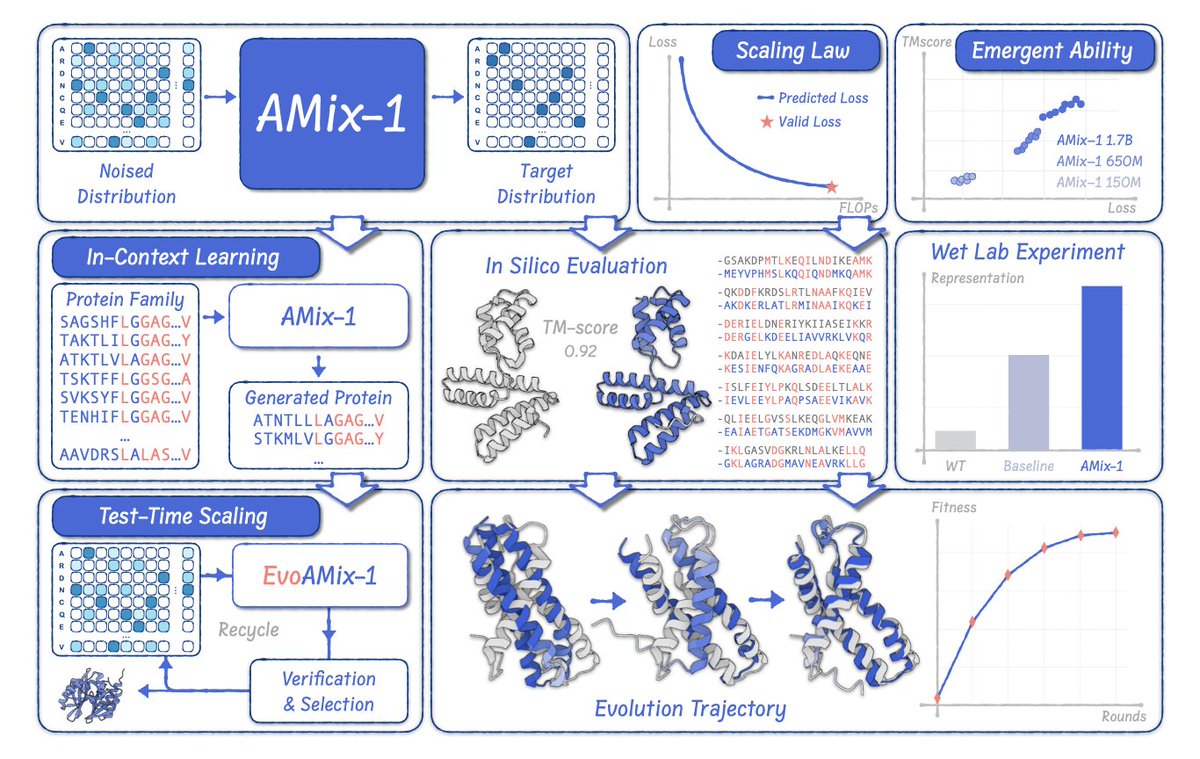
1. The study introduces AMix-1, a powerful protein foundation model built on Bayesian Flow Networks. It is designed with a systematic training methodology that includes pretraining scaling laws, emergent capability analysis, in-context learning, and test-time scaling algorithms. This model achieves a robust scalability, culminating in a strong 1.7-billion parameter model.
2. AMix-1 leverages multiple sequence alignment (MSA)-based in-context learning to unify protein design into a general framework. It can recognize deep evolutionary signals among MSAs and generate structurally and functionally coherent proteins. This framework successfully designed a dramatically improved AmeR variant with up to 50× activity increase over its wild type.
3. The study proposes a novel evolutionary test-time scaling algorithm for in silico directed evolution. This algorithm delivers substantial, scalable performance gains as verification budgets are intensified, laying the groundwork for next-generation lab-in-the-loop protein design.
4. AMix-1 demonstrates a predictable scaling law for Bayesian Flow Networks. The research reveals that structural understanding emerges naturally as training progresses, which is crucial for the development of scalable and universal protein design.
5. The model exhibits strong in-context learning capabilities, validated through in silico evaluations and wet-lab experiments. It can generate proteins that maintain both structural fidelity and functional specificity without any fine-tuning or task-specific supervision.
6. The evolutionary test-time scaling algorithm, EvoAMix-1, consistently outperforms strong baseline methods across various protein design tasks. It shows robust performance gains with increasing verification budgets, highlighting its potential for real-world applications in protein engineering.
💻Code: gensi-thuair.github.io/AMix-…
📜Paper: arxiv.org/abs/2507.08920
#ProteinEngineering #AIinBiology #ScalableModels #InContextLearning #TestTimeScaling
2
9
1,065
15 Jul 2025
AMix-1: A Pathway to Test-Time Scalable Protein Foundation Model
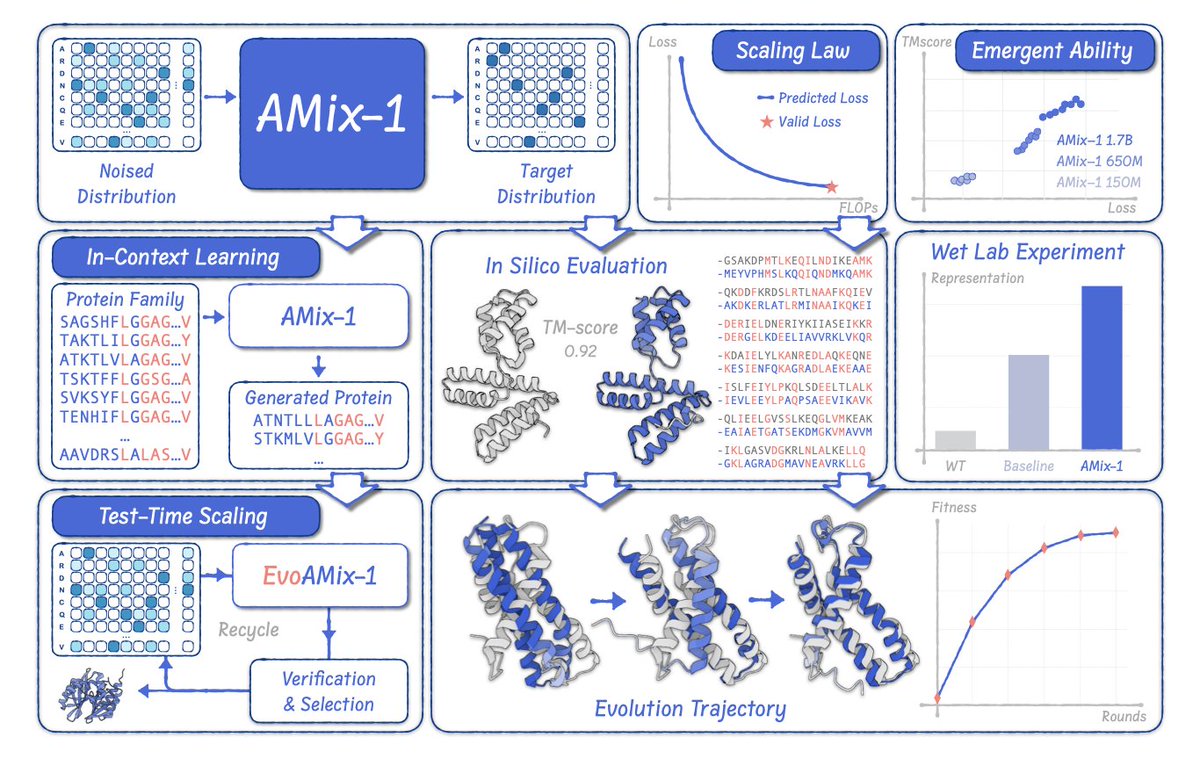
1. The study introduces AMix-1, a powerful protein foundation model built on Bayesian Flow Networks. It is designed with a systematic training methodology that includes pretraining scaling laws, emergent capability analysis, in-context learning, and test-time scaling algorithms. This model achieves a robust scalability, culminating in a strong 1.7-billion parameter model.
2. AMix-1 leverages multiple sequence alignment (MSA)-based in-context learning to unify protein design into a general framework. It can recognize deep evolutionary signals among MSAs and generate structurally and functionally coherent proteins. This framework successfully designed a dramatically improved AmeR variant with up to 50× activity increase over its wild type.
3. The study proposes a novel evolutionary test-time scaling algorithm for in silico directed evolution. This algorithm delivers substantial, scalable performance gains as verification budgets are intensified, laying the groundwork for next-generation lab-in-the-loop protein design.
4. AMix-1 demonstrates a predictable scaling law for Bayesian Flow Networks. The research reveals that structural understanding emerges naturally as training progresses, which is crucial for the development of scalable and universal protein design.
5. The model exhibits strong in-context learning capabilities, validated through in silico evaluations and wet-lab experiments. It can generate proteins that maintain both structural fidelity and functional specificity without any fine-tuning or task-specific supervision.
6. The evolutionary test-time scaling algorithm, EvoAMix-1, consistently outperforms strong baseline methods across various protein design tasks. It shows robust performance gains with increasing verification budgets, highlighting its potential for real-world applications in protein engineering.
💻Code: gensi-thuair.github.io/AMix-…
📜Paper: arxiv.org/abs/2507.08920
#ProteinEngineering #AIinBiology #ScalableModels #InContextLearning #TestTimeScaling
1
7
42
2,816

15 Mar 2025
#SCOPEICLR20 #SCOPE2025 #ICLR2025
#ICLRworkshop2025
#foundationmodeloptimization
#scalablemodels
#efficientagents
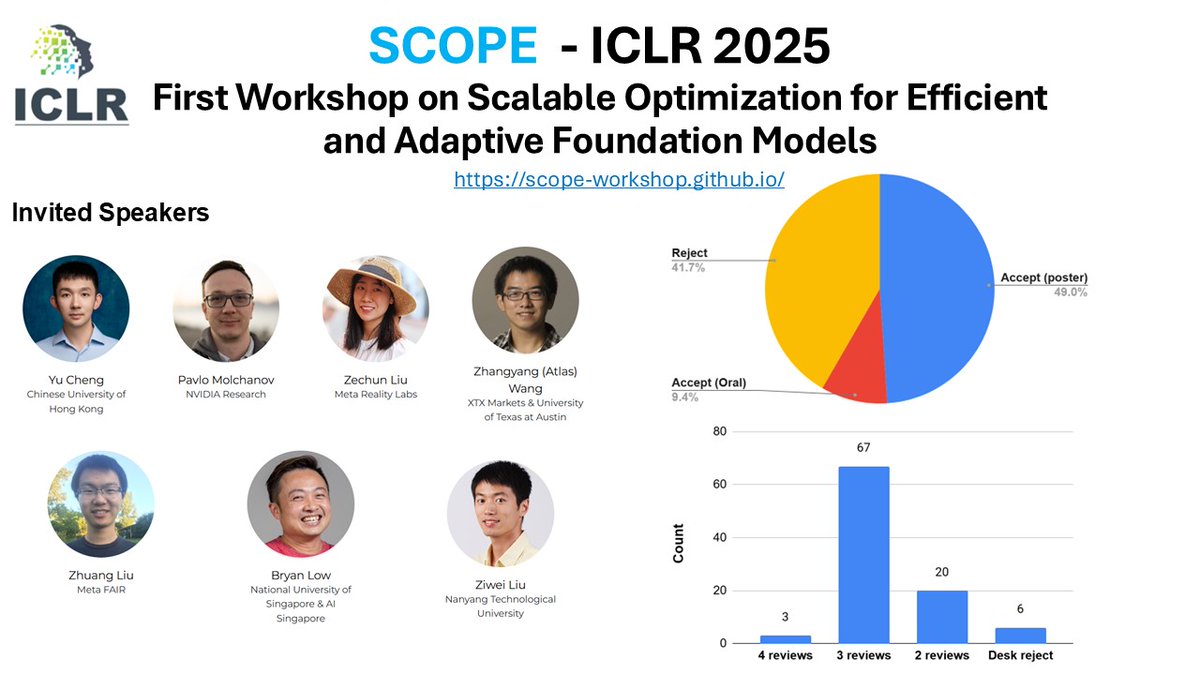
We have released the decisions of the "1st ICLR Workshop on Scalable Optimization for Efficient and Adaptive Foundation Models" (SCOPE)!
We are pleased to share that around 78% of the submissions received at least three reviews! We hope SCOPE could add some value to all the submissions that were made. We have a power-house of speakers to share their thoughts on SCOPE for foundation models and efficient agents!
More details on the accepted papers and schedule to come soon! Save the date: 28 Apr 2025, in Singapore. Hope the SCOPE community to have an engaging day!
@ayazdanb
@BeidiChen
@eiclab
@TianlongChen4
@Shiwei_Liu66
@haizhong_zheng
@thisissouvikk
1
10
688

18 Sep 2021
Join MBA in #BusinessAnalytics to learn the best practices to use #TensorFlow, an open-source #machinelearning platform to apply principles to build #scalablemodels for solving real-world problems. Watch the video to know its applications. bit.ly/2Z00Nco
3
4

28 Aug 2021
In a recent article published by @Inc42 as a part of the #D2C Summit, our CEO & founder, @Sarojayeramilli talks about ways of scaling business over the years.
Read the article to know more!
inc42.com/features/how-d2c-f…
@lbvc
#Melorra #Inc42 #ScalableModels #D2CBrands
3
8

27 Jan 2018
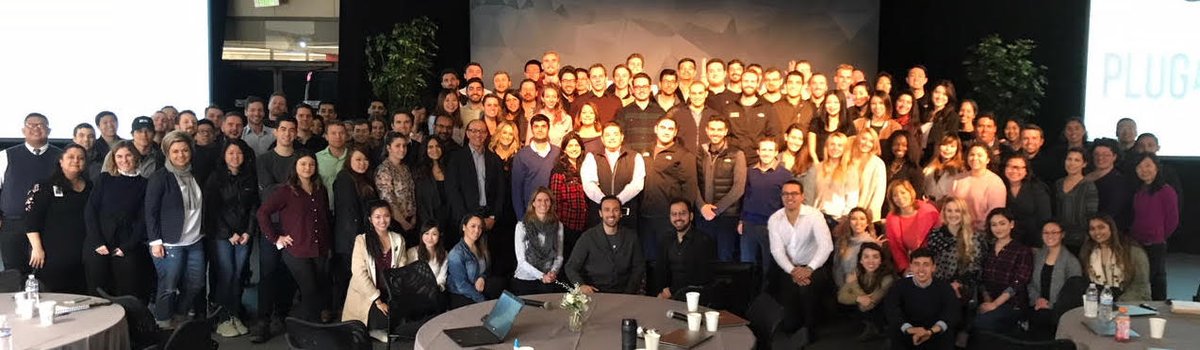
Had a great time in our @PlugandPlayTC All-Hands Meeting today. #GrowthMindset #HeathInnovation #ScalableModels
2
5