
Jun 10
#ICRA2026 highlights:
- @leto__jean and the @NVIDIARobotics team featured the Sharpa Wave in their SimToolReal and EgoScale talks 🙏
- We caught up with researchers and partners from around the world
- North handed out Austrian chocolates 🍫
- There were many kids in the audience. Austria starts teaching robotics early 👀
See you at RSS!
#ICRA2026 #AIRobotics #Robotics #IEEE #DexterousManipulation #TactileAI #Vienna #SharpaNorth #SharpaWave #DexterousHand
5
19
1,460
Aziz retweeted

Jun 8
The SharpaWave hand is really good but the main thing it has is tactile resolution -- thousands of pixels. Huge if you are an AI lab, which is presumably why nvidia picked it for their reference hardware. The price will come down but you want that data
Jun 8

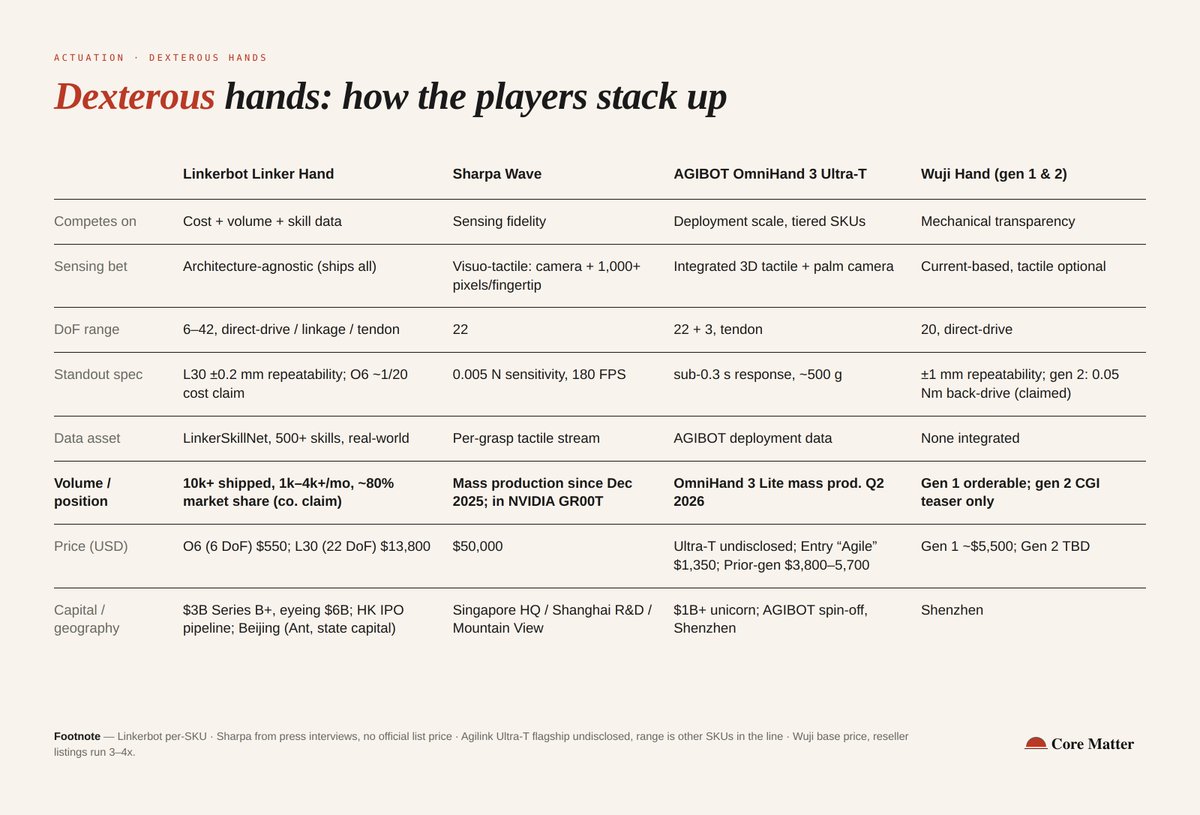
.@nvidia picked one of the priciest dexterous hands on the market for GR00T, @SharpaRobotics's Wave, 22 DoF, $50,000.
The dexterous hands market is much wider and cheaper:
- Linkerbot L30: 22 DoF, $13,800, 500-skill dataset, claims ~80% share
- @AGIBOTofficial OmniHand: tiered SKUs from $1,350
- Wuji: mechanical transparency, $5,500
Four dimensions of what a robot hand should optimize for. Here's how they stack up:
Full teardown in this week’s newsletter.
2
5
42
11,517
Jun 7
Serious blow to american academic robotics research, outside of big corporate labs. The prime operating mechanism is the FCC covered list (same as Huawei routers and telecom gear) which means universities can no longer even operate their existing fleets.
Hopefully a domestic developer market will arise to fill the gap, but i worry about the effect on research, at a time when I think american academic research is already in danger of falling behind.
Losing YAM arms, xArm, and unitree and agibot humanoids will hurt. Same for sharpawave and wuji hands.
Jun 7

What do you think
14
9
143
43,095

May 29
A SharpaWave robotic hand has demonstrated the ability to perform rapid hand cycles exceeding four repetitions per second.
One of the central engineering challenges in developing dexterous robotic hands is achieving an effective balance between strength and speed.
The hand features a Dynamic Tactile Array that integrates both visual and tactile sensing capabilities. Its fingertip combines an onboard camera with more than 1,000 tactile pixels, enabling sophisticated visuo-tactile feedback during operation.
1
3
4
55
May 29
Thanks for reading and for the comments, really interesting to read.
1 -- the point that "not all DOF are created equal" is actually incredibly important -- i dont see this as much in robot hands but certainly in arms that I have worked with its very noticeable.
2 -- Agree about the importance of sensation. It's largely (almost completely) lacking in robots now for reasons I barely touched on here. I think tactile sensation is going to be extremely important for robots.
3 -- I think i was definitely imprecise on human hand physics. Human hands dont map nearly as cleanly.
4 -- this is a really interesting point and one i dont know a lot about. Fundamentally my understanding is that the intrinsic muscles face the same issues as the coarse "degrees of freedom" understanding from my blog post. The logic of size, weight, and power remains the same. These muscles have lots of properties which are difficult (and mechanically complex) to replicate -- achieving variable stiffness which these do naturally and compactly takes encoders, motors, and a tight control loop integrating feedback. Worse with the kind of high gear ratio setups in many of these hands.
There have been a few robot hands with a "fingernail" actually, I think there's a ton more to go into in hand design. Fundamentally i think a lot of these design features are limited by control loop.
So I think its worthwhile to take the sharpawave hand as an example (arguably the best on the market right now). Its "direct drive" so gearing in each phalange. It definitely can mimic the sort of dexterous motions you see from a human hand. The problem now is sensing -- not just tactile sensing, which i think seems reasonably good, but building tight control loops that have the same reactivity thats built in to human hands naturally.
Will have to write more on this in the future, as a learning opportunity; honestly its really fascinating stuff.
1
2
305

May 28
A SharpaWave robotic hand has demonstrated the ability to perform rapid hand cycles exceeding four repetitions per second.
#humanoidtech #humanoid #robot #Robotics #AI #TechRevolution #TechInnovation #ArtificialInteligence #PhysicalAI
@PawlowskiMario @chidambara09 @Ym78200 @CurieuxExplorer @efipm @bigfundu @sayedflah @Ronald_vanLoon @cyngn @belindabeibi @odisseiaalfa @DigitalColmer @MyCompanionsAI @KirkDBorne @patricegorissen @jeffkagan @EdwardKens50830 @enilev @insom_ai333 @ChrisCCrowley @sallyeaves @gurmeet_judge @VairagyaSadhana @andresvilarino @amomsimpression @amit6060 @0xAmol @OfficialDabier
3
7
8
352

May 26
One engineering challenge in dexterous Robot hands is balancing strength and speed.
Here a SharpaWave performing rapid hand cycles at over 4x/sec. The Dynamic Tactile Array uses visuo-tactile sensing: fingertip integrates camera & 1,000 tactile pixels.
 Lukas Ziegler
10
19
131
19,761

May 16
SharpaWave Demo: High-Fidelity Teleoperation Lets #Robot Neatly Bag Trash
by @SharpaRobotics
#Robotics #EmergingTech #TechForGood #Innovation #Technology
1
4
1,049

May 4
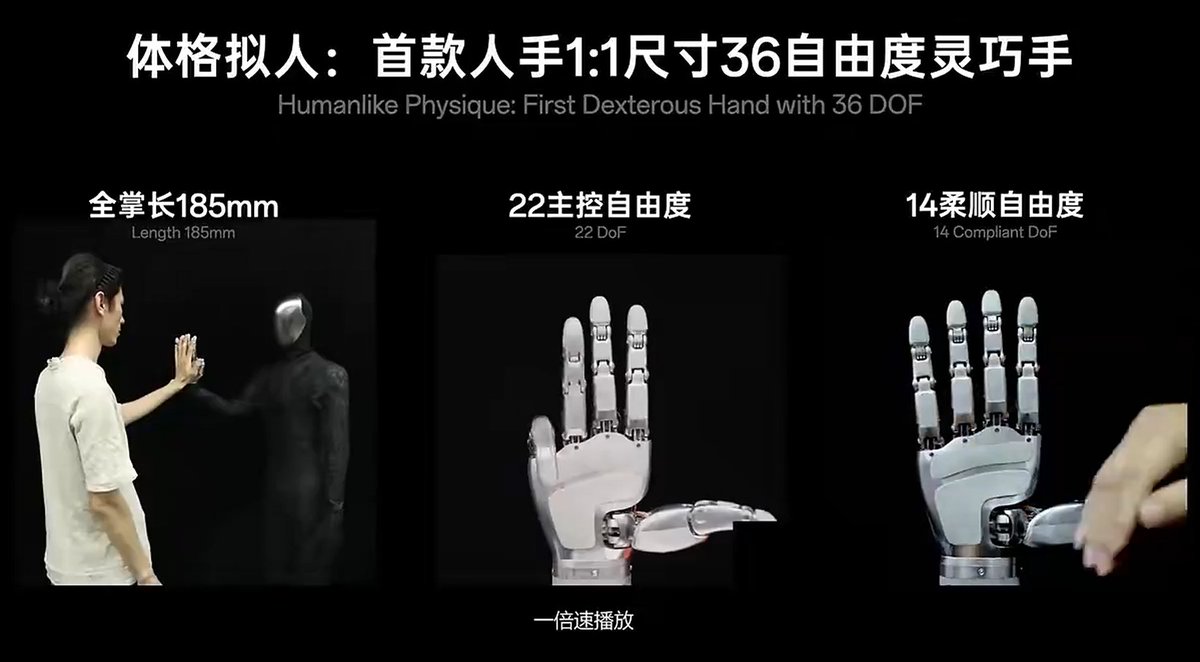
Shenzhen's new humanoid KAI's hands have a reported 36 degrees of freedom each. That's more than any robotic hand entering the market and even exceeds the moving joints of human hands, which typically have 27 DoF.
However, 22 are described as active joints for precise control, while the remaining 14 act as mechanical buffers for impact absorption and object adaptation. Regardless, the active degrees of freedom put the end effector in the upper echelon of robot hands hitting the market like the SharpaWave and the Wuji Hand.

6
15
72
14,855
Apr 24
It’s been a massive week for embodied AI foundation models: the pace of this field is truly staggering.
Throwing it back to the SimToolReal work by @kushalk_ and @tylerlum23 (Cornell & Stanford labs). In February, they achieved zero-shot tool manipulation across 24 tasks using a single RL policy and a robotic arm fitted with the SharpaWave hand.
Watching the robot nail these high-speed in-hand rotations is incredible. The precision is especially impressive when you consider the policy was never trained on these specific objects or tasks. This is what solving the manipulation bottleneck looks like. ⚡️
9
38
300
868,107
Apr 17
From Remote Control to Real Precision: SharpaWave in Action
by @SharpaRobotics
#Robotics #EmergingTech #TechForGood #Innovation #Technology
2
1
540
SharpaWave Demo: High-Fidelity Teleoperation Lets #Robot Neatly Bag Trash
by @SharpaRobotics
#Robotics #EmergingTech #TechForGood #Innovation #Technology
1
4
14
1,178
From Remote Control to Real Precision: SharpaWave in Action
by @SharpaRobotics
#Robotics #EmergingTech #TechForGood #Innovation #Technology
2
5
1,097
Apr 3
One engineering challenge in dexterous Robot hands is balancing strength and speed.
Here a SharpaWave performing rapid hand cycles at over 4x/sec. The Dynamic Tactile Array uses visuo-tactile sensing: fingertip integrates camera & 1,000 tactile pixels.
Lukas Ziegler
6
13
61
8,183
Mar 17
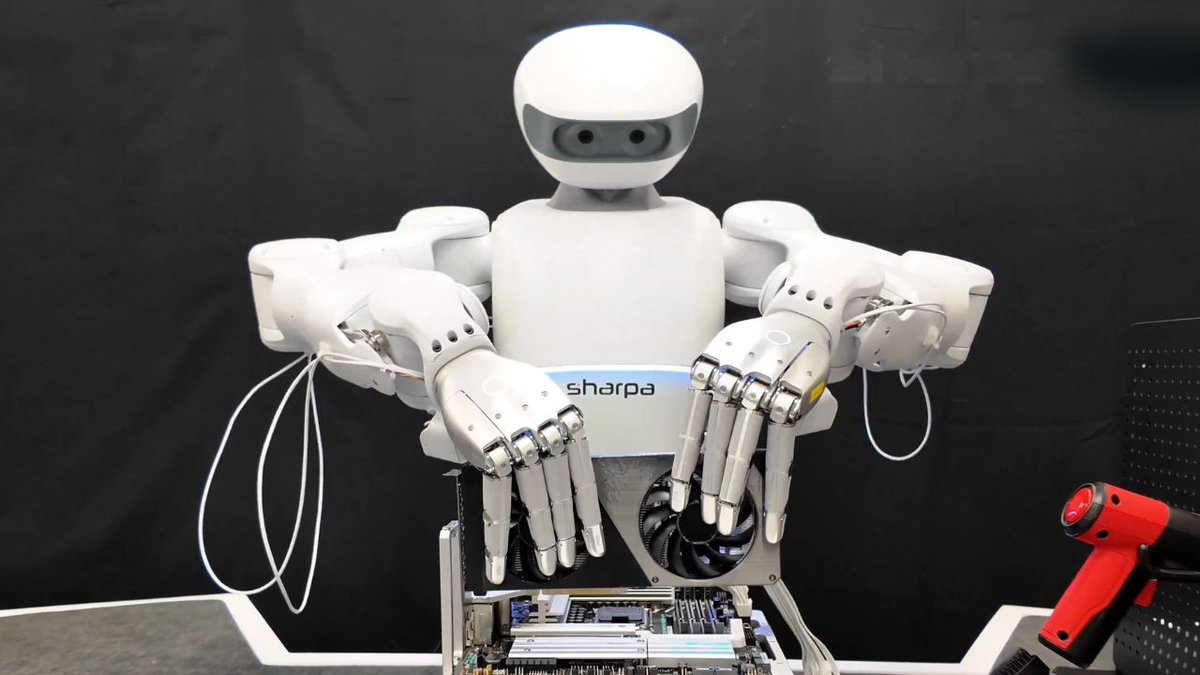
Sharpa Robotics' humanoid robot North demonstrated the ability to assemble a PC autonomously with submillimeter precision at NVIDIA's GTC 2026 conference.
The fast-rising Singaporean startup shared footage that shows the wheeled humanoid inserting a GPU into a PCIe slot. The task is extremely challenging for traditional industrial robots due to the tight tolerances and risk of damaging sensitive components. In the video, North finishes the job by securing components with screws and organizing internal wiring using its highly dexterous end effectors.
The startup's robotic hand, called the SharpaWave, boasts a reported 22 degrees of freedom (DoF), which approaches the agility and range of motion of human hands. Each fingertip has more than 1,000 touch sensors that detect miniscule changes in pressure and contact so North can adjust its movements to complete delicate tasks.
The tactile sensors send updated data on pressure, texture, and force readings up to 180 times per second to the SharpaWave’s artificial intelligence. The AI system uses that stream of data to make split-second decisions on how to move or adjust itself. With 30 N of fingertip force, the SharpaWave can firmly grasp tools, lift common objects, and manipulate parts in industrial or lab settings. It can open and close its fingertips more than four times per second, almost matching the speed of human digits. Thanks to its fine-touch sensors, the SharpaWave can adjust its grip instantly to avoid crushing fragile items.
North is powered by Sharpa's self-developed vision-tactile-language-action (VLTA) model, called CraftNet, that's specifically geared toward jobs requiring fine manipulation. The artificial intelligence is designed to handle physical interactions step by step and adapt its behaviors as contact conditions change.
Sharpa says it’s begun mass producing its SharpaWave hands but has not publicly disclosed pricing.
4
7
32
4,697