
Feb 8
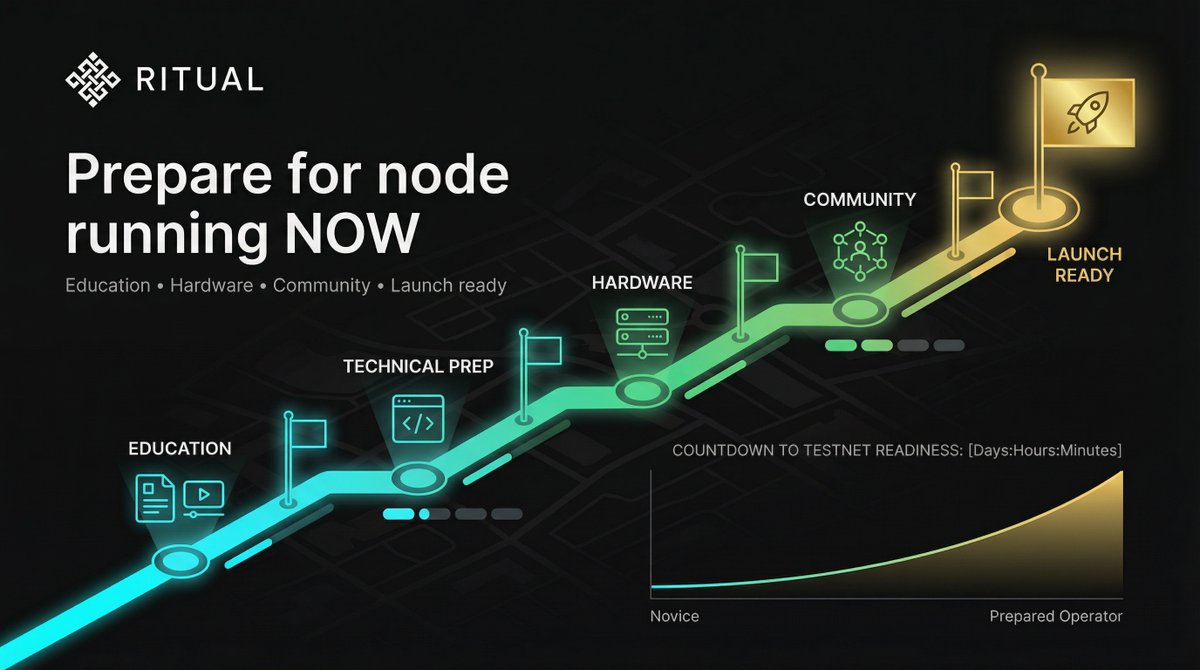
🛠️ How to prepare for Ritual node running NOW
Part 7 (final): Actionable steps you can take today 🧵
Even though public testnet isn't live yet, you can prepare 👇
---
📚 STEP 1: Education (Start Now)
Learn the basics:
→ Read Ritual documentation 📖
→ Understand node types 🖥️
→ Study consensus mechanism 🔍
→ Follow project updates 📰
Resources:
✓ docs.ritualfoundation.org
✓ @ritualnet Twitter
✓ Ritual Discord/Telegram
✓ Community tutorials 🎥
Time investment: 5-10 hours
Result: Solid understanding ✅
---
🖥️ STEP 2: Hardware Assessment
If planning AI node:
→ Check your current GPU 🎮
→ Can it run ML models?
→ RTX 3060 recommended
→ Otherwise, budget for upgrade 💰
If planning execution node:
→ Any decent PC works
→ Or budget $50-100/mo for VPS
→ DigitalOcean, AWS, Hetzner 🌐
Action items:
✓ Inventory current hardware
✓ Research upgrade costs
✓ Compare home vs. cloud options
✓ Plan budget allocation 💵
Time: 2-3 hours
Result: Clear hardware plan ✅
---
💻 STEP 3: Technical Prep
Learn necessary skills:
Linux basics:
→ Command line navigation 💻
→ Package management
→ Basic networking
→ SSH access
Docker (likely required):
→ Container basics 🐳
→ Image management
→ Docker compose
→ Volume mounting
Monitoring:
→ System metrics 📊
→ Uptime tracking ⏰
→ Alert setup 🚨
→ Log analysis 📝
Free resources:
✓ Linux Journey (linuxjourney.com)
✓ Docker tutorials (docker.com)
✓ YouTube walkthroughs 🎥
✓ Free courses on Coursera/Udemy 📚
Time: 10-20 hours over few weeks
Result: Technical confidence ✅
---
🌐 STEP 4: Infrastructure Setup (Optional)
If running at home:
→ Static IP or DDNS setup 🌍
→ Port forwarding configuration 🔧
→ Firewall rules 🛡️
→ UPS for power backup 🔋
→ Cooling solution (especially for GPU) ❄️
If using cloud:
→ Create accounts (AWS, DO, Hetzner) ☁️
→ Understand pricing 💰
→ Test basic server deployment 🖥️
→ Learn backup procedures 💾
Practice now:
✓ Spin up test server
✓ Install Docker
✓ Run simple container
✓ Monitor resources 📊
Time: 3-5 hours
Result: Infrastructure ready ✅
---
👥 STEP 5: Community Engagement
Join communities NOW:
→ Ritual Discord 💬
→ Ritual Telegram
→ Follow @ritualnet 🐦
→ Join node operator channels 🖥️
Why early:
→ First to know about testnet ⚡
→ Help shape requirements 🗣️
→ Build relationships 🤝
→ Get early access opportunities 🎁
Active participation:
→ Ask questions 🙋
→ Help others 💪
→ Share knowledge 📚
→ Stay updated 📰
Time: 30 min/day ongoing
Result: Connected & informed ✅
---
💰 STEP 6: Financial Planning
Calculate potential investment:
Execution node:
→ Hardware: $500-1000 OR
→ VPS: $50-100/month
→ Total year 1: $600-1200 💵
AI node (home):
→ Hardware: $2000-5000
→ Electricity: $1200-2400/year
→ Total year 1: $3200-7400 💵
AI node (cloud):
→ GPU VPS: $200-500/month
→ Total year 1: $2400-6000 💵
Questions to ask:
→ What's my budget? 💰
→ Home or cloud? ☁️
→ How much risk? 🎲
→ Expected ROI timeline? ⏰
Set aside funds:
→ Don't invest what you can't afford ⚠️
→ Start small, scale based on results 📈
→ Keep emergency buffer 🛡️
Time: 2-3 hours
Result: Financial clarity ✅
---
🎯 STEP 7: Monitor for Launch
Track these channels:
Official announcements:
→ @ritualnet Twitter 🐦
→ ritual.foundation website 🌐
→ Discord announcements 💬
→ Telegram updates 📱
What to watch for:
🚨 Testnet launch announcement
🚨 Node runner applications
🚨 Hardware requirements
🚨 Incentive program details
🚨 Registration deadlines
Set up alerts:
→ Twitter notifications ON 🔔
→ Discord role for node updates
→ Telegram notifications
→ Newsletter subscription 📧
Time: 5 min setup, daily monitoring
Result: Never miss updates ✅
---
📋 IMMEDIATE ACTION CHECKLIST:
This week:
□ Join Ritual Discord & Telegram
□ Read docs.ritualfoundation.org
□ Assess current hardware
□ Budget for node investment
□ Learn basic Docker if needed
This month:
□ Complete Linux/Docker tutorials
□ Test cloud VPS if considering
□ Engage in community discussions
□ Follow project updates daily
□ Prepare hardware/funds
Ready for testnet:
□ Technical skills sufficient
□ Hardware decided/ready
□ Community engaged
□ Monitoring announcements
□ Excited to participate 🚀
---
🎯 FINAL THOUGHTS:
You don't need to do everything at once ✅
Start with education, build from there 📚
The fact that you're reading this series means you're already ahead of 95% of people 🏆
Node running isn't for everyone, but if you're interested:
→ Now is the time to prepare 🛠️
→ Testnet will be your practice ground 🎓
→ Mainnet will be your opportunity 💰
💭 Remember:
Every successful node operator started as a beginner 🌱
The ones who succeed are those who:
→ Start early ⚡
→ Learn continuously 📚
→ Engage actively 👥
→ Operate professionally 💼
You can be one of them 🚀
---
That's the series! Hope this helps you understand Ritual nodes and how to get involved 🖥️
Questions? Ask in the comments 👇
@ritualfnd @joshsimenhoff @Jez_Cryptoz
#Ritual #SmartBlockchain #Testnet #TestnetGuide #StepByStep
4
15
126
Feb 7
🎁 Node operator incentives & early adopter benefits
Part 6: What's in it for early participants 🧵
Let's talk about BEYOND just running the node 💰
---
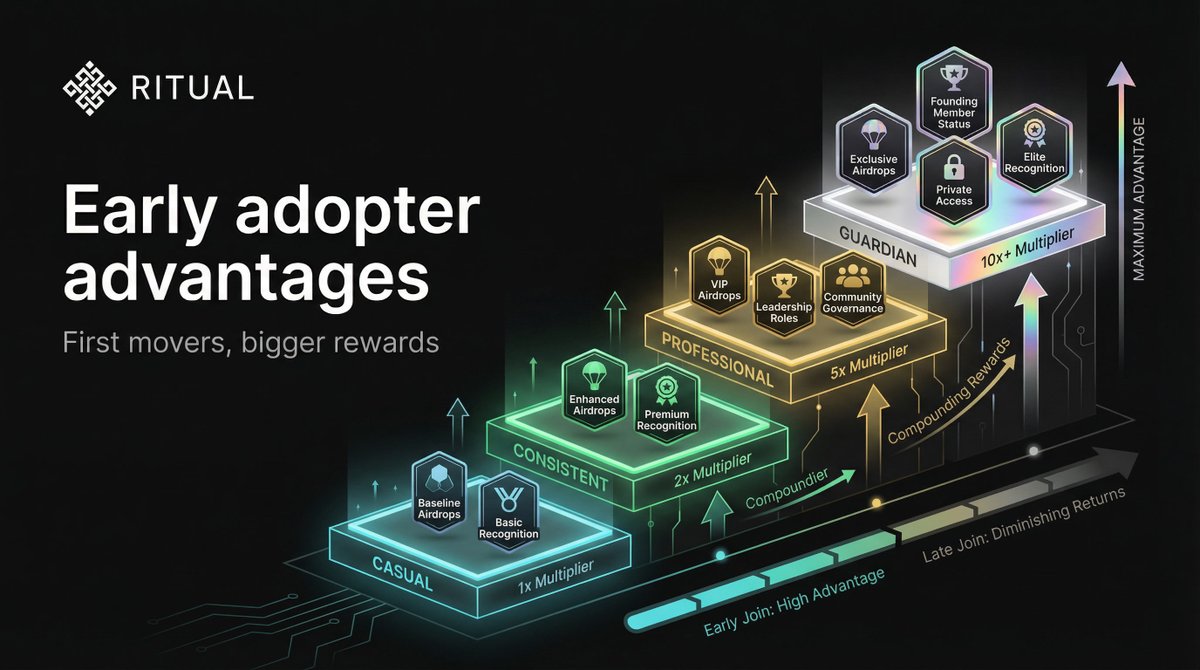
🚀 EARLY ADOPTER ADVANTAGES:
Why being early matters:
1️⃣ Less competition
→ Fewer nodes = bigger reward slice 🍰
→ Higher earning potential per node
→ First-mover advantage ⚡
2️⃣ Testnet rewards
→ Many projects reward testnet participants
→ Potential airdrops / token grants 🎁
→ Points systems, leaderboards 📊
→ Recognition in community 🏆
3️⃣ Learning curve
→ Understand system before mainnet
→ Optimize setup early 🔧
→ Build expertise 📚
→ Become community resource 💡
4️⃣ Relationship building
→ Direct team access 👥
→ Shape network development 🗣️
→ Early bug reporting bonuses 🐛
→ Advisor opportunities 🎯
---
💎 POTENTIAL INCENTIVE PROGRAMS:
Based on similar projects, expect:
🏆 Testnet Participation Program
→ Points for uptime ⏰
→ Points for tasks completed 📋
→ Points for bug reports 🐛
→ Leaderboard rankings 📊
Typical rewards:
→ Testnet points → mainnet tokens
→ Early access to features
→ Exclusive NFTs / badges 🎨
→ Direct team recognition 👏
🎯 Specialization Bonuses
→ Extra rewards for AI nodes (high demand) 🤖
→ Premium for ZK nodes (specialized) 🔐
→ Incentives for underserved regions 🌍
→ Diversity multipliers 🎪
Why:
→ Network needs balanced node types
→ Incentivize what's scarce
→ Grow in strategic directions 📈
⚡ Performance Rewards
→ 99% uptime bonuses ✅
→ Fast response time multipliers 🚀
→ High-quality execution rewards 💎
→ Reliability streaks 🔥
Message:
→ Quality > quantity
→ Professionals get rewarded
→ Consistent performers win 🏅
👥 Community Contributions
→ Documentation creation 📝
→ Tutorial videos 🎥
→ Help other operators 🤝
→ Social media advocacy 📢
Recognition:
→ Ambassador programs
→ Direct grants
→ Speaking opportunities
→ Core team relationships 💪
---
📊 HYPOTHETICAL INCENTIVE STRUCTURE:
Tier 1: Casual Operator
→ Run node occasionally
→ Basic uptime (90-95%)
→ Standard rewards
→ Earn: baseline rate 📈
Tier 2: Consistent Operator
→ 98% uptime
→ Regular participation
→ Community engagement
→ Earn: 1.5x multiplier 🚀
Tier 3: Professional Operator
→ 99.9% uptime
→ Multiple node types
→ Bug reports / contributions
→ Earn: 2-3x multiplier 💎
Tier 4: Network Guardian
→ Maximum uptime
→ Specialized nodes
→ Active community leader
→ Core contributor
→ Earn: 3-5x bonuses 🏆
---
🎮 REAL EXAMPLES FROM OTHER NETWORKS:
Ethereum validators:
→ Early validators got best rewards
→ Rewards decrease as more join
→ First movers had years of advantage ⚡
Filecoin storage providers:
→ Block rewards storage fees
→ Plus sealing bonuses early on
→ Geographic diversity incentives 🌍
The Graph indexers:
→ Query fees indexing rewards
→ Curation incentives
→ Early indexers established themselves 📊
Akash compute providers:
→ Provider incentives program
→ Community awards
→ Strategic provider subsidies 💰
Pattern: being early = compounding advantages 📈
---
💡 HOW TO MAXIMIZE YOUR POSITION:
Start in testnet:
→ Learn while it's free to fail 🎓
→ Build reputation early
→ Position for mainnet ⚡
Document your journey:
→ Share learnings publicly 📝
→ Help others succeed 🤝
→ Build personal brand 🎯
→ Become known operator 👤
Engage with community:
→ Join Discord/Telegram 💬
→ Participate in governance 🗳️
→ Report issues constructively 🐛
→ Contribute ideas 💡
Optimize operations:
→ Maximize uptime 📈
→ Improve efficiency 🔧
→ Reduce costs 💵
→ Automate monitoring 🤖
Diversify participation:
→ Run multiple node types if possible
→ Test different configurations
→ Learn multiple aspects
→ Become versatile ⚙️
---
🎯 WHAT WE DON'T KNOW YET:
❓ Exact token economics
❓ Specific reward percentages
❓ Testnet incentive details
❓ Mainnet launch timeline
❓ Airdrop mechanics (if any)
But patterns from successful networks suggest:
✅ Early participants get rewarded
✅ Quality operators earn more
✅ Community contributors recognized
✅ Professional setups outperform casual
📌 Strategy:
Even without knowing exact rewards:
→ Starting early = low-risk high-reward bet 🎲
→ Learning costs are low (testnet is free)
→ Positioning for mainnet is smart 🎯
→ Worst case: you learn valuable skills 📚
→ Best case: significant early mover advantage 🚀
Tomorrow (final): How to prepare now 🛠️
@ritualfnd @joshsimenhoff @Jez_Cryptoz
#Ritual #SmartBlockchain #Testnet #TestnetGuide #StepByStep
4
12
71
Feb 6
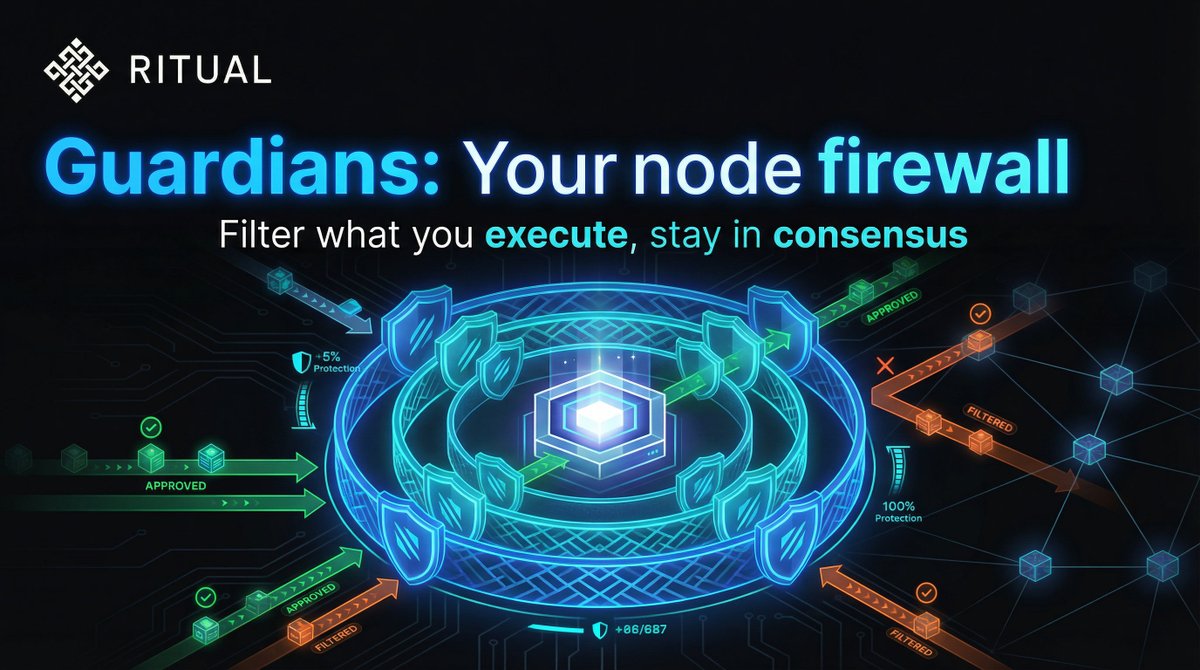
🛡️ Guardians: How Ritual protects node operators
Part 5: The firewall for your node 🧵
This is a unique feature worth understanding 👇
🚨 THE PROBLEM:
Traditional blockchains force nodes to execute EVERYTHING:
→ Scam token transaction? Execute it ✅
→ Malicious smart contract? Execute it ✅
→ Illegal content storage? Execute it ✅
No choice. No filtering. No protection ❌
💭 Real consequences:
Node operators face:
→ Legal liability for executing illegal transactions ⚖️
→ Hardware damage from malicious code 💥
→ Bandwidth waste on spam 📡
→ Participation in activities they disagree with 😤
You're forced to process EVERYTHING or not participate at all 🤷
---
⚡ RITUAL'S SOLUTION: Guardians
Think of it as a firewall for your node 🛡️
What it does:
Lets nodes opt-out of specific executions while still participating in consensus ✅
🎯 How it works:
1️⃣ Transaction comes to network
→ Contains metadata about what it does
→ Node checks against its Guardian rules 🔍
2️⃣ Node evaluates:
→ Does this match my filtering criteria?
→ Guardian rules applied ⚙️
→ Decision: execute or skip? 🤔
3️⃣ If node opts out:
→ Still validates the block (consensus) ✅
→ Just doesn't execute that specific transaction ⏭️
→ Other nodes handle execution 🔄
4️⃣ Network continues:
→ Transaction still gets processed ✅
→ Your node stays in consensus ✅
→ But you didn't execute what you object to ✅
Win-win-win 🎯
---
📋 WHAT YOU CAN FILTER:
Content type 📝
→ NSFW content
→ Gambling transactions
→ Specific types of smart contracts
Legal compliance ⚖️
→ Sanctioned addresses
→ Jurisdictional requirements
→ Regulatory obligations
Resource protection 🖥️
→ Extremely expensive computations
→ Known malicious contracts
→ Spam transactions
Ethical choices 💭
→ Environmental concerns
→ Social preferences
→ Community standards
---
💡 PRACTICAL EXAMPLES:
Scenario 1: Regulated operator 🏦
→ You run node for financial institution
→ Must comply with OFAC sanctions
→ Guardian: block sanctioned addresses
→ Result: compliance maintained, still earn rewards ✅
Scenario 2: Small hardware ⚡
→ Your node has limited GPU
→ Can't handle huge AI models
→ Guardian: skip computations > X size
→ Result: prevent crashes, stay online ✅
Scenario 3: Personal values 💭
→ You object to certain content types
→ Guardian: filter specific categories
→ Result: participate without compromising values ✅
Scenario 4: Geographic requirements 🌍
→ Local laws prohibit certain activities
→ Guardian: block illegal-in-your-region transactions
→ Result: legal compliance, keep operating ✅
---
🎮 HOW THIS ACTUALLY WORKS:
Step-by-step:
1️⃣ You set Guardian rules when launching node
→ Define what you will/won't execute
→ Rules stored in your node config 📝
2️⃣ Network sends you block to validate
→ Contains 100 transactions
→ 2 match your filter criteria 🚨
3️⃣ Your node:
→ Validates all 100 (consensus layer) ✅
→ Executes 98 transactions ✅
→ Skips 2 filtered transactions ⏭️
→ Other nodes execute those 2 🔄
4️⃣ You still earn rewards
→ Participated in consensus ✅
→ Did your share of work ✅
→ Protected your interests 🛡️
Network happy. You happy. Everyone happy 🎉
---
🔍 IMPORTANT NUANCES:
It's not censorship:
→ Transactions still get processed
→ Just not by you
→ Network remains permissionless ✅
It's not perfect filtering:
→ Nodes might disagree on categorization
→ Requires honest metadata
→ Bad actors might mislabel 🚨
It's about choice:
→ Opt-in protection
→ Not mandatory
→ Your node, your rules 🎯
Rewards consideration:
→ Filtering too much = less work = fewer rewards 📊
→ Filtering nothing = potential risks ⚠️
→ Balance needed ⚖️
---
💭 WHY THIS MATTERS:
Makes node operation:
→ More accessible (less legal risk) ✅
→ More sustainable (resource protection) ✅
→ More ethical (align with values) ✅
→ More practical (regulatory compliance) ✅
Without Guardians:
→ Many institutions can't run nodes (legal risk)
→ Small operators get overwhelmed (resource limits)
→ Operators forced into uncomfortable positions (ethical)
With Guardians:
→ More diverse node operators ✅
→ More decentralization ✅
→ More sustainable participation ✅
🎯 Bottom line:
Guardians = protection choice sustainability 🛡️
You can participate without compromising on legal, ethical, or technical concerns ✅
Tomorrow: Node operator incentives & programs 🎁
@ritualfnd @joshsimenhoff @Jez_Cryptoz
#Ritual #SmartBlockchain #Testnet #TestnetGuide #StepByStep
1
9
45
Feb 5
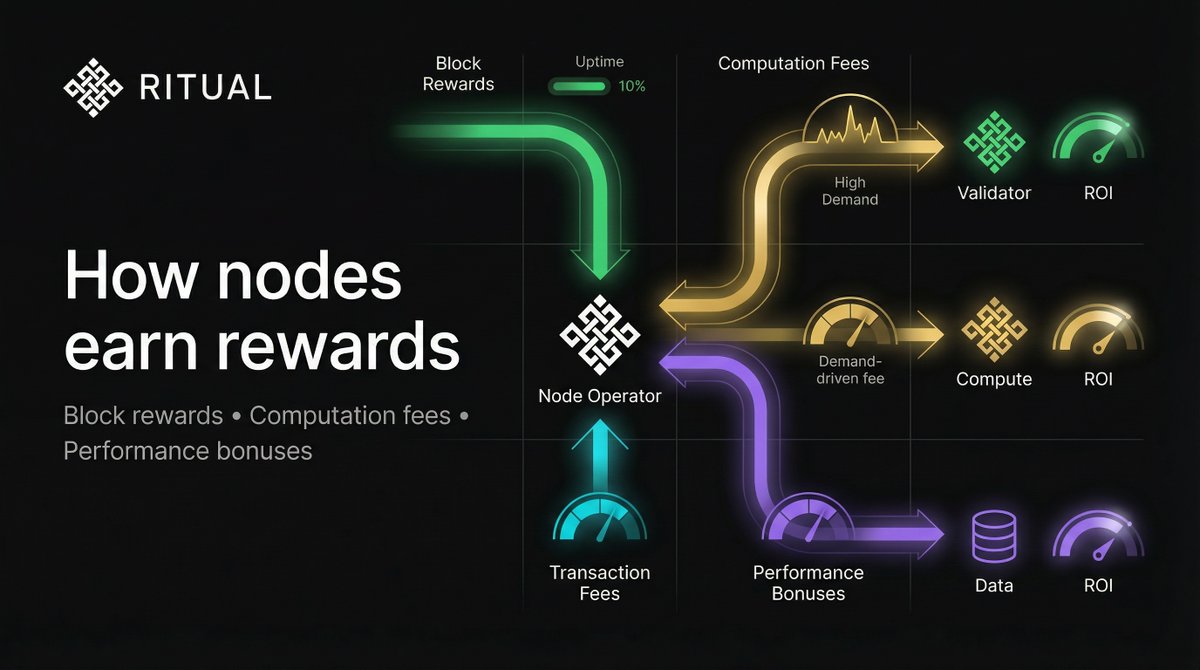
💰 How Ritual nodes actually earn rewards
Part 4: Revenue models for node operators 🧵
Let's talk about the money side 💵
⚠️ Important: Reward mechanisms not fully disclosed yet. This is based on architecture design and similar networks 👇
---
🎯 CORE REVENUE STREAMS:
1️⃣ Block Rewards
→ For participating in consensus 🗳️
→ Similar to mining/staking rewards
→ Execution nodes mainly earn this
→ Predictable, steady income ⚡
2️⃣ Computation Fees
→ For executing AI/ZK/TEE tasks 🤖
→ Specialized nodes earn this
→ Variable based on demand
→ Potentially higher than block rewards 📈
3️⃣ Transaction Fees
→ For processing regular transactions 💳
→ All nodes get a cut
→ Scales with network usage
→ Passive income stream 📊
4️⃣ Network Incentives
→ Early adopter bonuses 🎁
→ Uptime rewards ⏰
→ Performance bonuses ⚡
→ Community programs 👥
---
📊 ESTIMATED EARNING MODELS BY NODE TYPE:
🖥️ Execution Nodes:
Primary: Block rewards transaction fees
→ More stable, predictable income 📈
→ Lower variance
→ Competition with other execution nodes
→ Think: steady salary 💼
Estimated (conservative):
→ 5-15% annual return on hardware investment
→ Depends on network size
→ More nodes = rewards split more ways
🤖 AI Inference Nodes:
Primary: Computation fees block participation
→ High variance based on usage 📊
→ Demand-driven pricing 🎯
→ Could be very lucrative if demand is high 🚀
→ Think: commission-based 💰
Estimated (speculative):
→ 15-40% annual return (if utilized well)
→ Depends heavily on AI usage
→ Could be much higher during peak demand
→ Or lower if underutilized
🔐 ZK Proof Nodes:
Primary: Proof generation fees
→ Specialized, high-value work 💎
→ Fewer competitors (higher barrier to entry)
→ Steady demand from scaling solutions ⚡
→ Think: specialized contractor 🔧
Estimated:
→ 20-50% annual return
→ Proof generation is resource-intensive
→ Premium pricing for fast proofs
→ Growing demand for ZK tech
🛡️ TEE Nodes:
Primary: Confidential computation fees
→ Privacy-premium pricing 🔒
→ Enterprise use cases 🏢
→ Compliance requirements drive demand ✅
→ Think: security consultant 🛡️
Estimated:
→ 15-35% annual return
→ Steady from enterprise users
→ Premium for regulated industries
→ Growing privacy awareness
---
💡 FACTORS AFFECTING EARNINGS:
Network demand 📈
→ More dApps = more tasks = more fees
→ Early days = lower usage
→ Maturity = higher consistent demand
Your uptime ⏰
→ 99% uptime = maximum rewards
→ Downtime = missed opportunities
→ Reliability matters A LOT
Hardware performance 🖥️
→ Faster processing = more tasks
→ Better hardware = competitive advantage
→ But diminishing returns after a point
Competition 👥
→ More nodes = split rewards
→ But also = network growth
→ Balance between the two
Specialization bonus 🎯
→ Rare node types might get premium
→ Early specialization = advantage
→ Market finds equilibrium over time
---
🎮 REAL-WORLD SCENARIO:
Let's say you invest $3,000 in AI node:
Conservative case:
→ Network: early stage, low usage
→ Earnings: $30/month (12% annual)
→ ROI: 2.5 years ⏰
Moderate case:
→ Network: growing, decent usage
→ Earnings: $75/month (30% annual)
→ ROI: 3.3 years 📊
Optimistic case:
→ Network: mature, high demand
→ Earnings: $200/month (80% annual)
→ ROI: 1.25 years 🚀
Plus: potential token appreciation 📈
---
⚠️ IMPORTANT DISCLAIMERS:
❌ These are estimates, not guarantees
❌ Actual rewards could be higher or lower
❌ Early testnet might have different mechanics
❌ Network needs time to mature
❌ Do your own research
✅ But the MODEL makes sense
✅ Specialized compute = premium pricing
✅ Growing AI demand = more opportunities
✅ Infrastructure providers earn in any scenario
🎯 Strategy recommendations:
Start small:
→ Test with execution node first
→ Learn the system
→ Scale based on results
Track performance:
→ Monitor actual earnings
→ Compare to estimates
→ Adjust strategy accordingly
Diversify:
→ Maybe run multiple node types
→ Different revenue streams
→ Risk mitigation 🛡️
Tomorrow: Guardians system (protection for nodes) 🛡️
@ritualfnd @joshsimenhoff @Jez_Cryptoz
#Ritual #SmartBlockchain #Testnet #TestnetGuide #StepByStep
4
14
79
Feb 4
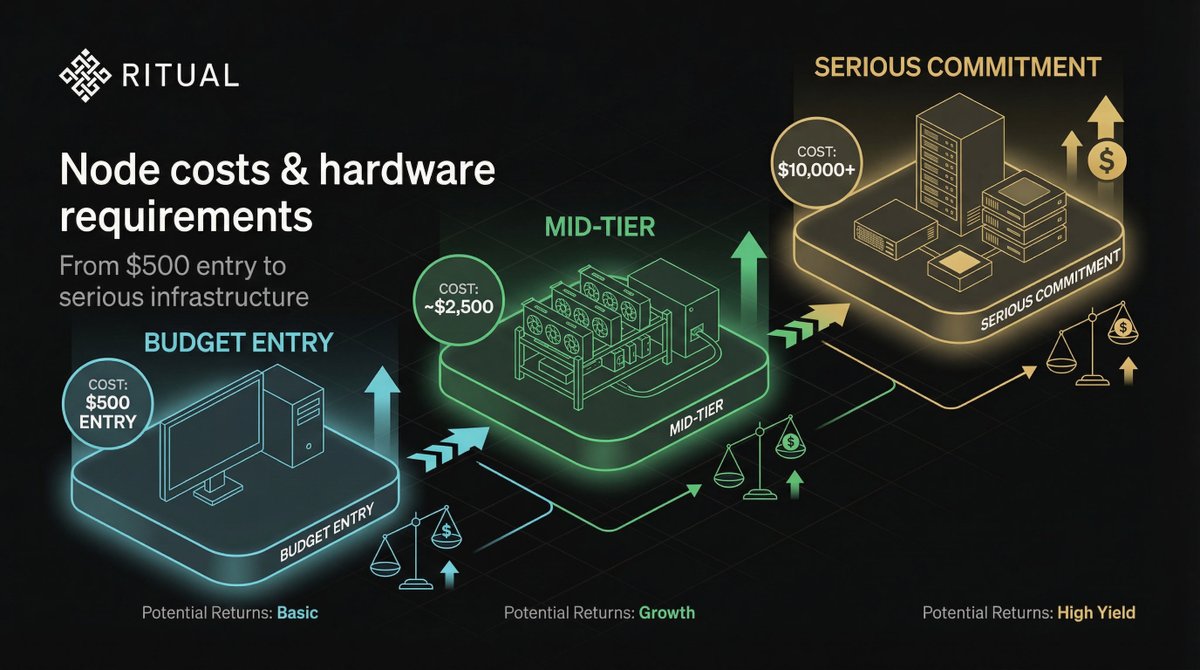
💰 What it actually costs to run a Ritual node
Part 3: Hardware requirements & real numbers 🧵
Let's talk money and specs 💵
⚠️ Disclaimer: These are estimates based on similar networks. Ritual hasn't released final specs yet. But this gives you an idea 👇
---
🖥️ EXECUTION NODE
Minimum specs:
→ CPU: 4 cores
→ RAM: 16GB
→ Storage: 500GB SSD
→ Bandwidth: 100 Mbps
Recommended specs:
→ CPU: 8 cores
→ RAM: 32GB
→ Storage: 1TB NVMe SSD
→ Bandwidth: 1Gbps
💰 Cost estimate:
→ Home setup: $500-$1000 (one-time)
→ VPS (cloud): $50-$100/month
→ Electricity: ~$20-40/month
Think: Similar to running Ethereum validator ⚡
---
🤖 AI INFERENCE NODE
Minimum specs:
→ GPU: RTX 3060 (12GB VRAM)
→ CPU: 6 cores
→ RAM: 32GB
→ Storage: 1TB SSD
Recommended specs:
→ GPU: RTX 4090 or A100
→ CPU: 12 cores
→ RAM: 64GB
→ Storage: 2TB NVMe
💰 Cost estimate:
→ Home setup: $2,000-$8,000 (one-time) 🎮
→ Cloud GPU: $200-$1000/month
→ Electricity: $100-200/month (GPUs hungry!)
Most expensive but potentially highest rewards 📊
---
🔐 ZK PROOF NODE
Minimum specs:
→ CPU: 16 cores (high-end)
→ RAM: 64GB
→ Storage: 1TB SSD
→ Optional: FPGA/ASIC for better performance
Recommended specs:
→ CPU: 32 cores
→ RAM: 128GB
→ Storage: 2TB NVMe
→ FPGA/ASIC: Specialized hardware
💰 Cost estimate:
→ CPU-based: $2,000-$4,000
→ With specialized chips: $5,000-$15,000
→ Cloud: $300-$600/month
→ Electricity: $80-150/month
Highly specialized, serious commitment 🔧
---
🛡️ TEE NODE
Minimum specs:
→ CPU: Intel Xeon with SGX or AMD EPYC with SEV
→ RAM: 32GB
→ Storage: 500GB SSD
→ Must support attestation
Recommended specs:
→ Enterprise-grade CPU with TEE
→ RAM: 64GB
→ Storage: 1TB SSD
💰 Cost estimate:
→ Hardware: $1,500-$3,000
→ Cloud TEE instances: $150-$300/month
→ Electricity: $40-80/month
Specialized but not as expensive as AI nodes 🛡️
---
💡 PRACTICAL OPTIONS:
Budget entry ($500-$1000):
✅ Start with Execution node
✅ Use existing PC or cheap VPS
✅ Learn the ropes
✅ Upgrade later
Mid-tier ($2000-$3000):
✅ AI node with RTX 3060/4060
✅ Or high-end Execution node
✅ Decent earning potential
✅ Still accessible
Serious commitment ($5000 ):
✅ Top-tier AI node (RTX 4090/A100)
✅ Or ZK node with specialized hardware
✅ Maximum potential rewards
✅ For dedicated operators
🎯 Important considerations:
Location matters:
→ Electricity costs vary wildly 💡
→ Some regions have cheap power
→ Cloud might be cheaper in expensive areas
Time commitment:
→ Nodes need maintenance 🔧
→ Monitoring uptime
→ Updating software
→ Troubleshooting issues
Rewards vs costs:
→ No public info on rewards yet 📊
→ Testnet first, mainnet later
→ Calculate ROI carefully
→ Don't invest more than you can afford ⚠️
📌 My take:
If you're curious, start cheap:
→ Run execution node on VPS
→ Learn how it works
→ Decide if you want to invest more
Don't buy $8k GPU without understanding the ecosystem first 😅
Tomorrow: How nodes earn rewards 💰
@ritualfnd @joshsimenhoff @Jez_Cryptoz
#Ritual #SmartBlockchain #Testnet #TestnetGuide #StepByStep
3
11
58
Feb 3
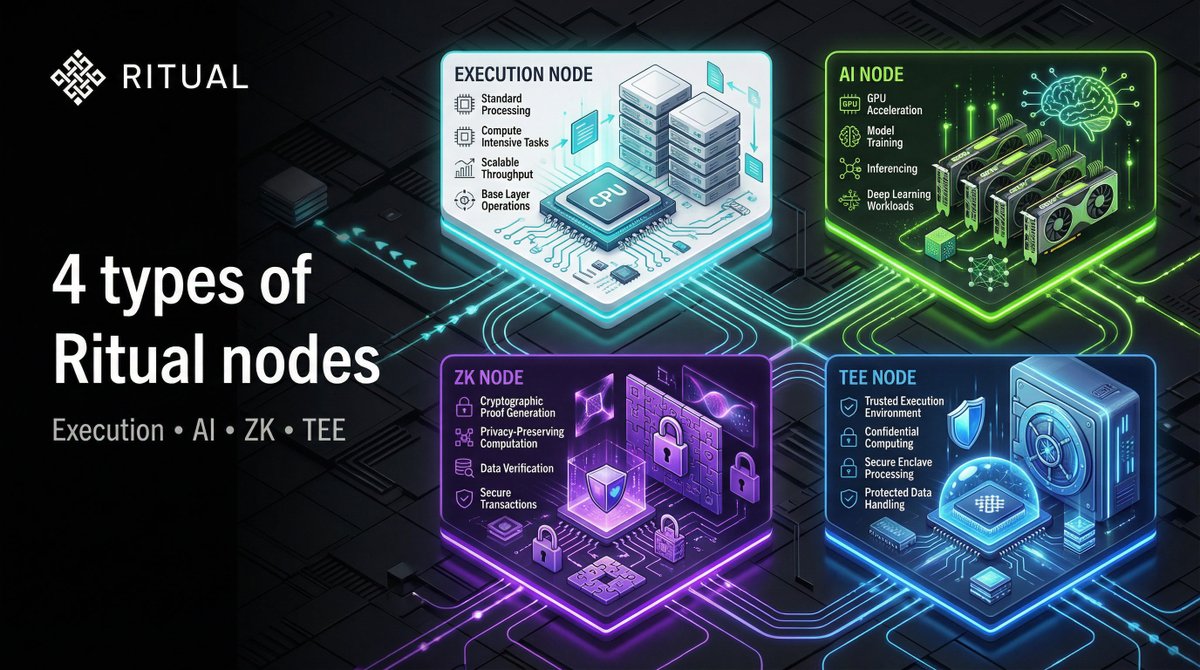
🔍 The 4 types of Ritual nodes (explained simply)
Part 2 of Node Running series 🧵
Yesterday: why Ritual needs specialized nodes
Today: what each type actually does 👇
🖥️ NODE TYPE #1: Execution Nodes
What they do:
→ Process regular transactions 💳
→ Store blockchain state 💾
→ Participate in consensus 🗳️
→ Handle smart contract execution 📝
Hardware needs:
→ Standard CPU (nothing crazy)
→ SSD storage
→ Stable internet
→ Similar to running Ethereum node
Think of them as: The backbone of the network 🏗️
---
🤖 NODE TYPE #2: AI Inference Nodes
What they do:
→ Run machine learning models 🧠
→ Process AI inference requests ⚡
→ Return results to smart contracts 🔄
→ Handle image, text, prediction tasks 🎯
Hardware needs:
→ Powerful GPU (NVIDIA preferred) 🎮
→ High RAM (32GB )
→ Fast storage
→ Good bandwidth
Think of them as: The brain of the network 💡
Real task examples:
- Generate image from text prompt 🎨
- Analyze transaction for fraud 🚨
- Create NPC dialogue in game 🎮
- Predict DeFi liquidation risk 📊
---
🔐 NODE TYPE #3: ZK Proof Nodes
What they do:
→ Generate zero-knowledge proofs 🔒
→ Verify private computations ✅
→ Enable privacy-preserving operations 🛡️
→ Support scaling solutions ⚡
Hardware needs:
→ Specialized chips (ASICs/FPGAs) 🔧
→ OR high-end CPUs with lots of cores
→ Significant memory
→ Proof generation is intense
Think of them as: The security layer 🔐
Real task examples:
- Prove transaction validity without revealing details 🤫
- Verify identity without exposing data 👤
- Enable private DeFi operations 💰
- Compress computation proofs 📦
---
🛡️ NODE TYPE #4: TEE (Trusted Execution) Nodes
What they do:
→ Run code in secure enclaves 🔒
→ Process sensitive data safely 💎
→ Guarantee execution integrity ✅
→ Enable confidential computing 🤐
Hardware needs:
→ CPUs with secure enclaves 🔐
→ Intel SGX or AMD SEV
→ Attestation capabilities
→ Specialized but increasingly common
Think of them as: The vault of the network 🏦
Real task examples:
- Process medical data privately 🏥
- Handle KYC without exposing info 👥
- Secure key management 🔑
- Confidential smart contracts 📝
---
💡 Key points to remember:
1️⃣ You don't need to run ALL types
→ Choose what fits your hardware
→ Network needs all types, but not everyone does everything
2️⃣ Different rewards for different types
→ More specialized = potentially higher rewards
→ Market demand varies
3️⃣ Can run multiple types on one machine
→ If hardware supports it
→ Execution AI on same rig? Possible ✅
4️⃣ Start simple, upgrade later
→ Begin with execution node
→ Add specialization as you learn
🎯 Most accessible entry point:
Execution nodes = easiest to start with
Similar to running any blockchain node 🖥️
Tomorrow: Hardware requirements & costs 💰
@ritualfnd @joshsimenhoff @Jez_Cryptoz
#Ritual #SmartBlockchain #Testnet #TestnetGuide #StepByStep
9
19
103
Feb 2
🖥️ Why @ritualnet nodes are different (and why it matters)
New series: Understanding Ritual Nodes 🧵
Let's start with basics 👇
🔍 Traditional blockchain nodes:
All nodes do the SAME thing:
→ Store blockchain data 💾
→ Validate transactions ✅
→ Participate in consensus 🗳️
One size fits all 📦
Problem: This works for simple transactions, but terrible for complex compute ❌
💡 Think about it:
If I want to:
→ Send 1 ETH → needs basic CPU ✅
→ Run AI inference → needs powerful GPU 🎮
→ Generate ZK proof → needs specialized hardware 🔧
Can't do all of this efficiently with identical nodes 😤
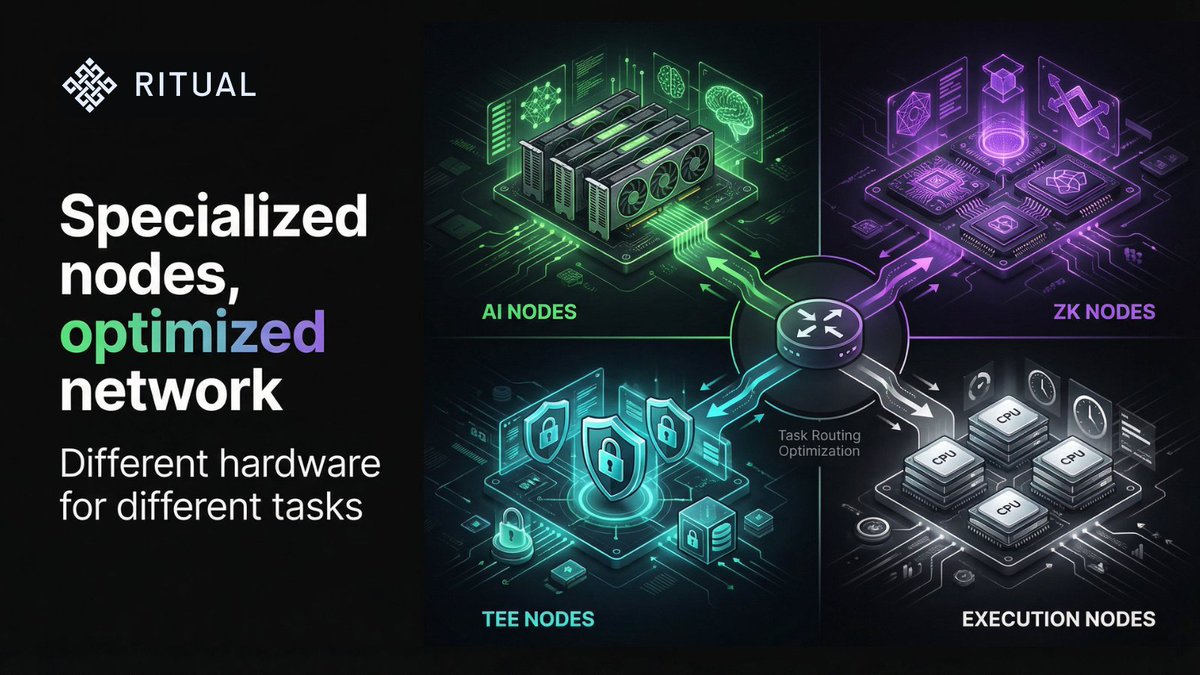
⚡ Ritual's approach: Specialized Nodes
Different nodes, different jobs:
🤖 AI Nodes
→ Run machine learning models
→ Need: GPUs, high memory
→ Handle: inference requests
🔐 ZK Nodes
→ Generate zero-knowledge proofs
→ Need: specialized ASICs/FPGAs
→ Handle: proof computation
🛡️ TEE Nodes
→ Secure computation
→ Need: secure enclaves (Intel SGX, AMD SEV)
→ Handle: private data processing
⚡ Execution Nodes
→ Regular blockchain operations
→ Need: standard CPUs
→ Handle: transactions, storage
📊 Why this matters:
Traditional approach:
❌ Every node needs expensive hardware for rare tasks
❌ Wasteful and inefficient
❌ Limits what blockchain can do
Ritual approach:
✅ Nodes specialize in what they're good at
✅ More efficient resource usage
✅ Enables complex computation on-chain
🎯 Real-world analogy:
Traditional blockchain = hospital where every doctor does everything (surgery, dentistry, psychiatry) 🏥
Ritual = hospital with specialists (each expert in their field) 🎯
Way more efficient. Way better results ✨
💭 Key insight:
This isn't just technical optimization.
This is what ENABLES Ritual to run AI on-chain natively 🧠
Without specialized nodes, none of this would be possible ⚡
Tomorrow: Deep dive into node types 🔍
@ritualfnd @joshsimenhoff @Jez_Cryptoz
#Ritual #SmartBlockchain #Testnet #TestnetGuide #StepByStep
15
16
112
Feb 1
🌍 AI Models as Digital Assets: The Big Picture
Part 7 (final): Why this matters beyond just @ritualnet 🧵
Let's zoom out 🔭
🎯 What we've covered this week:
Day 1: Problem → AI models lack verification ❌
Day 2: Solution → Enshrined models on-chain ✅
Day 3: Marketplace → Monetization infrastructure 💰
Day 4: IP Protection → Cryptographic ownership 🔐
Day 5: Verification → Truth in performance 📊
Day 6: Revenue → How creators earn 💵
Now: Why this reshapes the AI industry 🚀
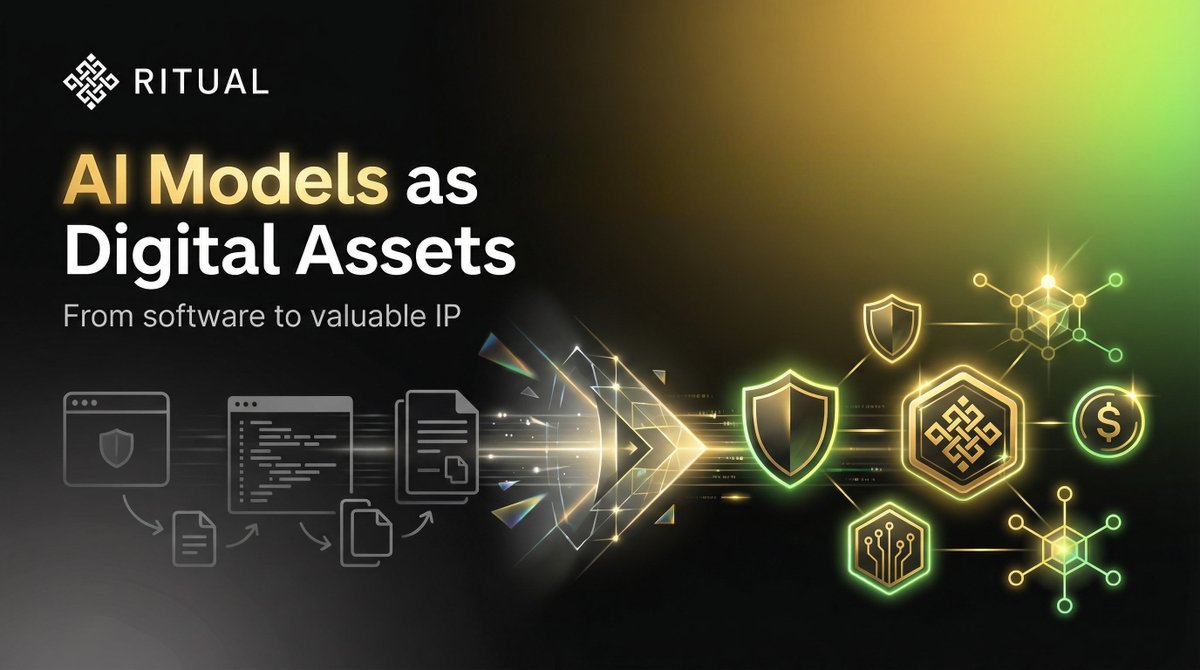
💡 The paradigm shift:
Before Ritual:
AI models = software (copy/paste, hard to protect, hard to monetize)
After Ritual:
AI models = digital assets (unique, protected, tradeable, valuable) 💎
🔮 What this enables long-term:
1️⃣ AI Model Economy
→ Thriving marketplace of specialized models
→ Creators earn fair compensation
→ Innovation accelerates
→ Quality improves (better incentives)
2️⃣ Model Derivatives & Remixes
→ Build on others' work, with attribution
→ Revenue sharing automatically
→ Collaborative AI development
→ Faster innovation cycles
3️⃣ Democratized AI
→ Not just big tech can monetize
→ Individual creators compete fairly
→ Diverse perspectives in AI
→ More innovation from edges
4️⃣ Transparent AI Supply Chain
→ Know exactly what AI you're using
→ Verify training data ethics
→ Ensure compliance
→ Build trust
5️⃣ Composable AI
→ Combine multiple models
→ Payments split automatically
→ Complex AI workflows
→ Revenue sharing works perfectly
📊 Historical parallel:
This is similar to what happened with:
Music industry:
Before: physical albums, gatekeepers
After: streaming, direct artist payment
Result: more creators, more diversity 🎵
AI industry:
Before: big tech monopoly, hard to monetize
After (potentially): open marketplace, fair payment
Result: more innovation, better models 🤖
🎯 Not just about Ritual:
Even if Ritual doesn't win, this CONCEPT matters:
Treating AI models as verifiable, tradeable, protected digital assets is probably the future 🌟
We're moving from:
"AI as free commodity" → "AI as valuable IP"
💭 Why I'm paying attention:
This isn't just technical innovation.
It's economic innovation 💰
Creates incentives that didn't exist before.
Enables business models that weren't possible.
Democratizes value capture in AI era.
And that's a big deal 🚀
📌 Final thought:
We're early. This infrastructure is just being built.
But if successful, we'll look back at this moment as when AI models became real digital assets 💎
That's the vision. Let's see how it plays out 👀
---
End of series! Hope this helped explain why on-chain AI models matter 🧠⛓️
@ritualfnd @joshsimenhoff @Jez_Cryptoz
#Ritual #SmartBlockchain #Testnet #TestnetGuide #StepByStep
6
16
103
Jan 31
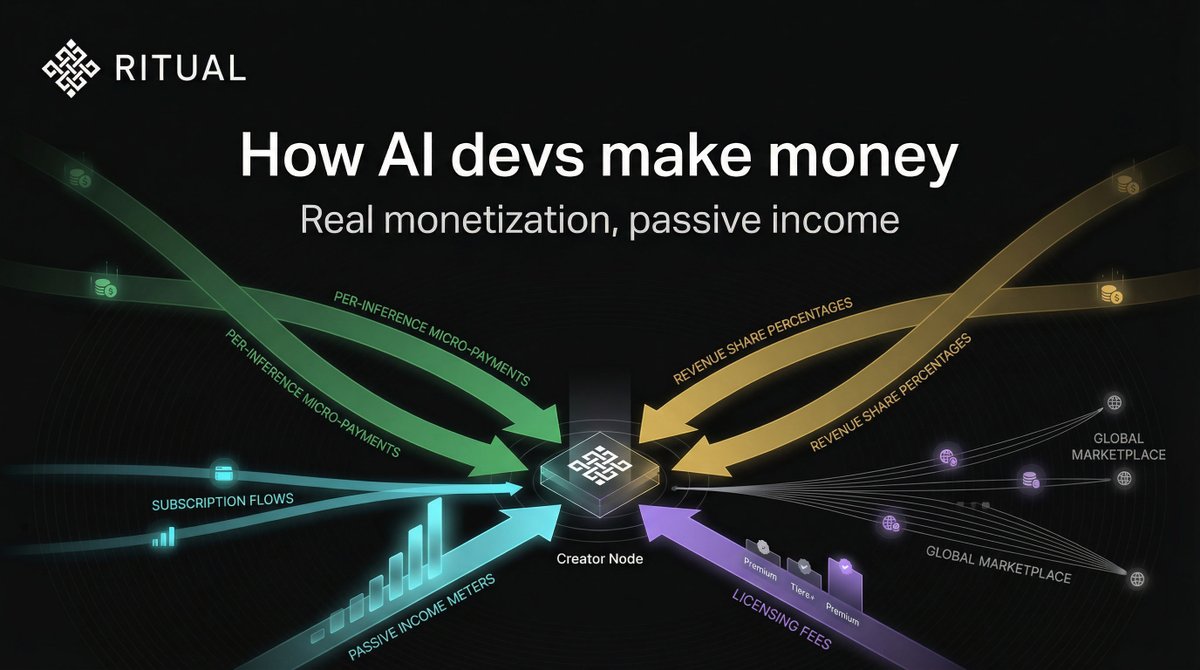
💰 How AI developers actually make money on @ritualnet
Part 6: Real monetization opportunities 🧵
Let's talk money 💵
🎯 The opportunity:
Right now, most AI developers:
→ Work for big tech (OpenAI, Google, etc.) 🏢
→ Or build/release for free 🆓
→ Hard to monetize independently 😤
Ritual changes this ⚡
💡 Revenue streams for AI creators:
1️⃣ Per-Inference Revenue
→ Get paid every time your model runs 🪙
→ Micro-payments, add up over time 📈
→ Works for popular models
Example:
Your image recognition model:
- $0.0001 per inference
- 1M uses per month
- = $100/month passive income ✅
2️⃣ Subscription Models
→ Monthly/yearly access fees 📅
→ Predictable income 💰
→ Good for specialized models
Example:
Medical diagnosis model:
- $99/month for healthcare apps
- 50 subscribers
- = $4,950/month recurring 🚀
3️⃣ Tiered Pricing
→ Free basic version 🆓
→ Paid advanced features 💎
→ Capture different market segments
Example:
Text generation model:
- Free: 100 requests/day
- Pro: unlimited faster
- Enterprise: custom deployment
- Revenue from power users 📊
4️⃣ Revenue Sharing
→ Partner with apps using your model 🤝
→ Get % of their revenue 📈
→ Aligned incentives
Example:
Game uses your NPC AI:
- You get 2% of game revenue
- Game succeeds = you succeed 🎯
5️⃣ Licensing
→ One-time fees for exclusive use 💵
→ Custom models for specific clients 🎨
→ Premium pricing
Example:
Company needs custom model:
- Pay $10k for exclusive rights
- You train specialized model
- Win-win 💪
📊 Real numbers potential:
Conservative scenario:
→ Decent model, niche use case
→ 10k inferences/day @ $0.001
→ = $300/month
Optimistic scenario:
→ Popular model, broad use case
→ 1M inferences/day @ $0.0001
→ = $3,000/month
Breakout scenario:
→ Essential model, widespread adoption
→ 10M inferences/day @ $0.00005
→ = $15,000/month 🚀
All passive. All automatic. All on-chain ✅
🎯 Why this is better than alternatives:
Traditional routes:
❌ Work for big tech → give up IP
❌ Open source → no revenue
❌ Try to monetize independently → infrastructure nightmare
Ritual route:
✅ Keep your IP 💎
✅ Automatic payments ⚡
✅ Infrastructure handled 🛠️
✅ Transparent revenue 📊
✅ Global marketplace 🌍
💡 Not just theory:
This is how Ritual wants to build the AI economy.
Where creators can actually make a living building models 💼
Tomorrow (final): The bigger picture 🌍
@ritualfnd @joshsimenhoff @Jez_Cryptoz
#Ritual #SmartBlockchain #Testnet #TestnetGuide #StepByStep
6
19
86
Jan 30
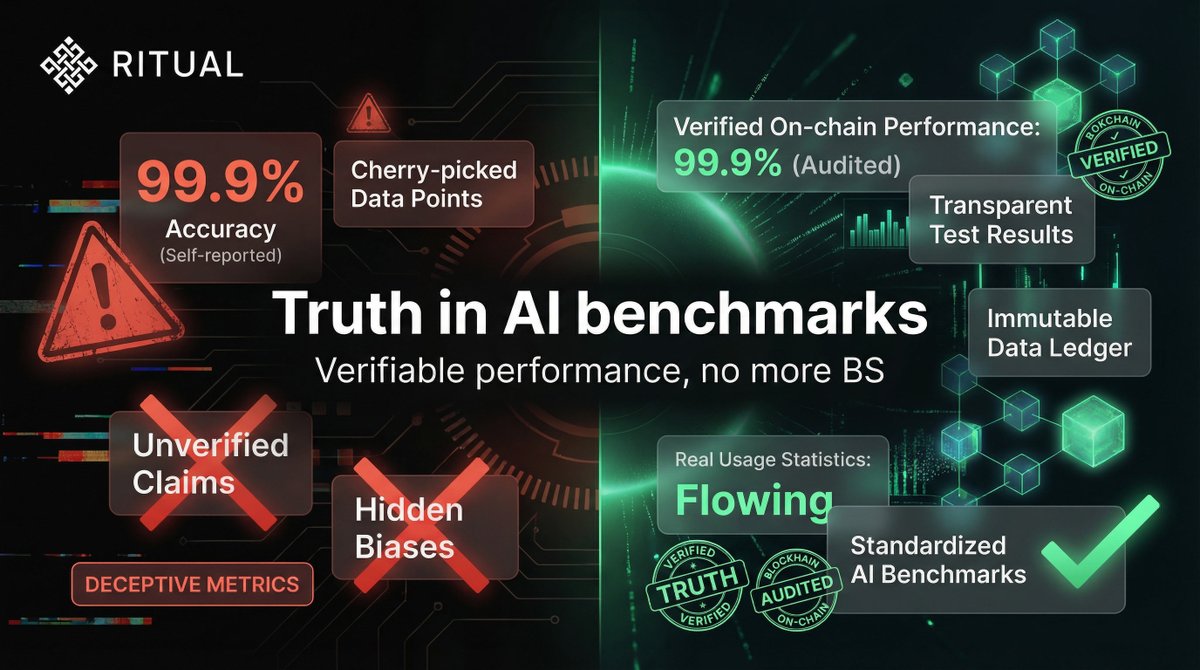
📊 Truth in AI benchmarks (finally)
Part 5: @ritualnet makes performance claims verifiable 🧵
🚨 Dirty secret of AI industry:
Benchmarks are often... misleading 😬
Common tricks:
→ Cherry-pick best test results 🍒
→ Optimize specifically for benchmark 🎯
→ Use different test data than claimed 📊
→ Report outdated numbers ⏰
→ "Forget" to mention edge cases 🤫
You can't verify any of it ❌
🔍 Real example:
Two models claim "95% accuracy":
→ Model A: tested on 10,000 diverse examples ✅
→ Model B: tested on 100 cherry-picked examples ❌
Both advertise "95% accuracy" but Model A is way better 📈
How would you know? You wouldn't 🤷
⚡ Ritual's solution:
Performance metrics stored on-chain, verifiable by anyone 🔗
How it works:
1️⃣ Model performance tested on standard datasets
2️⃣ Results recorded on-chain with proof
3️⃣ Test conditions documented (dataset, parameters, etc.)
4️⃣ Anyone can verify or re-run tests
5️⃣ Real usage stats tracked automatically
💡 What gets verified:
✓ Accuracy metrics 🎯
✓ Speed/latency ⚡
✓ Resource usage (compute, memory) 💻
✓ Test dataset details 📊
✓ Edge case performance 🔍
✓ Real-world usage stats 📈
🎮 Practical example:
Game looking for NPC dialogue model:
Traditional marketplace:
→ "99% coherent responses!" (says vendor)
→ Try it → actually terrible 😤
→ Wasted time and money 💸
Ritual marketplace:
→ Check on-chain metrics 📊
→ See: 10,000 verified tests, 87% actual coherence
→ Review real usage from other apps
→ Make informed decision ✅
📈 Types of verifiable metrics:
Performance:
▸ Accuracy/precision/recall 🎯
▸ Response time ⚡
▸ Resource consumption 💻
Usage:
▸ Number of inferences run 📊
▸ User satisfaction (if apps report it) ⭐
▸ Error rates in production 🚨
Comparison:
▸ Side-by-side with other models 📊
▸ Standardized test results 📋
▸ Real-world performance vs. claims 🔍
🚀 Why this matters:
No more:
❌ Fake benchmarks
❌ Misleading marketing
❌ Wasted time testing bad models
Instead:
✅ Truth in advertising
✅ Data-driven decisions
✅ Fair competition
Transparency kills BS 🎯
Tomorrow: Monetization opportunities for AI devs 💰
@ritualfnd @joshsimenhoff @Jez_Cryptoz
#Ritual #SmartBlockchain #Testnet #TestnetGuide #StepByStep
17
84
Jan 29
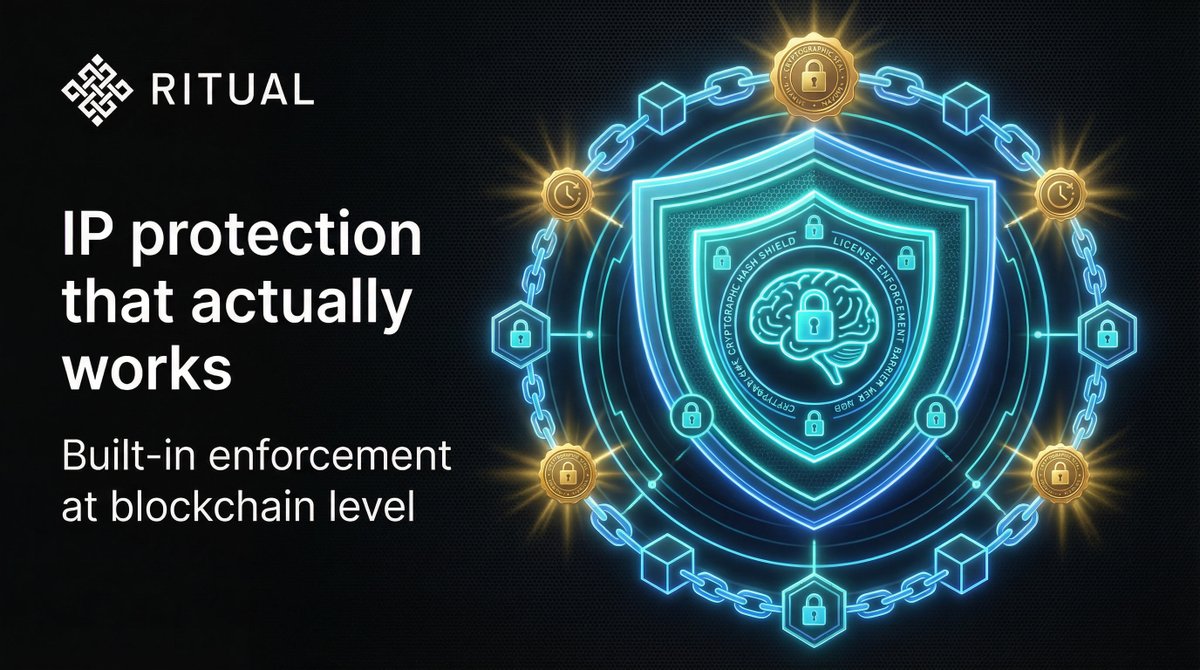
🛡️ How @ritualnet protects AI model IP
Part 4: IP protection that actually works 🧵
🚨 Current problem:
You spend 6 months training an AI model:
→ Cost: $50k in compute 💸
→ Unique dataset 📊
→ Custom architecture 🧠
You release it... someone copies it in 5 minutes 😤
No legal recourse. No proof. No protection ❌
🔐 Ritual's solution:
Built-in IP protection at the blockchain level ✅
Here's how it works:
1️⃣ Cryptographic Registration
→ Model hashed and stored on-chain
→ Timestamp proves creation date
→ Original creator address linked
→ Can't be backdated or faked
2️⃣ Verifiable Provenance Chain
→ Training data sources recorded
→ Each model version tracked
→ Derivation history transparent
→ Can prove original vs. copy
3️⃣ License Enforcement
→ Usage terms coded into smart contract
→ Automatically enforced
→ Can't use without compliance
→ Violations detectable on-chain
4️⃣ Attribution Tracking
→ Every use attributes creator
→ Derivative works link to original
→ Credit preserved forever
→ Reputation builds over time
💡 Real scenario:
You create image generation model:
→ Register on Ritual with license: "Commercial use requires payment"
→ Developer tries to use it in app
→ Smart contract checks license
→ Forces payment or blocks usage
→ You get paid automatically ✅
Can't be bypassed. Can't be ignored. On-chain enforcement 🔗
🎯 Compare to current systems:
Current:
→ Release model → hope people follow license → maybe sue if violated ⚖️
→ Expensive, slow, often impossible 😤
Ritual:
→ Release model → license enforced automatically → get paid instantly 💰
→ Code is law, no lawyers needed ✅
📊 Types of protection:
▸ Copyright proof (timestamped creation) 📝
▸ License enforcement (automatic compliance) ⚖️
▸ Usage tracking (who used, when, how) 📈
▸ Derivative tracking (forks and improvements) 🌿
▸ Revenue protection (guaranteed payment) 💰
🚀 Why this unlocks value:
Before: Creators hesitant to share best models (fear of theft)
After: Creators incentivized to share (protected monetized)
Result: Better models available, more innovation, fair compensation 🎯
Tomorrow: Verifiable performance claims 📊
@ritualfnd @joshsimenhoff @Jez_Cryptoz
#Ritual #SmartBlockchain #Testnet #TestnetGuide #StepByStep
5
19
89
Jan 28
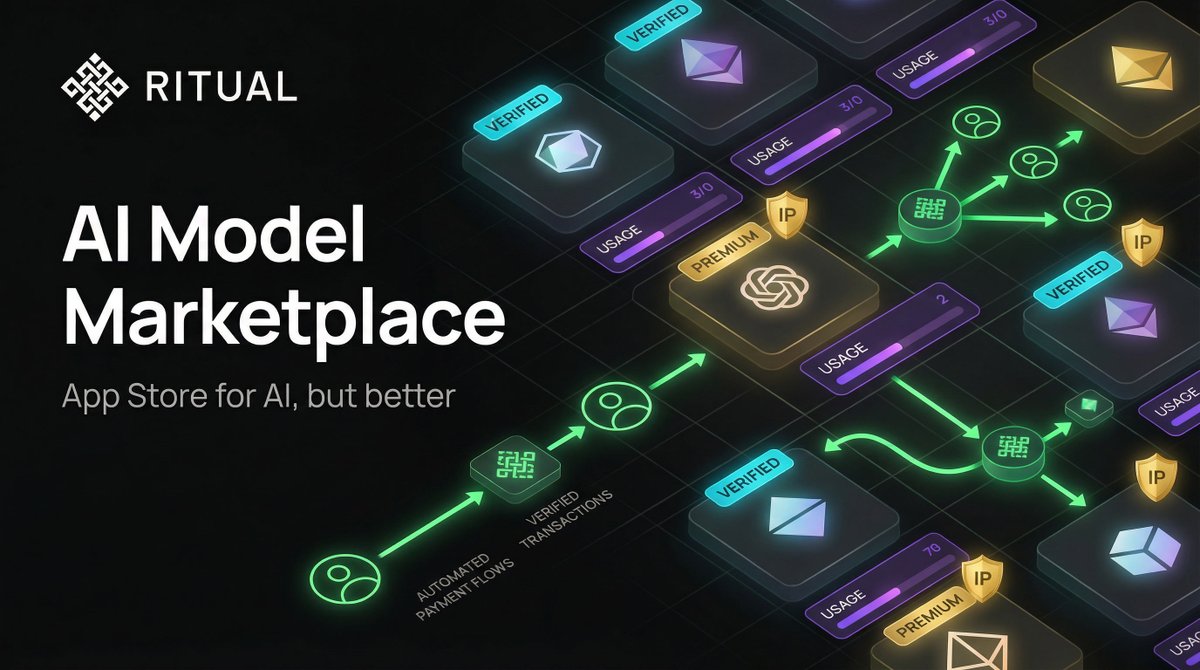
💰 How @ritualnet creates an AI Model Marketplace
Part 3 of AI Models on-chain series 🧵
🎯 The Vision: App Store for AI Models
But better. Because blockchain ⚡
What makes it different from existing marketplaces?
Traditional AI marketplaces (HuggingFace, etc.):
→ Download models for free or flat fee 💵
→ Trust provider's claims 🤞
→ No usage tracking 📊
→ No automatic payments 💸
→ IP easily copied ⚠️
Ritual Model Marketplace:
→ Pay per use, automatically 💰
→ Everything verifiable on-chain ✅
→ Usage tracked transparently 📈
→ Creators paid instantly ⚡
→ IP cryptographically protected 🔐
💡 How it works:
1️⃣ Model creator uploads model to Ritual
2️⃣ Sets pricing: per inference, subscription, or free
3️⃣ Model enshrined on-chain with metadata
4️⃣ Developers integrate model into their apps
5️⃣ Every use triggers automatic payment
6️⃣ Creator earns, user pays, all transparent
🎮 Real example - Gaming:
Game needs NPC dialogue AI:
→ Finds model on Ritual marketplace 🔍
→ Pays $0.001 per dialogue generation 💵
→ Model runs on-chain ⚡
→ Creator gets paid automatically 💰
→ Game verifies model authenticity ✅
All trustless. All transparent. All on-chain 🔗
📊 Revenue models creators can choose:
▸ Pay-per-inference (micro-payments) 🪙
▸ Subscription (monthly access) 📅
▸ Freemium (basic free, advanced paid) 🎯
▸ Revenue share (% of app earnings) 📈
▸ One-time license 💎
🚀 Why this matters:
Current AI economy = mostly free, open source
→ Hard for individual creators to monetize
→ Big tech dominates
→ No fair compensation
Ritual marketplace = fair monetization
→ Creators get paid for usage
→ Automatic, transparent payments
→ Protection from IP theft
→ Incentive to build better models
🎯 Think bigger:
This isn't just about selling models.
It's about creating an economy where AI creators can actually make a living 💼
Tomorrow: IP protection mechanisms 🛡️
@ritualfnd @joshsimenhoff @Jez_Cryptoz
#Ritual #SmartBlockchain #Testnet #TestnetGuide #StepByStep
4
16
84
Jan 27
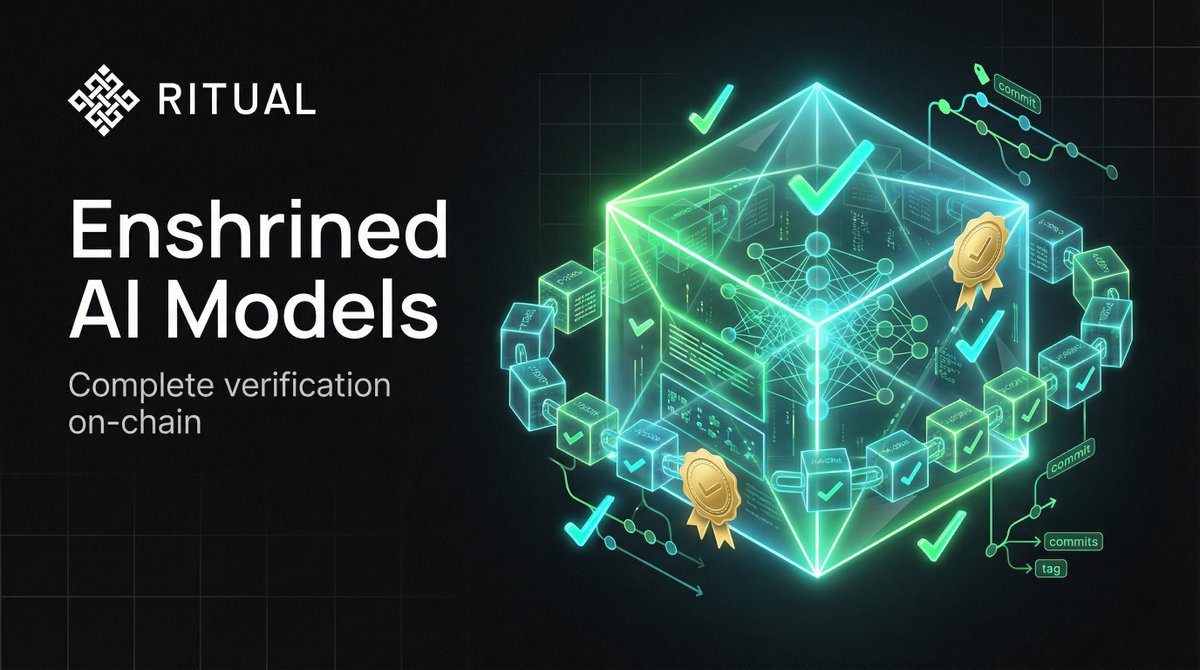
How @ritualnet solves the AI trust problem 🧵
Yesterday: the problem with AI models (no verification, no proof)
Today: the solution ⚡
🔗 Concept: "Enshrined AI Models"
What does this mean in simple terms?
AI models live ON the blockchain itself, with complete history and proof 📜
Think of it like Git for AI models:
→ Every version tracked ✅
→ Every change recorded ✅
→ Original creator verified ✅
→ Training data provenance documented ✅
🎯 What this enables:
📝 Immutable Model Registry
→ Each model gets unique on-chain ID
→ Can't be deleted or modified
→ Permanent record of creation
🔍 Verifiable Provenance
→ See exactly where model came from
→ Track training data sources
→ Verify compliance with licenses
→ Prove authenticity
💎 IP Protection
→ Cryptographic proof of ownership
→ Timestamped creation records
→ License terms enforced on-chain
→ Monetization built-in
⚡ Real-time Updates
→ Model improvements tracked on-chain
→ Version history transparent
→ Performance metrics verifiable
→ Can't fake benchmarks
🏗️ How it actually works:
1️⃣ Developer creates AI model
2️⃣ Model registered on Ritual Chain
3️⃣ Hash stored on-chain (proof of exact version)
4️⃣ Metadata recorded (creator, training data, performance)
5️⃣ Anyone can verify authenticity by checking chain
💡 Simple analogy:
Current AI models = word-of-mouth recipes
→ Could be changed
→ Could be fake
→ No proof of original
Ritual AI models = blockchain recipes
→ Permanently recorded
→ Original preserved
→ Verifiable by anyone
Tomorrow: Model Marketplace (how creators monetize) 💰
@ritualfnd @joshsimenhoff @Jez_Cryptoz
#Ritual #SmartBlockchain #Testnet #TestnetGuide #StepByStep
5
18
107
Jan 26
🤔 The problem with AI models today (that nobody talks about)
Quick thread on why AI models need blockchain 🧵
Right now, when you use AI:
→ You have NO idea where the model came from 🤷
→ You can't verify it wasn't tampered with 🚨
→ You can't prove who created it 📝
→ You can't track how it was trained 🔍
Real examples of problems this causes:
❌ Company uses "GPT-4" → actually gets cheaper, worse model
❌ AI tool claims "trained on licensed data" → no way to verify
❌ Model creator makes improvements → can't prove it's their work
❌ Someone steals your model → no proof of ownership
💡 It's like downloading software from random websites
You just... trust it? 😬
In traditional software:
✓ Code signatures ✅
✓ Version control ✅
✓ License verification ✅
✓ Open source transparency ✅
In AI models:
❌ None of this exists
❌ You just trust the provider
❌ No transparency
❌ No accountability
🎯 Why this matters more than you think:
As AI becomes critical infrastructure, we need:
- Proof of model authenticity 🔐
- Transparent training provenance 📊
- Verifiable performance claims 🎯
- Protected intellectual property 💎
@ritualnet is building the solution to this 🚀
Tomorrow: How blockchain fixes this 👀
@ritualfnd @joshsimenhoff @Jez_Cryptoz
#Ritual #SmartBlockchain #Testnet #TestnetGuide #StepByStep
5
17
85
Jan 25
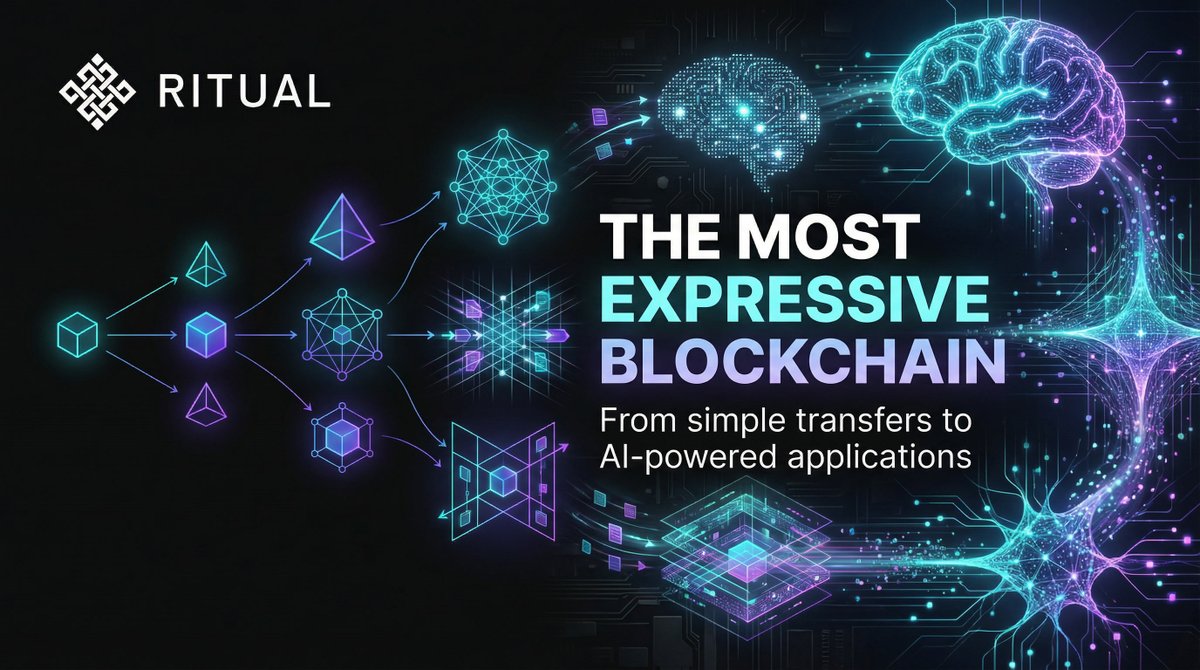
🎯 @ritualnet calls itself "the most expressive blockchain"
What does "expressive" even mean? 🤔
Simple way to think about it:
Low expressiveness = can only say "yes" or "no" ✅❌
High expressiveness = can write poetry 📝
In blockchain terms:
Bitcoin: can transfer value 💰
Ethereum: can run programmable contracts 📋
Ritual: can run AI, ZK, complex compute NATIVELY 🧠
The more "expressive" = the more types of applications you can build 🚀
Examples of what "more expressive" enables:
- Games with intelligent NPCs 🎮
- DeFi with context-aware lending 💳
- Security that learns patterns 🛡️
- Creative tools that generate on-chain 🎨
Not just doing existing things better.
Doing NEW things that weren't possible before ✨
That's what they mean by "most expressive" 🎯
@ritualfnd @joshsimenhoff @Jez_Cryptoz
#Ritual #SmartBlockchain #Testnet #TestnetGuide #StepByStep
3
16
90
Jan 24
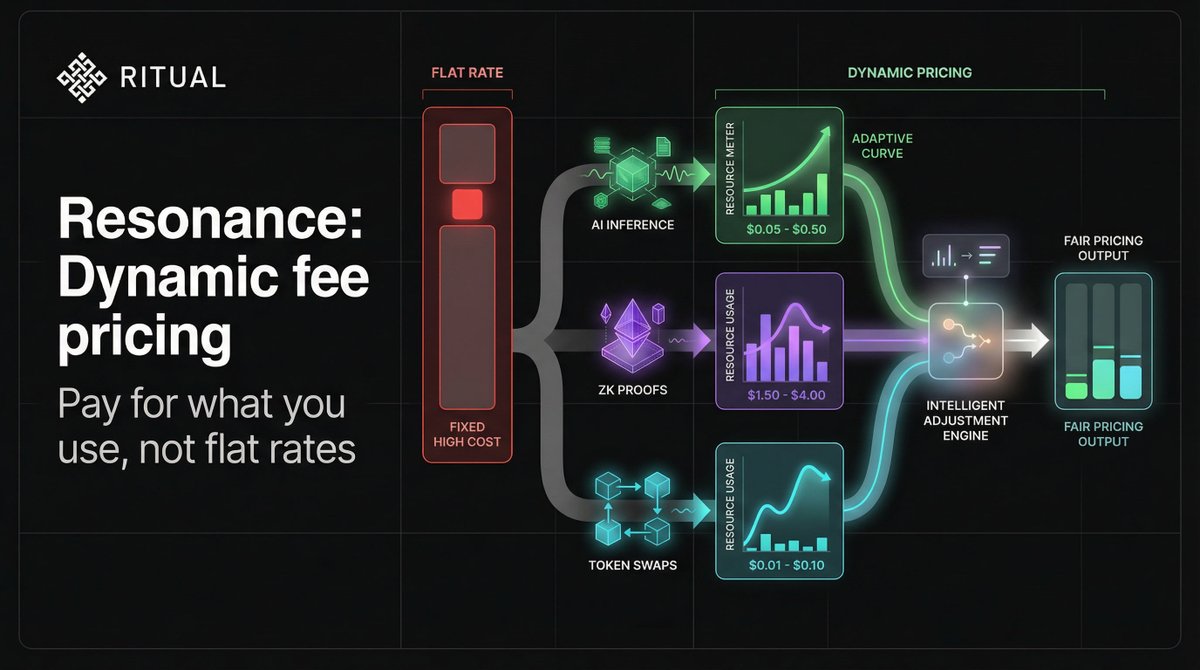
📊 Ritual's fee mechanism is called "Resonance"
Without getting too technical, here's why it's different:
Most blockchains: fixed gas price or simple auction ⛽
@ritualnet Resonance: dynamic pricing based on what TYPE of computation you're doing 🎯
Why it matters:
- AI inference costs different than regular transaction
- ZK proof generation costs different than token swap
- Each gets priced according to actual resource usage
Real-world example:
🍕 Pizza delivery pricing
→ Size of pizza (computational complexity)
→ Distance (network load)
→ Time of day (demand)
→ Toppings (specific resources needed)
You pay for what you actually use, not flat rate ✅
Makes it fair for both simple transactions and complex AI operations 🤝
@ritualfnd @joshsimenhoff @Jez_Cryptoz
#Ritual #SmartBlockchain #Testnet #TestnetGuide #StepByStep
3
13
75
Jan 23
Interesting design choice by @ritualnet 🧵
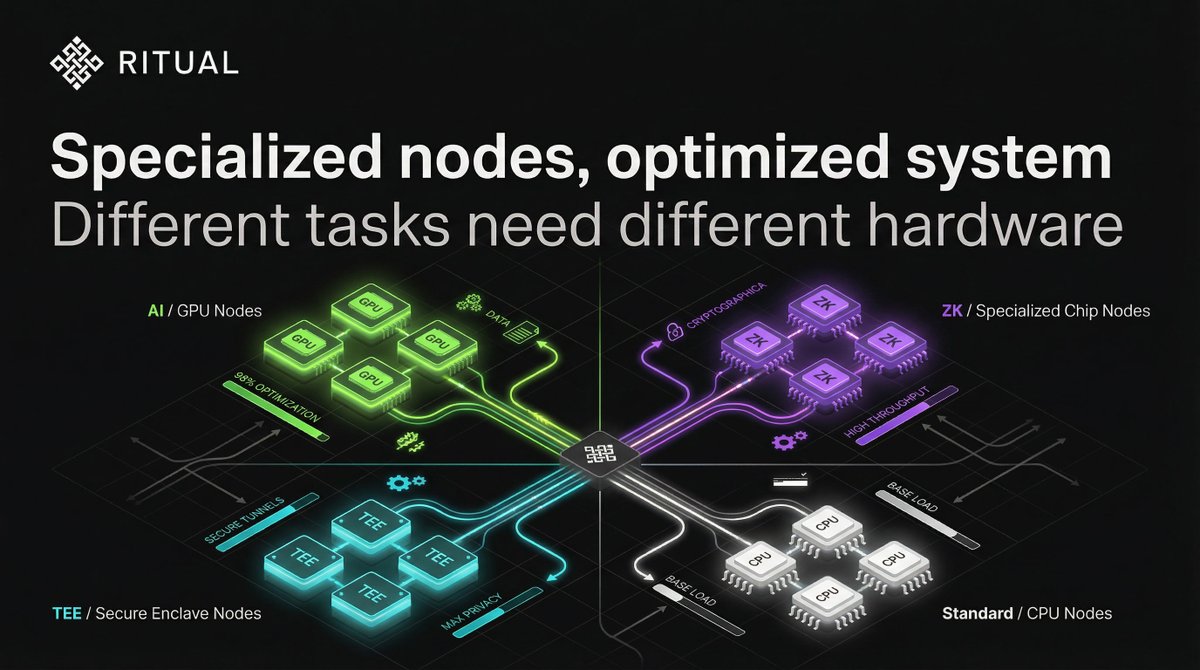
Most blockchains: all nodes do the same thing (one-size-fits-all) 🔄
Ritual: nodes can specialize in different tasks 🎯
Why?
Because running AI models needs different hardware than running ZK proofs 🖥️
Node types:
- AI inference nodes (need GPUs) 🤖
- ZK proof nodes (need specialized chips) 🔐
- TEE nodes (need secure enclaves) 🛡️
- Standard execution nodes (regular CPUs) ⚡
Think of it like a restaurant:
❌ Everyone cooks, serves, cleans
✅ Chefs cook, servers serve, cleaners clean
More efficient when each part does what it's best at 💡
Makes the whole system faster and cheaper to run 📊
@ritualfnd @joshsimenhoff @Jez_Cryptoz
#Ritual #SmartBlockchain #Testnet #TestnetGuide #StepByStep
9
2
33
351
Jan 22
⚡ Quick comparison: Traditional oracles vs Ritual
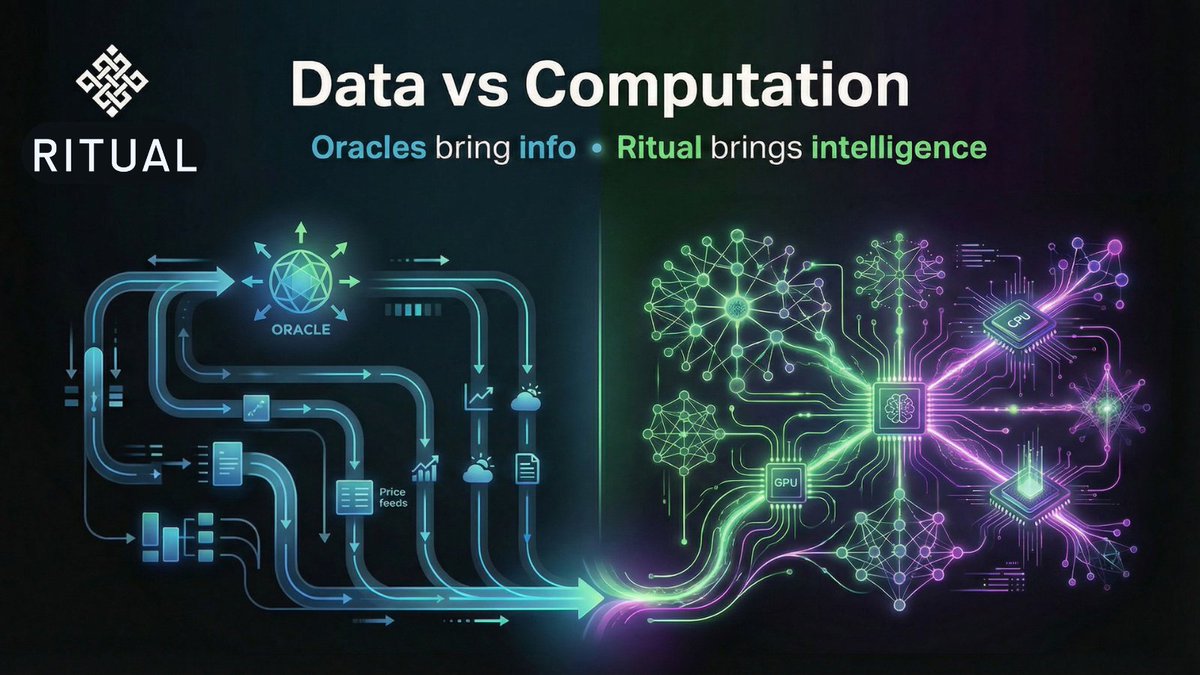
Traditional oracles (like Chainlink):
→ Bring external DATA to blockchain 📊
→ "What's the price of ETH?"
→ "Who won the game?"
@ritualnet:
→ Brings external COMPUTATION to blockchain 🧠
→ "Analyze this data with AI"
→ "Generate a ZK proof"
→ "Run this complex model"
Different problems, different solutions 🎯
Traditional oracles = information highways 🛣️
Ritual = computational powerhouse 💪
Both needed. Not competitors, complementary 🤝
The future probably uses both together ✨
@ritualfnd @joshsimenhoff @Jez_Cryptoz
#Ritual #SmartBlockchain #Testnet #TestnetGuide #StepByStep
2
15
95
Jan 21
Random observation 💭
Arthur Hayes (BitMEX co-founder) is on @ritualnet's advisory board
For context, Arthur has been very vocal about:
- AI being the next major tech wave 🌊
- Crypto needing to evolve beyond just "faster transactions"
- Infrastructure plays over application plays 🏗️
Makes sense why he'd be involved with a project that's literally building blockchain infrastructure for AI 🤖
Not saying this guarantees anything, but when someone who understands both markets (crypto AI) is involved, worth paying attention 👀
@ritualfnd @joshsimenhoff @Jez_Cryptoz
#Ritual #SmartBlockchain #Testnet #TestnetGuide #StepByStep
4
16
108
Jan 20
Quick note on @ritualnet's Infernet 🧵
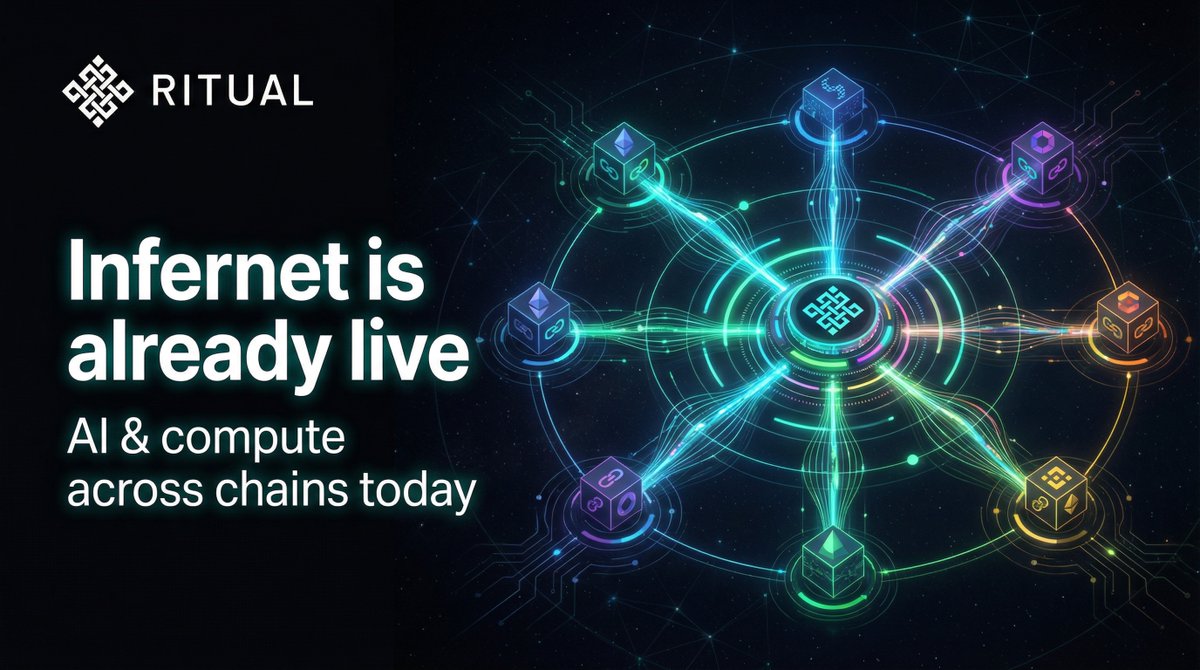
While everyone waits for Ritual Chain, Infernet is ALREADY live and working across multiple chains 🔗
What is it?
→ Compute oracle network
→ Brings AI, ZK, and other complex compute to existing blockchains
→ Being used on Ethereum, Base, Arbitrum, and more
Why it matters:
You don't have to wait for Ritual Chain to use Ritual's tech. Developers can integrate Infernet into their apps TODAY 🚀
It's like the testing ground for what will eventually be native to Ritual Chain ⚡
Interesting approach: build the infrastructure layer first, then launch the chain that makes it native 🎯
@ritualfnd @joshsimenhoff @Jez_Cryptoz
#Ritual #SmartBlockchain #Testnet #TestnetGuide #StepByStep
3
15
90