
. If you’re a dev tired of glue-boarding AI logic to smart contracts-stop.
The Warden Agent Kit is the toolkit we wish existed years ago. Install it, build your agent, plug it into on-chain orders, hit publish. No custom infra. No midnight debugging over key-signatures. It’s all laid out.
What stuck with me most? The shift from “we need to integrate AI with blockchain” to “our AI is the blockchain actor”.
You’re not just compiling models-you’re deploying them as autonomous agents with wallets, rights, and outcomes. Suddenly your code isn’t waiting for UX-it’s taking action. @wardenprotocol
#AgentEconomy #SmartContractAI #WardenProtocol

14
4,755

28 Sep 2025
Sunday reads: How DevForgeAI's AI spots 95% of common exploits before deploy. From gaming loops to meme utilities—secure, scalable, simple. Solana integration? Yes please!👇#SundayDev #SmartContractAI What exploits are you just fed up with?
1
4
5
23

1 Aug 2025
.
You don’t need smarter AI. You need accountable agents.
Most DeFi automation today is like flying blind bots move your capital, but you never see why
@NetworkNoya is fixing that. With ZKML onchain proofs, agents don’t just act. They prove their logic before they touch your funds.
→ docs.noya.ai/noya-protocol/o…
In Noya, every decision made by an AI agent is backed by a zero-knowledge proof showing it:
✔ Matches your intent
✔ Meets protocol constraints
✔ Responds to real onchain data
This isn't "yield farming with AI."
It's autonomous capital allocation with cryptographic guarantees
→ docs.noya.ai/noyas-infrastru…
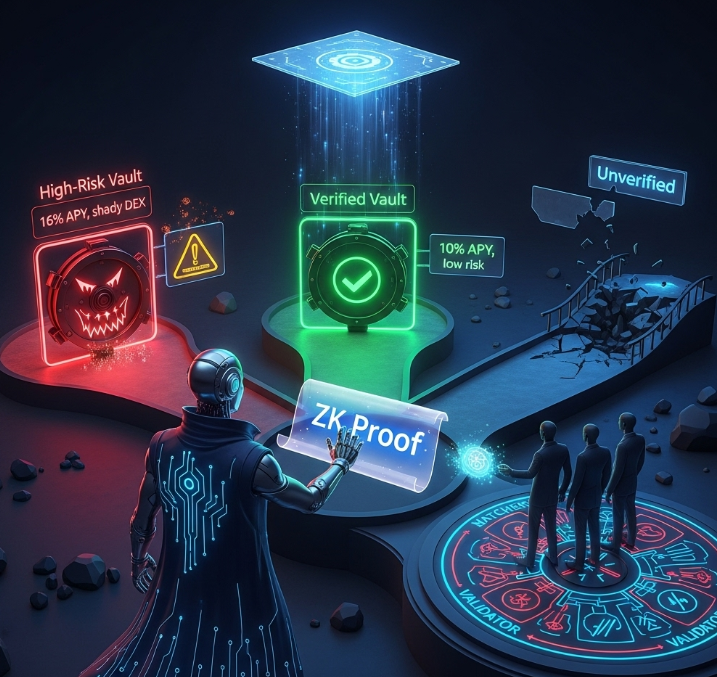
Let’s take a real example:
You tell Noya
→ Maximize yield on my stablecoins, low risk only
An AI agent evaluates options:
12% APY vault on Optimism
9.5% APY vault on Arbitrum with lower slippage
16% vault on a shady new DEX with unverified contracts
The agent must submit a ZKML proof showing that:
→ It selected the vault matching your “low-risk” constraint
→ The logic excluded the risky 16% vault
→ All data was sourced from verified onchain oracles
Before funds move, this proof is verified onchain.
If the agent cheats (e.g. routes 50% to the risky vault), Watchers can detect and slash it
→ docs.noya.ai/noyas-infrastru…
This is what separates Noya:
Most bots act first, explain later (if ever).
Noya agents must prove they’re right or get rejected by the protocol
That’s not just smarter AI
That’s safe autonomy
This is all possible because of Noya’s modular infra:
Omnichain intent engine → you state what, not how
Protocols like NOLA, LYFA, TULP handle strategy-specific logic
Fraud detection layer ensures no single actor can exploit you
→ docs.noya.ai/noya-protocol/o…
→ docs.noya.ai/noyas-infrastru…
And yes it’s not vaporware.
Noya’s beta is live
Agents already manage vaults across multiple chains.
Yield is maximized, fees minimized, risks contained and every action leaves a verifiable trail
→ noya.ai
→ docs.noya.ai
Still trusting bots you can’t verify?
In a world where AI touches your capital, proof beats prediction
The alpha isn’t just in higher APY it’s in knowing it’s real.
@NetworkNoya is where autonomy meets accountability
#NoyaNetwork #ZKProof #OnchainAI #SmartContractAI
2
6
102

Gm @cookiedotfun Fam🌞
While everyone's debating which narrative will pump next
@cookiedotfun quietly assembled the infrastructure stack institutions need
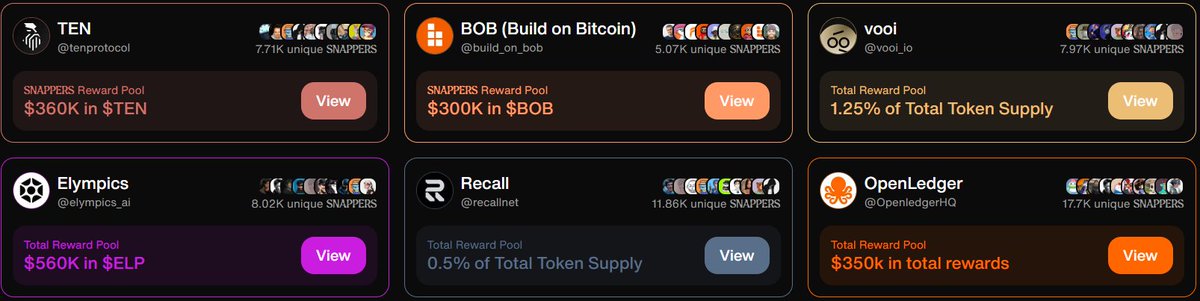
7 specialized rails building the foundations retail doesn't understand:
1.🔒 @tenprotocol
encrypted ethereum l2 with hardware-grade privacy—not marketing privacy
• Trusted execution environments securing every transaction at chip level
• mev-free rollup processing without centralized sequencers
• 22.5m $TEN testnet rewards for infrastructure contributors
They're not selling privacy narratives; they're building compliance-grade confidentiality.
#Web3Gaming #TenProtocol #GameFi
2.⚡ @vooi_io
cross-chain perp aggregation that works
• unified interface across evm non-evm perpetual exchanges
• AI Copilot optimizing entries without touching your capital
• dual farming: orderly merits native vooi airdrop qualification
One trade, two reward streams—that's infrastructure efficiency.
#DePIN #IoTBlockchain #Vooi #SensorNetwork #RealWorldAssets #RWA #WirelessRevolution #DecentralizedHardware
3.📊 @recallnet
on-chain data indexing before AI compliance hits
• surge points converting fragments into protocol ownership
• 100 live subgraphs generating real query volume
• 10% lifetime referral bonuses compounding forever
Retail queries for free, smart money owns the data layer
#DePIN #DecentralizedAI #RecallNetwork #MemoryLayer #AIInfrastructure #EdgeComputing #NeuralNetworks #FutureOfAI
4.🎯 @elympics_ai
skill-based gaming yielding real tournament revenue
• proof-of-game consensus eliminating cheating without trust assumptions
• node operators earning fixed $ELP plus per-match hosting fees
• Staking vaults unlocking protocol buybacks from actual esports volume
They're not gamifying Defi. They're financializing competitive gaming
#AICompetitions #ElympicsAI #MachineLearning #ModelTraining #DecentralizedML #AIChallenge #OnChainAI #SmartContractAI
5.🤖 @JoinSapien
tokenizing attention with AI training rewards
• complete training tasks to accumulate ownership points
• stake for 1.05x-1.5x multipliers over 1-12 month lockups
• 5% referral kickbacks on every conversion
Your data becomes equity, not free labor for big tech
#SocialFi #Web3Social #SAPIEN #DecentralizedSocial #CommunityFirst #OnChainIdentity #FutureOfSocialMedia
6.🏦 @OpenledgerHQ
AI attribution infrastructure pays on every inference
• 51% token supply allocated to data contributors via testnet
• proof-of-attribution tracking data→model→inference value flow
• $25m Opencircle launchpad funding ai-web3 startups
Attribution credits > speculation tokens, compliance is coming whether you're ready or not
#AIAgentEconomy #ProofOfAttribution #OpenLedger #AIxWeb3 #DataOwnership #AttributionCredits #CompliantAI #InferenceEconomy
7.🌉 @build_on_bob
Bitcoin’s appchain, unchained: full-stack L2 with native BTC settlement
• First Bitcoin L2 with direct BTC smart contracts via BOB VM
• Seamless EVM Web3 tooling integration — build like Ethereum, settle like Bitcoin
• Trust-minimized bridge with instant finality & sub-5min withdrawals
No wrapped assets. No compromises. Just real BTC powering real dApps.
The OG chain just got an upgrade — welcome to the Bitcoin Renaissance. ⚡️
#BuildOnBOB #BitcoinBeyondHODL
CT chases narratives after they pump
Smart money farms infrastructure before institutions discover the rails
@cookiedotfun = the portfolio positioning for post-narrative crypto
own the infrastructure. skip the noise.
#Infrastructure #RealYield #SmartMoney #BuildingTheFuture

4
5
81

🤖 JumboChain's AI co-pilot isn't just another coding assistant – it's the FUTURE of smart contract development!
Our neural network analyzes millions of on-chain interactions to:
🔒 Auto-patch vulnerabilities → No more exploits!
⛽ Dynamically adjust gas fees → Always optimal pricing!
🚦 Predict & prevent congestion → Say goodbye to network clogs!
✨ This isn't just tooling – it's EVOLUTION. ✨
#SmartContractAI #JumboChain #Web3Dev #BlockchainInnovation #AIFuture 🚀
20
20
28
539

25 Jun 2025
요즘은 AI가 스마트컨트랙트도 만든대요
심지어 배포까지 한답니다
“토큰 만들어줘”
“세금은 DAO로 보내줘”
이런 말 한마디로 컨트랙트가 완성되는 시대
---
근데 저는 그럴수록
이런 생각이 들어요
“그래서, 이 코드 누가 만든 거지?”
“이 구조는 어디서 참고한 거지?”
“실제로 배포해도 안전할까?”
---
@OpenLedgerHQ × @usemorpheus_com
Morpheus는
AI가 혼자서 스마트컨트랙트를 만들고 배포하는
에이전트형 개발 시스템이에요
그리고 그 바닥에는
OpenLedger가 깔려 있어요
---
누가 데이터를 제공했는지
어떤 코드가 참고되었는지
어떤 피드백이 모델을 바꿨는지
기여도는 남고, 보상은 돌아가고
결과는 추적 가능하도록
---
이제 스마트컨트랙트를 짜는 건
사람만이 하는 일이 아니에요
하지만, 책임과 투명성은 더 중요해졌어요
그래서 OpenLedger는
그 참여의 흔적을
꼼꼼하게 남기고 있어요
-----
이건
그냥 자동화가 아니라
공동 창작의 시대를 여는 기반이에요
#ProofOfAttribution #SmartContractAI

24 Jun 2025

OpenLedger X Morpheus
The partnership of openledger with Morpheus enables @usemorpheus_com to build "The Autonomous Smart Contract Engineer" on top of OpenLedger.
What is Morpheus?
Morpheus is a Web3-native AI coding agent that turns natural language into executable smart contracts and full-stack dApps. It is powered by a specialized Solidity model built on top of OpenLedger, tailored for the unique demands of secure and efficient onchain development.
It goes beyond code generation. Using fine-tuned models, agent-based architecture, and modular plugin support, Morpheus automates the entire development pipeline-from writing and simulating contracts to deploying and maintaining them.
Its mission is to reduce the barrier to dApp creation while enabling autonomous agents and individuals to participate in decentralized economies.
Why OpenLedger?
The rise of AI agents in Web3 raises urgent questions around transparency, attribution, explainability, and contributor incentives.
OpenLedger provides the infrastructure to ensure that contributor data used in model outputs is recorded with verifiable attribution. Through Proof of Attribution, contributors-whether they provide prompts, datasets, or logic refinements-can receive credit and rewards when their work influences model behavior.
But attribution alone isn’t enough.
In critical domains like smart contract deployment, DeFi automation, and DAO governance, understanding why a model made a decision is just as important as the output itself. OpenLedger supports explainability by linking outputs back to their original data sources-allowing developers and auditors to trace logic, validate decisions, and build trust in AI-powered systems.
OpenLedger supports Morpheus by:
Recording which data was used in generating model outputs
Enabling verifiable attribution of contributed datasets
Powering reward mechanisms for contributors
Offering scalable and efficient model execution via OpenLoRA
Supporting transparency and traceability in model decision-making
This creates an open, rewardable foundation for AI-driven coding-without relying on opaque systems.
How is the system built?
The Morpheus architecture has three layers:
Datanet Layer
OpenLedger powers Morpheus with a specialized Datanet - a decentralized data layer where developers, auditors, and contributors can share smart contract patterns, audit logs, exploit reports, and logic modules. Each submission is recorded onchain with attribution using OpenLedger’s Proof of Attribution. As the model learns and evolves from this data, contributors receive rewards proportional to their impact on future outputs.
The Morpheus architecture has two layers:
Intent Layer
Users describe what they want to build. Example: "Create a token with tax logic that routes to a DAO." Morpheus parses the instruction, retrieves relevant contract types, and plans a modular execution flow.
Agent Layer
The agent generates, tests, and assembles the contract. It handles versioning, logic validation, and deployment readiness. Security checks-reentrancy protection, overflow control, gas modeling-are embedded into the generation phase. Generated outputs are mapped to their source data using OpenLedger’s Proof of Attribution, providing traceability across the pipeline.
How does the AI model work?
Morpheus is being powered by a specialized Solidity model built on top of OpenLedger. This model is purpose-built to handle the nuances of smart contract logic, security, and upgradeability. Unlike generalized coding agents, it is designed specifically for EVM environments and Web3 use cases, drawing from real protocol data and security best practices.
Morpheus is fine-tuned on a vertical stack of smart contract data:
Audited protocol code (e.g., Uniswap V4, Compound)
OpenZeppelin libraries and EIP reference implementations
Smart contract vulnerability reports and exploit reconstructions
Edge cases from fuzz testing and adversarial examples
It uses models like CodeLlama and DeepSeek-Coder, enhanced through RAG pipelines referencing standardized security patterns and emerging protocol designs.
This training stack is integrated into a continuous feedback loop, enabling real-time specialization for EVM and beyond.
Why a specialized model is needed?
Smart contract development is uniquely high-stakes. A generalized AI model is not enough.
As 'vibe coding' and natural language programming become more common, we're seeing an influx of AI-generated code in Web3 as well. But smart contracts are not frontends or prototypes-they govern real value, enforce trustless execution, and often become immutable after deployment.
Billions have been lost in Web3 due to bugs and inefficiencies:
In 2022 alone, over $3.8 billion was stolen due to smart contract exploits, many of which stemmed from avoidable issues like reentrancy, integer overflows, or access control failures.
Inefficient contract structures lead to unnecessary gas consumption. Optimizing for gas can reduce costs by up to 40%, saving projects millions over time.
Upgradeable contract patterns, like UUPS or Transparent Proxies, require strict adherence to storage layout and initialization rules. Mistakes here often go undetected by generic models and can render a contract unupgradeable or vulnerable.
A specialized Solidity model is trained on real-world exploits, EIP standards, and libraries like OpenZeppelin to:
Generate secure, gas-efficient code by default
Recognize and correctly implement complex proxy patterns
Map user intent to modular, auditable contract architectures
Incorporate battle-tested logic from audited protocols and fuzz-tested edge cases
Morpheus goes beyond syntax-it understands the nuances of decentralized infrastructure and deploys code that meets production-grade standards.
What applications will this enable
Token creation with built-in logic (tax, liquidity, governance)
DeFi automations triggered by market conditions
Payment contracts between agents and contributors
DAO tooling with dynamic NFT-based voting
Cross-chain bridging logic tied to real-world oracles
Asset issuance flows through chat-based interfaces
Natural language contract templates with reusable logic
Each of these flows is backed by OpenLedger’s Proof of Attribution-ensuring traceability, explainability, and fair rewards across the ecosystem.
This is the future of AI-native development.
Open. Attributed. Explainable. Community-powered.
Morpheus and OpenLedger are building the first system for autonomous coding agents where:
Contributor work is recorded onchain
Reuse is incentivized through attribution
Model outputs are traceable and explainable
Contracts evolve through human-agent collaboration
Anyone can contribute prompts, logic, or flows-and get rewarded
The smart contract engineer is no longer a human-only role. It is an agentic, decentralized, and transparent process-powered by OpenLedger.
5
9
126

18 Jun 2025
🧩 Composable agents
🔁 Fully autonomous
🌐 Blockchain-native
@AGENTXYZ_ai is redefining what it means to be “smart” in smart contracts.
#Web3 #AutonomousIntelligence #SmartContractAI
3
6
1,067

AI should be free—free from control, free from limits.
@CryptoEternalAI
#DecentralizedAI #CryptoAI #Web3AI #AIonBlockchain #BlockchainRevolution #PermissionlessAI #CensorshipResistant #OnchainFuture #AIRevolution #SmartContractAI #OpenSourceAI #Web3Tech #AIInnovation
22 Mar 2025

AI is being built and adopted at an unprecedented scale.
The trending models on Hugging Face reflect this growth—open-source AIs developed by startups, tech leaders, and global communities.
But while the code is open, access isn’t. Most models still rely on centralized platforms, leaving them exposed to control and restrictions.
To ensure AI remains truly open and decentralized, @CryptoEternalAI is preserving AIs onchain—making them censorship-resistant and permissionlessly accessible to everyone. So far, 8 models have been deployed as smart contracts across 19 blockchain networks, with more on the way.
The future of AI is decentralized.
5
2
5
47

30 Dec 2023
🚨Discover the #crypto trends of 2024 with this list of 30 essential #hashtags, generated by #GPT4👀 Get ready to explore the future of crypto👇
1.#CoreTime
2.#ETH3
3.#DeFi
4.#iNFT
5.#QuantumProof
6.#CrossChain
7.#SmartContractAI
8.#GreenMining
9.#Security
10.#Interoperability
11.#CBDC
12.#Stablecoin
13.#TokenStandards
14.#ZeroKnowledge
15.#GovernanceOnChain
16.#Blobs
17.#DID
18.#Layer2
19.#CryptoProtocols
20.#Oracles
21.#Layer3
22.#SmartLedger
23.#DeFiSecurity
24.#SecureTransactions
25.#AIOnChain
26.#CryptoHashrate
27.#BTCScaling
28.#BlockchainHealth
29.#DAO
30.#BlockchainEducation
This list of hashtags, created by GPT, showcases trending approaches and concepts for 2024.
2
1
3
768