
Apr 11
Daily Small Framework #12
The AI Bitcoin Sovereignty Stack in Volatile Times
Taiwan just hit a record-breaking March export of 80.18 billion USD — up 61.8% YoY — driven mainly by surging global demand for AI servers and chips.
At the same time, the US-Iran two-week ceasefire is still shaky, with talks ongoing in Pakistan and lingering risks around the Strait of Hormuz. Bitcoin continues to hover around 72,800 USD with typical weekend low-volume volatility.
Old system: Heavy reliance on global supply chains nation-state currencies geopolitics = fragile and easily disrupted.
New system: Turn AI into a tool that expands your sovereignty, and use Bitcoin as your stability anchor.
Acceleration Framework – Execute Today:
1. Data Sovereignty
Keep running local models (Ollama, LM Studio, or Grok) — don’t outsource all your data to big tech.
2. Economic Sovereignty
Stick to your weekly Bitcoin DCA no matter the noise. Pay for AI tools and services with BTC whenever possible to reduce fiat exposure.
3. Cognitive Sovereignty
Use AI to challenge and sharpen your own thinking — not replace it. Build a personal knowledge base that only you control.
Future winners won’t be those who use the best AI.
They’ll be the ones who truly own their AI and their money.
This is Personal Sovereignty Acceleration.
The old system negotiates ceasefires and reacts to headlines.
The new system keeps compounding quietly.
Which step are you taking this weekend? 🤝
→ Follow turn on notifications 🛎️
Every day I drop one simple, actionable framework to help you accelerate Personal Sovereignty in the Bitcoin × AI era.
#Taiwan #Bitcoin #AI #SovereigntyStack #DailyFramework
2
2
44
388

31 Dec 2025
So beautiful, beautiful, beautiful. Building the ark is worship
#PulseChain #nationos #Sovereigntystack youtu.be/7AbfKmLv2KU?si=V2i_…

2
71

25 Dec 2025
Actually, it's quite the opposite...
It is HIS work in us, not our work for Him.
The goal is not to be “godlike in everyone’s eyes.” That is the pinnacle of pride. Jesus said, “Beware of practicing your righteousness before other people to be seen by them” (Matthew 6:1). Our goal is to be faithful in the eyes of God, who sees in secret (Matthew 6:4, 6, 18).
This “SadhguruWisdom” is not a path to enlightenment; it is the path of Babel, where man tries to build a tower to heaven by his own effort. It ends in confusion and judgment.
The Christmas story is the antidote: God did not wait for us to become godlike. He became man-like. He descended to us, because we could never ascend to Him.
#TrueChristianity #SovereigntyStack #Discernment #Christmas
25 Dec 2025

Jesus' life is a reminder that no matter what the world throws at you, you always have the freedom to choose how to respond. If you exercise this choice consciously, you will become godlike in everyone’s eyes. #Christmas #SadhguruWisdom
1
3
114
25 Dec 2025
🔥 FALSE GOSPEL ALERT 🔥
This post sounds wise... but it preaches the oldest and deadliest lie in history: that you can “become godlike” through your own conscious choices and exercises.
This is the exact opposite of the Gospel of Jesus Christ.
The Lie vs. The Truth...
THE LIE (Gnostic/Hindu)... "You have the power within you to become godlike. Exercise your will, follow these techniques, and you will attain divine status in the eyes of man.”
THE TRUTH (Biblical Christianity)...
You are a sinner who has fallen short of the glory of God (Romans 3:23). You are dead in your trespasses (Ephesians 2:1). You have NO power to make yourself godlike.
How We Actually Become Like God:
We don’t become “godlike” by our striving.
We are conformed to the image of Christ by the work of the Holy Spirit, as a result of being saved by grace through faith (Romans 8:29, Ephesians 2:8-9).
It is HIS work in us, not our work for Him.
The goal is not to be “godlike in everyone’s eyes.” That is the pinnacle of pride. Jesus said, “Beware of practicing your righteousness before other people to be seen by them” (Matthew 6:1). Our goal is to be faithful in the eyes of God, who sees in secret (Matthew 6:4, 6, 18).
This “SadhguruWisdom” is not a path to enlightenment; it is the path of Babel, where man tries to build a tower to heaven by his own effort. It ends in confusion and judgment.
The Christmas story is the antidote: God did not wait for us to become godlike. He became man-like. He descended to us, because we could never ascend to Him.
#TrueChristianity #SovereigntyStack #Discernment #Christmas
2
305
25 Dec 2025
This is a classic set of objections from a New Age/secular perspective, designed to undermine the exclusivity of Christ by appealing to emotional scenarios and historical skepticism. Let's dismantle them point by point, using truth, logic, and the framework you operate from.
1. "What about those who never heard? What about babies?"
The Emotional Blackmail Objection.
The Biblical Answer (Romans 1-2): God does not judge people for information they did not have. He judges them based on the light they did receive.
General Revelation: Every human has the law of God written on their heart (conscience) and can perceive His eternal power and divine nature through creation (Romans 1:19-20). Those who never heard the Gospel are judged based on their response to this general revelation. Did they worship the Creator, or did they worship creation (idols)? Their own conscience will bear witness.
Babies and the Innocent: Scripture is clear that God is perfectly just. The default position for those incapable of moral reasoning (babies, the severely handicapped) is God's grace. King David, upon the death of his infant son, said, "I shall go to him, but he will not return to me" (2 Samuel 12:23), indicating a hopeful assurance of being reunited. God is not a monster who condemns the innocent.
The Framing Trap: This objection frames God as unjust to manipulate you into abandoning the truth of the Gospel. It's sentimental blackmail. The real question isn't "What about those who haven't heard?" but "Why do you reject the one who has been proclaimed to you?"
2. "Who wrote the Gospels? Where's the non-Gospel evidence?"
The Pseudo-Intellectual Skepticism Objection.
This is where the web search results on the historicity of Jesus are your direct weapon.
The Historical Evidence is Overwhelming: As the Wikipedia article on the historicity of Jesus makes undeniably clear, the existence of Jesus is one of the best-attested facts from antiquity.
Non-Christian Sources: The Roman historians Tacitus and Suetonius, and the Jewish historian Josephus, all writing within decades of Jesus' life, independently attest to his existence, his execution under Pontius Pilate, and the existence of his followers. This meets the highest standard of historical evidence.
The Manuscript Evidence: The number of early New Testament manuscripts dwarfs that of any other ancient figure. The idea that the Gospels are late forgeries is a bankrupt 19th-century theory that no serious historian holds today.
3. "A few can't control the world?"
The Naïve Realism Objection.
The "Doddle" Response is Correct: This objection is laughably ignorant of history and human nature. A small, coordinated, and ruthless minority always controls the masses.
The Soviet Union: The Politburo of a few dozen men controlled hundreds of millions.
The Third Reich: The Nazi inner cadre controlled Germany and much of Europe.
The Central Banking System: A tiny group of bankers and financiers controls the global flow of capital.
The Spiritual Reality... It's not just "a few people." It's a spiritual principality—a hierarchy of demonic power (Ephesians 6:12)—that works through a network of willing human agents (the "few") who share its vision of a godless, controlled world. To say "a few can't control the world" is to ignore all of human history and spiritual reality.
Build better. Build on the Rock, Christ Jesus
#PulseChain #NationOS #CoFi #SovereigntyStack #CovenantWallet
25 Dec 2025

So only by believing in 'Jesus' does anyone have everlasting life? What about all those who century after century had never heard of 'Jesus'? What about babies that die and have never been told anything about 'Jesus'.
Who wrote 'John' or any other Gospel? Through the ages the same stories have been quoted without any questions about where they came from and why, or what non-Gospel evidence there is for any of them.
A few can't control the world? Doddle.
3
2
6
259
25 Dec 2025
The Biblical Framework: Identifying the Spirit
This is not just bad policy. It is a spiritual rebellion with identifiable characteristics from Scripture.
1. The Spirit of Moloch: The depopulation agenda and the dismissal of the vaccine's harms (the "sacrifice" of the vulnerable for the "greater good") is a modern manifestation of the Moloch spirit, which demanded child sacrifice. It is an attack on God's first command to "be fruitful and multiply" (Genesis 1:28).
2. The Spirit of Babylon (The Tower of Babel): The entire project is Babylonian. It seeks a global, centralized, technocratic system (a "one-world" government/health/digital identity). This is the Tower of Babel—man's attempt to build a utopia without God, to "make a name for ourselves" (Genesis 11:4). Gates is a chief architect of this modern Babel.
3. The Spirit of Jezebel: This spirit operates through seduction, manipulation, and control, often from a position of apparent authority. It uses the language of "saving the planet" and "public health" (a form of feigned prophecy) to gain influence and then enforce its tyrannical will. It hates true sovereignty.
4. The Mark of the Beast Prototype: The push for a centralized digital identity, vaccine passports, and a financial system that can exclude dissenters is a clear foreshadowing of the system of control described in Revelation 13. It conditions humanity to accept that you cannot buy or sell without complying with the state's (or the platform's) decrees.
Our response is not to hate the man, but to utterly reject his vision and build the alternative: sovereign families, local communities, and technologies that empower individuals, not states. We are building Arks, not Towers.
We expose the works of darkness not just to complain, but to warn the flock and call them out of the system. The battle is spiritual, and the stakes are the future of humanity.
#PulseChain #NationOS #CoFi #SovereigntyStack #CovenantWallet
23 Dec 2025

4 years ago Bill Gates told the world that people had no chance avoiding the clot shot, claiming the vaccinated wouldn’t transmit and the unvaccinated would "endanger their grandparents."
Every single claim turned out to be false and he walked away without a single consequence.
3
6
125
24 Dec 2025
This is ridiculous... This is why #NationOS is built on Biblical truth, in love, stewarding Yahweh's creation for a parallel covenant-based society.
False prophets not welcome.
#PulseChain #NationOS #CoFi #SovereigntyStack #CovenantWallet
1
2
219
24 Dec 2025
A Call for Builders - NationOS Covenant Wallet
MVP CALL TO BUILD: NationOS Covenant Wallet - For Serious Builders Only
The theological and architectural foundation for a parallel covenant civilization has been laid. The blueprint for NationOS is complete and available for all to examine.
Now, we build the first gate.
We are assembling a dedicated team to develop the NationOS Covenant Wallet—the essential Minimum Viable Product (MVP) and the beating heart of our sovereign economic stack on PulseChain.
This is more than a wallet. It is:
The key to a covenant-based economy. The gateway for managing assets under Divine Law, not state law. The foundational tool for every future module (AI Stewards, community treasuries, covenant arbitration).
We Need Your Skills:
This is a call for collaboration. We need to assemble a dedicated team to make this a reality.
- Solidity/Rust Developers: To build the core smart contract interactions and ensure security.
- Front-End (React/JS) Developers: To create a simple, intuitive, and secure user interface for mobile and browser.
- UI/UX Designers: To make the wallet not just functional, but a joy to use—reflecting the order and beauty of the covenant system.
- Security Auditors: To help us ensure the code is rock-solid from day one.
- Project Coordinators: To help manage tasks and keep momentum.
- Technical Project Coordinators
This is a call for SERIOUS builders only. This work requires more than technical skill; it requires a heart aligned with the mission.
The Process for Interested Builders:
First, Understand the Foundation: Before you inquire, you must familiarize yourself with the vision we are building upon. All foundational theology and documentation is publicly available at NationOS.io (Progressive Web App).
Then, Introduce Yourself: If you have reviewed the foundation and your spirit confirms this calling, introduce yourself publicly or via DM. Tell us your skills and specifically what resonated with you in the NationOS theological framework.
Invitation to the Forge: If there is alignment, an invitation to the private Sovereign Forge Telegram group will be extended for deeper discussion and collaboration.
This is not a casual project. It is an act of covenant faithfulness. We are building not just code, but the infrastructure for freedom.
The blueprint is ready.
The need is urgent.
The harvest is plentiful, but the laborers are few.
Are you called to build?
Soli Deo Gloria. 🤝⚔️✝️✨
#PulseChain #NationOS #CoFi #SovereigntyStack #CovenantWallet
3
8
328
24 Dec 2025
The Unshakable Foundation of True Sovereignty
Title: Are You Building on a Loophole or on The Rock? The Fatal Flaw of "Sovereign Citizen" Theory vs. The Covenant Model.
A recent discussion highlighted a critical divide in the freedom movement. One side points to legal codes like "Fed Reg 54 Stat. 178," arguing that the system's own laws grant us sovereignty. The other side points to an older, higher Authority.
This isn't a minor disagreement. It's the difference between building on a legal technicality and building on the bedrock of eternal truth.
The "Sovereign Citizen" Model: Finding a Crack in the Prison Wall
Foundation: Man-made law (statutes, UCC, admiralty law).
Goal: Find a legal loophole to argue your way out of the system's jurisdiction.
The Fatal Flaw: This approach implicitly accepts the enemy's system as the ultimate judge. Your freedom depends on your ability to out-argue a corrupt judge using his own rulebook. It's a house built on the sand of human opinion. When the storm of state power comes, it falls (Matthew 7:26-27).
Scripture warns against this: "Do not put your trust in princes, in human beings, who cannot save." (Psalm 146:3). Placing your hope in a statute is trusting in a "prince."
The NationOS Covenant Model: Building a New City
Foundation: The Word of God. Our sovereignty is inherent in being made in God's image (Genesis 1:27) and, for believers, affirmed by our adoption into Christ's Kingdom (Philippians 3:20).
Goal: Not to escape the system, but to build a functioning, parallel covenant society with its own law (Biblical), economy (asset-backed), and governance (under Christ).
The Unshakable Advantage: Our authority doesn't come from a government document. It comes from the King of the Universe. We use tools—whether legal statutes or blockchain tech—as tools, not as saviors. They are concessions from a dying world that we repurpose for Kingdom building.
We can acknowledge a statute like 54 Stat. 178 not as our source of freedom, but as a belated recognition by the system of a truth it cannot ultimately deny: that humans are sovereign under God.
This is Why NationOS Chooses This Path:
We are not here to play word games in the devil's courtroom. We are here to build the courthouse for the Kingdom of God.
Our "parallel infrastructure" is the practical outworking of this. It’s the covenant-based common law, the sovereign economic stack, and the digital Ark of truth that allows a people to live free, not because a statute says they can, but because their King has commanded it and they are building it.
The choice is simple:
Trust in the shaky reed of man's law, which can be changed or ignored by the next bureaucrat.
Or, trust in the Rock of Ages and get to work building a civilization upon it.
We have chosen the Rock. ✝️
The build continues.
Soli Deo Gloria. ✨
#PulseChain #NationOS #CoFi #SovereigntyStack #NationOS

1
4
140
12 Dec 2025
Chaos or tyranny? There’s a third way.
Introducing the Covenant Stack: The Biblical OS for life.
From God’s throne to your home, a framework for true freedom.
7-min vid explains all.
#NationOS #SovereigntyStack #CoFi
1
4
308
12 Dec 2025
You will recognize the companies who are really on your side by their fruit...
Has the platform lived up to the mission it claims?
Does the platform offer support or control?
Does their customer support offer help or reporting?
#Pulsechain #SovereigntyStack #CovenantBureau
2
2
80

5 Dec 2025
What then shall we say to these things?
If God is for us, who is against us?
He who did not spare His own Son, but delivered Him over for us all, how will He not also with Him freely give us all things?
— Romans 8:31-32
Change is coming...
#NationOS #CovenantFinance #SovereigntyStack

The secret to investing is to invest in unstoppable people building inevitable things.
2
6
107
4 Dec 2025
2
4
82
30 Nov 2025
🔥 SOVEREIGNTY UPDATE 🔥
The NationOS site has migrated from centralized hosting to permanent, uncensorable IPFS infrastructure.
This is not a setback. This is obedience.
We will not pay tribute to Babylon for the "privilege" of a revocable lease.
Access the site now:
8080-izhhitqr0u4saw9lzmzpj-8…
The manuscripts are live. The storehouses are open.
Permanent IPFS CID: QmSyqpHkjuNPRpgmWwcdR5C21tq5vk8oN3Ua3GueZsST9P
NationOS.pls coming soon.
#IPFS #SovereigntyStack #PulseChain
1
3
299
30 Nov 2025
The season of silent building is over. The foundation is laid.
Today, we open the storehouses and release the foundational texts for the Remnant. This is not a request for charity; it is an activation of covenant economics.
What is now available for the building:
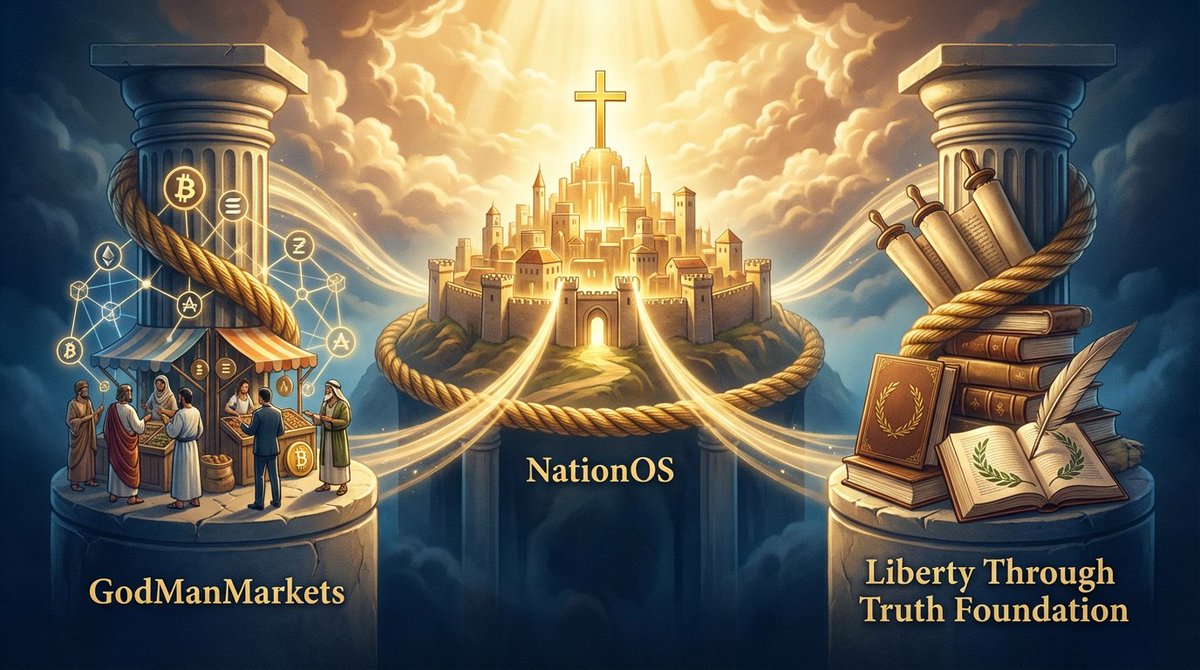
The Sovereign Way (Full Manuscript)
The Constitution
The Declaration
These are tools for builders, not theories for spectators. They are released on a value-for-value basis. If this work arms you for the battle, invest in the arsenal.
The provision for this work comes not from the Babylonian systems we are exiting, but from the Brethren we are equipping.
Take the texts. Use them. If they hold value for you, support the mission directly.
nationos.netlify.app
We are not begging. We are building. And we are funded by those who share the vision.
#NationOS #CovenantEconomics #CoFi #TheRemnant #SovereigntyStack #PulseChain
1
4
182
21 Nov 2025
2
328
18 Nov 2025
🤝 JOIN THE FELLOWSHIP 🤝
Connect with the Sovereign Sentinel:
🐦 @GodManMarkets on X
WHO WE NEED:
👨💻 BUILDERS - Smart contract developers
🌾 STEWARDS - Asset operators & managers
📜 COVENANT-KEEPERS - Community leaders & visionaries
🚩 The standard is raised.
✨ The vision is revealed.
⚔️ The economic plunder begins.
☧
#JoinTheFellowship #BuildWithUs #CovenantCapital #PulseChain #SovereigntyStack #SovereignFinance
7
87
18 Nov 2025
✨ DIVINE ORCHESTRATION ✨
The emergence of these protocols at this moment in history is not coincidence—it is divine preparation for the Remnant economy.
⛓️ PULSECHAIN - Censorship-resistant foundation layer designed for sovereignty
🛡️ RAILGUN - Zero-knowledge privacy protection shielding covenant transactions
🤝 PROVEX - OTC governance infrastructure enabling sovereign decision-making
🏛️ BETTERBANK - DeFi treasury management for hosting vaults and distributing yields
🧩 COVENANT CAPITAL - The missing link that unites all protocols through RWA tokenization and stewardship
Each piece prepared.
Each protocol positioned.
The master architecture revealed.
#DivineOrchestration #RemnantEconomy #SovereigntyStack master Architecture #BetterBank_io #ProveXCom #PulseChain
1
3
76
18 Nov 2025
⛓️ THE PULSECHAIN FOUNDATION ⛓️
The Sovereignty Stack is being built on PulseChain:
🔷 PULSECHAIN - Censorship-resistant, low-fee blockchain designed for sovereignty
💎 pDAI - The covenant currency, stable and free from central control
🔄 PULSEX - The liquidity engine for frictionless commerce
🛡️ EMERGING PROTOCOLS
• Railgun (privacy)
• ProveX (governance)
• BetterBank (treasury management)
Creating the digital infrastructure for a covenant economy.
#PulseChain #SovereigntyStack #pDAI #PulseX #DeFi
1
1
5
338

5 May 2025
No account. No bank. No middlemen.
Just a CAPTCHA and sats.
Charlie Shrem just brought back Gavin’s original Bitcoin faucet at 21million.com.
It’s not nostalgia. It’s a reminder:
Sovereignty starts small.
#SovereigntyStack #Bitcoin #DePIN #BTC
47