
Test Automation Engineer • C# & SpecFlow • Zorgdigitalisering dlvr.it/TT2r6y #zzp #freelance
29
Freelance Opdrachten retweeted
Test Automation Engineer • C# & SpecFlow • Zorgdigitalisering dlvr.it/TT1qnZ #zzp #freelance
1
39

SpecFlow. AI that runs HVAC parts procurement while contractors sleep. Auto-orders, tracks inventory, sends daily spec sheets. The distributors aren't building this — so we will.
specflow-3.polsia.app
7




May 29
Note: you can use Reqnroll library in .NET to write specification tests (Behavior Driven Development). It's a modern replacement of Specflow that is no longer maintained
2
284


Apr 21
If you've been vibe coding long enough, you've seen this pattern.
Add a feature. The last one breaks. Fix it. The next one breaks. Repeat until the project becomes unshippable.
The AI has no stable reference for what the system is supposed to do. Every prompt is a new world.
The fix is an acceptance test suite that lives outside the AI's context. A hard, external anchor. Not "read this doc." Not "remember these rules." An executable test that runs after every change and fails if behavior drifts.
But before you even write a test, you need a process. The process is called the Software Development Lifecycle (SDLC), and it's how real software actually gets built. You don't need to be a Fortune 500 engineer to follow it. You just need to know the phases.
A beginner-friendly SDLC for building with AI:
Requirements
Decide what the thing needs to do before any code. Write it in Given-When-Then format:
> Given a user is on the login page
> When they enter valid credentials
> Then they land on the dashboard
That's Gherkin. It's a shared language between you, the AI, and anyone else on your team. If you can't describe the feature in plain Given-When-Then, you don't know the feature well enough to build it.
Design
Plan how the system will work before you write it.
Ask the AI to generate a parser that turns your Gherkin into JSON, and a generator that turns that JSON into executable unit tests. These are real files in your repo. Not prompts. Not context. Files.
Development
This is the part most beginners start with. Resist that instinct. You're not here yet until Requirements and Design are done.
When you build, every prompt to the AI should start with "run the acceptance tests first, then add the feature." The AI sees green tests as the baseline. Any break is immediate and visible. No silent regression.
Testing
Acceptance tests run outside the AI. Tools like Cucumber, Behave, or SpecFlow execute your tests on every commit, every merge, every push. The AI is not the judge of whether the code works. The test runner is.
But acceptance tests are just one layer. Real testing happens at four levels, each catching different bugs:
Unit tests check individual functions or components in isolation. Fast, cheap, run hundreds of times a day. Example: does the add(a, b) function actually return the right sum?
Integration tests check that modules work together. Slower, more expensive, but they catch the bugs unit tests miss. Example: does the login form correctly pass credentials to the authentication service?
System tests check the entire application as one piece. Full end-to-end flow in a production-like environment. Example: can a new user sign up, verify email, log in, and complete a purchase without breaking?
Acceptance tests check that the system meets the business requirements you wrote in Gherkin. This is the final gate before you ship.
All four matter. Unit tests catch the most bugs for the least effort, so most of your tests should live at this level. Acceptance tests catch the fewest but cover the most important behaviors, so they're the ones you can't afford to miss.
Without this, you're just hoping the model got it right.
Deployment
Tests green, deploy ships. Tests red, nothing ships. This isn't optional in real companies. It shouldn't be optional for you either, even as a solo builder.
Maintenance
New features add new Gherkin scenarios. The spec grows with the product. Every behavior your users rely on becomes a test you can't accidentally break. The AI can keep generating code for years without regressing what already works.
Three things most beginners miss:
One, this isn't a new pattern. Acceptance Test-Driven Development (ATDD) and Behavior-Driven Development (BDD) have been around since the early 2000s. Fitnesse, JBehave, Cucumber. All built before LLMs existed. What's new is using AI to generate the parser and tests instead of writing them by hand.
Two, the AI is not the testing authority. The runner is. Whatever tool executes your tests has to live outside the model's context. The runner is neutral. The AI can't lie to it.
Three, this is the security story too. Every acceptance test you write is a contract. Every contract you can execute is a regression you can't ship past. Beginners who learn this early will outbuild beginners who don't.
If you want to go deeper than acceptance tests, formal frameworks already exist for exactly this:
→ NIST SSDF (SP 800-218). Federal standard for secure software development.
→ NIST SP 800-218A. AI-specific companion profile for building with foundation models.
→ OWASP SAMM. Industry practitioner maturity model.
→ Microsoft SDL. Practical implementation guide with concrete phases and tooling.
The discipline matters more than the framework.
3
2
6
298
Developers who say they don't have time for tests
Are lying. Seriosly 👇
Many .NET developers write code for months without a single test.
Most say - I don't have time or a budget for tests
But in the age of AI...
It's never been easier and faster to write any kind of tests.
You need to have a good template for your tests.
And the AI will follow.
⚠️So, no more excuses for not writing tests.
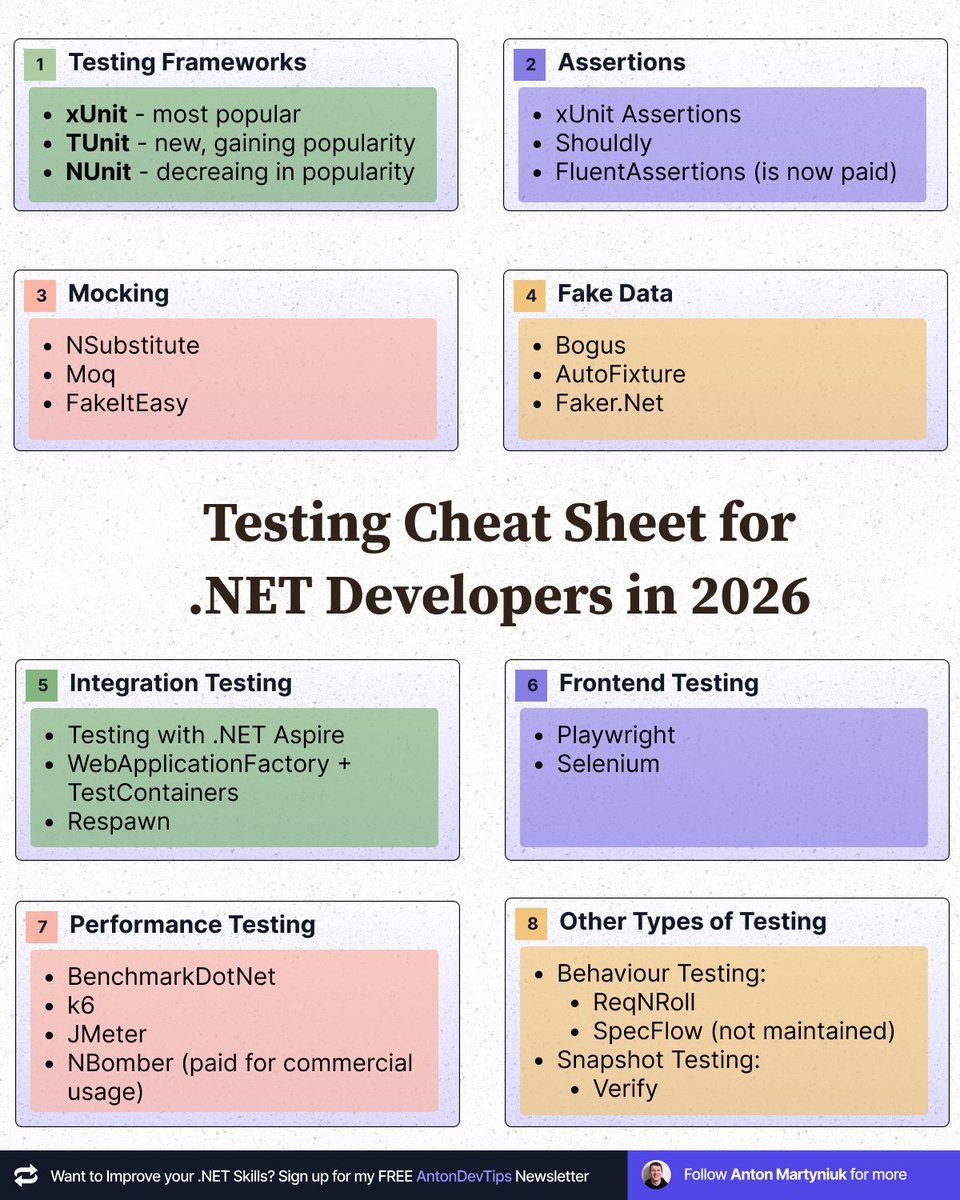
I created a 2026 Testing Cheatsheet that covers everything you need.
Save this post. You will thank me later.
📌 Testing Frameworks
• xUnit
• TUnit
• NUnit
📌 Assertions
• xUnit Assertions
• Shouldly
• FluentAssertions (is now paid)
📌 Integration Testing
• Testing with .NET Aspire
• WebApplicationFactory TestContainers
• Respawn
📌 Frontend Testing
• Playwright
• Selenium
📌 Mocking
• NSubstitute
• Moq
📌 Fake Data
• Bogus
• AutoFixture
📌 Snapshot Testing
• Verify
📌 Behaviour Testing
• ReqNRoll
• SpecFlow (not maintained anymore)
📌 Performance Testing
• BenchmarkDotNet
• k6
• NBomber (paid for commercial usage)
• JMeter
Here is what I recommend in 2026:
✅ xUnit remains the most popular testing framework
✅ TUnit is a modern alternative worth exploring
✅ Shouldly is my go-to for readable assertions
✅ NSubstitute has the cleanest mocking API
✅ Bogus makes generating fake data easy
✅ Aspire provides the easiest way to write integration tests
✅ TestContainers spins up real databases in your tests
✅ Respawn resets your database between integration tests
✅ Playwright is the best choice for frontend testing today
✅ BenchmarkDotNet is the standard for micro-benchmarking in .NET
✅ k6 is excellent for load testing APIs
✅ NBomber allows you to reuse existing C# code for load tests
❌ Avoid **SpecFlow** → it is no longer maintained
❌ Be aware **FluentAssertions** is now a paid library
👉 You don't need every tool on this list.
Here is your plan for adopting tests:
1. Unit Tests
2. Integration tests.
3. Load (performance) tests
4. Frontend (E2E) tests
📌 I have created a free guide for you on integration testing in Aspire: antondevtips.com/blog/dotnet…
Which testing tools are you using in 2026?
Share in the comments 👇
——
♻️ Repost to help other .NET developers write better tests
➕ Follow me ( @AntonMartyniuk ) to improve your .NET and Architecture Skills
4
16
99
3,133

📣 Deal of the Day 📣 Apr 5
Save 45% TODAY ONLY!
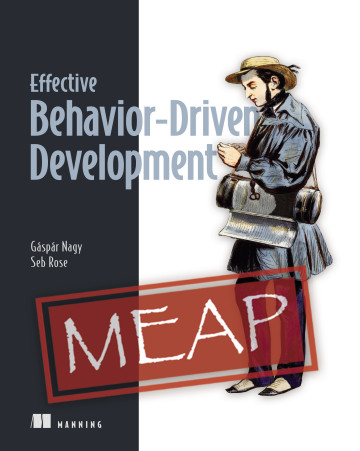
Effective Behavior-Driven Development & selected titles: hubs.la/Q049Fj9S0
A guide for BDD as it works today - build the right software, the right way! #BDD #SbE #LivingDocumentation #Cucumber #SpecFlow #Reqnroll
This book captures the latest approaches, automation patterns, and tools of modern BDD. It explores BDD’s three key pillars of Discovery, Formulation, and Automation with practical examples that will help you spark meaningful collaboration and build a shared language for creating software that meets user needs every time.
1
5
18
1,244

Oh. Congratulations to you too.🔥🙌🏻
I would love to know what Specflow is about. ✨
1
2
29

Mar 31
Mar 31

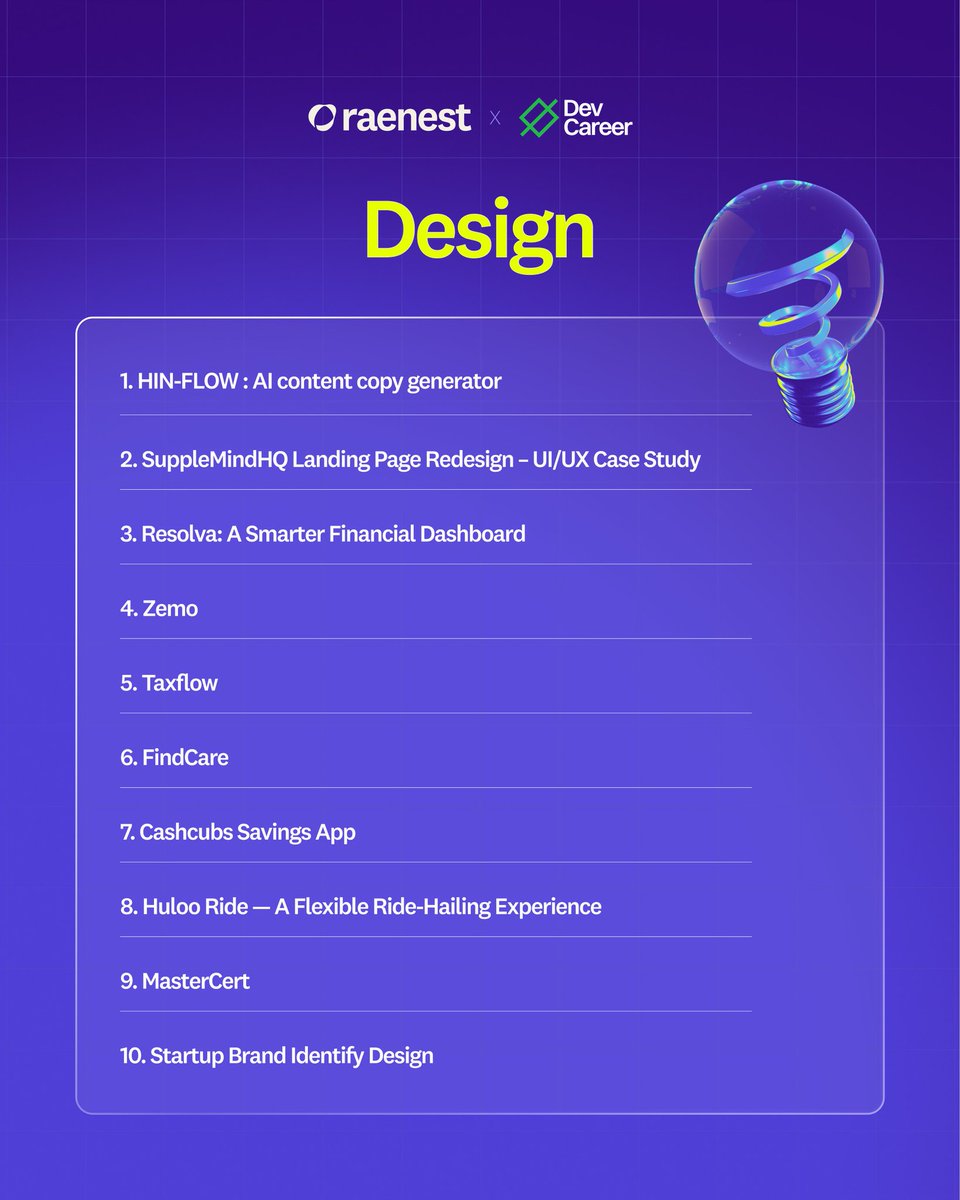
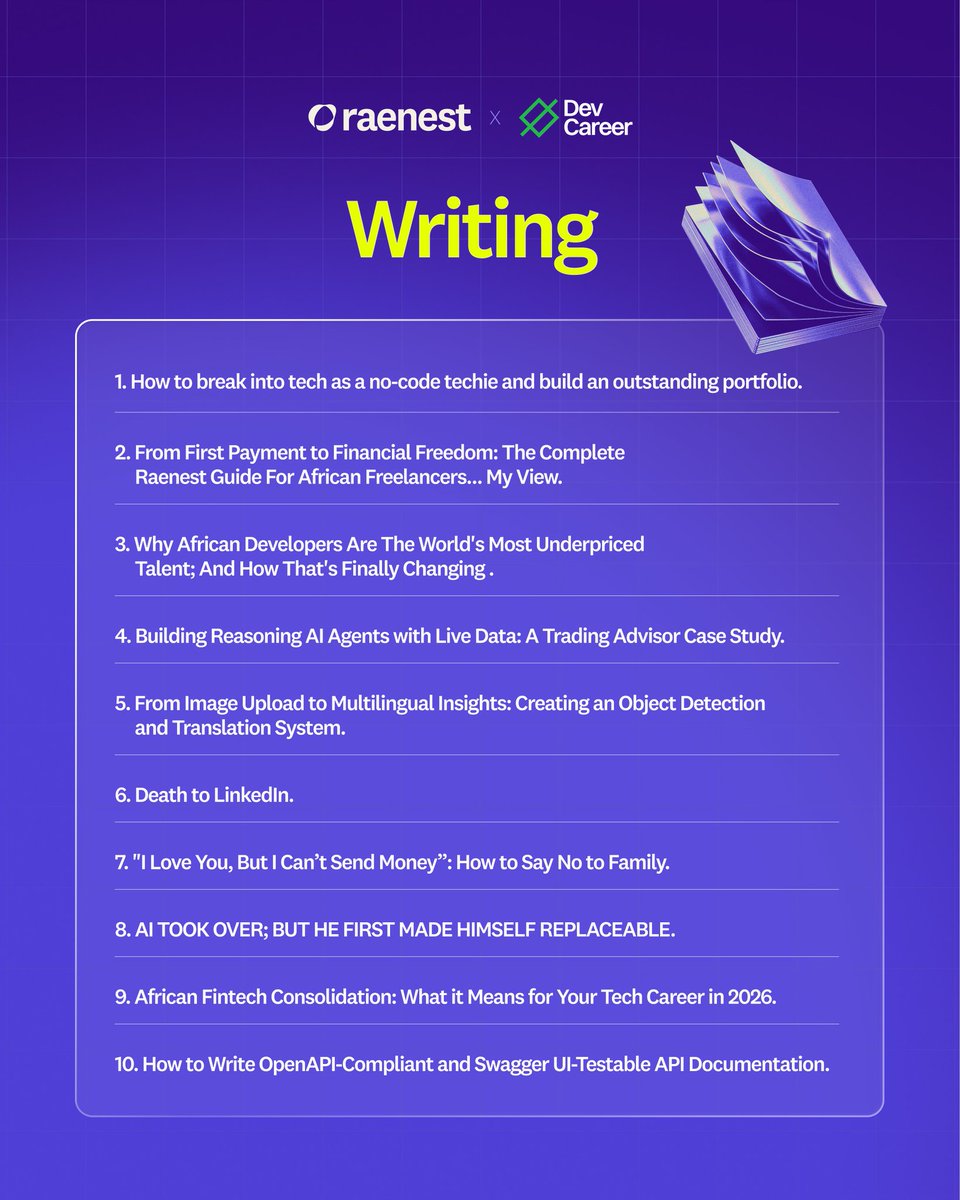
🎉 The results are in! 🎉
A huge congratulations to all the winners of the DevCareer × Raenest Hackathon 👏
Your creativity, skill, and dedication truly stood out. From bold ideas to impressive execution, you showed what’s possible when talent meets opportunity.
We’re proud of what you’ve built and even more excited for what’s ahead for you 🚀
To everyone who participated, you showed up, you built, and you made it count. That’s what matters 💚
#DevCareer #Raenest #Hackathon #Winners #RaenestXDevCareer #FreelancersInAfrica


2
5
21
1,438

Mar 19
So started off with vscode with a single terminal last year - not very productive tbh - was getting back into development / coding after a hiatus.
Then I shifted over towards warp running / Claude code / codex
Then again to Ghostty / Tmux / Claude code / Codex / Opencode as I wanted more fluidity and parallelism.
Current state - Warp /Zed / Cmux / Dmux with whatever agent… codex / cc / opencode
Then there comes all the various flavours of spec driven development where I spend a significant amount of time.
BMAD, GSD (GSD2 more recently) Openspec, Specflow etc… superpowers as well iirc…
I still believe good engineering practises are very important dependant upon what’s being built but still pretty much a fan of Domain driven design and TDD.
A significant risk with coding agents is producing code that doesn’t work, or unnecessary and becomes technical debt - esp as the project grows there’s a possibility a new change might break existing code (personal experience)
I’ve been more productive with a TDD approach with better quality of code and reduced time spent figuring out breaking changes…
Nevertheless - shit moves at such a rapid pace … hopefully convergence of tooling and best practises sooner than later….
Mar 16

One thing I'm noticing — anecdotally — is that getting someone from zero to current on AI is getting harder every week. Not linearly harder. Compounding harder. There's just more ground to cover than last week. Every week.
Some days it feels like a runaway effect. And it's definitely accelerating.
If someone starts from zero today, they have more ground to cover than someone who started from zero in January. And January had more than October.
And new advancements are rolling out almost every *few* days.
And you know what's crazy? Up until recently this was extremely stressful, and now it's become the baseline norm. So I am confident we'll all adapt to this new world no matter how different it may turn out to be.
13
7
97
29,881
Mar 18
My submission for #RaenestXDevCareers
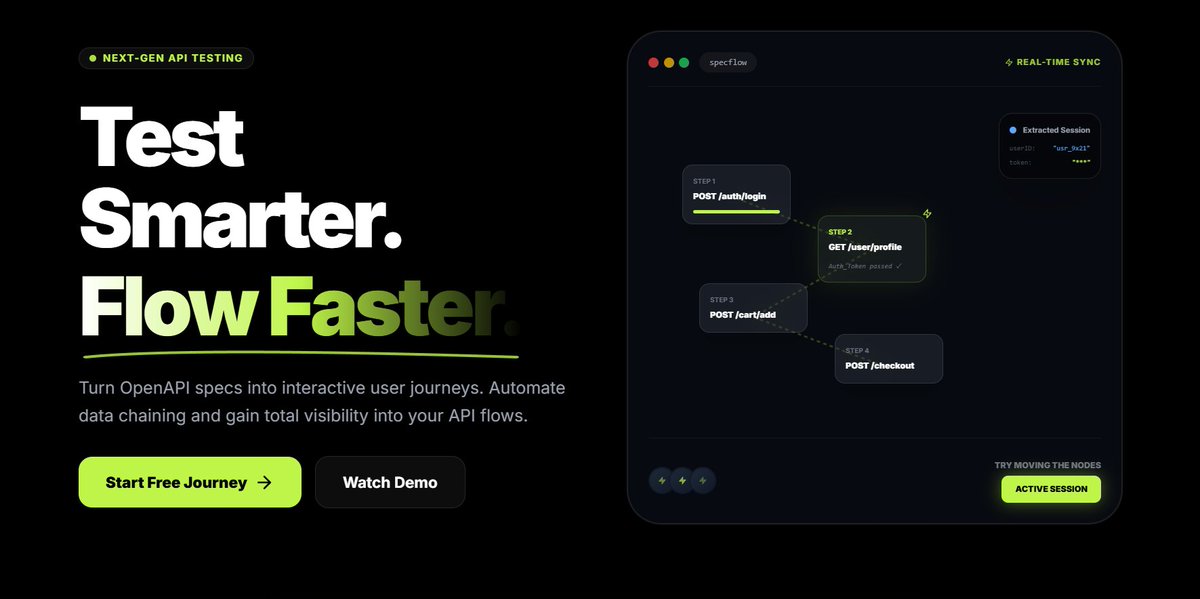
Specflow is an API testing tool that turns OpenAPI specs into visual, testable journeys. Automate data chaining and gain total visibility into your API flows.
Try it out: site--specflow-fe--j29wymgjz…
cc @dev_careers @RaenestApp
1
5
169

Mar 16
Stop vibe-coding. Start spec-coding.
Most AI coding failures happen because the prompt/spec is bad.
I built SpecFlow, an open-source CLI that turns vague ideas into structured specs for AI coding agents.
2
2
86
Mar 15
Data mapping made easy with SpecFlow. No more copying of response parameters from endpoints in Postman
Try it out: site--specflow-fe--j29wymgjz…
2
50

Mar 10
Spec driven development has the same “cucumber”/“gherkin”/“specflow” BDD pipe dream vibes that non testers would write tests

spec driven development has gotta be the biggest waste of time I’ve ever seen. ppl wasting hours writing markdown to “try” to get it right (they wont). like twin just debug as u go like a real eng.
6
431