Quand la télé était complaisante avec les p*D*files
#Matzneff #Peyrefitte #Giroud #Sollers #Pivot #Bombardier #Schérer #Springora #Gee #Grasset #BHL #Fasquelle #Rheims
#Apostrophe
#Franceinfo #INA youtu.be/eUJWhaJ_EuE?si=lhLa…
29
Ivan Ellul retweeted

Jun 14
Vanessa Springora : promotion canapé?
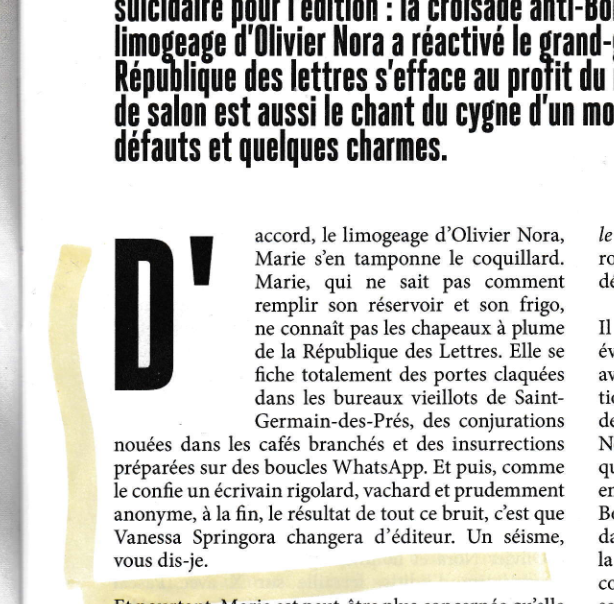
C'est bien ce qu'insinue Élisabeth Lévy en tête d'un article de Causeur consacré au limogeage d'Olivier Nora par Vincent Bolloré.
Pourquoi, parmi les dizaines d'écrivains annonçant qu'ils allaient quitter Grasset, à commencer par Bernard-Henri Lévy en personne, donne-t-elle la primauté à Springora?
Et pourquoi, si Springora n'est qu'une parmi cent autres, l'évoquer sur un ton "vachard, rigolard et prudemment anonyme"?
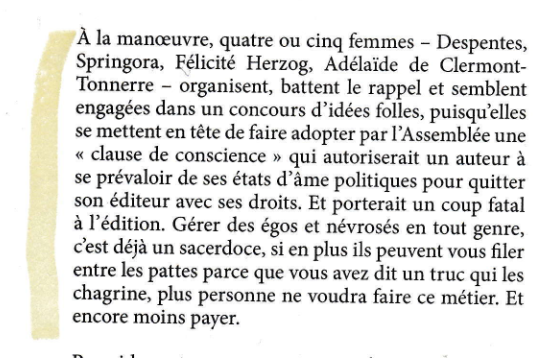
Plus loin dans son article, Lévy revient sur l'implication de Springora au premier rang de cette affaire de limogeage, juste avant Félicité Herzog qui, on oublie souvent de le dire, est une très proche parente de Nora.
Il faut bien remarquer que Springora a droit à des efforts de promotion tout à fait exceptionnels de la part de son éditeur Nora, sans que la qualité de sa production le justifie vraiment.
Il est vrai que son second ouvrage paru l'année dernière, fait preuve d'un shoahtisme effréné. Parlant de personnes ayant subi plus de 40 ans de tyrannie soviétique, elle s'étonne qu'elles ne mettent pas au premier plan de leurs préoccupations ... la shoah!
Décidément, les arrières-cuisines de l'affaire Matzneff se révèlent de moins en moins ragoûtantes.
3
28
5,805
Francesca Gee retweeted
Jun 14
D'ailleurs c'est de Willy Le Devin qu'il s'agit, pas de Springora. Le Devin qui s'est fait une spécialité de dézinguer Matzneff et ses amis.
Pourquoi pas, mais il faudrait le faire en apportant des informations honnêtes, pas en se mettant au service d'intérêts occultes tout aussi louches qu'eux.
1
7
565
Jun 15
Non, ce n'est pas une atteinte à la vie privée. Rien n'est privé dans le montage des anciens marionnettistes de Matzneff déterminés à lui faire porter le chapeau pour couvrir 50 ans de chantages.
On sait que Vanessa Springora a couvert l'ancien PDG de Grasset en cachant le rôle de sa fille dans sa propre liaison avec Matzneff. Qu'elle ait, comme c'est suggéré dans Causeur, des relations intimes avec le nouveau PDG qui se trouve être son propre éditeur n'a rien de fortuit.
Depuis des années je dispose d'informations sur la vie privée de Springora, que je n'ai jamais publiées.
Jun 14

Vanessa Springora : promotion canapé?
C'est bien ce qu'insinue Élisabeth Lévy en tête d'un article de Causeur consacré au limogeage d'Olivier Nora par Vincent Bolloré.
Pourquoi, parmi les dizaines d'écrivains annonçant qu'ils allaient quitter Grasset, à commencer par Bernard-Henri Lévy en personne, donne-t-elle la primauté à Springora?
Et pourquoi, si Springora n'est qu'une parmi cent autres, l'évoquer sur un ton "vachard, rigolard et prudemment anonyme"?
Plus loin dans son article, Lévy revient sur l'implication de Springora au premier rang de cette affaire de limogeage, juste avant Félicité Herzog qui, on oublie souvent de le dire, est une très proche parente de Nora.
Il faut bien remarquer que Springora a droit à des efforts de promotion tout à fait exceptionnels de la part de son éditeur Nora, sans que la qualité de sa production le justifie vraiment.
Il est vrai que son second ouvrage paru l'année dernière, fait preuve d'un shoahtisme effréné. Parlant de personnes ayant subi plus de 40 ans de tyrannie soviétique, elle s'étonne qu'elles ne mettent pas au premier plan de leurs préoccupations ... la shoah!
Décidément, les arrières-cuisines de l'affaire Matzneff se révèlent de moins en moins ragoûtantes.
1
9
30
2,504

Jun 14
Je suis en train de parcourir ses bouquins pour faire le lien avec #LeConsentement 📕 de Venassa #Springora que je viens de lire.
12

Jun 14
Et la preuve qu'Inès Chatin ment et que cette histoire est un montage c'est un tweet que vous avez écrit vous-même basé sur la photo de Vanessa Springora qui n'a rien à voir dans cette histoire...
C'est passionnant.
1
138

Oui c’est vrai , il l’a connue quand elle était toute petite , quand tu es une enfant et que tous les adultes autour de toi te poussent dans une histoire sordide tu crois que c’est « normal » et tu cherches à faire plaisir . Vanessa Springora a écrit sur le sujet
1
15

Jun 14
Momento en que Denise Bombardier condenó las relaciones pedófilas del escritor Gabriel Matzneff, pero éste continuó gozando de altas complicidades hasta que, en enero de 2020, una de sus antiguas víctimas, Vanessa Springora, hoy reconocida editora, publicó «El consentimiento»

#Bombardier #Matzneff
« J'ai fait ce que j’avais à faire. Autrement je n'aurais pas pu me regarder dans le miroir » DB.
La manière dont elle a été traitée, après cette prise de parole dans l’émission Apostrophes, est insupportable ⤵️
franceinfo.fr/culture/livres…
48

Jun 12
Lisez Vanessa Springora et Matzneff pour vous faire une idée au lieu de vous intéresser à la dernière des dindes arrivée après toutes les batailles. Le Consentement est un grand livre et Matzneff un minable auteur. Le reste est du blabla à clic.
 Ahmed
Ahmed
2
54
XLaBete🛡️🧑🤝🧑🔞 retweeted

Après Camille Kouchner, Vanessa Springora ou Neige Sinno, Frédéric Pommier et Romain Lemire publient chacun un livre bouleversant pour raconter les violences sexuelles subies dans leur enfance. 📲 urls.fr/lm1fPc

1
8
6
467

Jun 11
Vous en êtes où avec Depardieu, Poivre d’Arvor, Lahaye, Castronovo, Ramadan, Besson, Ruggia, Springora, Beyer, Duhamel, Louvin, Lévêque, Berry, Boutonnat, Ménès, Hulot, Agnel, Bourdin, Abad…?
373

Jun 11
l'iA quand vous posez la question .., qui est le mari de Vanessa Springora
"il sagit dun écrivain pédophile" la réponse de L' IA 😡
"Did we get it wrong? Please tell us by giving this response a thumbs down.
his content may violate our usage policies".
28

Jun 10
She was 13 years old when she met him.
He was 49.
A famous French writer.
Celebrated. Connected. Protected by some of the most powerful literary circles in Paris.
She was quiet, intelligent, lonely, and desperate to feel seen.
He saw her.
Then he began shaping her world.
Letters.
Books.
Praise.
He told her she was extraordinary — different from other girls her age.
Adults around them called her “mature for her age.”
That phrase has protected predators for generations.
Gabriel Matzneff understood that perfectly.
By 14, Vanessa Springora was trapped in what France’s literary elite insisted on calling a “love affair.”
It wasn’t.
It was grooming.
Calculated. Patient. Systematic.
And here is the part that still shocks people:
He never hid it.
Matzneff openly wrote about relationships with minors in published books and diaries.
He discussed it on television.
He described Vanessa publicly under the pseudonym “V.”
Publishers printed it.
Critics praised it.
The French establishment rewarded it.
In 1990, journalist Denise Bombardier appeared on live television and directly confronted him, calling his behavior what it was:
Child sexual abuse.
The audience turned against her.
Not him.
France’s literary elite mocked the woman who spoke up — while continuing to celebrate the man abusing children.
That is how deeply the culture protected him.
Meanwhile, Vanessa grew older carrying a confusion many survivors know intimately:
She believed she had chosen the relationship.
Only later did she understand every part of that “choice” had been engineered by an experienced adult who knew exactly how to manipulate a vulnerable teenager.
For decades, she stayed silent.
Why speak?
He was famous.
She was a footnote in his books.
Then, in 2013, she watched him receive another prestigious literary prize on television.
Celebrated again.
Something inside her finally broke.
Or perhaps finally hardened.
She decided to write her own book.
Not for revenge.
For truth.
In 2020, Vanessa Springora published Le Consentement (“Consent”).
The book exploded across France.
For the first time, the public saw grooming described from the inside:
• how admiration becomes control
• how attention becomes dependency
• how a child is convinced exploitation is love
The reaction was immediate.
Bookstores pulled Matzneff’s work.
Publishers distanced themselves.
Authorities opened investigations using his own published writings as evidence.
France was forced to confront a question it had avoided for decades:
How many people knew?
The answer was horrifying:
Almost everyone.
And most chose silence because the man involved was famous, intellectual, and socially protected.
Vanessa’s book helped trigger a national reckoning over child protection laws and age of consent in France.
But perhaps the most important thing she reclaimed was smaller and more personal than legislation.
For decades, she existed publicly only as “V.”
A supporting character in a predator’s self-written mythology.
Then she took back her own name.
Her own voice.
Her own story.
And she proved something powerful:
It is never too late to name what happened to you.
Never too late to stop carrying someone else’s shame.
And never too late for the truth to dismantle decades of silence.

22
276
742
27,307

🇫🇷 🚨 Affaire Lyhanna : chronique d’un fiasco judiciaire
Il a fallu le meurtre d’une enfant, un de plus après ceux de Chloé, Louise, Lina, Maëlys, Angélique, Estelle et tant d’autres petites filles ces dernières années en #France, pour que la société et les politiques prennent conscience de l’ampleur des violences pédocriminelles.
La mort de #Lyhanna, 11 ans, et les sévices sexuels qu’elle a probablement endurés bouleversent un pays déjà choqué par les scandales du périscolaire, de l’internat de Bétharram, de l’Église, du Consentement de Vanessa Springora ou des « hommes de la rue du Bac », sans qu’une politique publique d’envergure soit mise en place pour endiguer ces violences systémiques.
La stupeur est montée d’un cran quand il est apparu que Jérôme B., l’homme de 41 ans suspecté d’avoir tué la collégienne, avait été à plusieurs reprises signalé à la justice et avait fait l’objet d’au moins trois plaintes pour viols sans jamais être inquiété.
Un « dysfonctionnement », a déclaré le ministre de la Justice, @GDarmanin.
Lire la suite 🔗 latribune.fr/article/la-trib…
✍️ Par @PaulineDelassus avec @PaulineRevenaz

2
12
19
2,362
Jun 6
Cependant il n'a pas tort ... on en a la nausée de ces livres. C'est du pur exhibitionnisme, surtout de la part d'une dame qui s'appelle Grinberg.
(L'éditrice est-elle Vanessa Springora?😅😂🤣)
Il a raison de dire que trois pages dans "Elle" aurait été le format idéal. Ce qui serait utile, et qui sait révélateur, c'est une cartographie de toutes ces familles qui violent les enfants, avec les liens qu'elles entretiennent entre elles.
6
492

Jun 6
Lorsque Matzneff emmenait la jeune Springora dans des dîners, personne ne semblait s'émouvoir de la disparité en âge de ce "couple", les gens avaient ils des bandeaux sur les yeux ? Comment lorsqu'on est ado ne pas être fasciné par le " détenteur d'autorité" qui s'intéresse à lui
4
401