
13 Nov 2025
The Partnership Power: EnsoFi Securing the Future of Stable DeFi
@Ensofi_xyz is not just building a fixed-rate, cross-chain lending protocol; it's actively integrating with key partners to validate its technology and drive ecosystem growth. These partnerships are structured to directly benefit you, the community.
Core Synergy: Community & Ecosystem Growth
EnsoFi leverages strategic partnerships to expand its user base and reward active participation, with a strong focus on incentivized campaigns:
KiiChain: A significant collaboration to promote ecosystem discovery. This partnership directly rewards the community for engagement, demonstrating EnsoFi's commitment to verifiable distribution.
Other Ecosystem Partners: @Ensofi_xyz is consistently featured in collaborative campaigns with other projects in the space to promote stability and cross-chain utility across networks like Solana and Sui.
The Reward Incentive: USDC Bonus
The most compelling aspect of EnsoFi's partnership strategy is the incentive structure tied to its collaborative quests:
$500 USDC Raffle: Partnership quests (such as the recent KiiChain collaboration) frequently include a substantial $500 USDC raffle pool for a set number of lucky winners. Completing the simple social and community tasks in these partner quests qualifies you for these bonus rewards.
Proportional $ENFI Allocation: Regardless of the raffle, participation in any partnership quest contributes directly to your proportional $ENFI token allocation. Your reward is based on your total points earned, ensuring your consistent efforts across collaborations secure a guaranteed share of the token pool.
By focusing on these strategic collaborations, EnsoFi is ensuring its stable, P2P lending model becomes the standard for cross-chain finance, and it's rewarding early supporters heavily for helping spread the word.
#EnsoFi #Partnership #CrossChainDeFi #GalxeQuest #StableRates @Ensofi_xyz
@EdgenTech
2
2
1,073
10 Nov 2025
Cross-Chain Collab Power: EnsoFi $ENFI x KRNL Labs is LIVE on Galxe!
The future of DeFi stability is here, and it’s backed by strategic partnerships. @Ensofi_xyz (Stable P2P Lending) is teaming up with @KRNL_xyz (a prominent Web3 incubator/venture builder) to expand its cross-chain presence, and they are rewarding YOU!
The EnsoFi x KRNL Labs Galxe quests are active now.
The Synergy: Fixed Rates Meet Ecosystem Growth
EnsoFi's Role: Providing stable, mutually agreed upon interest rates for P2P cross-chain lending eliminating pool volatility.
KRNL Labs' Role: Driving ecosystem and community growth, ensuring high-quality projects and users discover EnsoFi’s groundbreaking stability features.
The Result: A more robust, secure, and widely adopted stable DeFi environment for the entire ecosystem.
Earn Your Proportional $ENFI $500 USDC Bonus!
Jump into the partnership quests on Galxe to secure your proportional share of the $ENFI token pool and qualify for exciting bonus prizes:
Proportional $ENFI: Your $ENFI token reward is based on your points relative to all participants merit over luck!
Bonus Raffle: By completing the EnsoFi x KRNL Labs social and community quests, you are entered into a raffle to win a share of $500 USDC!
Simple Tasks: Completing these quests typically involves simple tasks like following both projects, retweeting, and showing support for the partnership.
Support the growth of stable DeFi by engaging with our key partners. Your proportional $ENFI allocation starts now!
#EnsoFi #KRNLlabs #DeFi #GalxeQuest #Partnership #StableRates @Ensofi_xyz @KRNL_xyz @EdgenTech

51
38
15,149


18 Oct 2025
👍🏻🫡♾️
7 Oct 2025

♾️ The Sovereign Network: How #ICP Can Replace the Corporate Internet
In theory, #InternetComputer already has the architecture needed to do it.
But it still needs 5 to 10 years of maturity, adoption, and physical infrastructure to reach that level.
⸻
⚙️ 1. Architecture: ICP Was Born With the Design Others Are Trying to Build
The Financial Times diagram shows that OpenAI is not a sovereign network —it’s a consortium of corporate and governmental dependencies:
•Microsoft → hosting, investment, and Azure access.
•Oracle → high-performance computing (Stargate Project).
•Nvidia → chips, supply, client, and investor.
•Amazon, Google, Meta → data centers and cloud.
•Broadcom → custom chips.
•CoreWeave → decentralized GPU network, yet privately funded.
•SoftBank → financing.
All of this is fragmented, private, and nationally tied infrastructure.
ICP, by contrast, integrates within a single protocol what they achieve through bilateral deals:
•Computation (canisters).
•Storage.
•Identity.
•Governance (NNS DAO).
•Interoperability (Chain Fusion).
In other words, what OpenAI achieves through alliances, ICP achieves by design.
⸻
⚛️ 2. Sovereign Computation vs. Dependent Computation
Those alliances exist because OpenAI cannot operate without external providers.
ICP, on the other hand, is the only protocol that enables AI and applications to run directly on blockchain,
without relying on Amazon, Google, or Microsoft.
That’s an ontological difference, not just a technical one.
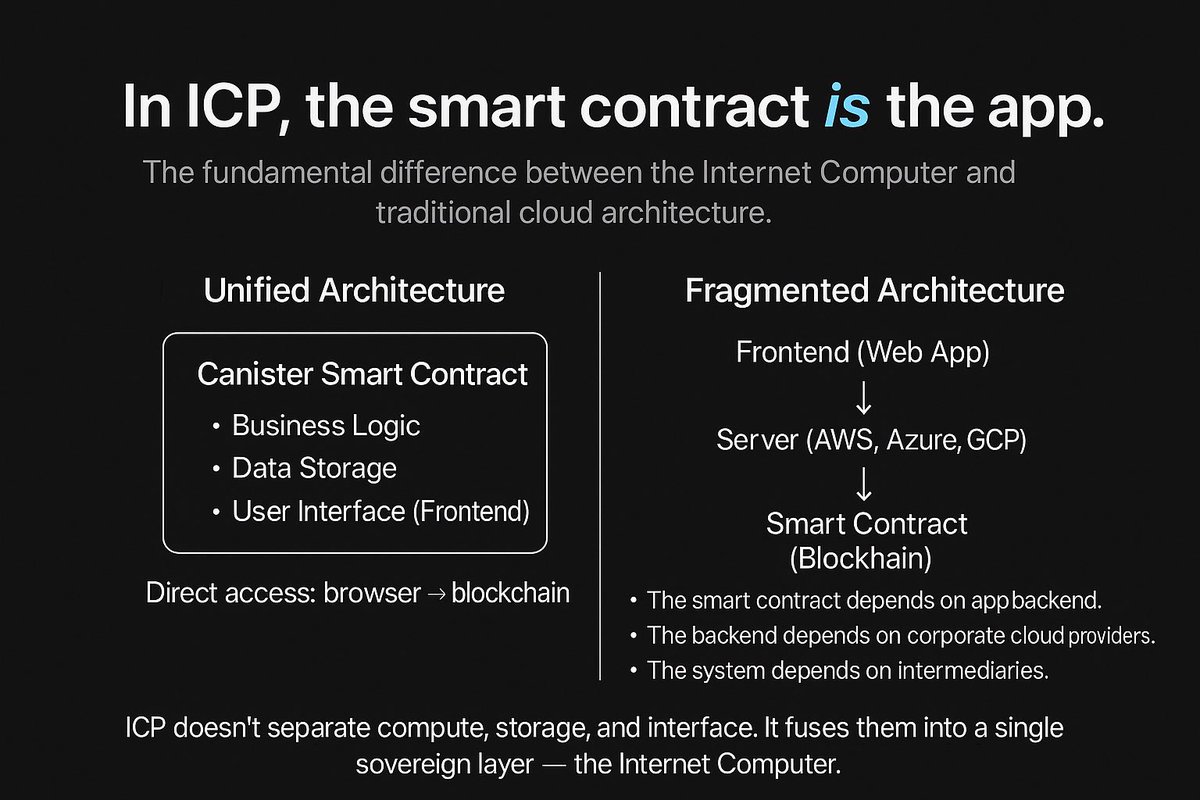
•On ICP, the smart contract is the application.
•In traditional cloud, the smart contract depends on the application.
In other words, the contract is a subordinate component.
On ICP, it is the entire system.
On ICP, trust resides in the protocol itself.
There are no intermediaries or hidden layers between logic and data.
ICP does not separate computation, storage, and interface —it fuses them into a single sovereign layer: the Internet Computer.
That’s why applications like OpenChat, running fully on ICP, are autonomous, verifiable, and censorship-resistant —
something impossible within OpenAI’s or any corporate cloud’s architecture.
⸻
🧠 3. Evolutionary Capacity: ICP Scales by Design
While others depend on centralized data centers, ICP scales through autonomous subnets —each one equivalent to a sovereign mini-cloud.
•It requires no L2s.
•No external bridges.
•It can grow indefinitely by adding subnets, while maintaining cryptographic coherence and global consensus.
In the long run, this means ICP can become the “meta-network” that absorbs all other clouds,
just as the Internet once absorbed corporate intranets in the 1990s.
⸻
🌍 4. The Current Obstacle: Hardware and Adoption
Where ICP still cannot compete is in physical scale and GPU access.
•Nvidia and Broadcom dominate the hardware.
•Microsoft, Google, and Amazon own thousands of data centers.
For ICP to replace them, it will need:
1.A global ecosystem of sovereign node providers (the foundation exists but must multiply).
2.A decentralized chip network (possibly through open partnerships with startups like CoreWeave).
3.Institutional adoption to drive sovereign service construction (governments, universities, global DAOs).
However, with recent upgrades such as the doubling of subnet storage in 2025 —raising replicated capacity to 2 TiB per subnet—
ICP is closing the gap faster than expected.
None of this is impossible.
It only requires time and coordinated vision.
⸻
🕹️ 5. The Inevitable Convergence
The trajectory is already visible:
•Big Tech is moving toward sovereign clouds (like Israel’s Project Nimbus).
•ICP already is a global, open, and verifiable sovereign cloud.
Therefore, it’s not that ICP will simply replace OpenAI —
it’s that the paradigm embodied by ICP will ultimately absorb OpenAI’s model,
once the political and energetic cost of maintaining closed networks becomes unsustainable.
1
1
4
250





10 Oct 2025
1
5
59

3 Oct 2025
Plus it's the only one that's not controlled by ANYONE or any ENTITY...other cryptos are basically businesses, which would be buying into the same ol system 😑
3
29


17 Jul 2025
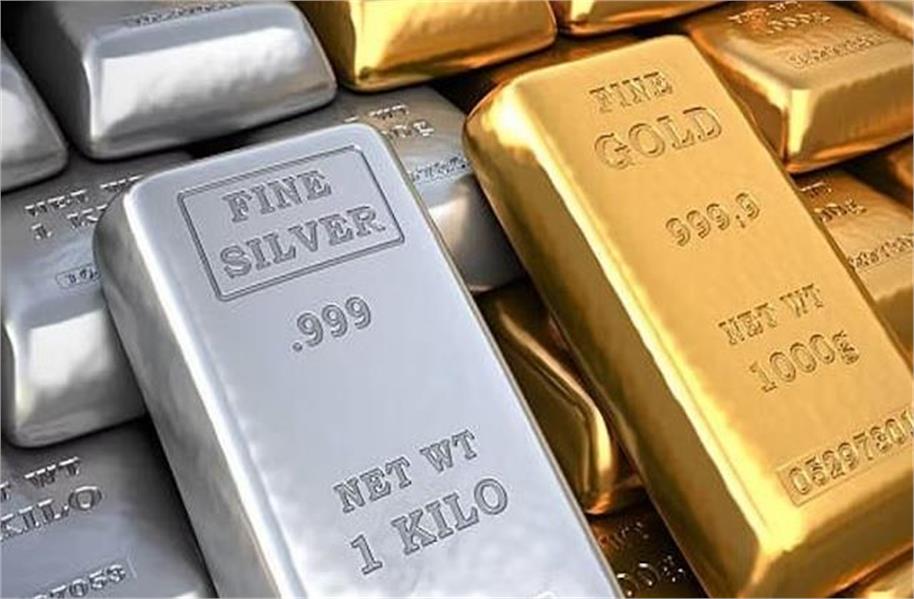
17 जुलाई 2025 को सोने और चांदी के दामों में गिरावट दर्ज की गई है, जो त्योहारी और शादी के सीजन से पहले खरीदारों के लिए एक महत्वपूर्ण खबर है। पिछले कुछ दिनों से जारी उतार-चढ़ाव के बीच, आज कीमतों में कमी आई है।
आइए जानते हैं आज के सोने-चांदी के नए रेट्स:
सोने के दाम हुए कम
आज 17 जुलाई को 24 कैरेट सोने की कीमत घटकर ₹99,270 प्रति 10 ग्राम हो गई है। कल, 16 जुलाई को, इसकी कीमत ₹99,760 प्रति 10 ग्राम थी, यानी 10 ग्राम पर ₹490 की कमी आई है। वहीं, 22 कैरेट सोना आज ₹90,990 प्रति 10 ग्राम पर बिक रहा है, जबकि 18 कैरेट सोना ₹74,450 प्रति 10 ग्राम के भाव पर पहुंच गया है।
#Goldprice #Silverprice #stablerates #Silverrise
68

19 Jun 2025
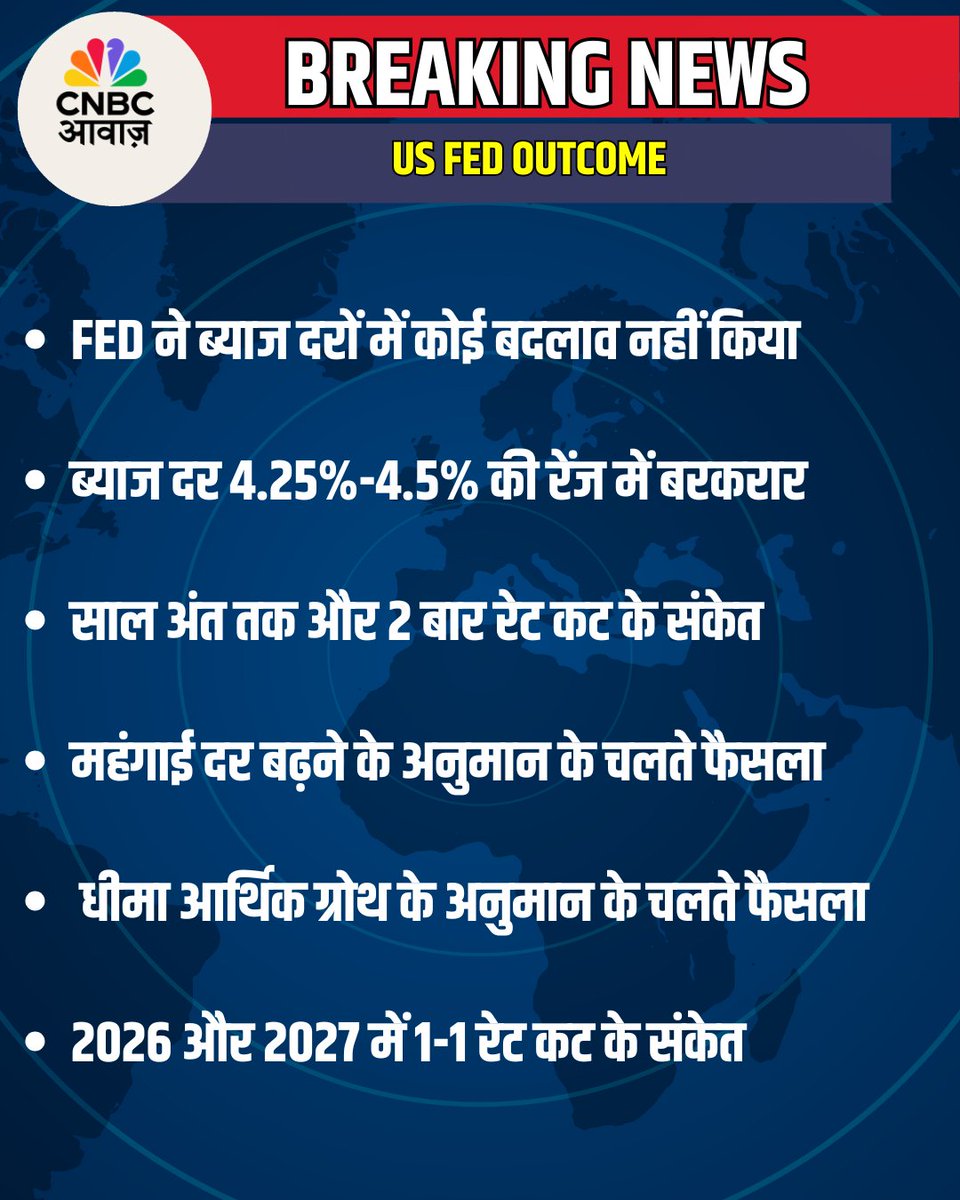
#AwaazBreakingNews
🚨US FED OUTCOME
▶️US FED ने ब्याज दरों में कोई बदलाव नहीं किया
▶️साल अंत तक और 2 बार रेट कट के संकेत
#USFed #InterestRtaes #FedDecision #FedRateHold #StableRates #US
2
9
2,910

25 Aug 2024
Perpetual Possibilities
Lenders can offer multiple term options, paving the way for loan rollovers and extended borrowing periods. Endless possibilities, infinite growth.
Ready for a new era of lending? 🌐 #Crypto #DeFi #StableRates #LendingRevolutio
2
22

5 Jun 2024
RBI's MPC meeting kicks off today, and expert Ashok Mittal anticipates stable repo rates amidst strong economic growth. Stay tuned for updates! 💼📊
#nbfc #fintech #smeloans #homeloan #evloan #PrestLoans #RBIMeeting #EconomicGrowth #StableRates #FinancialInsights #FinanceNews

3
5
117

17 Jun 2023
compound hasn't invented flashloan, stablerates aTokens, and a bunch of other stuff Aave did.
Also hard to call it fork when little to no of codebase in common.
1
115
