
6 Apr 2025
🧵 Walrus Protocol ($WAL) – The Ultimate Deep Dive into Web3’s Storage Titan by BlackNode 🐳
• Walrus Protocol marks a pivotal development in decentralized storage, launched on Mainnet by Mysten Labs on March 27, 2025, backed by $140 million from Standard Crypto, Andreessen Horowitz (a16z crypto), Electric Capital, Franklin Templeton, and RW3 Ventures, achieving a $2 billion valuation.
• Designed for scalability, security, and cost-efficiency, it targets large binary files—“blobs”—such as NFT media, AI datasets, game assets, and blockchain archives. This thread offers an in-depth examination of its technology, tokenomics, ecosystem, roadmap, and areas for improvement, enriched with recent community insights. Let’s explore its structure and significance.
/🧵 What is Walrus Protocol?
• Walrus Protocol is a decentralized storage and data availability platform optimized for managing substantial binary data. It distributes content across a network of nodes, ensuring resilience even if two-thirds fail or act maliciously.
• Integrated with the $Sui blockchain, it became fully operational on Mainnet as of March 27, 2025, aiming to deliver exabyte-scale storage at significantly reduced costs compared to centralized providers like AWS. Applications range from censorship-resistant media to programmable NFT metadata.
/🧵 How It Works Walrus employs a sophisticated architecture—here’s a detailed overview:
• Erasure Coding: Utilizes Red Stuff, a 2D erasure coding system based on fountain codes, fragmenting files into “slivers” with repair data. This ensures data recovery even with a two-thirds node loss, minimizing bandwidth through efficient reconstruction—ideal for high-throughput applications like streaming or rollups. Merkle proofs further validate data integrity without requiring full downloads.
• Node Network: Data is dispersed across a decentralized array of nodes—currently hundreds, with plans for thousands—each storing a shard, eliminating single points of failure and enhancing fault tolerance.
• Sui Integration: The Sui blockchain orchestrates operations via smart contracts, managing blob assignment, certifying availability, and enabling lifespan extensions with $WAL token payments. This programmability distinguishes it for dynamic use cases.
• Payment Mechanism: Users commit $WAL tokens upfront for fixed storage durations (e.g., six months), with funds gradually distributed to node operators and stakers, stabilized against fiat values to mitigate cryptocurrency volatility.
• Scalability: Designed for horizontal scaling to exabytes, nodes compete to host data, optimizing redundancy and efficiency. Community feedback highlights its speed for smaller files but notes latency challenges with high-resolution video retrievals—an area under scrutiny.
/🧵 Why It’s Distinctive Walrus sets itself apart in the decentralized storage landscape:
• Efficiency: Unlike Filecoin’s resource-intensive full replication (often exceeding 100x overhead), Walrus achieves a 4x-5x replication factor, balancing cost and reliability with erasure coding—a leaner, more economical approach.
• Flexibility: In contrast to Arweave’s permanent storage model, Walrus allows blob deletion, offering users control over temporary datasets (e.g., AI training) or evolving assets (e.g., game content).
• Programmability: Sui’s smart contracts enable real-time availability verification, term adjustments, and data management—capabilities absent in standalone systems like Sia or IPFS, making it a programmable storage layer for applications.
• Performance: Fountain codes enhance retrieval speed for large files, outperforming Filecoin’s miner-dependent structure and Arweave’s static design, positioning Walrus as a leader for media, rollups, and interactive use cases.
• The Team Developed by Mysten Labs, established in 2021 by former Meta cryptocurrency researchers:
• Evan Cheng (CEO)
• Adeniyi Abiodun (CPO)
• Sam Blackshear (CTO)
• George Danezis (Chief Scientist)
– Their expertise in distributed systems and cryptography underpins Walrus’s technical foundation.
• Partnerships Since Mainnet, Walrus has secured notable collaborations:
• DecryptMedia: Stores 1,709 articles on-chain for censorship resistance.
• ONE Championship: Produces decentralized comics to engage fans.
• MyWebacy: Develops an on-chain risk analysis layer.
• TradePort: Manages NFT metadata across multiple chains.
• Claynosaurz: Launched on Mainnet Day 1 (March 27, 2025), leveraging Walrus for programmable claymation collectibles—demonstrating its versatility.
Investors Walrus secured $140 million in a token sale led by Standard Crypto:
• Supported by Andreessen Horowitz’s crypto division, Electric Capital, Franklin Templeton, and RW3 Ventures.
• Valued at $2 billion, reflecting strong confidence from institutional investors in its potential.
/🧵 Tokenomics and $WAL Token:
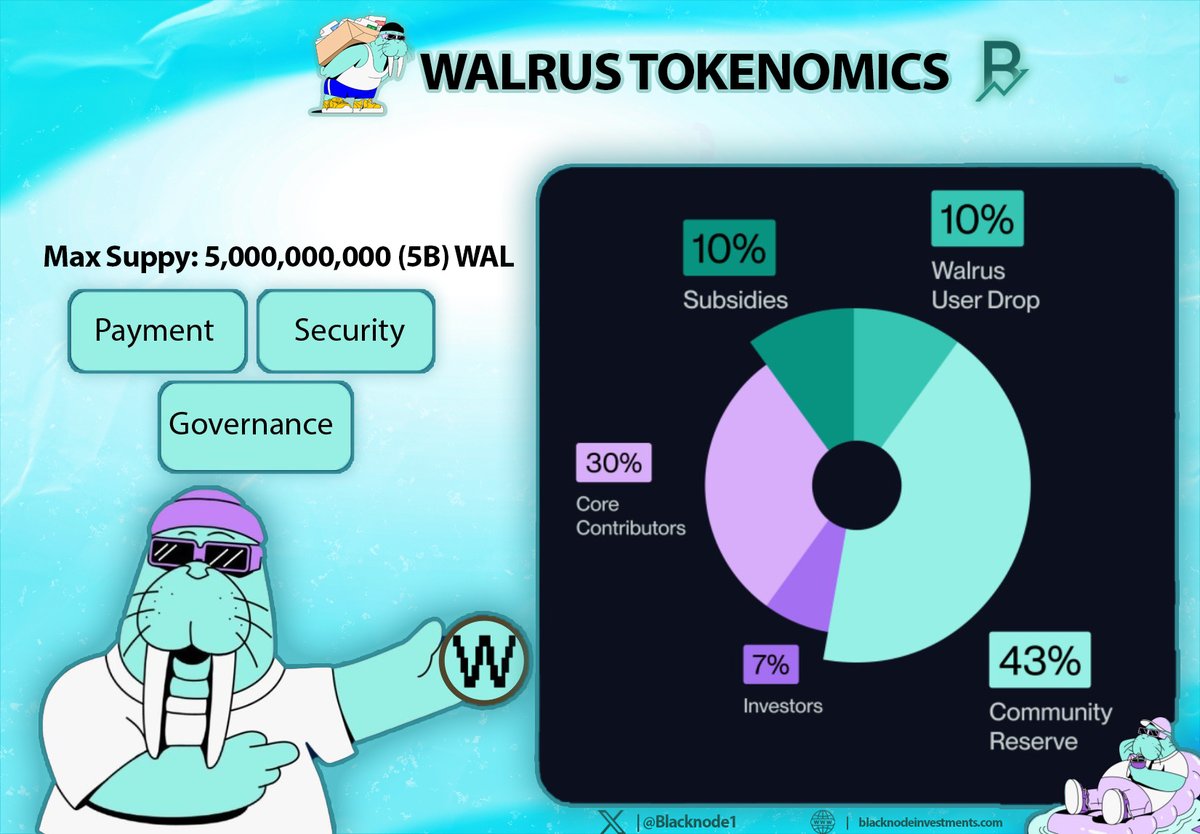
• Total Supply: Fixed at 5 billion $WAL tokens, with approximately 1.25 billion (25%) in circulation following the Mainnet launch on March 27, 2025.
• Community Allocation: Over 60% (3.05 billion $WAL) is dedicated to community initiatives:
• 10% Walrus User Drop: 500 million $WAL airdropped to early adopters (4% or 200 million pre-Mainnet via soul-bound NFTs, 6% or 300 million earmarked for post-Mainnet distributions) to reward engagement and incentivize adoption.
• 43% Community Reserve: 2.15 billion $WAL allocated for ecosystem growth—690 million available at launch, with the remainder unlocking linearly until March 2033 to fund grants, developer support, and incentive programs.
• 10% Subsidies: 500 million $WAL distributed over 50 months to support storage node operators as the fee base expands, ensuring network sustainability during early scaling.
• Core Contributors and Investors: 37% (1.85 billion $WAL) reserved for key stakeholders:
• 30% Core Contributors: 1.5 billion $WAL for early builders—20% (1 billion) to initial team members with a four-year vesting schedule and one-year cliff, and 10% (500 million) to Mysten Labs with a linear unlock until March 2030.
• 7% Investors: 350 million $WAL for participants in the $140 million raise led by Standard Crypto, subject to a 12-month unlock period post-Mainnet.
• Utility: $WAL serves multiple functions—payment for storage (prepaid and fiat-stabilized to mitigate volatility), staking for network security (nodes compete for allocations), and governance through weighted voting to determine penalties for underperformance. A Binance “Vote to List” campaign launched on April 2, 2025, has amplified community interest and potential liquidity.
• Deflationary Features: Penalties for short-term stake adjustments are partially burned, reducing supply, while underperforming nodes face slashing—mechanisms designed to enhance long-term commitment and maintain network efficiency.
/🧵 Walrus Ecosystem
• Akord Adoption: Over 120,000 users migrated from alternative platforms, utilizing Walrus for secure document and media storage—a testament to its reliability and appeal for sensitive data management.
• TradePort Integration: A multi-chain NFT marketplace relies on Walrus for tamper-proof metadata, ensuring consistency and trust across blockchain networks—an essential feature for digital asset ecosystems.
• DecryptMedia Initiative: On-chain storage of articles combats digital degradation and censorship, showcasing its utility for media preservation and accessibility in Web3.
• Claynosaurz Launch: Introduced on Mainnet (March 27, 2025), offering dynamic claymation collectibles with programmable features—illustrating Walrus’s capacity to support innovative, interactive content.
• Developer Activity: The “Breaking the Ice” hackathon engaged over 200 developers, yielding projects like DriftBottle (a decentralized messaging application) and SuiPet (a digital pet game), demonstrating versatility in decentralized application and media development.
• Community Engagement: A pre-Mainnet airdrop distributed 4% of $WAL tokens via soul-bound NFTs, fostering long-term user commitment. A community discussion (March 26, 2025) emphasized enhanced SDK tools for developers, further strengthening participation.
• Cross-Chain Ambitions: Sponsorship of the Solana Breakout Hackathon’s infrastructure track (April 3, 2025) signals intent to extend beyond Sui, broadening its Web3 footprint and interoperability potential.
• Emerging Projects: Talus (AI agents), Itheum (data marketplaces), Linera (microchains), and SnowReads (a decentralized digital library) enrich the ecosystem, with potential as a rollup data availability layer expanding its scope to support next-generation blockchain solutions.
/🧵 Roadmap Walrus’s future plans are ambitious and strategically focused, though specific timelines remain undisclosed:
• Independent Network: Transition to a fully autonomous decentralized system powered by $WAL and a delegated proof-of-stake (DPoS) model, enabling nodes to stake tokens for network security and rewards without intermediaries—a shift toward complete self-sufficiency.
• Walrus Foundation: Establish an entity to accelerate adoption through developer grants, user education initiatives, and community events—recent discussions (March 26, 2025) underscored this as a priority to cultivate a robust user and developer base.
• Technical Enhancements: Introduce node audits to ensure operational quality through cost-effective challenges, maintaining network integrity; premium read options to provide faster data access for a fee; and light node functionality to allow smaller participants to enhance network resilience and earn rewards—deepening decentralization and inclusivity.
• Growth Strategy: Post-Mainnet efforts concentrate on scaling the node network to reduce storage costs and enhance security, building on Testnet feedback from over 200 developers. The focus includes onboarding additional operators to diversify and strengthen the infrastructure.
• Scalability and Reach: Targeting exabyte-scale dominance by expanding the node ecosystem—more nodes translate to lower costs and greater reliability. Multi-chain integration, exemplified by the Solana collaboration (April 3, 2025), and support for rollups as a data availability layer aim to position Walrus as a universal Web3 storage solution, capable of serving diverse blockchain environments.
/🧵 Why It Matters Walrus addresses critical inefficiencies in Web3 storage, where centralized systems are costly and vulnerable:
• Scales to exabytes with a 4x-5x replication factor, significantly reducing expenses compared to traditional providers through advanced erasure coding and Sui’s intelligent contract system.
• Offers erasable blobs, granting users control over data lifecycles—a departure from immutable storage paradigms, enhancing flexibility.
• Enables a wide range of applications, from NFT media and AI datasets to game assets and censorship-resistant content, serving as a foundational infrastructure for Web3 innovation and adoption.
• With a $2 billion valuation and a thriving ecosystem, Walrus establishes itself as a cornerstone for secure, scalable, and user-empowered decentralized storage, poised to influence the broader blockchain landscape.
/🧵 What Still Needs Work Despite its strengths, Walrus faces areas requiring attention:
• Node Expansion: Increasing the number of storage nodes is essential—greater participation reduces costs and enhances security, necessitating accelerated operator onboarding.
• User Education: The complexity of erasure coding and Sui integration requires clearer documentation and tutorials to broaden adoption among non-technical users.
• Latency Challenges: Retrieval delays for large media files, such as high-resolution videos, remain a concern, particularly for media-focused applications—improving read speeds is critical.
• Security Scaling: As the network grows, risks of node collusion could emerge; robust audit mechanisms must evolve to maintain trust and integrity.
• Multi-Chain Adoption: Extending beyond Sui to additional blockchains will solidify its position as a leading Web3 storage solution—current efforts (e.g., Solana) need further momentum.
/🧵 Revised Overview
• Walrus Protocol stands out as a transformative force in decentralized storage, blending innovative technology with an economic model that puts people at its heart.
• Since launching on Mainnet on March 27, 2025, it’s shown remarkable promise through its scalable architecture, pioneering erasure coding, and programmable features powered by Sui integration—setting it apart from peers like Filecoin and Arweave.
• Its ecosystem thrives with partnerships like DecryptMedia and Claynosaurz, supported by over 120,000 users and more than 200 developers, reflecting strong early adoption and versatility across media, NFTs, and cutting-edge blockchain applications like rollups.
• The $WAL tokenomics, allocating over 60% to community-driven initiatives, encourages lasting participation, while its roadmap charts a course toward independence, scalability, and seamless multi-chain integration. Challenges remain, such as delays with large file retrievals and the need to grow its node network, but with a $2 billion valuation and backing from top-tier institutions, Walrus is poised as a vital pillar for Web3.
As it evolves, Walrus Protocol promises to reshape decentralized data management, delivering a secure, adaptable, and scalable foundation for the next wave of blockchain innovation.
TAGS: #WalrusProtocol #WAL #Sui #SuiBlockchain #SuiNetwork #SuiThread #SuiNetworkThread #WalrusProtocolThread #MystenLabs #MystenLabsThread #Crypto #CryptoThread #SuiCommunity @vyz_cm @Mysten_Labs @WalrusProtocol @SuiFamOfficial @SuiFoundation
55
7
151
7,623