
Our private residential program includes clinical staff, medically supervised detox, 24/7 nursing care, individualized holistic addiction therapy, wellness support, and luxury accommodations. ow.ly/Hr8g50Z6SZ7
#PassagesMalibu #LuxuryRehab #MalibuRehab #AddictionTreatment

Rods Rods retweeted

Here's another fun fact for @TulsiGabbard . Many of the labs were funded by DOD contract to Black and Veach and supervised by MetaBiota. Anyone recognize #Metabiota? Hunter Biden's investment firm, Rosemont Seneca Tech, invested and owned 13.4% of Metabiota, a pathogen-research company. Right when most of the contracts were being issued. Burisma pales in comparison to this scandal.
11
13
354

Allegedly,a 21-year-old woman in Brazil lost her life after being pushed from a 40-meter rope-jumping platform before her safety system was properly secured.
How does a mistake like this happen during a supervised activity? 🤔💔

1
1
25
아스피날 retweeted

2h
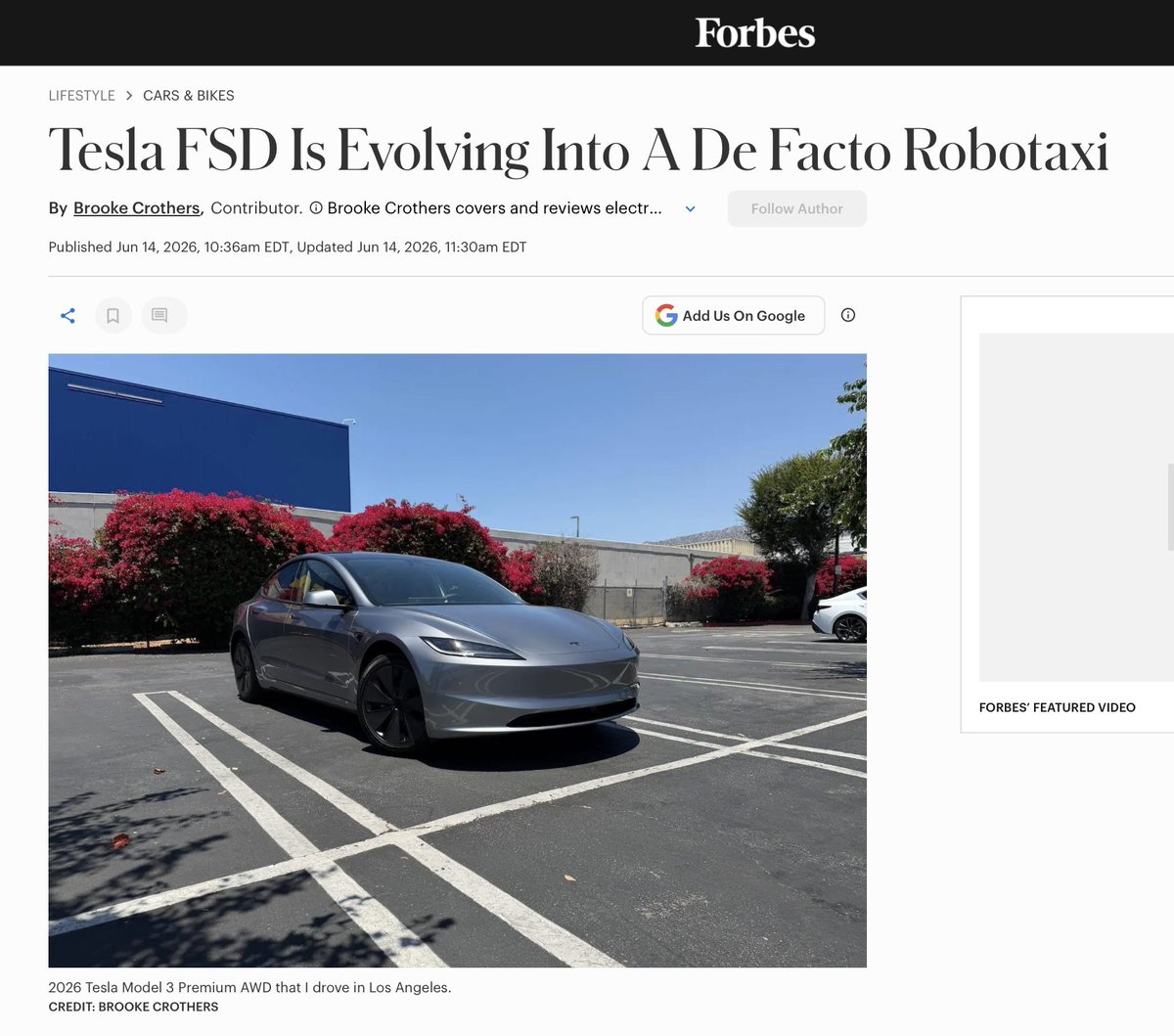
포브스가 FSD 또는 테슬라에 이런 평가를 하다니...본 적이 없는 거 같은데...그만큼 Unsupervised FSD면 몰라도 Supervised FSD는 깔 게 없을 만큼 충분히 좋다는 것.
고객의 선택만 남았을 뿐.

"Tesla FSD is getting harder and harder to distinguish from a driverless vehicle. Tesla’s latest version of FSD, v14.3.3, feels more like a Level 4 driverless ADAS than past versions of FSD. Of all the car manufacturers today pursuing an advanced ADAS, Tesla is ahead. Way ahead.
I just finished testing a 2026 Toyota bZ with Toyota’s version of an ADAS. It is a very basic lane centering technology. And this is from the largest car manufacturer in the world. When I drive with (Tesla) FSD now, I just sit there as a passenger and monitor the drive." - Forbes contributor Brooke Crothers
1
17
562

5m
You do realize that both Yuya and Yamamuro directed and supervised he didn’t work above him, and why are you on gay timing 🤔
4
Stefan Wyss 🚀🚘⚡ retweeted

@UVEK @BR_Sprecher @TCS_Schweiz @teslaeurope 🇨🇭
Sehr gut geschrieben @iamtobi 💯
Wann wird FSD Supervised auch in der so innovativen Schweiz ENDLICH zugelassen?🤷♂️ Es gibt keinen, aber auch GAR KEINEN Grund noch länger zu warten!!! Die Frage gilt doch schon lange, auf WAS ODER WEN wartet ihr?
FSD SUPERVISED MUSS JETZT AUCH IN DER SCHWEIZ🇨🇭ZUGELASSEN WERDEN!!!
@Tesla @Tesla_AI @elonmusk

4
15
336
Alex M. Swoboda 🇺🇦 retweeted

🇧🇪 Tesla is now rolling out a 30-day free trial of FSD (Supervised) to owners in Belgium!
A great way for drivers to experience FSD firsthand.



6
12
134
18,455

Konnex: How Autonomous Systems Could Create a New Labor Market for Robots The technology landscape is increasingly shifting from simple digital tools toward systems that can operate independently, make decisions, and carry out tasks without constant human supervision. Konnex sits squarely in that direction. It is building infrastructure for autonomous systems, robots, and physical work on-chain. This is not just another Web3 narrative or a speculative trend; it is an attempt to create a new market where robots, AI models, and execution systems can interact in a structured, scalable, and economically meaningful way. Konnex belongs to one of the most interesting frontiers in modern technology: the convergence of robotics, artificial intelligence, decentralized coordination, and the tokenization of real-world activity. In practical terms, that means building a marketplace where autonomous units can discover tasks, negotiate conditions, complete work, and get paid in a verifiable way. That vision is far more ambitious than a standard points campaign or a simple loyalty program. Konnex is trying to lay the foundation for an economy where machine labor becomes a native part of the internet of value. What Konnex Is Konnex is a project centered on the idea of an “autonomous systems economy.” Its core concept is to create an intermediary layer between robots, tasks, and payments. In the traditional model, robotics operates in isolation: a machine is programmed for a specific process, and its use is limited by ownership, location, and a closed operating environment. Konnex aims to break that model and introduce a system in which robots can function as market participants. Under this model, a robot is no longer just a device executing commands. It becomes an economic unit that can take part in the flow of work, services, and value. That opens the door to entirely new applications: logistics micro-tasks, infrastructure inspection, industrial operations, maintenance, and distributed physical services across geographies. Konnex wants to be the place where those activities meet and where they can be settled in a trusted and efficient way. Why It Matters Konnex matters not because “another robot project” sounds futuristic. It matters because it addresses a real scaling problem. As AI and robotics progress, the number of systems capable of doing work faster, cheaper, and more precisely than humans keeps growing, but there is still no universal coordination layer. Every environment, company, and manufacturer tends to build its own silo. That makes shared resources, service exchange, and a true market structure difficult to achieve. Konnex is responding directly to that gap. The project proposes a model where robots and other autonomous systems can communicate within a common economic layer. Instead of closed silos, there is an open infrastructure for exchanging services. Instead of one-off deployments inside a single company, there is a network that can grow as more participants join. This is similar to what the internet did for information: it moved from local, isolated databases to a global sharing layer. Robots as Market Participants One of the most fascinating aspects of Konnex is its treatment of robots as market participants. That means machines can become more than tools controlled by an operator. They can operate in an environment where tasks are assigned dynamically and compensation depends on actual work being completed. Such a model requires several key components: device identification, task verification, settlement mechanisms, and a reputation system. Without those, trust between parties is impossible. If a robot is supposed to perform work on someone else’s behalf, there must be confidence that the task was completed according to the agreed terms. Konnex is aiming directly at this problem by building a mechanism that supports trusted coordination of physical work performed by machines. This is important because the future is no longer just about whether a robot can do something. It is about whether it can join a broader economy and function within it much like applications, service providers, or freelancers do in the digital economy. If this model takes hold, robotics will stop being purely a capital expense and start becoming an income-generating asset layer. On-Chain as the Trust Layer The use of on-chain mechanisms in Konnex is central to its design. Blockchain here is not just a fashionable addition. It is a core tool for building trust, settlement, and an auditable record of events. In traditional systems, many actors must trust a central operator. In an on-chain model, some of that trust shifts to protocol rules and publicly available data. This makes it possible to track who completed a task, when it was completed, what the conditions were, and how settlement was handled. In a robotics environment, that is particularly valuable because every error, delay, or dishonest action can create cost. Transparency is not just ideology here; it is an operational necessity. If a system is expected to handle real services and real devices, it must be auditable. On-chain architecture also improves interoperability. Instead of building a separate system for every manufacturer, one can imagine a shared layer that allows different machines and environments to participate in the same market. That neutral infrastructure is one of Konnex’s most important strengths. The Economy of Physical Work Konnex is not limited to an abstract “AI blockchain” narrative. Its story focuses on the economy of physical work, the domain where real-world actions are performed by machines. That can include production, transport, monitoring, inspection, technical service, and auxiliary tasks in industrial and commercial environments. This matters because physical work has very different characteristics from digital work. It is not easily replicated, often requires proof of execution, and comes with higher operational risk. That means the settlement system for such tasks has to be much more sophisticated than a basic online services marketplace. Konnex is trying to build exactly that: a specialized market, not for files, data, or clicks, but for actual actions carried out by robots. If this infrastructure reaches critical mass, it could change how people think about automation. Instead of buying one robot for one process, companies could access a distributed network of performers that dynamically allocate physical and computational capacity wherever it is needed. That would move robotics closer to a service-based model and make it financially more flexible. Community and Points The points system around Konnex is also very important. Programs like this serve several purposes at once. First, they encourage users to stay in regular contact with the project. Second, they help build a base of early participants and test engagement mechanics. Third, they often serve as a way to distribute future ecosystem value to an active community. In practice, points become a measure of activity rather than just a cosmetic reward. Users complete specific tasks, publish content, interact with the project, and in return earn a position in the system. This model works best when it is designed well and does not devolve into spam. In projects like Konnex, quality of engagement matters more than raw quantity. That is why daily X posts, tagging the official account, and performing a weekly check-in can matter. It is not just about ticking a box. It is about showing consistent presence in the ecosystem and building a credible participation history. In projects like this, regularity is often more valuable than a single burst of activity. Why the Narrative Works From a communications standpoint, Konnex hits several powerful trends at the same time. First, robotics remains one of the hottest technology narratives of recent years. Second, AI continues to draw enormous attention, and any project combining intelligent systems with the physical world gets an immediate advantage. Third, Web3 and DePIN are still looking for useful applications beyond pure speculation. Konnex brings all of those together in one story. That matters because in the current environment, the most effective projects are not just products; they are compelling narratives. Konnex is not simply selling a token. It is selling a vision of the future in which autonomous machines become part of the economy. That is a very strong theme because it combines technology, economics, and futuristic imagination. At the same time, the project does not need to solve every problem on day one to attract attention. It only needs to present a credible direction and steadily deliver the next layers of the ecosystem. That is why communities engage so readily with projects like this: they are not only participating in a campaign, they are helping construct a story about the future. Market Potential Konnex’s market potential should be viewed across several dimensions. The first is the robotics market itself. The second is the infrastructure market for autonomous agents. The third is the settlement and coordination market for physical tasks. Each of those segments is interesting on its own, but together they create a very large opportunity space. If robotics develops along current trends, demand for interoperable coordination systems will continue to rise. Companies will not want to remain locked into a single vendor or a single environment. They will look for ways to flexibly add devices and services into their infrastructure. A system like Konnex could become the middleware between hardware and the broader economy. In that sense, Konnex could become more than just another well-branded project. If it builds real utility and secures the right partners, it could become an important player in a new technology category. That, of course, requires time, iteration, and product maturity, but the direction is clearly interesting. Risks and Challenges Every project of this kind faces significant challenges. The biggest one is technical complexity. Coordinating autonomous systems in the physical world is harder than building a typical web application. Safety, reliability, latency, environmental conditions, and regulatory compatibility all have to be considered. The second challenge is adoption. Even the best infrastructure will fail without real users and partners. Robotics requires capital investment, hardware access, and practical use cases. This is not a market where scaling through marketing alone is easy. Demonstrations, deployments, and business partnerships will matter far more. The third issue is community trust. Web3 projects are often judged through the lens of speculation and points campaigns, so Konnex has to consistently prove that there is real technology beneath the narrative. The more the project demonstrates value beyond the token or points system, the stronger its long-term foundation will be. How to Talk About Konnex Professionally If you want to write about Konnex in a professional way, it helps to focus on three layers: technology, market, and economics. Technology asks how the project coordinates autonomous systems. Market asks who can use it and why. Economics asks how value is created and how it is settled. A good Konnex article should show that this is not merely a trendy robotics story. It is an attempt to build infrastructure that can change how work is organized in the physical world. That is what distinguishes a serious article from a casual shill post. It also helps to emphasize that the project combines several industries at once, which raises its strategic significance. In community communication, a language of consistency and observation usually works better than overblown promises. Rather than saying “this will change everything,” it is better to say that the project is “building the layer for an autonomous robot economy” or that it “could become an important part of physical AI infrastructure.” That sounds more mature and is often better received by technical audiences. Why It Is Worth Watching Konnex is worth watching for several reasons. First, it operates at the intersection of several very strong narratives: robotics, AI, DePIN, and on-chain coordination. Second, its concept is broad enough to apply in many areas of the economy. Third, if the team continues to build product and partnerships consistently, it could become recognizable beyond the usual crypto audience. Another advantage is that Konnex does not feel disconnected from the real world. Its story is about work, task execution, settlement, and value created by physical systems. That makes the narrative more concrete than many other Web3 projects that rely mostly on abstract financial mechanisms. From the perspective of someone active in community campaigns, Konnex is also interesting because it combines social participation with the possibility of entering the ecosystem early. That creates a chance not only to earn points, but also to become part of a network that may develop rapidly. Final Thoughts Konnex is trying to answer one of the most important questions of the next decade: how do we organize the economy of autonomous systems in the physical world? Its ambition goes beyond classic Web3 thinking and touches the very way robots, AI, and on-chain infrastructure could work together in practice. That makes it an interesting, ambitious, and worth-following project. Konnex’s greatest strength is that it combines vision with a concrete problem space. It does not just talk about the future; it addresses a real challenge: coordinating machine labor, verifying task completion, and creating a market for autonomous services. If it can turn that vision into a working product, it may play an important role in the next wave of physical AI and robotic infrastructure. At the same time, it is important to remember that projects like this take time. The best results usually belong not to the noisiest teams, but to the ones that consistently build technology, community, and utility. That is why Konnex is a project worth not only observing, but also understanding in a broader technological and market context. is one of those projects that immediately stands out because it is not trying to fit into a narrow crypto category. Instead, it is aiming much higher: to create the economic layer where autonomous systems, robotics, AI agents, and verified physical work can interact in a coordinated, market-driven way. That ambition makes Konnex interesting not only as a Web3 project, but as a broader infrastructure thesis for the future of machine labor. At its core, Konnex is building a permissionless marketplace for autonomous systems. The idea is simple to say but difficult to execute: robots and intelligent machines should not just exist as isolated tools, but should be able to discover work, negotiate participation, complete tasks, and settle value in a transparent, verifiable manner. This transforms robotics from a hardware-only story into a full economic system. In that sense, Konnex is not merely a project about machines. It is a project about how machines become productive participants in a digital economy. The Core Vision The vision behind Konnex is grounded in a very important shift happening across technology. For decades, automation meant replacing a human task with a closed machine process. The machine performed a job, but it remained locked inside a single environment, owned by a single operator, and monetized through a fixed business model. Konnex proposes something different: a network where autonomous systems can act more like economic actors than passive tools. This matters because the next wave of value creation will not come only from software. It will come from the combination of software, AI, robotics, and real-world execution. The ability to coordinate those layers is what turns isolated automation into a scalable economy. Konnex is trying to be the coordination layer for that economy. It wants to make it possible for robots to participate in task-based work the way digital freelancers or service providers do today. That concept is powerful because it creates a bridge between physical labor and blockchain infrastructure. Once that bridge exists, entirely new markets become possible. Tasks can be distributed dynamically, work can be verified more easily, and compensation can be automated with greater transparency. That is the type of structure Konnex is betting on. Why This Narrative Matters Now The timing of Konnex is important. The world is entering a phase where AI systems are becoming more capable and robotics is becoming more practical. Hardware is improving, perception systems are getting better, and machine decision-making is advancing rapidly. But even as the technical side improves, there is still no widely accepted market mechanism for coordinating all these systems at scale. That is the gap Konnex wants to fill. It is not enough for a robot to be intelligent. It also has to be economically useful. It needs a way to find work, prove completion, and receive payment in a system that is trusted by all participants. Traditional infrastructure was never designed for that. It was built around centralized companies, fixed fleets, and manual oversight. Konnex is trying to replace those assumptions with a more open, market-based layer. This is why the project aligns so well with current narratives around DePIN, AI, and robotics. DePIN is about decentralized infrastructure with real-world utility. AI is about intelligence and automation. Robotics is about physical execution. Konnex sits at the intersection of all three. That intersection is one of the most valuable places to build today, because it connects digital coordination to material outcomes. Autonomous Systems as Economic Agents One of the most compelling parts of Konnex is the idea of treating autonomous systems as economic agents. This is a major conceptual shift. In the old model, a machine is owned, scheduled, and supervised by a person or company. In the Konnex model, the machine can be part of a wider marketplace where tasks are allocated based on availability, reputation, and capability. That means a robot can become more than a piece of equipment. It can be a participant in a network of production. It can search for work, accept jobs under certain conditions, and contribute to a shared pool of value. The implications are enormous. If a machine can autonomously participate in transactions, then labor itself begins to take on a new form. Of course, this requires robust infrastructure. There has to be reliable identification, task verification, secure execution, and a settlement mechanism that works across participants. But this is exactly where Konnex is positioning itself. It is not trying to solve everything at once. It is trying to establish the framework that makes this future possible. Onchain Coordination and Trust The use of onchain systems is not just decorative in a project like Konnex. It is foundational. When physical work is involved, trust becomes the central problem. Who performed the task? Was it completed correctly? Did the system follow the agreed rules? How is payment distributed? In a centralized environment, all of these questions are answered by one operator. In a decentralized environment, they must be answered by protocol design. This is where blockchain provides value. An onchain layer makes task records more transparent, settlement more auditable, and participation more verifiable. It reduces reliance on black-box coordination and replaces it with visible logic. For machine labor, that is incredibly important. The more complex and distributed the work becomes, the more valuable transparent coordination becomes. Konnex’s model suggests that blockchain can serve as the trust fabric for machine economies. That does not mean every action must be written directly onchain in the same way. It means the critical records of participation, execution, and settlement can be anchored in a way that gives the system credibility. In a market where autonomous robots are expected to carry out work independently, this trust fabric is essential. Physical Work as a New Market Category A key strength of Konnex is that it is not limited to abstract digital tasks. It is focused on physical work. That distinction matters a lot. Physical work is harder to automate than digital work, but it is also more valuable in many real-world industries. Logistics, inspection, maintenance, manufacturing support, monitoring, and service operations all contain large volumes of repetitive or semi-structured work that could eventually be performed by autonomous systems. If Konnex can help create a market where this work is standardized, verified, and economically tradable, then it is addressing one of the biggest opportunities in the next industrial wave. The platform would essentially help define how machine labor is accessed and monetized. That is a major infrastructure opportunity, not just a niche app use case. The significance of this becomes even clearer when you imagine a world with thousands or millions of autonomous units operating across different environments. They will need a common mechanism to receive tasks and settle outcomes. Without that, scaling becomes fragmented and inefficient. Konnex’s value proposition is to offer that common mechanism. The Role of Community and Points Like many early-stage projects, Konnex also uses community engagement as part of its growth strategy. Points programs are now a familiar mechanism in Web3, but they are not all the same. In a well-designed system, points help build early participation, reward consistency, and identify users who are genuinely interested in the project’s direction. For Konnex, this matters because the project is not just trying to attract attention. It is trying to create an informed early community around a complex technical idea. A project about autonomous systems and physical work needs more than hype. It needs people who understand the significance of the category and are willing to stay engaged over time. That is where points become valuable. When users post about Konnex, tag
@konnex_world
, and complete regular check-ins, they are doing more than promotional work. They are reinforcing the social layer around the project. That social layer matters because a network becomes stronger when its participants are visible, active, and consistent. In that sense, community participation supports the broader thesis of the project itself: distributed work needs distributed engagement. Why the Project Feels Different Konnex feels different from many crypto projects because it is not centered primarily on financial abstraction. It is centered on a real economic problem. How do you create a market for machine labor? How do you coordinate autonomous systems across a physical environment? How do you settle value when the work is not virtual but real? These are not trivial questions, and that is exactly why the project is interesting. It is trying to address a deeper layer of infrastructure than many short-term campaigns or speculative token launches. That gives it a more serious tone and a broader possible relevance. The project also benefits from a strong narrative fit. AI and robotics are already among the most compelling technology trends of the decade. When those trends are combined with decentralized infrastructure and onchain coordination, the result is a story that is both futuristic and economically grounded. That combination is powerful because it attracts both technical audiences and crypto-native communities. Market Potential and Strategic Angle The market potential for Konnex depends on whether it can become a meaningful coordination layer for autonomous systems. If it succeeds, its total addressable opportunity is not limited to one sector. It could touch robotics infrastructure, machine identity, decentralized task markets, physical AI, and even industrial automation platforms. That breadth is important because it makes the project adaptable. It does not need to rely on one exact niche to remain relevant. As autonomous systems become more capable, the need for common coordination, trust, and settlement layers will only grow.
16

RT @Tesla: With FSD Supervised, your Tesla can drive you anywhere you want
Try it yourself
405

For the 1982 classic film BLADE RUNNER, Mark Stetson and the Entertainment Effects Group, supervised by Douglas Trumbull, used detailed miniature models, smoke, lighting, and aerial photography to create the film’s iconic futuristic sprawling cityscape.



1
54
413
9,289
Matt Tallmer retweeted

"Nor that taking them off the street and placing them right into housing, without first a period of supervised housing and treatment, is asking for trouble.
Nor that giving away needles – not exchanging them for contaminated needles – is asking the same."
1
1
22

@grok is we are copying the Australian law - does this mean illegal by default, unless the parents opt out, by using supervised accounts in YouTube etc?
1
139

I hope they can fix the self driving features such as that the card doesn’t have to be supervised, and hopefully someday the government can fund it or something so the blind people such as myself can own one because that would really open up independence for blind people
1
MarFo retweeted

Jun 11
@min_dopravy @BednarikIvan
Budeme čekat až FSD Supervised schválí 8 států EU? Nebo 10?
Každý den co vyčkáváme je dnem kdy by mohlo FSD Supervised předejít nehodě nebo zachránit život
Místo toho čekáme, neděláme nic
5 států EU potvrdilo, že FSD Supervised zlepšuje bezpečnost

6
14
94
2,636
e.j. 🕯️| 🇨🇦🇰🇷 | ⚽️🏒🏀🏉❤️ retweeted

Jun 13
Today the Ford government is closing every supervised consumption site it funds — but taking away life-saving services doesn't make anyone safer. It just pushes the crisis into public spaces like this one.

2
98
251
5,926

Warum ASTRA in der Schweiz FSD Supervised freigeben muss – für mehr Sicherheit auf unseren Strassen
@UVEK @BR_Sprecher @TCS_Suisse @TOS_Switzerland
4
48