
Jun 15
Who runs the world?
The New Mexico Whiptail Lizard! 🦎
This lizard species is entirely female – so how do they reproduce?
Find out in this episode of #SurprisingScience!
#Lizards #Science #NaturalHistory
instagram.com/reel/DZhg4XVDt…
22
Did you know that the New Mexico Whiptail Lizard is entirely female? 🦎
But how do they reproduce? Find out in this episode of #SurprisingScience!
1
4
33
6,597
Don’t lose your head over these macabre mantis facts! 😳
In this episode of #SurprisingScience, discover how these insects give a whole new meaning to “looking good enough to eat” 🍴
1
7
26
5,160
Overfishing doesn’t just reduce cod populations, it can change the fish themselves. 🐟
Find out how cod have evolved – and why sustainable fishing is so important – in this week’s #SurprisingScience.
2
11
38
5,070
Do goats really faint and scream? 🤔
Find out in this week's #SurprisingScience! 👇
11
40
7,843
Find out about the fascinating behaviour of the Surinam toad in today's #SurprisingScience 🐸
2
21
6,698

27 Sep 2025
Contrary to popular belief, only about 70% of snakes lay eggs - many species, like the anaconda, give birth to live young! 🐍
Discover why they do this and how it works in this week’s #SurprisingScience 🥚
2
15
5,288
19 Sep 2025
While attacks on humans are thankfully rare, Komodo dragons are well equipped to hunt prey much larger than themselves - with all three of the above. ☠️
Discover more of their deadly dental secrets in this week’s #SurprisingScience 🦎
1
3
15
3,459
6 Sep 2025
This was not a labelling error, but a taxidermy one - the scientists were confused by echidna’s backwards-facing feet, and mounted them forward!
Find out all about echidna’s wonderful feet and what they’re used for in this week’s #SurprisingScience 🦔🦶🏾
1
21
3,867
31 Aug 2025
Most of us humans are lucky enough to keep our bones safely tucked away - but the showboating sloth has theirs on show every day! 🦥
Find out which part of their skeleton lives outside of their body and why in this week’s #SurprisingScience 🦴
1
4
18
4,405
16 Aug 2025
Whilst we’re dreaming in hypotheticals, butterflies don’t have to choose - and they make good use of their tasting feet, too.
Find out all about it in this week’s #SurprisingScience 👅🦋
2
18
4,206
9 Aug 2025
These are all top contenders - but it’s actually sperm whales that produce the loudest noise of any animal on the planet, with calls reaching up to 230 decibels! 🐳🫨
So how do these creatures create a noise as loud as a jet engine? Find out in this week’s #SurprisingScience 🔊
5
32
4,489
26 Jul 2025
Aside from the beautiful individual colours and patterns, the unusual pyriform shape of guillemot eggs has caused a lot of discussion among scientists - and as always, it comes down to egg-volution.
Find out the point of these perfectly peaked eggs in this week’s #SurprisingScience 🥚🏔️
1
2
18
3,904

25 Jul 2025
On this day in 1978, a baby was born who changed the definition of what was possible. Louise Brown, the world's first IVF baby, wasn't the product of some sci-fi lab; she was the result of one of the most delicate engineering feats in human history.
For the first time, scientists were able to successfully fertilize an egg with sperm outside the body, in a simple laboratory dish, and transfer the resulting embryo back to the womb to grow naturally.
The media's term "test-tube baby" made the process sound cold and unnatural. But the true innovation was in creating a microscopic, perfectly controlled environment that could mimic the safety of the human body for just a few critical days. The goal wasn't to replace a mother, but to give biology a brilliant, helping hand at the most crucial first step. It is a technology of hope, not hubris, that has since helped create millions of families.
What's another scientific breakthrough that was initially met with fear or misunderstanding, largely because of how the media described it?
#SurprisingScience #History #Engineering
For more analysis that reframes the world, you know where to find me.

ALT Daily Mail
4
2
11
609
25 Jul 2025
It's a bizarre paradox of pain: a deep, bleeding cut can be less agonizing than a tiny, shallow paper cut. This isn't in your head. It's a matter of brutal microscopic physics.
A sharp blade makes a clean incision, slicing neatly through skin. But a piece of paper is a different beast entirely. On a microscopic level, its edge is a flexible, porous, and surprisingly serrated saw that tears a chaotic path through your skin cells.
This rough ride damages a huge number of pain receptors (nociceptors) right at the surface, leaving them exposed to the air. Because the cut is so shallow, it often doesn't bleed enough to clean out irritants or form a protective clot. The nerve endings are left open and exposed, sending a relentless barrage of high-alert signals to your brain from a seemingly insignificant wound.
What's another small, everyday thing that seems way more painful or annoying than it has any right to be?
#SurprisingScience #HiddenGenius #Biology
For more analysis that reframes the world, you know where to find me.
4
11
515
24 Jul 2025
There's an object, known for 400 years, that's so strong you can shoot a bullet at its head without it breaking. But if you gently snip its delicate tail, the entire thing instantly vaporizes into dust, with fractures traveling at over 4,000 miles per hour.
It's called a Prince Rupert's Drop. You make one by dripping molten glass into a bucket of cold water. The outside of the droplet solidifies almost instantly, while the inside remains molten and cools much more slowly, contracting as it does.
The process results in immense compressive stress on the outer shell (making the head incredibly tough) while trapping massive, high energy tensile stress on the inside. The fragile tail is the single key to this glass bomb. Snapping it releases all that stored energy at once in a catastrophic, supersonic chain reaction.
This seems like a wildly impractical property. Where could you actually use a material with this bizarre combination of extreme strength and explosive failure?
#SurprisingScience #Engineering #Physics
For more analysis that reframes the world, you know where to find me.
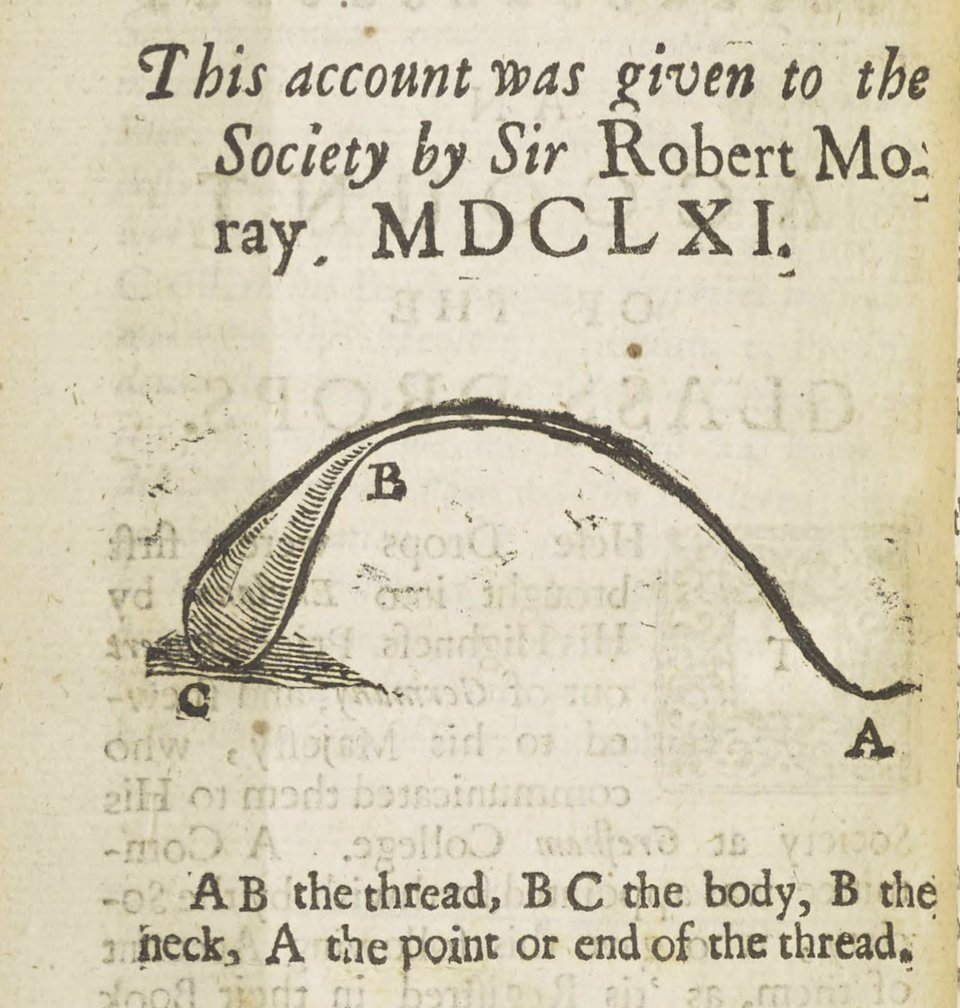
ALT Figure from "Account of the Glass Drops" by Sir Robert Moray, as given to The Royal Society in 1661.
2
4
323
14 Jul 2025
A lot of people think hyenas are a kind of dog, and they do share a lot of similar traits - but actually, hyenas are in a family all of their own.
So why are they so similar to dogs? Find out in this week’s #SurprisingScience 🐕
5
23
3,903
12 Jul 2025
Turns out “once in a blue moon” isn’t just a phrase - the moon really can turn blue, and it did for a whole year after Krakatau erupted! 🌋
Find out how it happened, why, and when you might see another blue moon in this week’s #SurprisingScience 🔵🌙
1
10
30
4,294
1 Jul 2025
If you picked to be cool, you’re definitely on the right track…but there’s a little more to these peculiar patches!
Find out exactly why giraffes have spots, what they do and what lies beneath them in this week’s #SurprisingScience 🦒🟠
2
5
3,088
27 Jun 2025
Unsurprisingly, none of these are the real reason we haven’t visited Venus or Mars (though we’re probably still waiting on a formal invite.) 💌
Discover the actual dilemmas preventing us from popping to the neighbours in this week’s #SurprisingScience 🚀🌌
5
3,190