
“The techstream data was lined up with the Waze data” is not a correct statement. Trigger 1162-2 is not correlated to Waze at all.
1
8
Medical testimony focused on injury mechanism and blunt force trauma patterns, not labels like “car strike” or “no car strike.”
Dr. Scordi-Bello listed the cause of death as blunt impact injuries of the head with hypothermia as a contributory factor, and ruled the manner “undetermined.”
Dr. Aizik Wolf testified that the injury pattern was consistent with a sudden fall causing severe head trauma and rapid incapacitation.
Dr. Laposata described a coup-contrecoup injury from a backward fall, not consistent with a simple frontal bumper strike.
Dr. Stonebridge identified brainstem herniation consistent with severe blunt force trauma and rapid deceleration.
Dr. Rentschler testified based on autopsy X-rays, finding no indication of acute injury to the arm, while acknowledging that X-rays do not show soft tissue injury and that an MRI would be required. He also maintained that the abrasions were not consistent with a vehicle impact based on his interpretation. It is worth noting that his analysis was limited and did not incorporate physical evidence at the scene, vehicle TechStream data, or cellular phone data.
The testimony isn’t “no expert said it.” It’s what experts described as severe blunt force trauma and offered competing interpretations of the mechanism.
1
14

yes and I discount the taillight fragments because of that. Proctor had nothing to do with cell phones, or techstream data. They tell the story. Karen backs up and John never moves again.
2
32

Did it record a collision ? Its like Dr Rentschler said , you might find a smoking gun beside the body but it doesn't prove how the victim was stabbed , in other words there was no collision unless you can prove it , and no I doubt the Lexus tail light had dog teeth inside , other than the dogbites John had no injuries consistent with an auto strike and techstream data doesn't prove anything unless it lines up with injuries .
1
10
Why are you avoiding speaking about trial 2 testimony?
Before Trial 2, a full extraction was performed of the TechStream data in the presence of both parties and their experts.
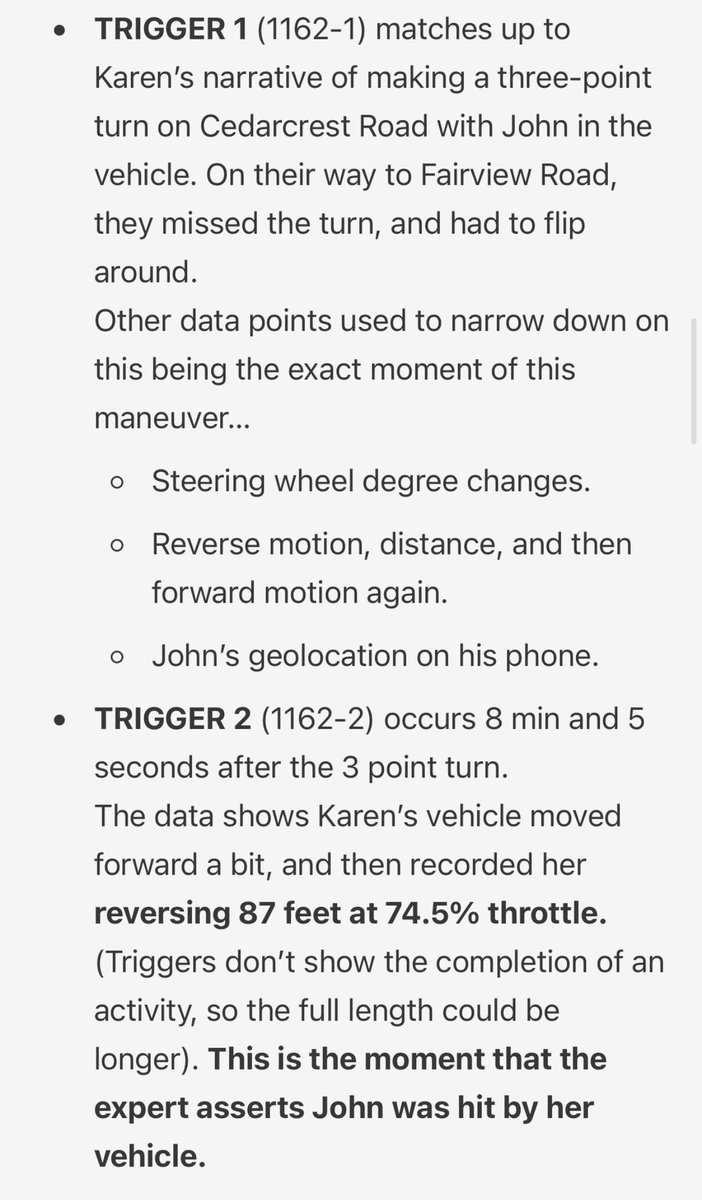
Using Karen Read's own timeline, vehicle mileage, surveillance video, Waze high accuracy location from John O'Keefe's phone data, steering wheel inputs during the trigger events, and the admitted three-point turn on the way to 34 Fairview, the reconstruction expert was able to identify Trigger Event 1. That, in turn, allowed him to align Trigger Event 2 with the reverse maneuver occurring approximately eight minutes later at the same location and around the same time John's phone recorded its last movements.
From there, the phone data shows no meaningful movement until John was discovered hours later.
2
8

That's the issue. In any other case there are concrete timelines with data to back it up. That is not the case here because they are only using Waze data from JOK's phone where they claim there is "clock drift" by 3 minutes and TechStream data that doesn't have dates or times. Plus on top of MSP deleting Karen's location data from her phone while in their custody.
Once you research, you'll hear a lot about key cycles. The very key cycle where they claim an impact happened, actually occurred when her vehicle was being towed much later that day by MSP. This very issue is why the Commonwealth had to change their theory of the time of impact 4 times (twice during either trial).. and that still doesn't matter because ⤵️
Other data you must factor in is her phone connecting to JOK's home wifi at 12:36 AM and JOK's phone disconnecting from her vehicle at 12:30 AM. This lines up with the average drive from 34 Fairview to JOK's (6-7 minutes). JOK's phone was still moving at 12:32 AM. The SUV had already left the property before the phone's last movements. And the video footage from her drive home is missing. This same footage would've given investigators a clear view of the rear of the SUV.
This is why I am trying to explain that the data is not as simple as it seems.
It's much easier to comprehend that JOK's body, along with every medical examiner and expert agreed, does not align with being hit with a vehicle. He was punched in the face, has classic self-defense bruising on his hands, and fell into some sort of ledge surface that does not match anything on the side of the road where he was found. On top of the lack of frostbite he should have had being out in below freezing temps, during a blizzard, wearing no protective snow gear, for over 6 hours.
JOK arrived at either 12:21 or 12:24 AM. And where the theory goes from there depends on who you believe.
1
6
109
Samantha Watt Music retweeted

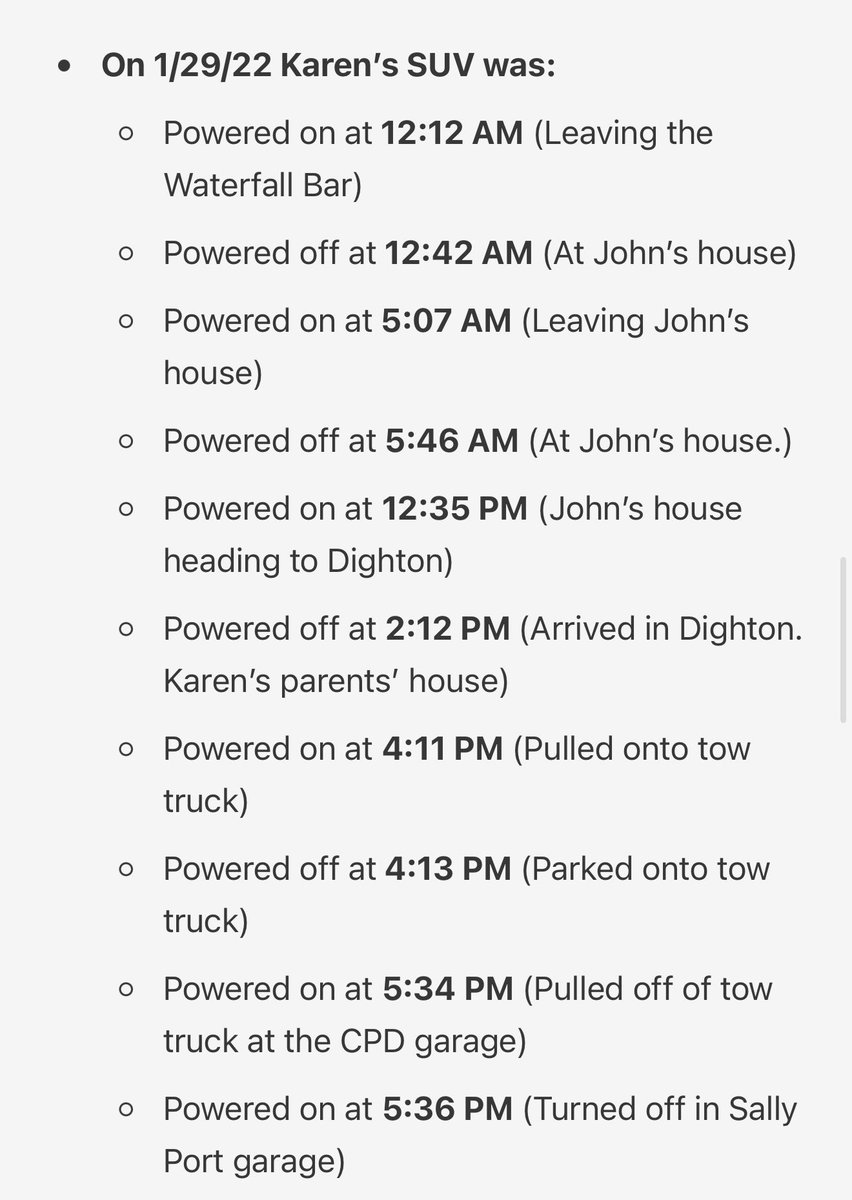
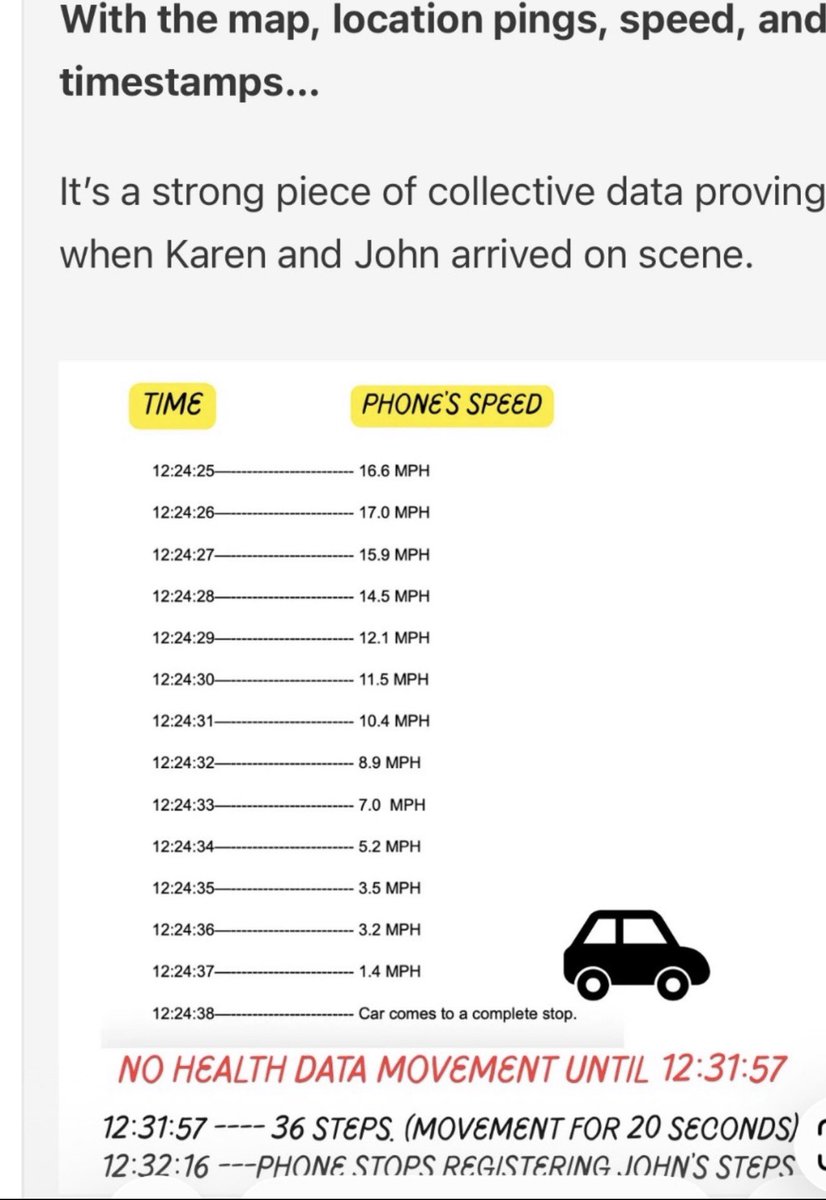
You are incorrect. The techstream data was lined up with the Waze data, John’s geolocation and speed data, Karen’s 3 point turn (steering wheel movement, etc), power on-power off time, and triggers within one set of power on and power off.
It’s very clear. ARCCA couldn’t even contest it. And Karen could only respond with “the data is the data” when asked about it by media.
3
1
18
929
Ma’am, this is the data from the second trial. The “key cycles” were used in first trial prior to the full techstream data being extracted.
1
11
59

20h
Posting a picture of the victim while actively advocating for the person the victim's family believes is responsible for his death, and whom they are suing for wrongful death, strikes me as deeply tone-deaf.
John O'Keefe was a real person, not a symbol for a movement. Using his image while promoting a narrative that is directly opposed to the position of the people who loved him most feels less like honoring his memory and more like using him to advance a cause.
Your questions don't make people emotional as much as they make people angry. That's because many of them are not grounded in the evidence but in speculation derived from the narrative of the person the evidence points toward.
Objective data has no bias. Cell phone data, TechStream data, and other digital evidence do not care about hashtags, influencers, or public opinion. The frustration comes when those objective data points are ignored in favor of speculation and talking points that came “straight from the horses mouth.”
1
2
147
Jun 13
Fair commentary is objective. It is not taking a position before hearing all of the evidence. It is not becoming so closely aligned with a murder defendant that you purchase her used mattress. It is not escorting her out the doors of political events, dressing up in an inflatable duck costume while rubber ducks are used around to accuse a young man of murder.
Fair commentary is not overlooking objective data because it conflicts with a preferred narrative. It is not dismissing cell phone data, Techstream data, or expert testimony simply because the conclusions are inconvenient.
Fair commentary asks questions of everyone. It scrutinizes all claims equally. It follows the evidence wherever it leads, even when the answer is not the one you were hoping for.
Advocacy is allowed. Commentary is allowed. But they are not the same thing. Calling advocacy "commentary" is a lie.
5
6
49
8,002
Jun 13
You don’t discuss the objective data. John’s cell phone data or the TechStream data and you certainly don’t discuss the broken taillight at the 8:23 wellness check or ask where the red lens is or how she damaged the taillight.
6
3
488

Jun 13
Like the Techstream data? The 3 point turn, the 74.5% reverse incident? The lack of digital data showing JOK’s movements after KR “dropped him off?” What about the physics disproving the taillight could have broken when the Lexus tapped the Traverse?
1
13
Mariano Rivera retweeted
Jun 13
You want to talk about the cell phone data and the TechStream data? Great. Let's talk about it.
These are the facts presented at trial, and notably, the defense did not call an expert to refute them.
Karen Read was intoxicated. Her SUV recorded a reverse event reaching 74.5% throttle and speeds up to 24 mph. At the same time, Officer John O'Keefe's cell phone stopped moving. She then left him and phoned him within minutes to tell him she “f*cking hated him”.
The SUV stops at 12:24:38. There is no recorded movement for seven minutes. At 12:31:56, a brief 20-second step event begins. During that period, the phone briefly pings the house while refining GPS accuracy, but the latitude and longitude do not change.
At 12:32:09, the last user interaction with the phone occurs.
At 12:32:16, movement stops.
Beginning at 12:33:14, 26,532 Doppler checks consistently register a pocket state for more than five hours, indicating the phone remained stationary.
At approximately 12:37 a.m., the battery temperature begins dropping and continues to decline, consistent with the phone being outside in cold conditions.
Coincidentally, Burgess concluded that the second trigger event, 74.5% throttle and speeds up to 24 mph in reverse, occurred between 12:32:04 and 12:32:12.
Movement does not resume until 6:04:01 a.m., when Karen Read, Kerry Roberts, and Jen McCabe are performing CPR. The phone registers movement because it is underneath John.
Notably, after John is moved onto the stretcher and the phone is exposed, the device records its lowest temperature, 37°F, at 6:14 a.m.
At 6:15:01 a.m., Kerry Roberts is seen on dash cam picking up the phone and baby blankets. At that same time, the pocket state clears. Once the phone is placed in her pocket, the battery temperature begins to rise. It continues rising when she gets into a warm vehicle.
This conclusion was not based on one isolated data point. Ian Whiffin relied on multiple independent data streams: steps, Doppler pocket state, user interactions, battery temperature, and location data. All of them told the same story.
He concluded that John O'Keefe's phone never moved far from the flagpole area from 12:25 a.m. until it was recovered in the morning.
Before Trial 2, a full extraction was performed in the presence of both parties' experts.
Burgess used Karen Read's own timeline, vehicle mileage, surveillance video, John O'Keefe's phone data, steering wheel inputs during the trigger events, and the admitted three-point turn on the way to 34 Fairview. That analysis allowed him to identify Trigger Event 1 (the three-point turn) and align Trigger Event 2 with the reverse maneuver that occurred eight minutes and 5 seconds later in front of 34 Fairview at the same time John's phone recorded its last movements.
At 8:23 a.m., a police dash cam captured the damaged taillight in the driveway of 1 Meadows. Barros confirmed on cross and recross that the taillight damage visible in the wellness check image was consistent with what he observed in Deighton. He also testified that the image in the Sally Port was not consistent with what he saw at Deighton, and that's correct. The image of the SUV in the Sally Port was no longer covered and packed with snow as it had been when he first observed it in Deighton.
All of those independent data sources tell the same story: John O'Keefe never entered the home. His phone stopped moving at the same time Karen Read's SUV recorded a high-speed reverse event, and the cell phone remained stationary until John O'Keefe was found. Her taillight was damaged and missing the red lens before the vehicle was ever brought to the Sally Port.
If John never entered the home, then arguments about who called whom, who butt-dialed whom, whose wording changed across multiple sworn testimonies, and who remembers what become secondary questions.
As David Yannetti stated on your show, "testimony changing is not unusual ... it doesn't always mean someone is lying ... when you tell a story of what happened, you never tell it the same way twice." The more important question is whether the objective digital evidence changes.
It doesn't.
That's why the phone data, vehicle data, battery temperature data, Doppler data, location data, and physical evidence all matter. They are independent data streams, and they all point in the same direction.
She was drunk, she hit him, and she left him.
5
7
46
995