
Apr 20
#AwaazStory | आपका टेलीकॉम बिल फिर से बढ़ गया है....
भारती एयरटेल ने 84 दिन वाले अपने सबसे पॉपुलर प्लान का टैरिफ बढ़ा दिया है...
क्या है डिटेल ?
#BhartiAirtel @aseemmanchanda #recharge #telecombill
1
4
2,962

28 Jul 2025
Will India’s draft telecom cybersecurity rules backfire? Rajya Sabha flags vague terms like “any other data” & TIUEs. Experts warn of privacy risks, compliance chaos & regulatory overreach.
#CyberSecurity #TelecomBill #DigitalPrivacy #RajyaSabha
medianama.com/2025/07/223-ra…
163

11 Jul 2024
MP @charith9, during the debate on the Telecom Bill, told the P’ment that consulting experts like Prof. @samarajiva leads to more effective legislation.
“His well-versed suggestions were agreed upon in the Supreme Court Determination.”
#SriLanka #LKA #TelecomBill #LIRNEasia
1
4
9
1,014

10 Jul 2024
With a new telecom bill amending a 28-year-old law, Sri Lanka allows Elon Musk's Starlink to operate in the country. This move aims to boost the IT sector to a $15 billion industry by 2030 and improve rural internet access. #SriLanka #Starlink #TelecomBill finance.yahoo.com/news/sri-l…
2
5
311
29 Jun 2024
This decision comes after significant criticism from experts, including LIRNEasia Chair @samarajiva, who had been vocal about the potential threats to #democratic values posed by the certain provision in the #TelecomBill.
lirneasia.net/2024/06/suprem… #SriLanka #LKA #News
1
1
3
370
24 Jun 2024
Supreme Court of Sri Lanka cites LIRNEasia's insights in Telecom Bill Determination
lirneasia.net/2024/06/suprem…
@samarajiva @tahaniiqbal @IDRC_CRDI @IOSPress_STM
#LIRNEasia #SriLanka #CPRSouth #PolicyImpact #TelecomBill #LKA #Telecommunications #supremecourt
6
13
768

18 Jun 2024
सरकार बताएगी कौन होगा टेलीकॉम सेक्टर का राजा! समझिए इस वीडियों में
#trai #telecom #setellelite #ashwinivaishnav #telecombill
@dwivedi_arnima
3
131

10 Jun 2024
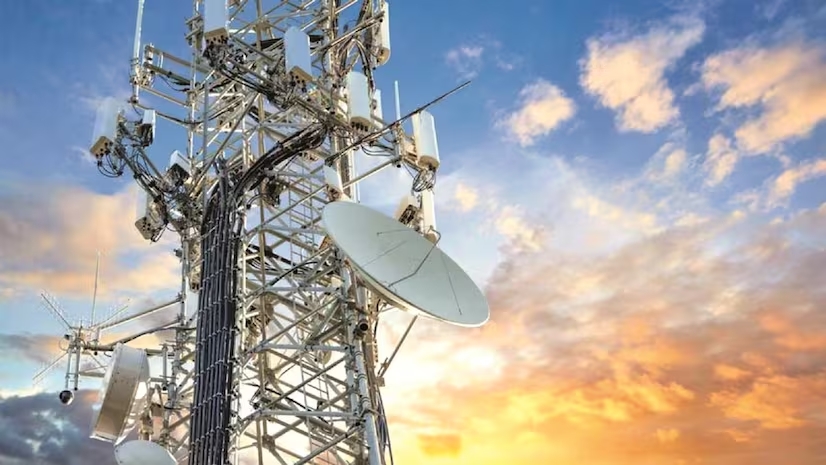
In the first 100 days, expect major strides in India's tech policy!
The IT & telecom ministers will focus on notifying rules for Digital Personal Data Protection Act and #TelecomBill. Plus, guidelines for #AI and satellite spectrum are in the pipeline.
@Subhayan_ism
mybs.in/2dWa1BB
2,538

18 May 2024
In December last year, with most Opposition MPs suspended in Parliament, Lok Sabha passed
the Telecommunications Bill, 2023, replacing these three archaic laws - Telegraph Act of 1885,
the Indian Wireless Telegraphy Act of 1933 and The Telegraph Wires (Unlawful Possession)
Act, 1950 and brings all telecom regulations under one Act.
The Telecom Bill, 2023 deteriorates user rights in several other ways, many of which directly
infringe on the user’s fundamental right to privacy. Clause 3(7) is one such privacy invading
provision which imposes an obligation on any authorised entity, as notified by the Union govt, to
identify the person to whom it provides telecom services, through use of any verifiable biometric
based identification “as may be prescribed”. The Telegraph Act, 1885 also contained a similar
provision for licensed entities, but with safeguards and specificity. Section 4(3)(a) listed the
various modes of authentication that may be used by the licensee, including offline
authentication, and also explicitly mentioned alternatives authentication modes to Aadhaar such
as passport. This inclusion of “verifiable biometric based identification” raises fears that it may
provide a legislative basis for the mandatory linking of Aadhaar to mobile phones which was
ruled as unconstitutional by the Supreme Court of India.
Written & Narrated by : @madiiihahaha
@mygovindia @MIB_India
@EduMinOfIndia @DoT_India
@CBCCHENNAI_MIB
@AshwiniVaishnaw
@TelecomTalk @PIB_India
@BJP4India
#telecombill #India #Government #Act #BJP
1
1
89

25 Apr 2024
Let's prioritize genuine debate over baseless claims.
The #TelecomBill 2023, introduced last December, permits administrative spectrum assignment for specific services like radio backhaul, in-flight connectivity, maritime services, & satellite operations, including GMPCS licenses
24 Apr 2024

2G Spectrum पर हल्ला करने वाले मोदी, अब 5G Spectrum का महाघोटाला कर रहे हैं।
#Modi_Ka_5G_Ghotala
1
6
3
199
5 Feb 2024
2
2
13
4,355

31 Jan 2024
#TransparencyInternational ranks India 93 of 180 nations on corruption perceptions index, says 'ahead of the elections, further narrowing of civic space, including passage of a (#TelecomBill) could be "grave threat" to fundamental rights'. #anticorruption nationalheraldindia.com/inte…
1
4
283

12 Jan 2024
#TelecomBill 2023 mandates biometric verification of every social media user by the telecom services provider. This creates the architecture of an identity-linked internet telecom service that will erase all anonymity online.
By @ShashiTharoor
newindianexpress.com/opinion…
2
352
12 Jan 2024
#OPINION | “Bharat moves on,” telecoms minister Ashwini Vaishnaw tweeted when the #TelecomBill 2023 was passed. But in which direction are we moving? Towards the world of 2024 or the dystopia of 1984? @ShashiTharoor writes.
newindianexpress.com/opinion…
8
7
950
9 Jan 2024
📡 Exploring the gray area in India's new telecom act: Does it cover WhatsApp, Signal, Telegram? MediaNama's Kamya Pandey highlights areas of ambiguities. #TelecomBill #OTTservices
medianama.com/2024/01/223-te…
267

7 Jan 2024
#NDTVProfitExclusive | Minister for Communications @AshwiniVaishnaw addresses concerns on 'surveillance' and encryption post approval of #TelecomBill 2023.
Watch his whole conversation with @TamannaInamdar: bit.ly/41EzbWJ
3
14
3,193
7 Jan 2024
#NDTVProfitExclusive | No more 'Press 3, Press 5'
Minister for Communications @AshwiniVaishnaw says #TelecomBill will set a time frame for resolution of online disputes.
Watch whole conversation with @TamannaInamdar: bit.ly/41GVgDS
1
5
3,379
3 Jan 2024
#NDTVProfitExclusive | No more 'Press 3, Press 5'
Minister for Communications @AshwiniVaishnaw says #TelecomBill will set a time frame for resolution of online disputes.
Watch whole conversation with @TamannaInamdar: bit.ly/41GVgDS
2
9
4,462
2 Jan 2024
#NDTVProfitExclusive | Minister for Communications @AshwiniVaishnaw addresses concerns on 'surveillance' and encryption post approval of #TelecomBill 2023.
Watch his whole conversation with @TamannaInamdar: bit.ly/41EzbWJ
2
9
5,141

30 Dec 2023
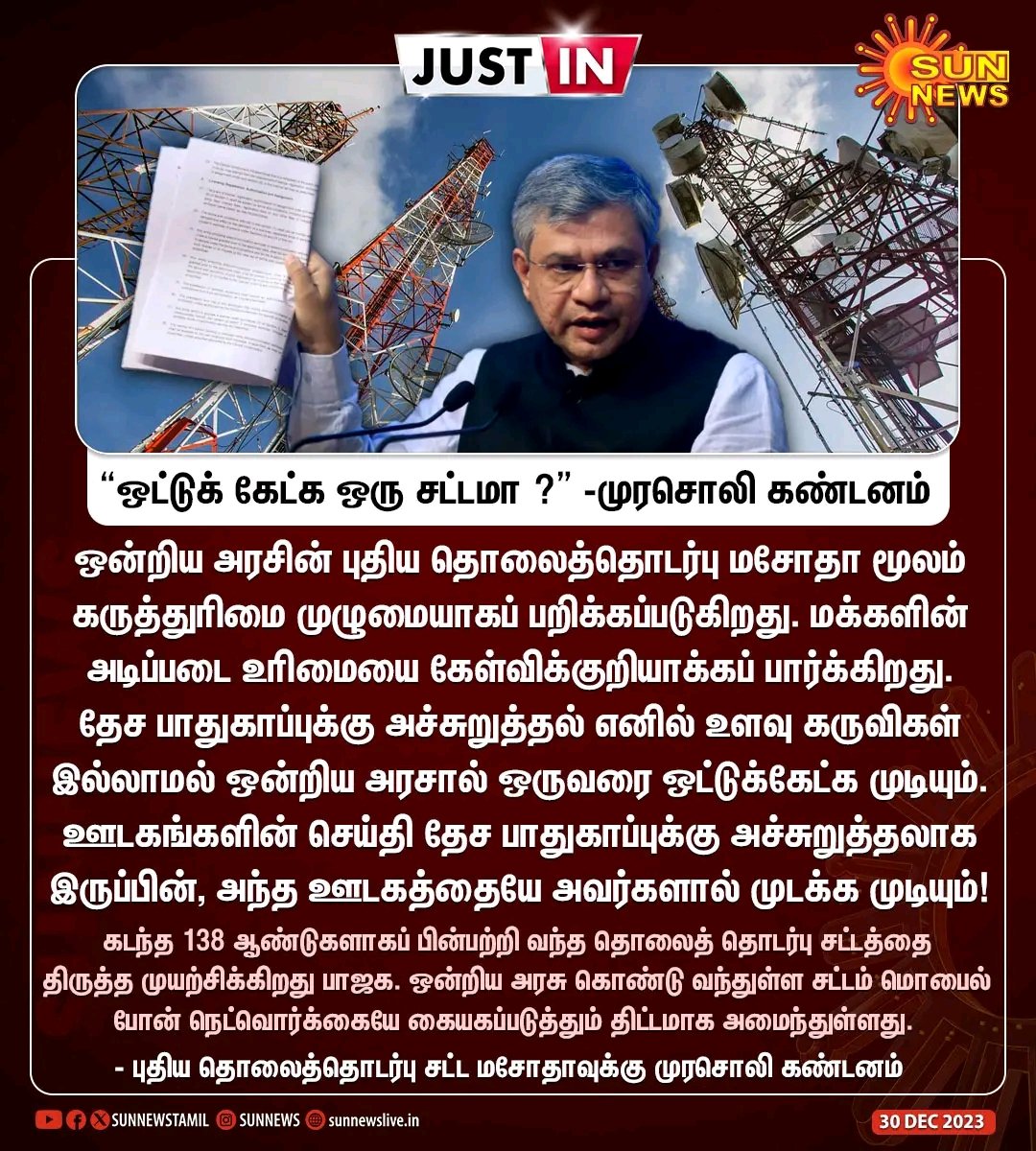
“ஒட்டுக் கேட்க ஒரு சட்டமா?”
- புதிய தொலைத்தொடர்பு சட்ட மசோதாவுக்கு முரசொலி கண்டனம்
#TelecomBill #NewTelecommunictionBill
3
4
129