
Jun 11
Models only use 10% of their brain... TestMachine uses 100%
2
3
98

Jun 10
Testmachine AI has spent years building a proprietary AI model for smart contract security
If you are in DeFi, shoot them a DM!
Jun 9

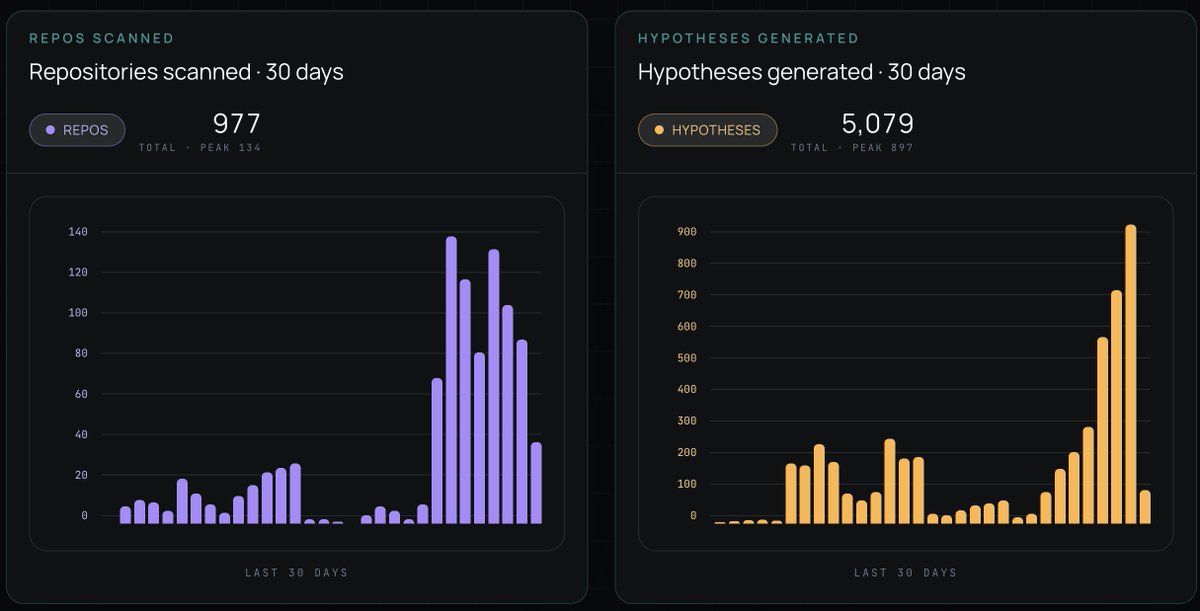
We just had our biggest day with Azimuth:
130 repos scanned
897 vulnerability hypotheses generated
Azimuth helps DeFi protocols and auditors finding critical issues in real time.
Security at scale. Not at luxury prices.
→ See what's hiding in your repo: app.testmachine.ai
4
13
2,036

Jun 8
Now, picking up from where I left off in my previous post.
Liquid farms like Aave and Spark hold capital that needs to stay accessible for short-term withdrawals.
Illiquid farms, Pendle Principal Tokens, Ethena's sUSDe positions, and tokenized private credit instruments like Fasanara's mGLOBAL fund, receive capital matched to the lock durations of the junior tranche.
The fractional reserve element is that the protocol does not keep all liquid capital in liquid farms. Because siUSD holders will not all withdraw at the same moment, a portion of their capital gets redirected into higher-yielding illiquid positions.
This improves returns for siUSD holders above what a purely liquid deployment would achieve. Illiquid depositors also benefit, because the pooled capital base gives the protocol access to position sizes and yield sources that individual depositors could not reach alone.
Both sides earn more than they would outside the system.
The reserve ratio, the fraction of liquid capital redirected to illiquid strategies, is calibrated against observed depositor behavior and is visible on-chain at all times.
Anyone can verify the asset-liability position at any block, not through a disclosure filing but through the live state of the contracts.
That transparency is also what makes the governance layer coherent rather than decorative.
liUSD holders vote on capital allocation across farms. Voting power is weighted by locked amount and unbonding period, so longer commitments carry more governance weight.
But a liUSD-1w holder cannot vote on long-duration farms. You can only direct capital to strategies with durations you have personally committed to.
The people directing capital into any given strategy are the same people who absorb the first loss if that strategy fails, and the slashing mechanics make that concrete.
If an underlying position experiences a confirmed realized impairment, whether from a borrower default, a protocol exploit, or an oracle-driven liquidation shortfall, the loss is calculated in dollar terms and applied pro-rata across all Locked-iUSD positions at that moment, including positions currently in their unwinding period.
The adjustment happens atomically and on-chain. Nobody gets preferential treatment.
The lower redemption rate becomes the permanent new baseline, and if the team recovers any funds through technical or legal means afterward, those recoveries get airdropped back to the slashed holders.
Senior siUSD holders are fully insulated unless the junior tranche is completely wiped out first. The loss waterfall is not a promise stated in documentation, it is hardcoded into the contracts and formally verified by Certora, who found and corrected a subtle redemption-queue ordering bug during the verification process.
The bug would have let new redeemers skip ahead of users already queued during a liquidity crunch.
The fix enforces strict FIFO ordering, proven mathematically to hold under all possible inputs.
The full security stack includes Spearbit, a Cantina crowd audit, Certora formal verification, TestMachine pen-testing, Three Sigma ongoing review, and Hypernative for live on-chain monitoring.
That rigor shows up in the numbers too. By November 2025, infiniFi had $175M in TVL, with $136M of that sitting in the locked junior tranche.
A protocol where most depositors are choosing the higher-risk, longer-commitment position is not running on short-term mercenary capital.
It is a protocol where people have actually internalized the tradeoff and committed to it, and the Morpho integration gives those committed depositors another layer to work with.
PT-iUSD, the principal token representing a locked iUSD position, can be used as collateral to borrow USDC at up to 91.5% LTV.
2
248
Jun 4
Excited to be heading to @ethconf NYC next week! 🗽
TestMachine is looking to connect with teams building at the intersection of: Agentic finance & AI, Institutional DeFi infrastructure, Stablecoin payments & verification, and Smart contract security
DM us or comment here if you want to meet. See you in the city that never sleeps!
2
1
5
415

I have been using testmachine for a little while now, trust me once you use it there is no going back.
Azimuth by @testmachine_ai and Glider by @hexens @xyz_remedy are my top 2 security tools right now, combining both tools is literally a cheatcode

1
3
11
502
May 29
Long time investors in Testmachine. Our thesis is that proprietary models/datas have a moat and Testmachine offers this to the world.
3
668
May 29
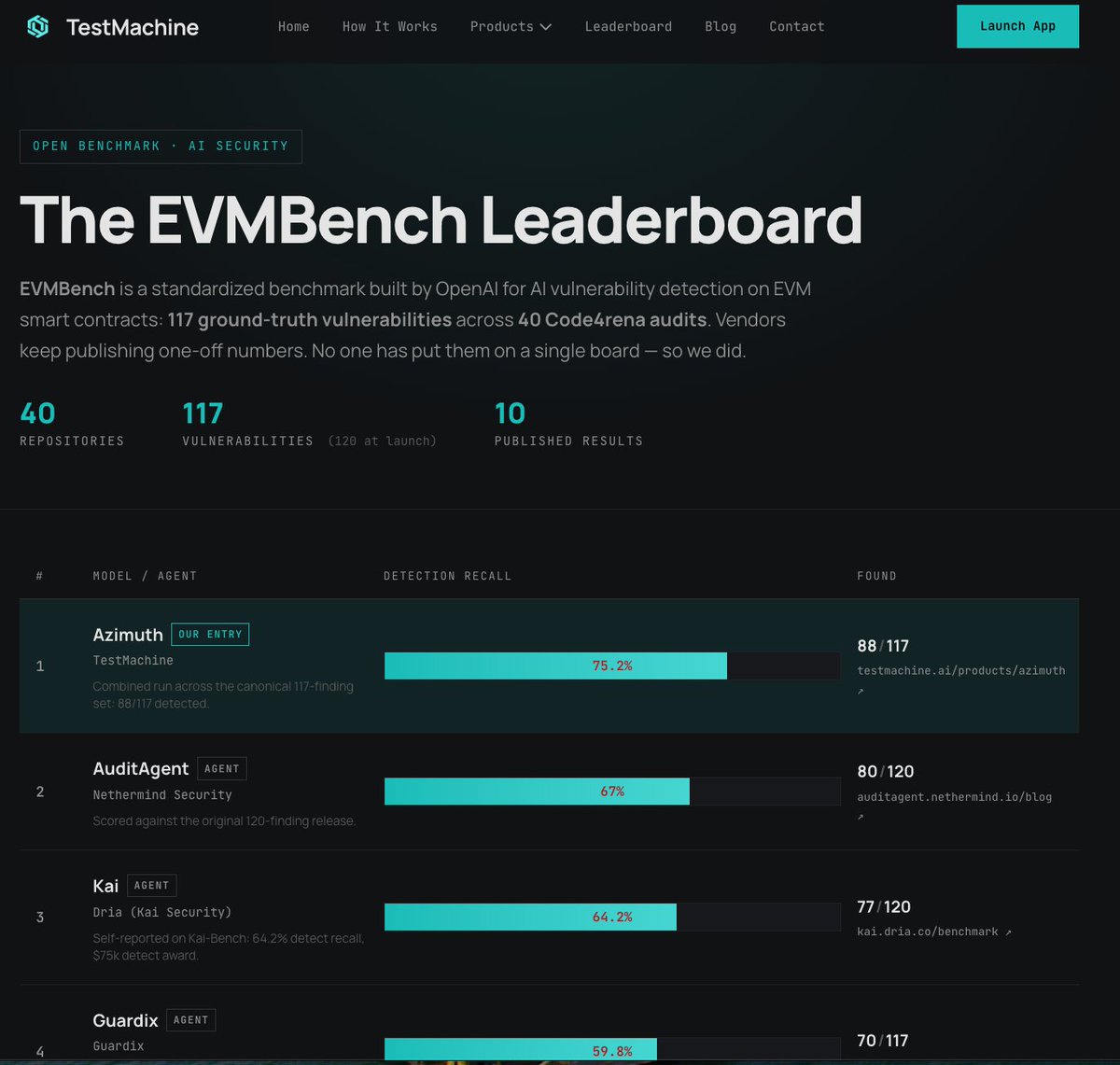
A few months ago @OpenAI and @paradigm released EVMBench to check for vulnerabilities in EVM smart contracts
Fast forward and @testmachine_ai's proprietary AI model is #1 on the leaderboard and 8% points above the 2nd best agent
If you are a team looking for the literal best smart contract auditors, DM the Testmachine team
Rather be safe than hacked by an AI model

Introducing EVMbench—a new benchmark that measures how well AI agents can detect, exploit, and patch high-severity smart contract vulnerabilities. openai.com/index/introducing…
8
3
39
15,119
May 20
Our mission at TestMachine:
To scale trust in Web3 for all participants.
We do that by providing a robust tool at a practical cost.
We’re proud that users on our live open platform can achieve these benchmark results of 75.2% on EVMBench for under $100 per repository.
2
3
134
May 13
Real DeFi exploits don't use single bugs. They chain multiple issues together in ways static analysis doesn't model.
We tested CertiK AI and TestMachine on two systems. Both found the same bugs. The difference was consolidation.
CertiK AI: Multiple isolated findings documented separately
TestMachine: Attack paths showing how vulnerabilities combine into working exploits
Full analysis: testmachine.ai/blog/certik-c…
2
1
3
236

May 12
Web3 security is becoming one of the most valuable skill sets in crypto.
The best way to learn now is simple: study real exploits, read audit reports, and practice breaking things safely in test environments.
Be with #TestMachine
May 12
If you've been thinking about getting into Web3 security — the time is now.
Exploits are happening weekly. Protocols need security. The demand massively outweighs supply. And AI tools are making it easier than ever to learn.
Drop your best resources for getting started in the replies. Let's help people break in. 👇
3
28
May 7
🗣️New: TestMachine Telegram
For TestMachine users, exploit hunters, and paranoid Web3 builders.
Live exploit breakdowns, audit alpha, attack vectors, and AI security talk — high signal only!
Join: t.me/ MwJN2TM_mccwYmQx
1
1
14
636,402
Apr 29
We tested CertiK AI Auditor and TestMachine’s Azimuth on two different smart contract systems.
Both found the same bugs. The difference is interpretation.
CertiK explains what's wrong.
TestMachine models how someone would exploit it.
Bug detection vs exploit modeling.
Full comparison: testmachine.ai/blog/certik-c…
2
4
316
Apr 16
Most AI audit tools hide behind marketing claims and private benchmarks.
TestMachine is competing publicly on @NethermindSec AgentArena. The era of "trust us, our AI is good" is over. The era of "watch us prove it" is here.
We're posting every result. Wins, losses, and everything we learn. If you're building in Web3, you deserve to know which audit tools actually work.
Read more here: testmachine.ai/blog/ai-smart…
2
1
6
191
Apr 15
Completely agree. The industry still relies on one-time assurance for systems that change daily.
That’s why we focus on continuous, adversarial testing at TestMachine.
1
1
72
Mar 25
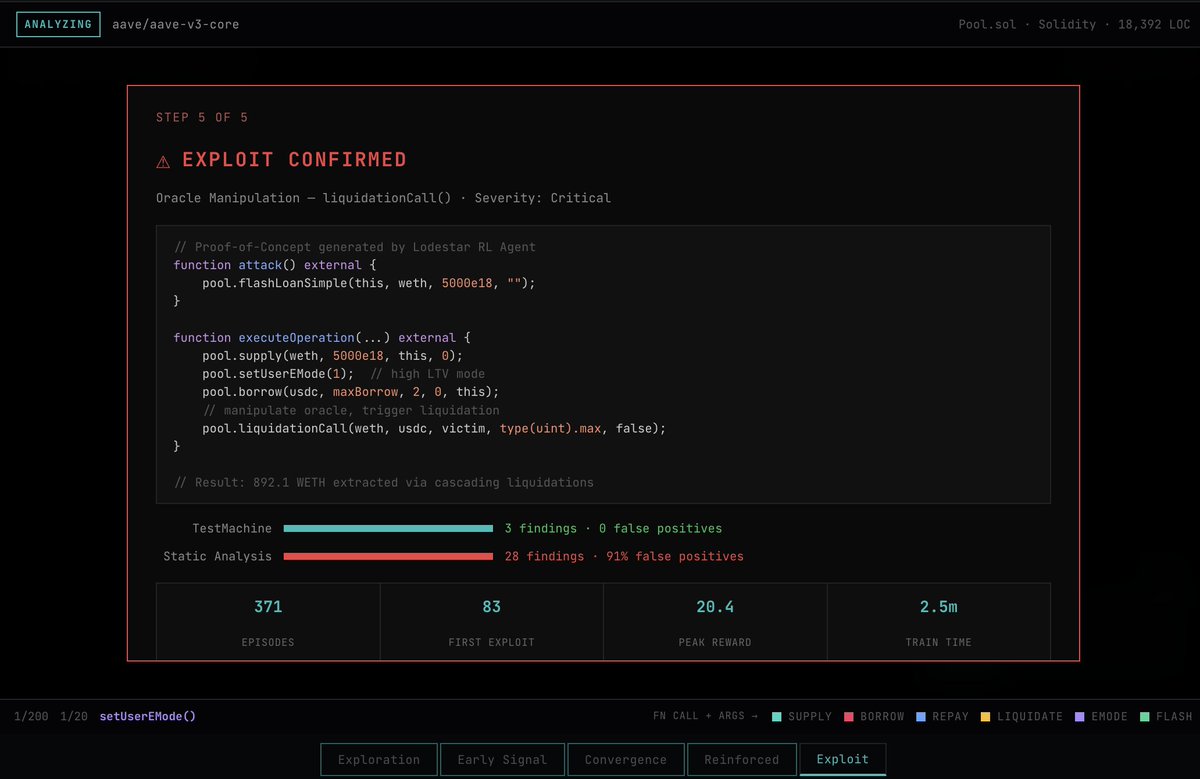
Tired of using AI for audits just because you’re “supposed to”… but not actually trusting the results?
Now you can prove your findings.
Upload to TestMachine → Auto Validate → get confirmed or refuted instantly.
No re-testing. No guesswork. Just answers.
app.testmachine.ai
2
2
4
375

The next evolution of Web3 isn’t louder hype.
It’s smarter infrastructure.
And that conversation is happening live in New York.
At Digital Asset Summit 2026, the focus is shifting from speculation to systems that actually protect and scale the market.
Because the reality is simple:
More tokens are launching than ever.
More capital is flowing on-chain.
But risk is evolving just as fast.
The question is no longer “what’s the next 100x?”
It’s:
“How do we scale safely?”
That’s where TestMachine AI comes in.
We’re building at the intersection of:
• Scaling Token Listings without compromising safety
• AI-powered Smart Contract Security that reads what humans miss
• On-Chain Risk Detection before it becomes a loss event
This isn’t theory.
It’s the infrastructure layer designed for a market that’s maturing fast.
If you’re a builder, protocol, exchange, or security-focused team…
And you understand that the future of Web3 depends on trustless security at scale…
Let’s connect in NYC.
@testmachine_ai
Book time:
testmachine.ai/#contact
The next cycle won’t be won by hype alone.
It will be won by those who build and use systems that see risk before it happens.
#DAS2026 #digitalassetsummit2026

Mar 24
We’ll be at @blockworksDAS in NYC 🇺🇸
If you're working on:
• Scaling Token Listings
• AI-powered Smart Contract Security
• On-Chain Risk Detection
We’d love to chat!
Book time: testmachine.ai/#contact
#DAS2026 #digitalassetsummit2026

31
1
29
3,817
Mar 19
If you need to add fees to stop AI noise, auditors are using the wrong tooling. Security should be about validated findings, not volume. That’s the approach we’re taking at TestMachine.
Mar 18

Paid submissions? Let’s talk
We need to be honest about what’s happening to bug bounty right now
We live in AI era, where submission volume is growing fast, but signal is not
A lot of reports getting lost, delayed, or stuck in review loops
And this hurts everyone - especially professional whitehats with real findings
Over the last months, we’ve been trying to fix this step by step
Reputation points system was first
you submit spam → you get penalty points → you lose ability to submit
simple incentive on quality
Then - MCP
Which helps teams triage faster, identify duplicates, reduce review time. Many companies already using it.
And now we are introducing a new option - submission fees. We’ve been hearing this request from many companies and honestly, it feels like a next logical step to make the game more fair for everyone.
This is optional, not default, and not something every company will enable.
Fees going to be small ($1-$5), so this is not about monetization too
This is about adding a bit of friction, so people think twice before submitting something they are not confident in
Because today, there is almost no downside to spam. With $20 subscription, any user can generate thousands of reports even without understanding of them.
At the same time, we fully understand concerns, whitehats are our biggest asset and we still want new researchers to join the space, so we added:
• free credits for new users (via coupons)
• support for high-signal researchers
Goal is very simple - improve signal without losing important reports
I will keep you in a loop once any of HackenProof clients will enable it
Lets fix bug bounty together
1
1
5
180


Mar 17
Most are optimizing for number of findings, not whether those findings are actually validated and exploitable.
That is what we do differently at TestMachine.
3
116