
May 5
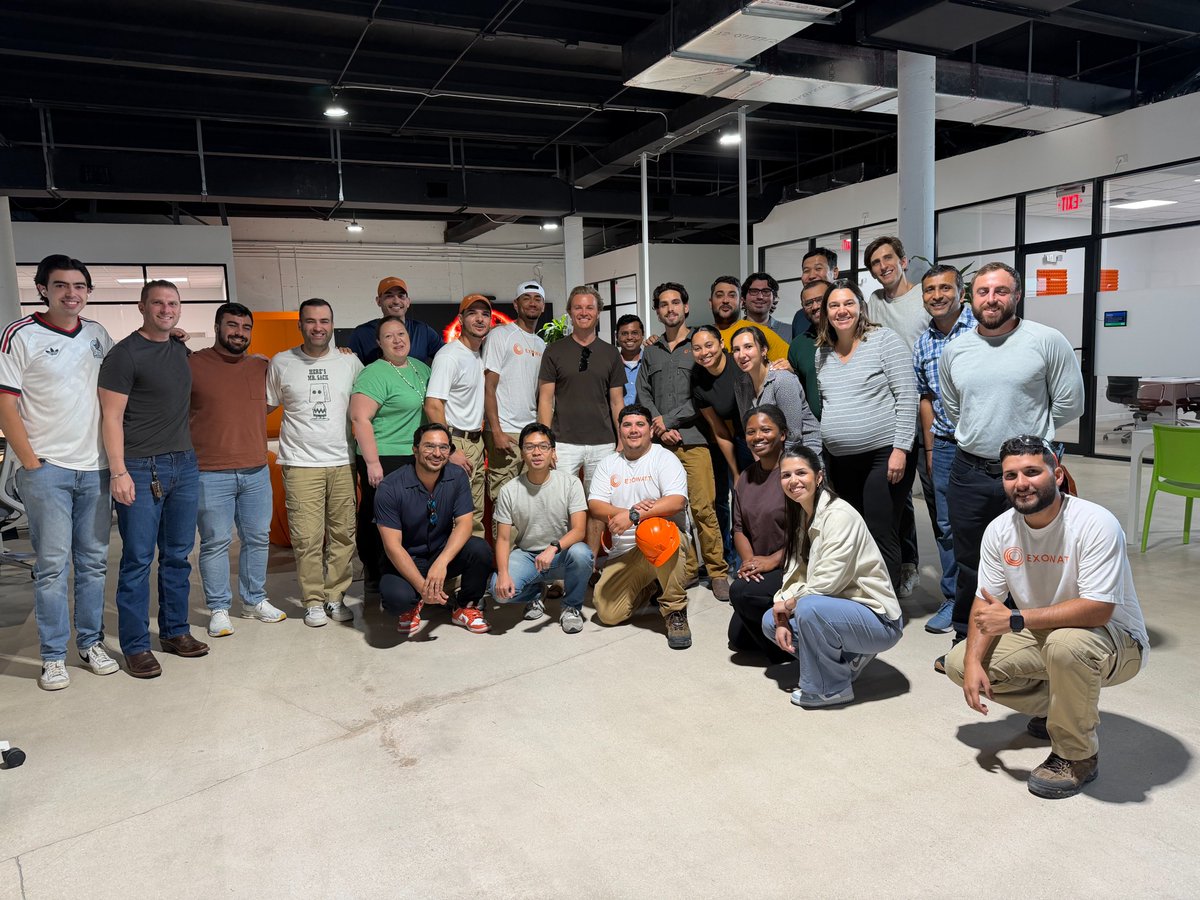
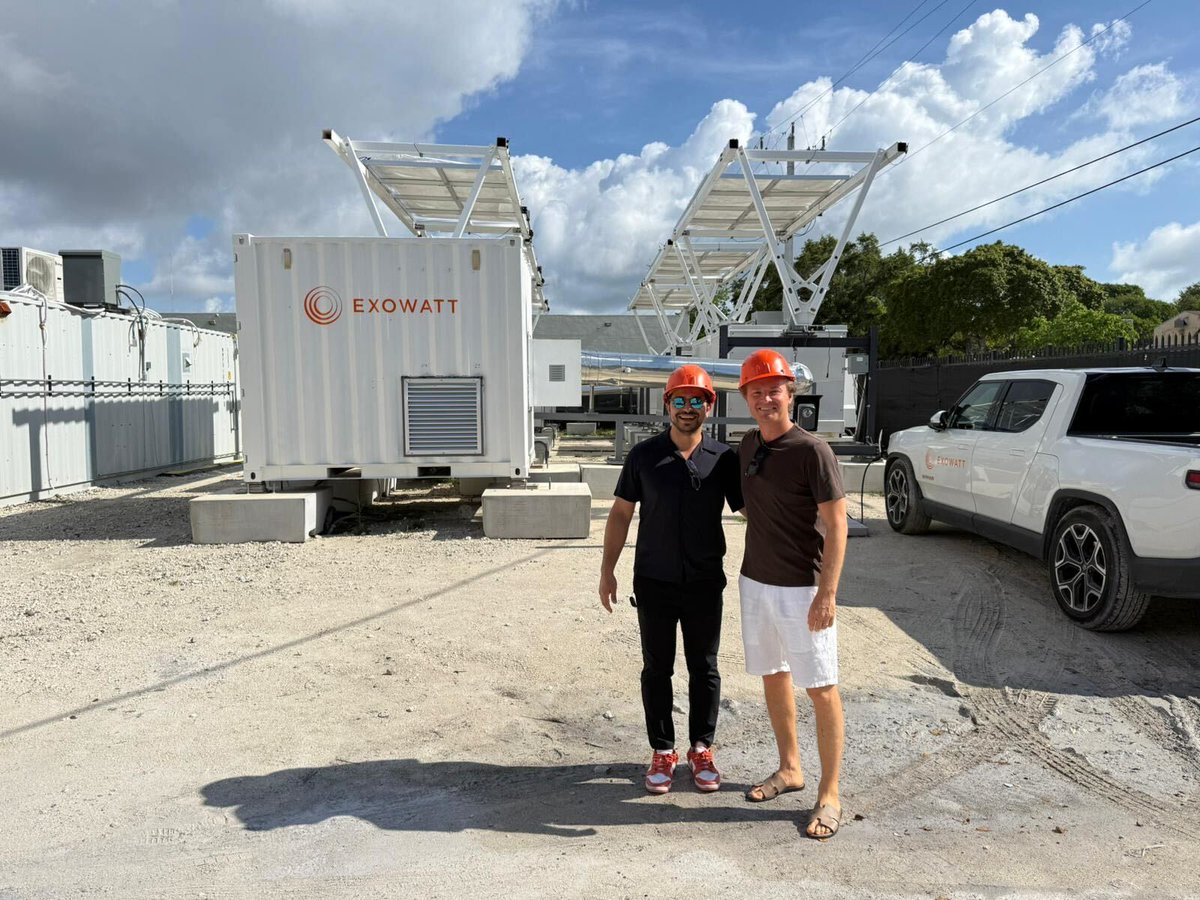
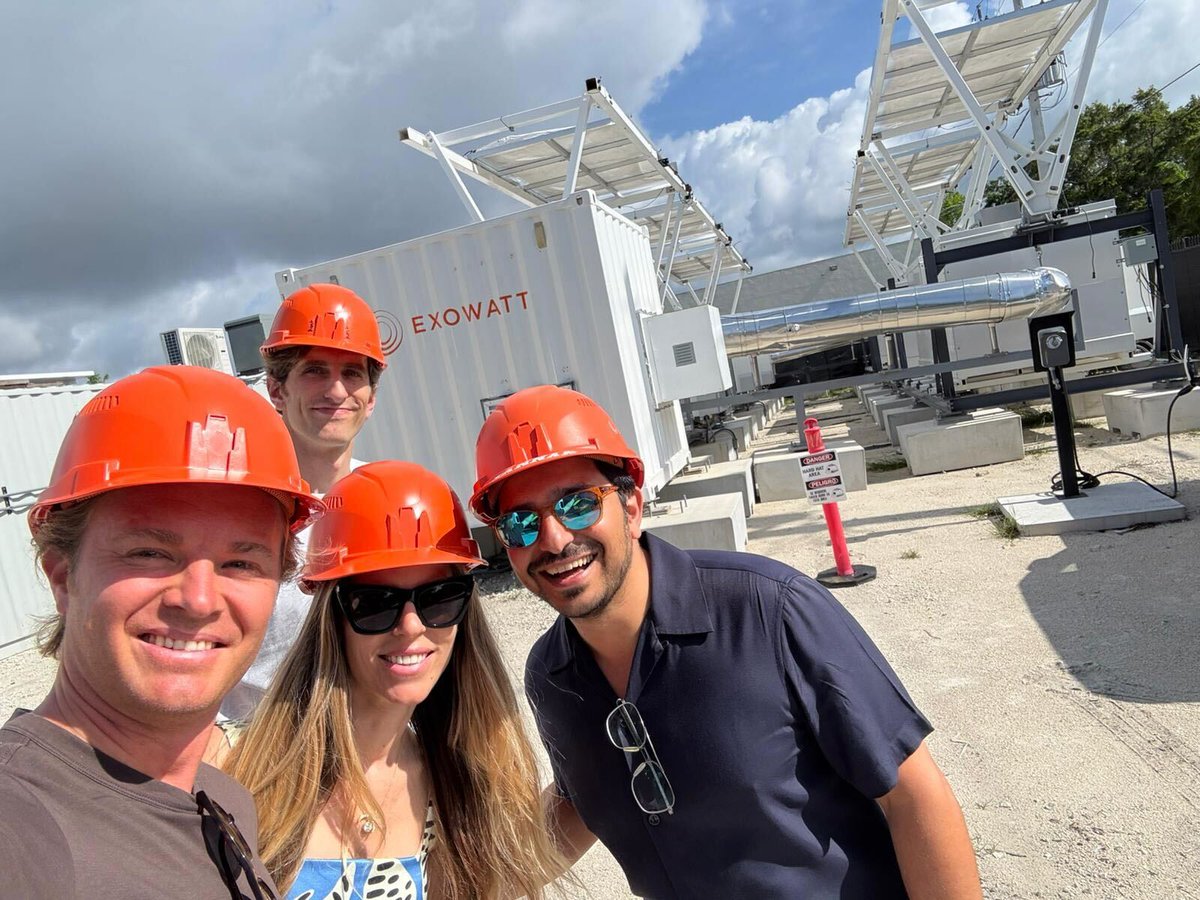
Capping off F1 week in Miami with a visit from F1 World Champion @NicoRosberg.
It's always great when leaders from outside our industry lean in to understand what we're building — and how #AI can be powered sustainably at incredibly fast speeds with Exowatt. ⚡ 🏁
#F1 #TimeToPower #CleanEnergy
8
236

Mar 26
$OKLO
規制がボトルネックから加速装置に変わった。
これまで
「作れるのに作れない」
これから
「作れるものは、すぐ作れる」
#Oklo #TimeToPower #SMR
Part 53のインパクトはこれまでの規制ボトルネックを全て変える
Mar 26

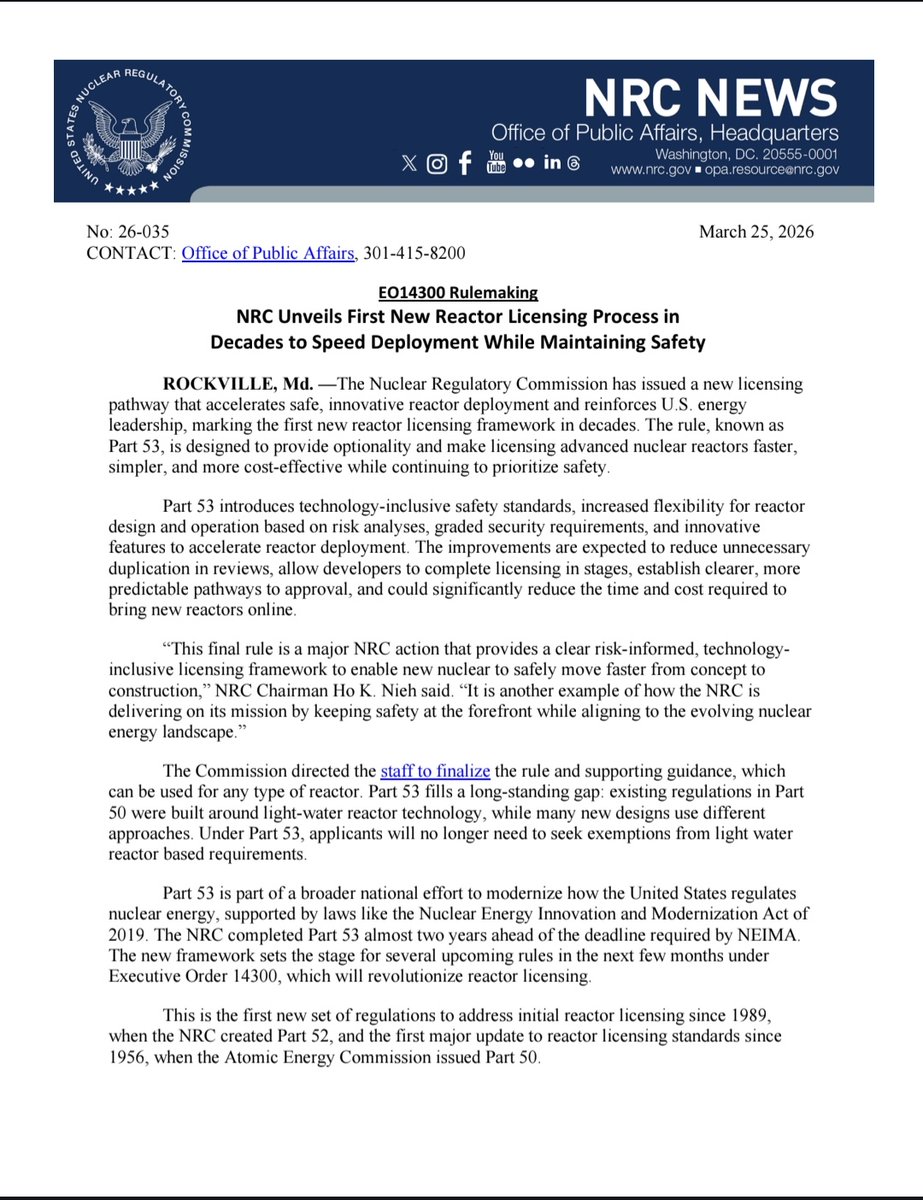
This may be one of the more important developments for advanced #nuclear:
#NRC Part 53 creates a structured, staged pathway for licensing non-light water reactors.
From unpredictable → more defined.
That shift alone can unlock capital and deployment.
$OKLO
nrc.gov/sites/default/files/…
2
187
Feb 19
In a phase where market sentiment is cooling,
I added a small amount of $OKLO yesterday.
Volume is down from the peak.
Short-term hype is fading.
#Oklo #TimeToPower
2
263
Feb 6
$Oklo
What matters in structural investing
is not eliminating concerns,
but facing them head-on from the start.
With Oklo,
the first unit will be delayed.
Regulatory approval won’t be a one-shot pass.
Financials will stay in the red until mass deployment.
These aren’t risks to hand-wave away.
They’re assumptions to be priced in from day one.
So there’s only one real question:
even with these constraints,
are the underlying conditions — demand, policy, and time horizon — still moving forward?
Structural investing isn’t about optimism or denial.
It’s about watching whether
the structure itself is still intact.
#Oklo
#TimeToPower
3
221
Feb 4
$Oklo
“後出し規制”が、構造的に起きなくなる。
それが今回のNRC発表の本質。
NRCが、数十年ぶりに組織構造そのものを抜本改革。
機能別の縦割りから、プロジェクト単位の事業ライン型へ移行した。
1.新型炉
2.既設炉
3.核物質・廃棄物
最大の変更点は、許認可と検査を同一ラインに統合。
これまでの最大ボトルネックは、
「許認可の後に、検査部門が初めて関与する」という時系列の分断。
これからは、プロジェクト初日から同じチームが動くため、“後出し規制”が消えることを意味する。
NRCはこれまで「安全を守る機関」だったが、これからは「安全を守りながら、電源を増やす機関」となる。
$Oklo のような先進炉企業が抱えていた、
「最終判断者が見えない」という規制リスクが消える。
これは規制緩和ではない。
規制プロセスの設計変更。
原子力のTime-to-Powerの最大ボトルネックが一つ外れたということ。
#Nuclear #Oklo #TimeToPower #Regulation

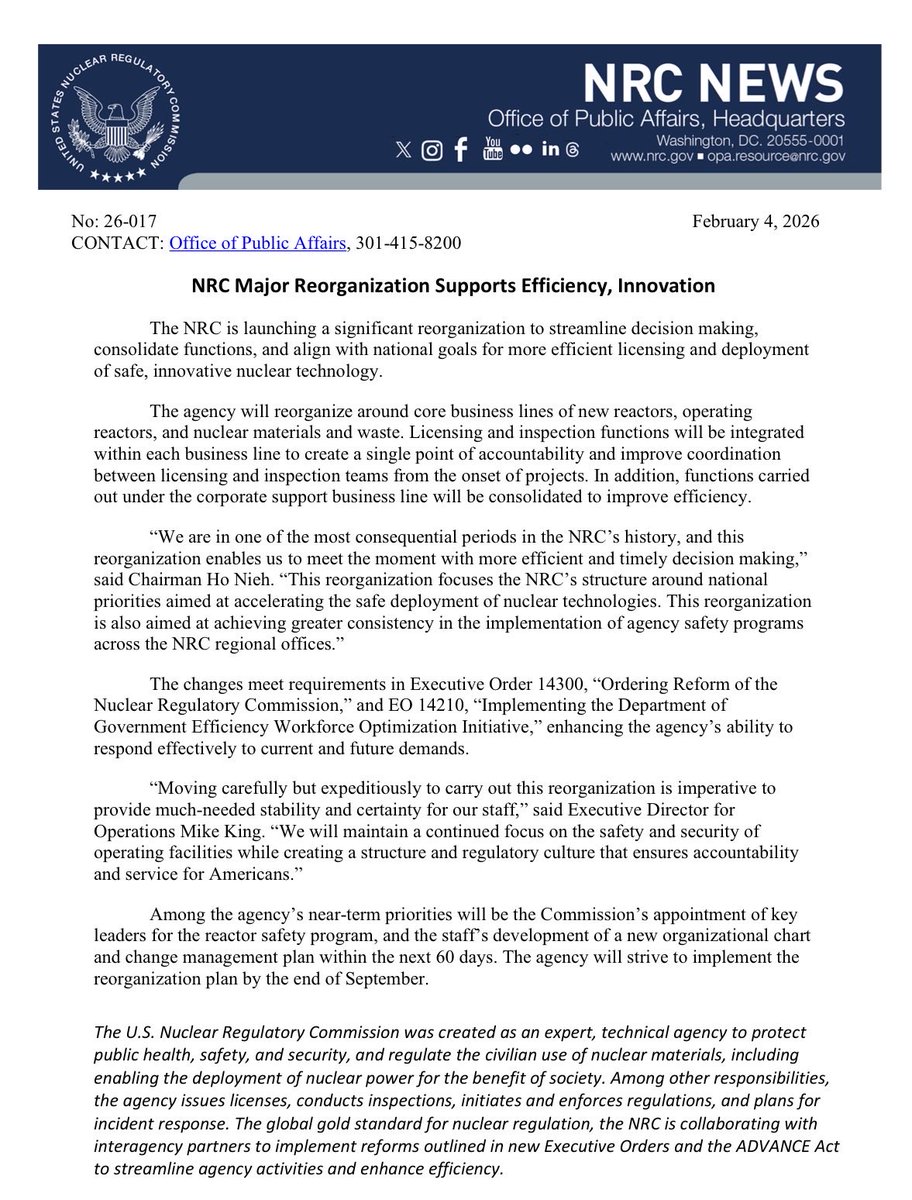
The NRC just announced a major internal reorganization to accelerate nuclear licensing and oversight.
Key change: the agency will now be structured around three core business lines:
• New reactors
• Operating reactors
• Nuclear materials & waste
Licensing and inspections will be integrated within each line, creating a single point of accountability and tighter coordination from day one of projects.
This reform aligns with new Executive Orders and the ADVANCE Act, signaling a shift toward faster, more predictable regulation while maintaining safety as the core mission.
This is one of the most important structural changes at the NRC in decades for enabling advanced reactors and nuclear deployment in the U.S.
2
519
Feb 2
Adding to $OKLO now is rational.
Markets price assets on short-term macroeconomics, and only later reprice them based on structural drivers.
Historically, the stocks that outperformed after periods like this shared the same traits:
•Structural drivers independent of macroeconomics
•Demand that cannot be paused
•Extreme supply shortages
•Regulatory and policy tailwinds
Oklo Inc. meets all of these conditions.
Gold and equities are being sold due to financial factors: rates, the dollar, and liquidity.
But Oklo’s valuation axis is not financial — it is a physical constraint: power scarcity.
The market is focused on earnings and interest rates — the short term.
Meanwhile, power scarcity is already a structural problem unfolding in real time.
Owning Oklo is not about buying a dip.
It is about owning the solution before the market reprices it when data centers struggle to secure power.
Right now, only the price is down. The structure is unchanged.
That’s why I see it as rational.
#RiskOff #StockMarketCrash
#AIInfrastructure #TimeToPower
#NuclearEnergy #SMR
1
3
397
Feb 1
$Oklo
環境審査がなくなったわけではない。
ボトルネックは依然として存在する。
それでもTime-to-Power は確実に近づいた。
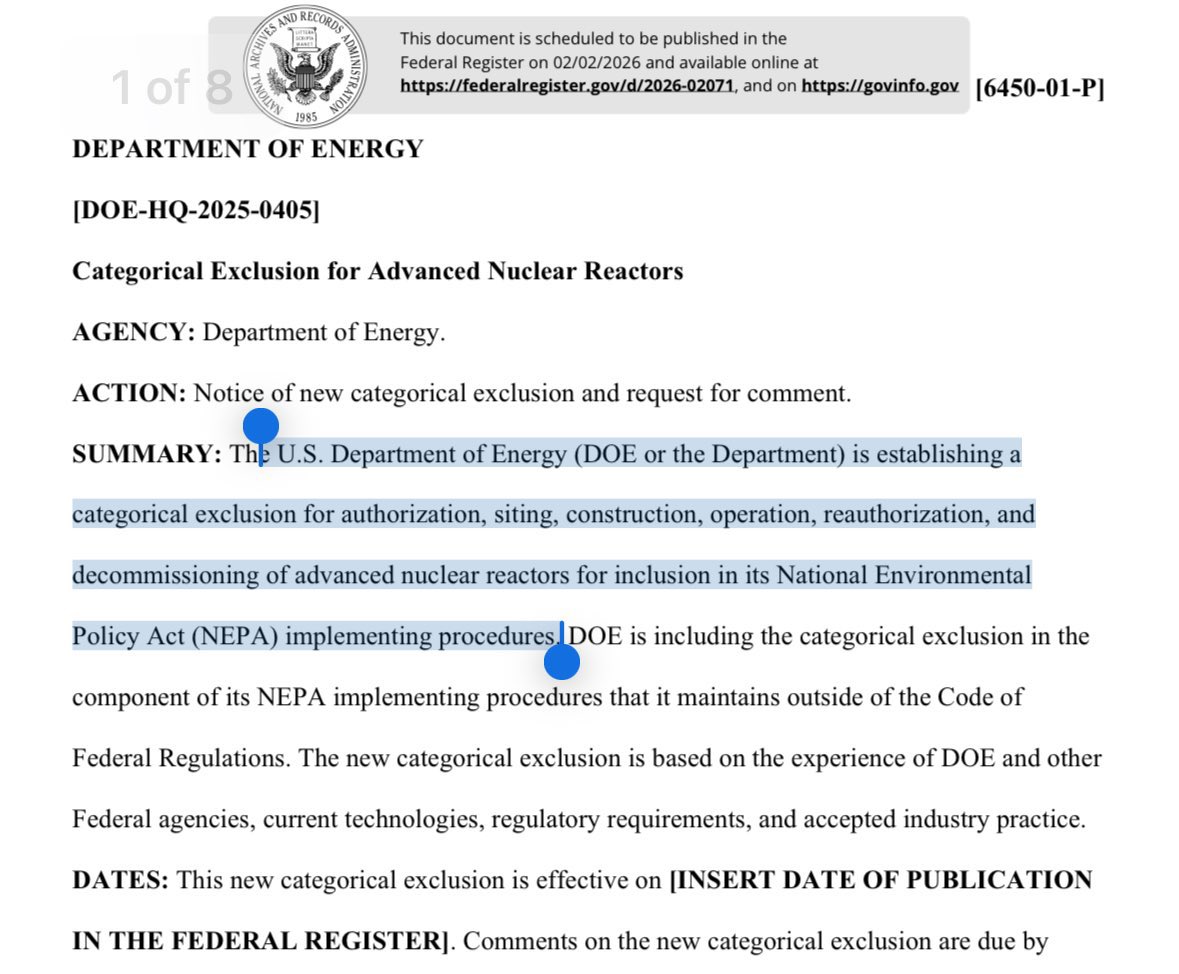
DOEは先進炉をNEPAの詳細EISから原則CXへ整理。
環境・安全を“見ない”のではなく、NRC審査に一本化した。
重複審査が外れ、
立地ごとの長期プロセス・公聴会・訴訟リスクが大幅に低減。
これは安全基準の緩和ではない。
供給時間を短縮する制度設計への転換。
#SMR #AdvancedNuclear #TimeToPower #GridConstraints

3
551
Jan 31
$Oklo
This isn’t the stock price losing expectation.
It’s simply that those who didn’t understand the structure have exited the chart.
With price sitting near the 200-day EMA and volume drying up,
what remains are holders who understand the constraints — quietly holding for structural reasons.
#Oklo #SMR #AIInfrastructure #TimeToPower #GridConstraints
1
2
309
Jan 30
When markets fall,
people who were bullish yesterday
suddenly turn bearish and sell.
Nothing fundamental changed.
Price did.
If you truly believe in the structure long term,
short-term drawdowns don’t change your behavior.
That’s how I look at $OKLO —
not as a trade,
but as a thesis built on constraints and design.
#Oklo
#StructuralInvesting
#TimeToPower
3
366
Jan 29
Most people look at $OKLO and ask:
Is it going up or down next?
But is that really the question that matters?
There are two ways to look at a stock.
Short-term price action — and structure.
Short-term is about flows, technicals, sentiment.
Structure is about constraints, timelines, and
which models actually work in the real world.
Here’s the reality:
• Grid expansion takes 5–10 years
• Data center demand doesn’t stop
• Prices don’t shut this demand off
• Time-to-Power becomes the binding constraint
Under these conditions, only one model works:
power moves to compute, not the other way around.
$OKLO isn’t a bet on “the best reactor.”
It’s a bet on whether this model fits a grid-constrained world.
Short-term trades are fine.
I’m focused on structure.
Which layer are you looking at?
#OKLO #TimeToPower #GridConstraints
#AIInfrastructure
2
177
Jan 28
#Oklo
To understand why nuclear has struggled to expand into new use cases and locations,
you have to understand EPZs (Emergency Planning Zones).
EPZs are set based on assumed accident impact.
With conventional large reactors, EPZs are wide,
making siting, permitting, and social acceptance the real bottlenecks.
Oklo’s design revisits those assumptions.
By adopting a modular approach —
combining a smaller core, passive safety, low-pressure cooling, and underground siting —
potential accident impacts can be inherently localized.
This isn’t about avoiding regulation.
It’s about reducing the assumptions regulation is built on.
And that’s what makes on-site power feasible in the first place.
Shorter Time-to-Power,
smaller regulatory and siting friction,
and power that can actually be deployed where demand exists.
That’s the core of Oklo.
#Oklo #TimeToPower #OnsitePower
2
2
206
Jan 28
Oklo Inc. is mostly discussed through short-term technicals.
But that’s not what matters. What matters is the structure.
Oklo’s innovation is not the reactor alone,
but the reactor and the business model designed as one system.
Most nuclear / SMR companies sell reactors.
Oklo builds, owns, and operates the plant — and sells power (Built-in Operate).
What this changes:
•Customers avoid upfront CAPEX
•Operational and regulatory risk stays with Oklo
•Revenue compounds as long-term, recurring power sales
As deployment scales, design, operations, and maintenance are standardized —
so scale directly improves margins.
This is not a debate about “which reactor is better.”
It’s about which model actually works in a grid-constrained world.
That’s why $OKLO isn’t a short-term technical trade.
It’s a structural stock for an era where constraints, not prices, decide outcomes.
#Oklo #StructuralStock #BuiltInOperate #GridConstraints #AIInfrastructure #TimeToPower
1
5
319

$nuai
Time-to-power is the bottleneck most people still underweight.
Hyperscalers don’t need “land.” They need hundreds of MW with timeline certainty. And in many regions, grid-delivered hyperscale power is now a multi-year problem (interconnect studies, substation/transmission upgrades, transformer/switchgear lead times, utility coordination). Hyperscalers want deployment schedules that look like quarters; grid timelines increasingly look like years. That gap is the opportunity.
That’s why behind-the-meter (BTM) matters.
BTM isn’t “free power” and it isn’t “no permitting.” It shifts the critical path from “wait for the grid” to “execute a sponsor-controlled build”: fuel supply, permits, EPC, equipment procurement, commissioning, and reliable operations. Many projects still keep a grid tie for redundancy—but BTM reduces dependence on the slowest part of the stack: grid upgrade timing.
This is central to the $NUAI thesis.
The edge is not “BTM exists.” Plenty of players can talk about BTM. The edge is turning it into bankable MW that both hyperscalers and lenders will underwrite—then repeating it in standardized tranches:
bankable MW → financeable cap stack → on-time energization → rinse & repeat.
That’s what makes $NUAI unusually asymmetric in my work: it’s early and subscale (so the market discounts it heavily), but the path to re-rating is mechanically tied to a small set of gates:
1.anchor tenant with terms (committed MW vs options, credit support, phasing)
2.financing/FID (project-level, repeatable template)
3.first MW energized (execution proof)
4.repeatability to 1GW (platform multiple)
If they clear those gates with credible partners and a modular tranche approach, the upside is nonlinear. If they don’t, the thesis breaks quickly. That’s the convexity. (NFA)
한국어 Vr.
전력 공급까지 걸리는 시간(time-to-power)이 지금 AI 데이터센터 시장에서 가장 과소평가된 병목입니다.
하이퍼스케일러가 필요한 건 ‘땅’이 아니라 ‘수백 MW를 언제까지 확실히 공급할 수 있느냐(타임라인 확정)’입니다. 그런데 많은 지역에서 그리드(계통) 기반 전력 공급은 이제 수년 단위 문제가 됐습니다(계통 연계 심사, 변전소/송전망 증설, 변압기·스위치기어 리드타임, 유틸리티 조율 등). 하이퍼스케일러는 분기 단위로 배치하고 싶은데, 그리드는 점점 연 단위로 늘어나는 격차가 생겼고, 그 격차가 기회입니다.
그래서 BTM(behind-the-meter, 현장/전용선 기반 전력)이 중요해졌습니다.
BTM은 ‘공짜 전력’도 아니고 ‘인허가가 필요 없다’도 아닙니다. 다만 병목을 ‘그리드 기다리기’에서 ‘스폰서가 통제 가능한 실행’으로 옮깁니다: 연료 공급(가스 등), 인허가, EPC, 장비 조달, 커미셔닝, 운영 안정성. 많은 프로젝트가 예비/유연성 확보를 위해 그리드 연결도 병행하지만, 핵심은 가장 느린 구간인 ‘그리드 업그레이드 타이밍’ 의존도를 줄인다는 점입니다.
이게 $NUAI 투자 논리의 핵심입니다.
해자는 ‘BTM을 한다’가 아닙니다. 누구나 말은 할 수 있습니다. 진짜 해자는 BTM을 ‘하이퍼스케일러와 대주단이 돈을 댈 수 있는 bankable MW’로 만들고, 이를 표준화된 트랜치로 반복 실행하는 능력입니다:
bankable MW → 금융 구조 확정(FID) → 제때 energization → 반복 확장
그래서 저는 $NUAI를 비대칭적으로 봅니다. 지금은 작고 초기라 시장이 큰 할인율을 적용하지만, 리레이팅은 몇 개의 관문을 통과하면 기계적으로 일어납니다:
1.조건이 있는 앵커 테넌트(확정 MW vs 옵션, 신용/담보, 단계별 인도 일정)
2.프로젝트 금융/FID(반복 가능한 템플릿)
3.첫 MW energize(실행 증명)
4.1GW 까지 반복 가능성(플랫폼 멀티플)
신뢰할 만한 파트너와 모듈형 트랜치 방식으로 이 관문들을 하나씩 넘기면, 업사이드는 선형이 아니라 비선형(가속)으로 커질 수 있습니다. 반대로 관문을 못 넘기면 기대하던 그림이 빠르게 무너지고 주가도 그에 맞게 재평가될 겁니다.
제가 말하는 컨벡시티는 결국 이거예요: 성공하면 보상이 크게 기울어져 있고, 실패하면 빨리 티가 난다. (투자조언 아님)
#NUAI #AIInfrastructure #DataCenters #Hyperscale #BehindTheMeter #BTM #TimeToPower #ProjectFinance #Infrastructure #Energy #Power
#NUAI #AI인프라 #데이터센터 #하이퍼스케일 #BTM #계통연계 #전력 #프로젝트파이낸싱 #인프라투자 #에너지 #미국주식
4
4
28
4,374

19 Nov 2025
What does an electrified, digitalized, AI-powered future look like?
Here are 5 key takeaways from @SchneiderElectric Innovation Summit:
1. One Digital Grid: Adding 1,000-2,000 TWh of electricity per decade. Platform on Azure reduces outages 40%, cuts interconnection timelines 25% with AI-powered intelligence.
2. AI Factories: Rack densities jumped from 15-20kW to 100 kW. Liquid cooling is 3,000x more efficient than air. Tokens per watt per dollar = the new metric.
3. EcoStruxure Foresight: "Energy saved in buildings can power AI factories." AI-powered platform delivers 50% energy efficiency gains, resolves issues 90% faster.
4. Power Meets Process: Unified data hub AI agent CIRA automates energy management across industrial facilities consuming 50% of regional electricity.
5. Customer Impact: FedEx tracks carbon footprint per package with 1 petabyte of data. McLaren processes 1.5TB per race weekend for 2-second pit decisions.
"AI is taking digitalization to the next level, giving us a massive opportunity to make energy much more efficient everywhere." - Olivier Blum, CEO
The future is being built now and powered by @SchneiderNA
#InnovationSummitLasVegas #ISNA2025 #TimeToPower #Sponsored
6
57
5,806
19 Nov 2025
Day 1 vibes at the @SchneiderNA Innovation Summit reception!
From stunning green aesthetics to larger-than-life experiences, the energy was absolutely electric ⚡️🟢
"Time to Power" - As CEO Olivier Blum said: "We are your Energy Technology Partner. We electrify, automate and digitalize every industry, business and home, driving efficiency and sustainability for all."
Ready for an incredible few days of innovation and connection.
#InnovationSummitLasVegas #SchneiderElectric #TimeToPower #ISNA2025
1
6
101
6,254

28 Feb 2025
The @TeraWulfInc #earnings call this morning was as expected. Paul and Patrick were forthright and transparent. What a refreshing bit of integrity in this murky #BitcoinMining #AI and #HPC space!!! $WULF is the best of breed and building (correctly) for the #longterm. Well done @TeraWulfInc team!
#WULFPack $WULF @TeraWulfInc #Bitcoin #HPCAI #BitcoinMiningMafia
#LowCostPower #TimeToPower #Facts #ShareholderValue #NoATM #NoDilution #PremiumHPCTerms #Core42 #G42 #HighPoweredCompute #MegaWatts #DiversityOfAssets #REIT #FreeCashFlow @business @markets
$IREN $RIOT $CLSK $MARA $CIFR $BTBT $MSTR
22 Feb 2025

In my opinion, there is no greater value or upside in the #BitcoinMining space than @TeraWulfInc!!! Here is why, from a great interview by @_adrian and the late, great @Charge_Stack. #RIP D.R.Lewis
“Unlike most of the other companies in this space, we ARE NOT DILUTING SHAREHOLDERS. And I will do everything from here on out not to dilute shareholders AND decrease our share count. And that stands in stark contrast to all of the other Bitcoin mining peers and a lot of the folks trying to go into high powered compute.” — Patrick Fleury, CFO of @TeraWulfInc
$WULF has $85,000,000 remaining in their share buyback program, and you can darn sure believe they are buying back $WULF shares at these discounted prices!
To recap one more time for the people in the back: NO ATM or shareholder dilution (in stark contrast to nearly every publicly traded #BitcoinMiner!), aggressive $WULF stock buyback, and the best #HPC terms of any public miner to date.
#WULFPack $WULF @TeraWulfInc #Bitcoin #BitcoinMiningMafia
#LowCostPower #TimeToPower #Facts #ShareholderValue #NoATM #NoDilution #PremiumHPCTerms #Core42 #G42 #HighPoweredCompute #MegaWatts #DiversityOfAssets #REIT #FreeCashFlow @business @markets
2
12
874
22 Feb 2025
In my opinion, there is no greater value or upside in the #BitcoinMining space than @TeraWulfInc!!! Here is why, from a great interview by @_adrian and the late, great @Charge_Stack. #RIP D.R.Lewis
“Unlike most of the other companies in this space, we ARE NOT DILUTING SHAREHOLDERS. And I will do everything from here on out not to dilute shareholders AND decrease our share count. And that stands in stark contrast to all of the other Bitcoin mining peers and a lot of the folks trying to go into high powered compute.” — Patrick Fleury, CFO of @TeraWulfInc
$WULF has $85,000,000 remaining in their share buyback program, and you can darn sure believe they are buying back $WULF shares at these discounted prices!
To recap one more time for the people in the back: NO ATM or shareholder dilution (in stark contrast to nearly every publicly traded #BitcoinMiner!), aggressive $WULF stock buyback, and the best #HPC terms of any public miner to date.
#WULFPack $WULF @TeraWulfInc #Bitcoin #BitcoinMiningMafia
#LowCostPower #TimeToPower #Facts #ShareholderValue #NoATM #NoDilution #PremiumHPCTerms #Core42 #G42 #HighPoweredCompute #MegaWatts #DiversityOfAssets #REIT #FreeCashFlow @business @markets
5
8
32
4,356

13 Feb 2024
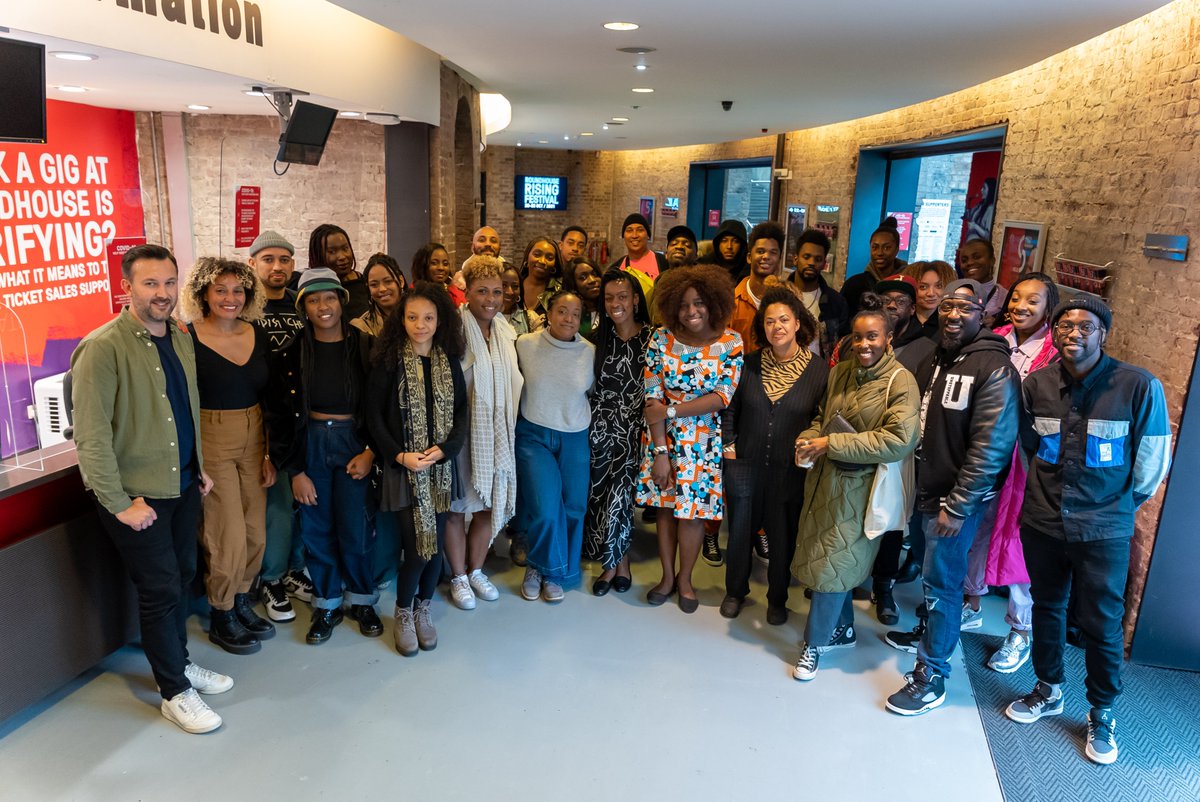
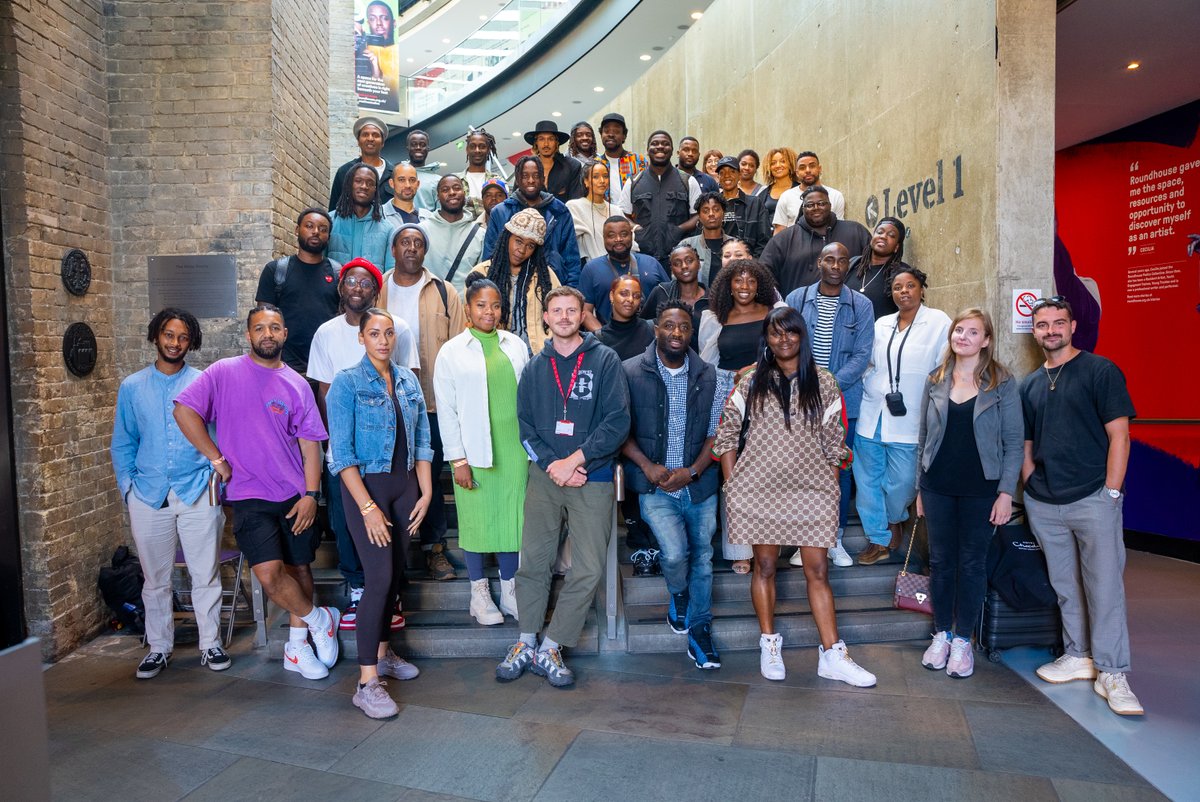
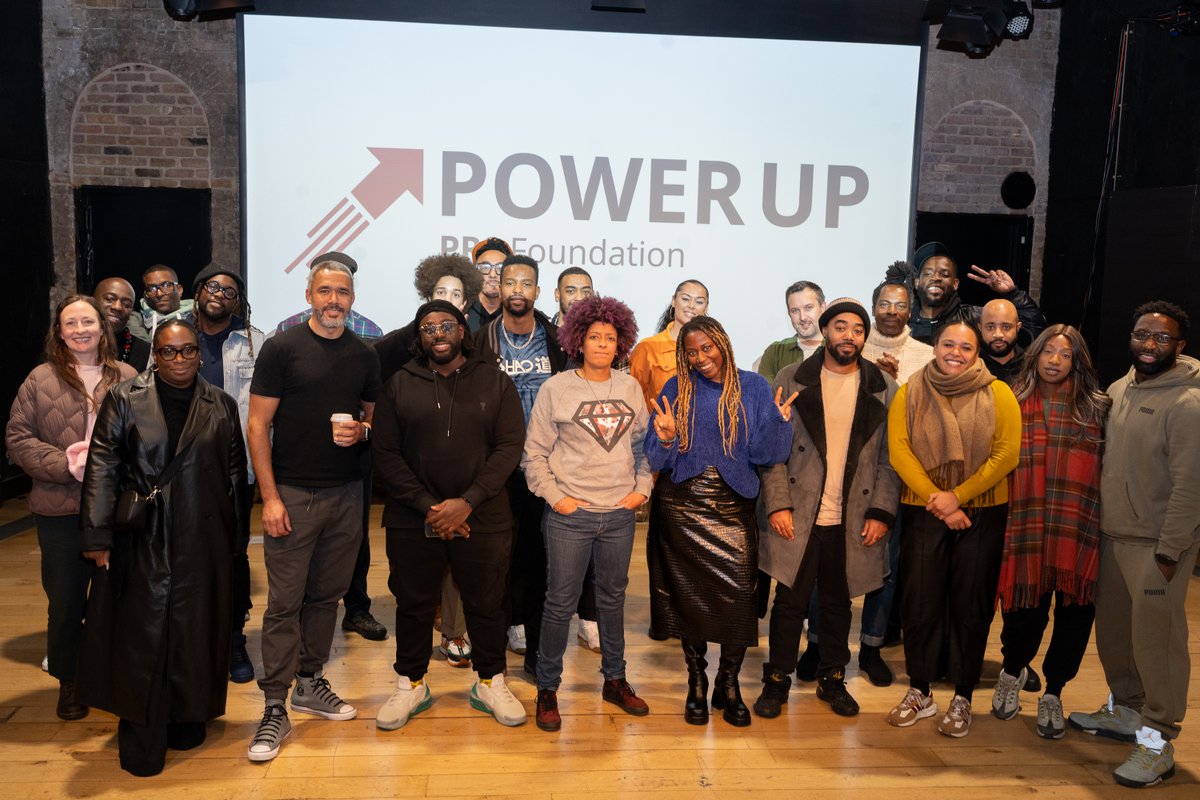
Yr4 #TimeToPOWER NOW OPEN FOR APPLICATION 🚀
The POWER UP Participant Programme is designed to elevate exciting Black music creators and industry professionals & address barriers for those at crucial career stages.
prsfoundation.com/power-up-p…
1
14
13
4,604
10 Nov 2023
#TimeToPower up has won the DE&I Initiative Award at the Women In Music Awards @MusicWeek big congrats @BillionaireBen Eunice Obianagha, Yaw Owusu @Joe_Frankland & a big thanks to all our partners and supporters for helping us build this incredible network 🏆

6
17
2,864

21 Nov 2016
"Beni bende demen, bende degilim. Bir ben var bende, benden iceri" #yunusemre #timetopower #gym… instagram.com/p/BNFVl2XAvYT/
1