
Jun 12
🚀 Why Everyone Wants to Be Part of PYRAX Network
In a crowded crypto space full of hype, PYRAX stands out as the real deal — a next-gen Layer 1 DAG blockchain built for speed, security, and real utility. Here's why people are joining:
Blazing Fast Performance — Sub-second finality 500,000 TPS with TriStream Consensus. Parallel processing that actually works.
True Decentralization Security — PoW BlockDAG architecture with ZK proof finality. ASIC GPU/CPU friendly mining.
Built for the AI Era — Decentralized AI compute layer where GPU owners earn rewards while powering real infrastructure.
EVM Compatible Modular — Seamless for devs. Multi-VM support (EVM, WASM, Rust) ZK rollups for massive scaling.
Strong Tokenomics & Utility — Stake to validate, govern via DAO, pay fees, and power the ecosystem. Deflationary pressure built-in.
Community-First — Built by the people, for the people. DevNet live, early involvement opportunities, and transparent roadmap.
Whether you're a miner, builder, investor, or believer in decentralized AI blockchain — PYRAX gives you a real seat at the table.
The future isn't just faster chains. It's smarter, fairer, and actually usable.
Join the movement before it goes mainstream.
👉 Check pyrax.org
Drop your reason below 👇
#PYRAXNetwork #TriStream #Web3 #Crypto #AI
1
1
39

Jun 10
Tristream Media Inc. presents an evening reception introducing TRI, a new community media platform, at THEMUSEUM on Wednesday, June 24, 2026 at 7:00 pm
Get your tickets online ticketscene.ca/events/61560/…
#kitchener #kitchenerevents #localmediareimagined

12
𝐖𝐡𝐚𝐭 𝐈𝐟 𝐘𝐨𝐮𝐫 𝐁𝐥𝐨𝐜𝐤𝐜𝐡𝐚𝐢𝐧 𝐂𝐨𝐮𝐥𝐝 𝐒𝐞𝐜𝐮𝐫𝐞 𝐓𝐫𝐚𝐧𝐬𝐚𝐜𝐭𝐢𝐨𝐧𝐬 𝐚𝐧𝐝 𝐏𝐨𝐰𝐞𝐫 𝐀𝐈 𝐀𝐭 𝐓𝐡𝐞 𝐒𝐚𝐦𝐞 𝐓𝐢𝐦𝐞?
Here's why. 👇👇👇👇👇
When i started my WEB3 journey, if someone told me blockchain networks would eventually become part of the AI infrastructure stack, I probably would have laughed.
Back then, blockchains were mainly about transferring value.
🔰Send tokens.
🔰Receive tokens.
🔰Pay fees........... Repeat.
Today, the conversation is changing.
As AI demand grows globally, so does the need for compute power. GPUs have become some of the most valuable resources in technology, yet millions of them sit idle for portions of every day.
That is where PYRAX @PYRAX_Official introduces an idea worth paying attention to.
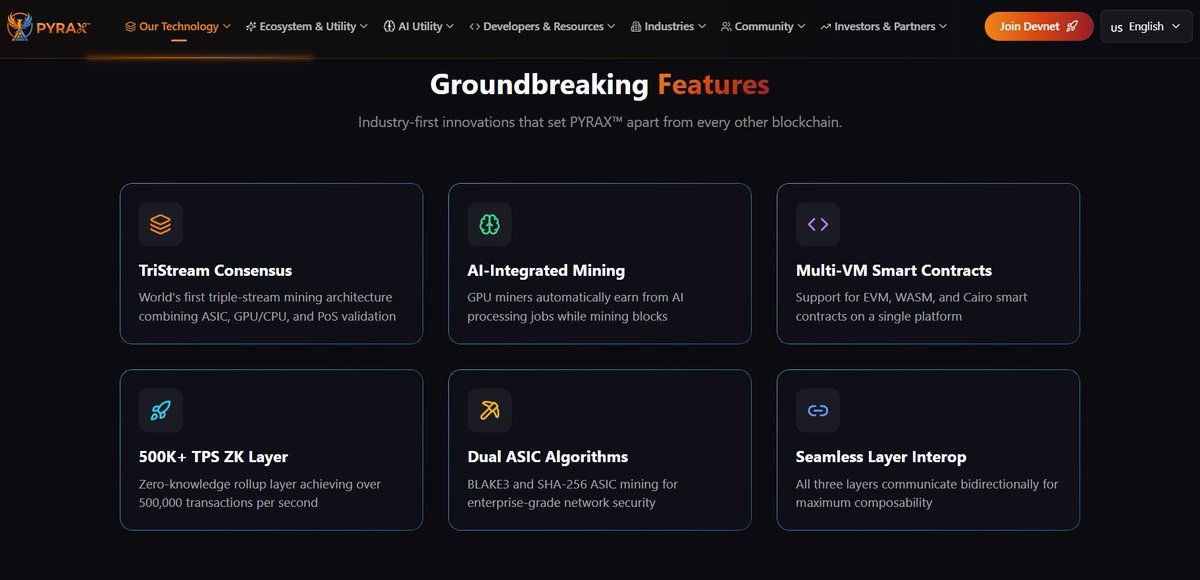
Beyond securing transactions, the network is designed to support an AI Processing Pool through its Layer 1 architecture.
Here's the interesting part.
Within the TriStream Consensus system, CPU and GPU participants do more than contribute to network security. Idle GPU resources can potentially be redirected toward compute workloads while remaining part of the broader PYRAX ecosystem.
In simple terms, unused computational power does not have to remain unused. It can become productive.
This matters because the future internet will require more than financial infrastructure.
It will require computational infrastructure.
AI models, Gaming ecosystems, Real time applications, and High performance workloads, all competing for resources.
Instead of viewing blockchain and compute as separate industries, PYRAX appears to be exploring how both can exist within the same ecosystem.
But some of the most important innovations begin when someone stops asking, "How do we build a better blockchain?" And starts asking, "What else can blockchain infrastructure become?"
That is one of the reasons I keep studying PYRAX.
The architecture is not only trying to scale transactions. It is exploring how decentralized networks may eventually power computation itself.
Let me know: "If you had a powerful GPU sitting idle today, would you rather use it for mining, AI compute, or both?"
Learn more at pyrax.org. Kindly follow my account for more educative contents. Thanks for reading, liking and sharing the post. See you on the next post.
#PYRAXTriStreamBlockchain
7
11
123
𝐓𝐡𝐞 𝐁𝐢𝐠𝐠𝐞𝐬𝐭 𝐌𝐢𝐬𝐭𝐚𝐤𝐞 𝐏𝐞𝐨𝐩𝐥𝐞 𝐌𝐚𝐤𝐞 𝐖𝐡𝐞𝐧 𝐄𝐯𝐚𝐥𝐮𝐚𝐭𝐢𝐧𝐠 𝐚 𝐁𝐥𝐨𝐜𝐤𝐜𝐡𝐚𝐢𝐧.
A few years ago, whenever someone asked whether a blockchain was good, the first thing people wanted to know was its TPS (Transaction Per Second).
Higher TPS meant better technology. Or so we thought.
The more time I spend studying blockchain architecture, the more I realize that raw transaction speed tells only a small part of the story.
A network can process thousands of transactions per second and still struggle if its security model is weak. Another can be highly secure but become unusable when demand increases.
That is why I find PYRAX @PYRAX_Official interesting.
𝑰𝒏𝒔𝒕𝒆𝒂𝒅 𝒐𝒇 𝒕𝒓𝒆𝒂𝒕𝒊𝒏𝒈 𝒔𝒄𝒂𝒍𝒂𝒃𝒊𝒍𝒊𝒕𝒚 𝒂𝒔 𝒂 𝒔𝒕𝒂𝒏𝒅𝒂𝒍𝒐𝒏𝒆 𝒑𝒓𝒐𝒃𝒍𝒆𝒎, 𝒕𝒉𝒆 𝒏𝒆𝒕𝒘𝒐𝒓𝒌 𝒂𝒑𝒑𝒓𝒐𝒂𝒄𝒉𝒆𝒔 𝒊𝒕 𝒂𝒔 𝒂𝒏 𝒂𝒓𝒄𝒉𝒊𝒕𝒆𝒄𝒕𝒖𝒓𝒂𝒍 𝒄𝒉𝒂𝒍𝒍𝒆𝒏𝒈𝒆.
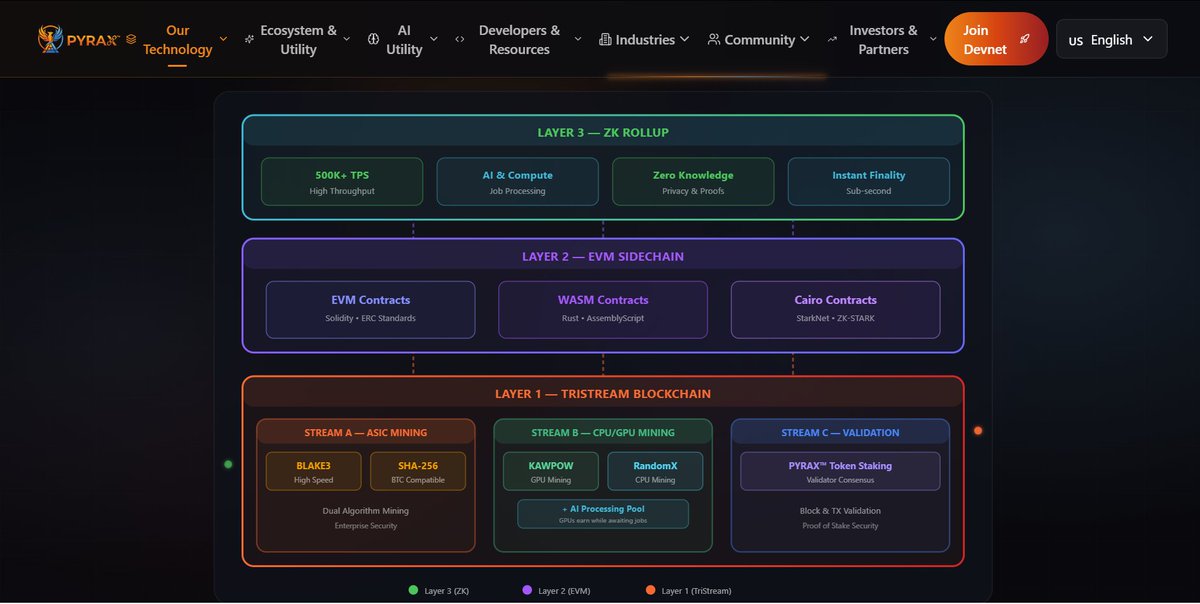
At the foundation sits the Layer 1 TriStream Blockchain.Rather than relying on a single consensus path, PYRAX distributes responsibility across three parallel streams:
🎯 ASIC mining for robust network security
🎯 CPU and GPU mining for broader participation and decentralization
🎯 Proof of Stake validation for economic security and finality
The idea is simple but powerful.
Different security mechanisms bring different strengths. Instead of choosing one, PYRAX combines them into a coordinated system designed to operate simultaneously.
Then the architecture expands further.
Layer 2 provides an execution environment supporting EVM, WASM, and Cairo based applications, giving developers multiple ways to build.
Layer 3 introduces ZK Rollup technology designed to handle large scale activity through proof aggregation while maintaining security guarantees inherited from the lower layers.
𝑾𝒉𝒂𝒕 𝒔𝒕𝒂𝒏𝒅𝒔 𝒐𝒖𝒕 𝒕𝒐 𝒎𝒆 𝒊𝒔 𝒕𝒉𝒂𝒕 𝒆𝒗𝒆𝒓𝒚 𝒍𝒂𝒚𝒆𝒓 𝒉𝒂𝒔 𝒂 𝒔𝒑𝒆𝒄𝒊𝒇𝒊𝒄 𝒋𝒐𝒃.
Security is not competing with execution.
Execution is not competing with scalability.
Each component focuses on what it does best.
That is a very different philosophy from forcing one blockchain layer to handle every responsibility at once.
The future of blockchain will not belong to the fastest chain alone.
It will belong to the networks that can scale intelligently without compromising the principles that made blockchain valuable in the first place.
That is the lens through which I continue to study PYRAX.
And honestly, the deeper I look, the more interesting the architecture becomes.
#PYRAXTriStream #Blockchain #Crypto
3
9
70

May 29
3️⃣ Devnet Launches in < 30 Days!
Our groundbreaking TriStream ZK-DAG architecture and EVM compatibility move from concept to reality. Expect exclusive tech sneak peeks soon!
Want to join the Devnet? Reach out via Telegram t.me/PYRAXNetwork and we’ll get you hooked up.
Let's make history! ⏳🔥
1
1
3
141

May 29
Saturday nights in Web3 always feel different to me.
The timeline slows down a little. Builders reflect. Communities become more conversational. Somewhere in between the noise, you start noticing which projects are genuinely trying to build long term infrastructure and which ones are simply chasing attention.
That is partly why I keep paying attention to PYRAX @PYRAX_Official .
The more I study the architecture, the clearer the direction becomes.
PYRAX is not approaching blockchain as a single chain trying to do everything alone. It is building a layered ecosystem where security, execution, scalability, and compute processing operate together without forcing one layer to carry the entire burden.
At the core sits the TriStream Layer 1 architecture.
Instead of relying on one consensus path, PYRAX splits validation into three synchronized streams:
• ASIC mining for foundational security
• CPU and GPU mining for broader decentralization
• Proof of Stake validation for economic security and finality
That design alone already separates PYRAX from many conventional networks.
Then the ecosystem expands upward through:
• an EVM compatible Layer 2
• WASM execution support
• Cairo compatibility for ZK applications
• a Layer 3 ZK Rollup targeting massive throughput and near instant finality
But honestly, one detail keeps standing out to me more than the TPS numbers.
The AI Processing Pool.
Idle GPU resources can eventually contribute toward decentralized compute tasks while remaining connected to the broader network economy.
That changes the conversation entirely.
Because once blockchain networks begin integrating scalable compute infrastructure directly into their architecture, they stop being “just blockchains.”
They start becoming decentralized digital infrastructure layers capable of supporting AI, gaming, finance, computation, and real time applications simultaneously.
That vision is ambitious.
Very ambitious.
But those are usually the projects worth watching closely during the quiet moments before the wider market finally catches on.
Weekend thoughts from a builder still studying the future one block at a time ⚡
#Blockchain #PYRAX #TriStreamBlockchian

1
7
79
May 25
𝐏𝐘𝐑𝐀𝐗 𝐈𝐬 𝐍𝐨𝐭 𝐉𝐮𝐬𝐭 𝐒𝐜𝐚𝐥𝐢𝐧𝐠 𝐁𝐥𝐨𝐜𝐤𝐜𝐡𝐚𝐢𝐧. 𝐈𝐭'𝐬 𝐑𝐞𝐭𝐡𝐢𝐧𝐤𝐢𝐧𝐠 𝐭𝐡𝐞 𝐄𝐧𝐭𝐢𝐫𝐞 𝐒𝐭𝐚𝐜𝐤.
𝐇𝐞𝐫𝐞'𝐬 𝐖𝐡𝐚𝐭 𝐏𝐘𝐑𝐀𝐗 𝐈𝐬 𝐀𝐜𝐭𝐮𝐚𝐥𝐥𝐲 𝐁𝐮𝐢𝐥𝐝𝐢𝐧𝐠. A 🧵👇👇
Not long ago, blockchain conversations were dominated by one question:
"𝓗𝓸𝔀 𝓯𝓪𝓼𝓽 𝓬𝓪𝓷 𝓽𝓱𝓲𝓼 𝓬𝓱𝓪𝓲𝓷 𝓹𝓻𝓸𝓬𝓮𝓼𝓼 𝓽𝓻𝓪𝓷𝓼𝓪𝓬𝓽𝓲𝓸𝓷𝓼?"
Today, the smarter question is becoming something entirely different.
“𝓗𝓸𝔀 𝓮𝓯𝓯𝓲𝓬𝓲𝓮𝓷𝓽𝓵𝔂 𝓬𝓪𝓷 𝓽𝓱𝓲𝓼 𝓷𝓮𝓽𝔀𝓸𝓻𝓴 𝓼𝓬𝓪𝓵𝓮 𝔀𝓲𝓽𝓱𝓸𝓾𝓽 𝓫𝓻𝓮𝓪𝓴𝓲𝓷𝓰 𝓼𝓮𝓬𝓾𝓻𝓲𝓽𝔂 𝓸𝓻 𝓭𝓮𝓬𝓮𝓷𝓽𝓻𝓪𝓵𝓲𝔃𝓪𝓽𝓲𝓸𝓷?”
That shift in thinking is exactly why PYRAX stands out to me.
Most people look at the 500,000 TPS target and immediately focus on speed, but the deeper innovation inside PYRAX is actually the architecture supporting that scalability.
PYRAX @PYRAX_Official is built as a multi layer ecosystem instead of forcing one blockchain layer to handle every responsibility at once.
The Layer 1 serves as the foundation for security and consensus through the TriStream mechanism.
Above that sits the Layer 2 execution environment supporting EVM, WASM, and Cairo based smart contracts.
Then Layer 3 introduces a high performance ZK Rollup focused on recursive proof aggregation and ultra fast execution.

1
3
7
69
May 14
𝐔𝐧𝐝𝐞𝐫𝐬𝐭𝐚𝐧𝐝𝐢𝐧𝐠 𝐏𝐘𝐑𝐀𝐗 𝐋𝐚𝐲𝐞𝐫 1 𝐓𝐫𝐢𝐒𝐭𝐫𝐞𝐚𝐦 𝐁𝐥𝐨𝐜𝐤𝐜𝐡𝐚𝐢𝐧.
A few nights ago, I was explaining blockchain mining to a friend who asked me a simple question that honestly stayed in my head longer than expected.
“If blockchains are supposed to power the future, why do they still slow down whenever too many people use them?”
That question points directly at one of the biggest problems in crypto infrastructure today.
Most blockchains still rely on a single consensus engine to process transactions, validate activity, and secure the network. The result is usually familiar: congestion, rising fees, slower confirmations, or increasing centralization.
PYRAX @PYRAX_Official approaches this differently through what it calls the Layer 1 TriStream Blockchain.
Instead of depending on one validation system, PYRAX splits network security and processing into three parallel consensus streams working together simultaneously.
Think of it like a highway with three active lanes instead of forcing every transaction into one crowded route.
Stream A focuses on ASIC mining.
This stream combines SHA 256 and BLAKE3 to create a high security mining environment powered by enterprise grade hardware. SHA 256 brings the same battle tested cryptographic foundation that helped secure Bitcoin for years, while BLAKE3 introduces faster and more efficient hashing performance.
The goal here is simple: strong foundational security.
Then comes Stream B, which honestly might be one of the most interesting parts of the architecture.
Instead of making mining exclusive to expensive industrial hardware, PYRAX opens participation to GPU and CPU miners through KAWPOW and RandomX. That means ordinary users can still contribute to network security using consumer hardware.
Even more interesting, idle GPU power can be redirected into the PYRAX AI Processing Pool, allowing compute resources to earn rewards beyond traditional mining activity.
That creates a bridge between blockchain infrastructure and decentralized AI compute.
Finally, Stream C introduces Proof of Stake validation.
Validators stake PYRAX tokens to help secure the network, confirm transactions, and maintain consensus integrity. The staking layer also adds another line of economic security because malicious behavior can trigger slashing penalties.
What makes the entire system stand out is not simply the existence of these three streams.
It is the fact that they operate in parallel.
While many blockchains process activity sequentially, PYRAX is designed to distribute validation responsibilities across multiple synchronized streams at once. That architecture is part of the reason the network targets massive throughput and near instant transaction finality.
The Layer 1 TriStream Blockchain is not trying to imitate older blockchain models.
It is attempting to redesign how consensus itself operates by combining ASIC security, decentralized GPU and CPU participation, and staking based validation into one coordinated foundation.
If PYRAX executes this properly, the conversation around blockchain scalability could start looking very different over the next few years.

2
4
79
May 13
I still remember the first time I tried sending crypto across networks during peak congestion. The transaction took forever, the fees felt unreasonable, and somewhere in that moment, I realized blockchain was still far from mainstream readiness.
For years, the industry kept choosing between speed, decentralization, or security. Bitcoin mastered security. Ethereum unlocked programmability. Other chains chased speed. Yet the deeper problem never disappeared.
PYRAX @PYRAX_Official is attempting something different.
Instead of forcing one blockchain layer to handle everything, PYRAX introduces a modular architecture built around three coordinated layers working together like a synchronized digital engine.
📌At the foundation sits the Layer 1 TriStream Blockchain, which powers the network through three parallel consensus streams.
The first stream uses ASIC mining with SHA 256 and BLAKE3. That creates a strong security foundation similar to battle tested Proof of Work systems while introducing faster cryptographic efficiency through BLAKE3.
📌The second stream focuses on CPU and GPU participation using KAWPOW and RandomX. This matters because mining stays accessible to ordinary users instead of becoming exclusive to massive industrial operators. PYRAX also introduces an AI Processing Pool where idle GPU power can be redirected toward compute tasks, allowing participants to earn rewards beyond traditional mining.
📌The third stream introduces Proof of Stake validation through PYRAX staking. Validators secure the network, participate in consensus, and strengthen finality through economic commitment.
What makes this architecture interesting is not simply the existence of three streams. It is the fact that they operate in parallel.
Most blockchains process transactions sequentially. PYRAX is designed around simultaneous processing, which is one reason the network targets throughput beyond 500,000 transactions per second alongside near instant confirmations.
Above the base layer sits the Layer 2 execution environment.
This layer supports Solidity, Vyper, WASM, Rust, AssemblyScript, and even Cairo for StarkNet compatible contracts. In simple terms, PYRAX is not building for one developer ecosystem. It is building for multiple execution environments at once.
Then comes the Layer 3 ZK Rollup.
This is where scalability expands aggressively through recursive proof aggregation and zero knowledge verification. Instead of verifying every action individually, multiple proofs are compressed into efficient batches while still inheriting Layer 1 security.
That structure opens the door for high frequency trading, AI computation, gaming economies, micropayments, and real time decentralized applications without forcing users to deal with painful fees or network congestion.
What personally caught my attention was the infrastructure underneath it all.
PYRAX uses a dynamic mesh network powered by libp2p, QUIC, GossipSub, WebRTC, and distributed discovery nodes across regions including Africa. The network is designed to self heal, reroute traffic intelligently, and maintain resilience under pressure.
This is bigger than another Layer 1 conversation.
PYRAX is positioning itself at the intersection of blockchain scalability, decentralized compute infrastructure, AI processing, and modular execution systems.
The architecture is ambitious. Extremely ambitious.
But if executed properly, PYRAX may not just compete with existing chains.
It could help redefine what modern blockchain infrastructure looks like globally.
Follow for more updates on PYRAX.
Website: pyrax.org
X: @PYRAX_Official
TG Community: t.me/PYRAXNetwork

7
2
25
348

My father and I got to bond over how retarded Hassan Piker is, so... I got a great conversation with my dad because of him.
Either way, view botting is destroying Twitch and making it next to impossible to properly grow and audience. I tristream for a reason.
1
3
281

Apr 14
Gm CT❤️
Creator user = early access to real tech. And yeah… I found something worth talking about.
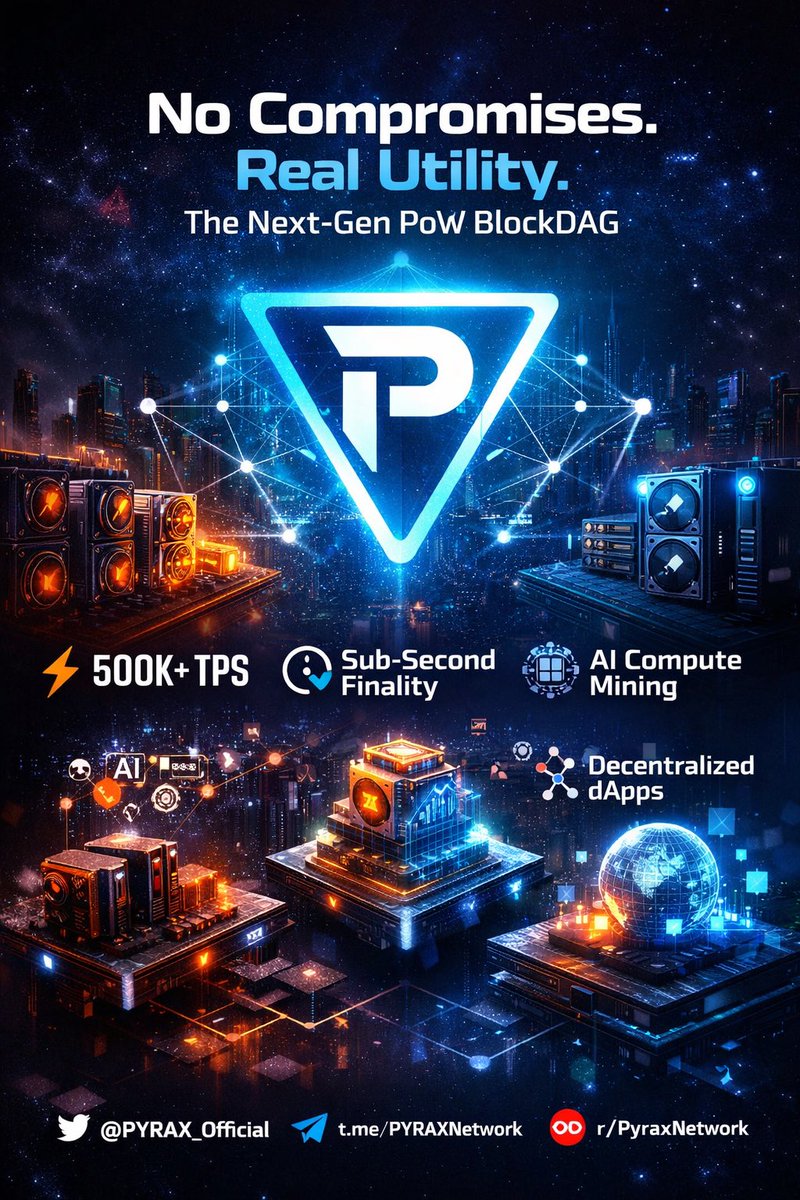
Most Layer 1s still force a tradeoff between speed, security, and decentralization. PYRAX is built differently, combining PoW security, BlockDAG scalability, and zero-knowledge finality into one system through its TriStream ZK-DAG architecture, where ASICs, GPUs, and validators all work in parallel.
Performance is strong on paper, 500,000 TPS with sub-second finality powered by ZK-STARKs, bringing real mathematical certainty to a PoW network.
But beyond the tech, the utilities are what make it interesting.
Mining isn’t just hashing anymore. GPU miners can run AI compute tasks, earn extra rewards, and contribute real processing power to the network. That opens the door for decentralized AI, machine learning workloads, and a more productive use of compute.
For builders, @PYRAX_Official supports Solidity, Rust, and WASM, alongside a dual-state model (UTXO account-based), making it flexible for DeFi, AI-driven apps, and scalable on-chain systems without being locked into one environment.
Add built-in ZK-rollup support, and you get a network designed to handle high-throughput applications like payments, gaming, data systems, and AI-powered dApps at scale.
What stands out is the approach, building first before heavy hype. It’s a more execution-focused path in a space full of promises.
From my perspective as someone inside the ecosystem, it’s not about overhyping it. It’s about recognizing a structure that’s trying to push both performance and real-world utility at the same time.
26
9
32
350

Just discovered an early-stage project — PYRAX™ 👀
• Claims 500K TPS ⚡
• Uses TriStream (mining staking)
• Built on L1, L2, L3
• Also integrating AI 🤖
Still early but very interesting 🚀
Supporting this project — keep building 💪
@PYRAX_Official
@pyrax_shawn

1
1
58

Single-stream validation is a bottleneck. ⛓️❌
Pyrax is evolving the game with TriStream Consensus—a 3-stream approach using specialized mining, GPU mining, and checkpoints for max decentralization.
See why 3 > 1: pyrax.org/blogs/pyraxs-trist…
#Pyrax #Web3 #Blockchain #DAG
1
2
51
Apr 1
Why does sending crypto feel like you're cutting the red wire on a ticking time bomb? ✂️🔴
.
One wrong character. One wrong network. No "undo" button.
.
We took a deep dive into why blockchain UX is broken and how we can change the "defusal" mindset.
.
Read more 👇🏼👇🏼👇🏼👇🏼👇🏼
🔗 pyrax.org/blogs/why-crypto-u…
.
#PYRAX #Blockchain #Web3 #CryptoUX #TriStream
1
4
7
204

Mar 31
TriStream DAG cuts down bottlenecks, enables consensus across multiple streams, and allows ZK finality to run in parallel Resulting in higher throughput and stronger fault tolerance
2
18
Mar 31
Most blockchains are a solo act, but PYRAX is a symphony. 🎼
If traditional Layer-1s use a single validation stream, what’s the biggest advantage of having THREE parallel streams (TriStream DAG) running at once?
1️⃣ Impossible to bottleneck
2️⃣ Decentralized 'Majority Rule'
3️⃣ Faster ZK-finality
4️⃣ All of the above!
Drop your thoughts below! 👇
#PYRAX #Layer1 #Crypto
2
3
8
231
Mar 19
⚡️ The Single Validator Era is Over.
Most blockchains struggle with bottlenecks and centralization because they rely on one stream. At Pyrax, we’re breaking the mold with TriStream.
Why settle for 1 when 3 is objectively better? Our 3-stream consensus model outperforms traditional systems by separating roles into specialized channels.
🛡️ The TriStream Advantage:
• Hardware Diversity: Optimized performance across different setups.
• Rapid Finality: No more waiting around for confirmations.
• Max Security: Decentralized resilience is baked into the architecture.
The future isn't just faster—it’s specialized.
Dive into the technical breakdown:
🔗 pyrax.org/blogs/pyraxs-trist…
#PYRAX #Web3 #Blockchain #Crypto #Tech #Scalability
3
9
21
665

“PYRAX’s TriStream: 3-Stream Consensus Beats Single Validation” by PYRAX Network medium.com/@PYRAXNetwork/pyr…
1
3
35

Thanks for the follows!
25 years in Networking and Cybersecurity. USAF Veteran. CCIE #14019.
I’m building the ecosystem I wish existed when I started. Zero BS. No paywalls.
🔐 protocol14019.com — Real analysis on China threats, AI security, and defense.
🌌 mondoshawan.io — Post-quantum Layer 1. Rust. TriStream mining. Open Source
🐕 scamhoundcrypto.com — Evidence-based scam detection.
🇺🇸 hodl1776.com — $WIGS. History meets meme culture.
I pulled my 11-book Crypto Mastery series from Amazon to make it free for everyone. No email gates. No catches.
Wallet security, DeFi, taxes, and bots. Everything you need to not get rekt.
Download the full library: drive.google.com/drive/folde…
Share this. Save a wallet.
#Blockchain #Cybersecurity #Web3 #WIGS

2
7
43
1,399
Feb 28
⚠️ATTENTION: We are back online! ⚠️
The PYRAX website (pyrax.org/) is back up and running smoothly. Thank you for your patience while we tuned the engines.
Now is the perfect time to:
📖 Dive back into the Whitepaper.
💻 Check our GitHub updates.
🛠️ Explore the TriStream DAG architecture.
The build doesn't stop. Let’s get back to work! 🚀
#PyraxNetwork #Layer1 #Web3 #CryptoCommunity
2
9
28
787