
Os alarmes ligados comprovadamente geram estresse e fator de confusão nas UTIs. A equipe se acostuma com o barulho e não percebem quando realmente há a intercorrência. UTIs renomadas vivem com os alarmes silenciados e ativam somente quando tem intercorrência
63

You gotta be a dummy & deal with UTIs because your bf won’t stop cheating on you. Nahhhh I love my peaceful life and regulated nervous system :)
117
𝐍𝐚𝐭𝐡 (𝐚 𝐭𝐨𝐫𝐭𝐮𝐫𝐞𝐝 𝐩𝐨𝐞𝐭) ✒️ retweeted

Tim sobre “Is It Any Wonder?”💡
Escucha el demo aquí: shortlink.uk/1ruMw 📲
.
.
.
#Keane #UTIS #UTIS20

4
6
98

Pero desde día 1 lo único que era pesado era el spam de utis que tenía eso sí pero fuera de eso es basurilla
1
4

My mother is 81 and has never taken a flu, shingles, pneumonia or any of those vaccines. She is very healthy other than normal aches and pains and a few UTIs occasionally.
1
2
186

No they are way off. They like to call any utis serious but they are not ie anything requiring a single coarse of antibiotics is classified as serious
6

Normal labia minors can’t, but hypertrophic labia can cause chafing, make sitting uncomfortable, and cause frequent UTIs. This surgery is for those that are so big it’s causing problems.
1
10


Bandl's Ring retweeted

Jun 9
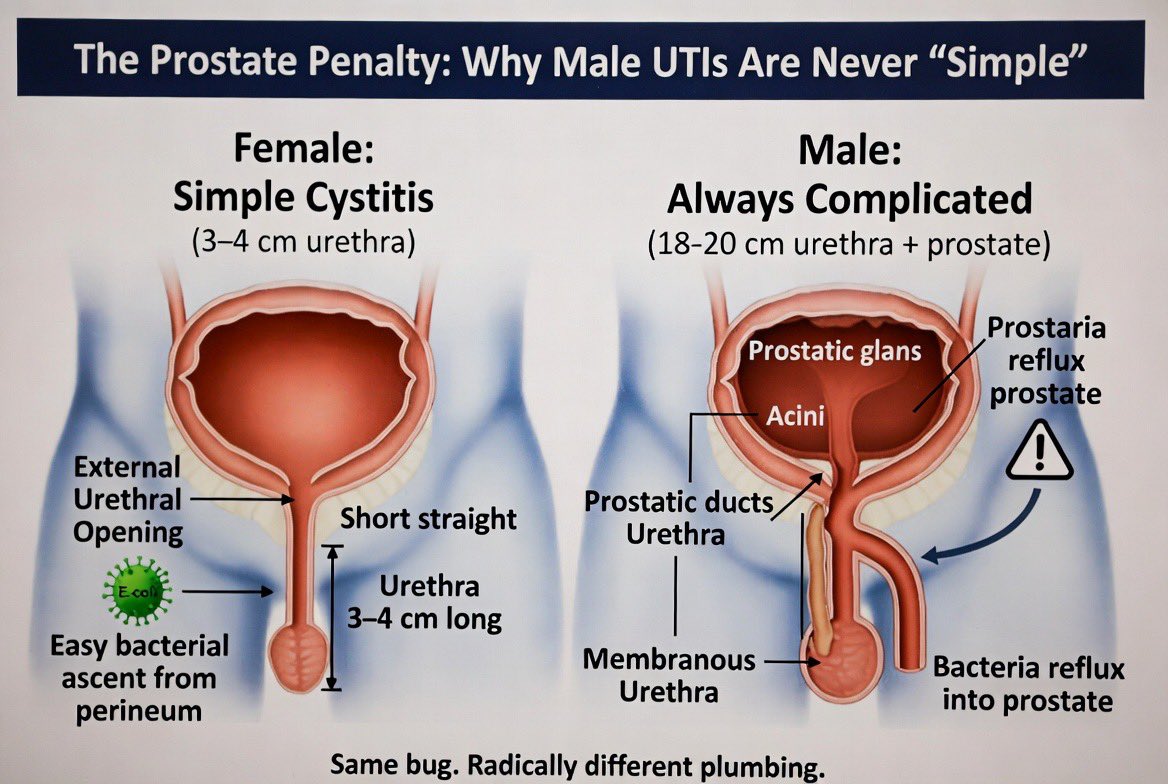
The Prostate Penalty: Why Male UTIs Are Never “Simple”
—————————————————
It’s not sexism—it’s 20 cm of urethra versus 4 cm, plus a prostate that turns every infection into a potential sanctuary.
In women, the urethra is a short, straight 3–4 cm tube opening just anterior to the vaginal introitus. Perineal flora (usually E. coli) travel a few centimeters and reach the bladder. The vaginal microbiome and estrogen keep colonization in check. Result: uncomplicated cystitis. High urinary concentrations of nitrofurantoin or trimethoprim-sulfamethoxazole sterilize the bladder in 3 days; recurrence is common but rarely ascends without stones or obstruction. Guidelines (IDSA, EAU) therefore endorse short-course therapy and discharge.
In men, the urethra is 18–20 cm long, curves through the membranous and prostatic segments, and is bathed in zinc-rich prostatic fluid that normally kills bacteria. When pathogens reach the bladder—often because of benign prostatic hyperplasia, stricture, or incomplete emptying—they reflux into prostatic ducts and acini. The prostate’s lipid-rich stroma and poor vascularity create a biofilm-friendly niche with sub-therapeutic antibiotic levels. A 3-day course leaves viable organisms behind, risking chronic prostatitis, epididymitis, or abscess. Therefore every male UTI is automatically “complicated.” Treatment jumps to 7–14 days of fluoroquinolone or TMP-SMX, followed by urine culture and urologic imaging to exclude anatomic culprits. Same organism, radically different plumbing—radically different rules.As a Surgeon- I how difficult is it to treat UTI associated Prostatitis as sometimes patients go in septicaemia #MedTwitter #MedEd #MedX @IhabFathiSulima @Lap_surgeon
3
30
153
94,559
Tathagata M. retweeted

Recurrent UTIs: Examining the evidence for bacterial reservoirs in the bladder. @gwerneburg @UMich joins Alan Wein, MD, PhD(hon), FACS @dsui_miami_uro to review intracellular bacterial communities (IBCs), reproducibly demonstrated in rodent models using confocal microscopy showing uropathogenic E. coli within uroepithelial cells. #WatchNow > bit.ly/3OxMshG

1
3
4
385


This! No other human "vulnerability" is treated this way, such as being fragile to illnesses or the fact we would be getting recurring UTIs if it wasn't for the invention of toilets. We're just used to not having our needs met but that doesn't mean we have to blame our biology
1
1
8
183

UTIs are common in all women, this has nothing to do with promiscuity. It is mainly affected by the size of the man relative to the woman’s vaginal opening, among a few other factors. UTIs are not STDs and happen a lot more in pregnant women for obvious reasons
1
11

Did your doc tell you this? UTIs
"If you are dealing with a relatively mild UTI case, chances are it will be cleared within a day or two of water therapy. Besides, you may also opt for other UTI-relieving drinks, such as sugar-free cranberry extract and other vitamin C-rich juices. " OR TAKE LOTS OF VITAMIN C 2ITH LOTS 9F WATER
Drinking a lot of water will help keep unwanted bacteria out of your body. Don't hold in your urine for long periods. The rule of thumb is to urinate every two to three hours or when you first feel the urge.
medicinenet.com/why_is_my_ur…
3
UroCare retweeted

UTIs take centre stage at BAUS 2026
Join us on 17 June at 11:30 AM for a dedicated UTI session featuring discussions on Chronic UTI and the latest insights from the National UTI Audit #BOOMERANG #UTI
@BAUSurology @kujawa_magda @ased_ali @sonnyurol @urosurg7 @sachmalde
5
14
604

🚨 FDA approves cefepime-zidebactam (Zaynich) for complicated UTIs, including pyelonephritis.
The new antibiotic offers another option against susceptible gram-negative pathogens as clinicians continue to battle antimicrobial resistance: idse.net/a/SDsBAA/t #FDA

1
32

esther kabati retweeted

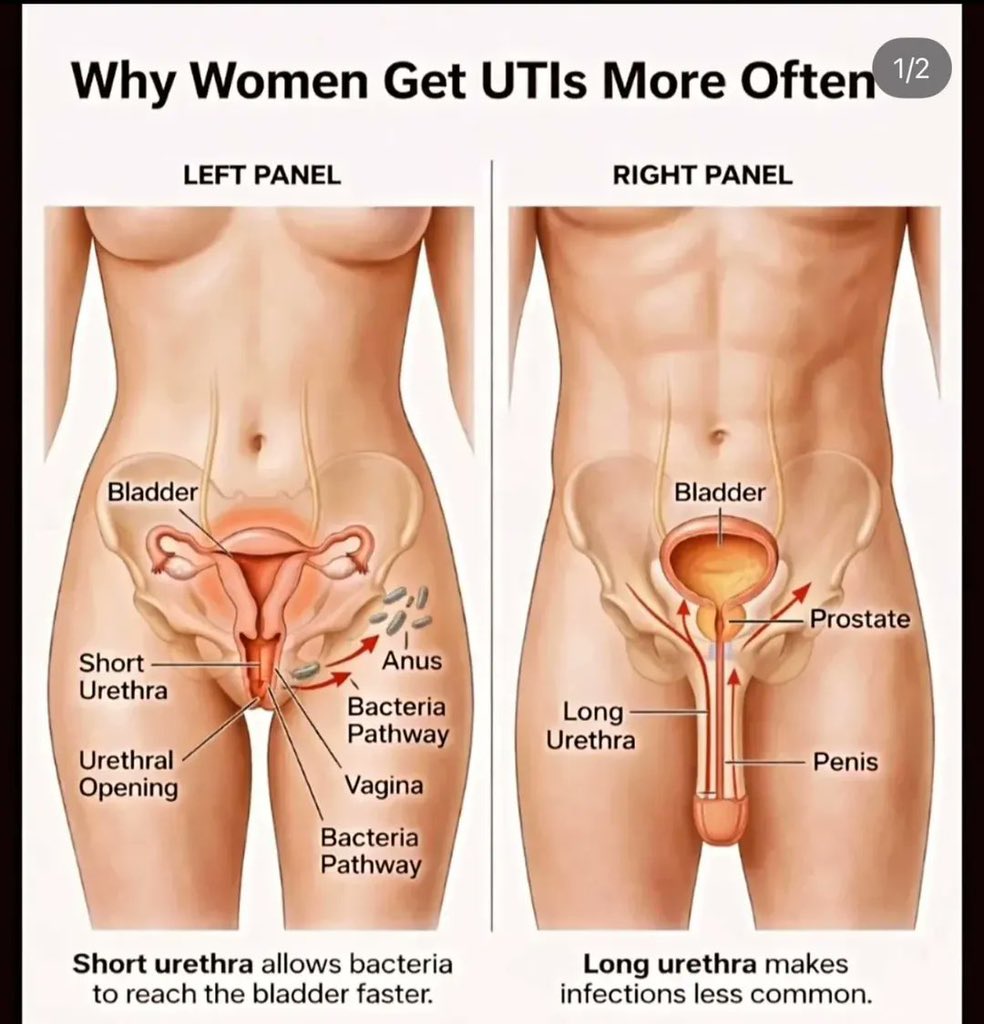
Why women get UTIs more often
6
35
325
70,706

this screencap fucking sends me like wdym an axe throwing facility for women with chronic UTIs?
103