
Discover how SURGI-PVA™ Eye Spears support effective fluid management through their ultraclean, highly absorbent, and lint-free design, helping surgeons maintain control during delicate eye procedures.
Link to the blog - aegis-lifesciences.com/surgi…
#Ophthalmology #AegisLifesciences

13

AD. Post-hosting kitchen reset. I should have done this on the night but sometimes I get lazy and leave it to the morning. Anyone else?
I didn't think I could get excited about a mop, but here we are. The UltraClean Mop from separates clean and dir...
12

May 16
Anyone can buy an EUV machine from ASML with $500M, but it doesn't end with that.
Making silicon ingots, wafers, cutting them, everything in the ultraclean rooms, making the wafers reach EUV, making OSAT, logistics from fab to OSAT.
4
2
309

All HEPA filtered to class 10/100, but the main thing is nothing ever, ever, EVER touches any part of the optic clear aperture after it come out of the ultrasonic DI baths. You CAN'T touch it with anything. Even the most ultraclean cleanroom wipe will leave shittons of particles.
1
2
59

May 10
Entropy becomes the IoBNT's programmable signal, not its waste product. Graphene's Dirac fluid physics lets you manipulate entropy actively through two mechanisms: electrostatically gated demon waves and magnetically tunable Shannon entropy.
The demon wave transistor demonstrated in the Nature paper achieves over 80% modulation of heat flow using gate voltages, turning thermal transport into switchable circuitry. For bio-nano devices, this means you can route heat like electricity—creating thermal logic gates that process information via entropy pulses rather than electrons. This matters because biological systems are thermally sensitive but electrically noisy; entropy waves let you send signals or trigger reactions (like drug release) without ionic interference.
The Dirac fluid regime also decouples heat and charge transport, violating the Wiedemann-Franz law by factors of 200. In an IoBNT context, this lets you harvest or dissipate thermal energy while maintaining electrical neutrality, crucial for interfacing with cells or proteins that are sensitive to electromagnetic fields but need precise temperature regulation.
Practically, this enables nanobots with thermal biosensors that use entropy waves to communicate, or targeted hyperthermia where heat is steered to specific biological sites via gated graphene channels. The switching speeds could hit gigahertz, far faster than biological diffusion limits.
The limitation is fabrication—you need ultraclean, hBN-encapsulated graphene and precise electrostatic gating at the nanoscale. But if solved, entropy transforms from a passive dissipation problem into an active resource for computation, sensing, and control in biological environments.
1
1
4
305
May 10
Graphene demon waves are collective entropy waves that ripple through graphene's electron fluid when it enters a hydrodynamic state. In ultraclean graphene near charge neutrality at room temperature, electrons and holes collide so frequently they form a viscous "Dirac fluid" that behaves like a liquid rather than individual particles.
The "demon" label stands for "distinct electron motion" - a collective mode where electrons and holes oscillate in phase, carrying heat as a coherent wave rather than through diffusion. These entropy waves propagate at speeds ranging from roughly 0.7 to 2.1 times graphene's Fermi velocity (up to about 2 million meters per second), showing linear dispersion like sound waves.
The recent breakthrough demonstrates a thermal transistor that gates these waves. Researchers use a local electrostatic gate to create a carrier-density wall in the graphene channel. When the wall matches the background polarity (n-type passing through n-type), the wave transmits freely. When polarities oppose (n-p-n junction), impedance mismatch reflects over 80% of the thermal wave, creating an on/off heat valve.
This establishes active thermal circuitry - the ability to switch and logic-process heat signals electronically rather than just dissipating them passively. With potential switching speeds in the tens of gigahertz, it opens the door to thermal logic devices that manage heat flow with the same precision electrical transistors provide for current.
1
3
120

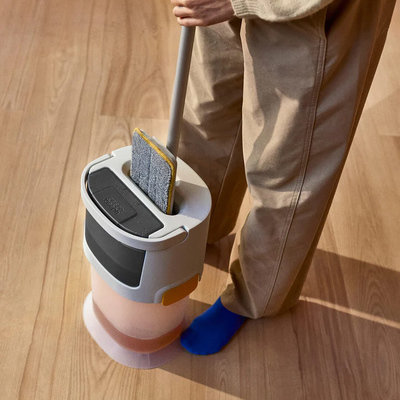
Using a traditional mop and bucket means you're continually dunking the mop head back into dirty water. Joseph Joseph's designers have completely rethought this arrangement with their… core77.com/posts/143840/Jose… #JosephJoseph #MopDesign #HomeCleaning #InnovativeDesign #UltraClean
1
219

Apr 21
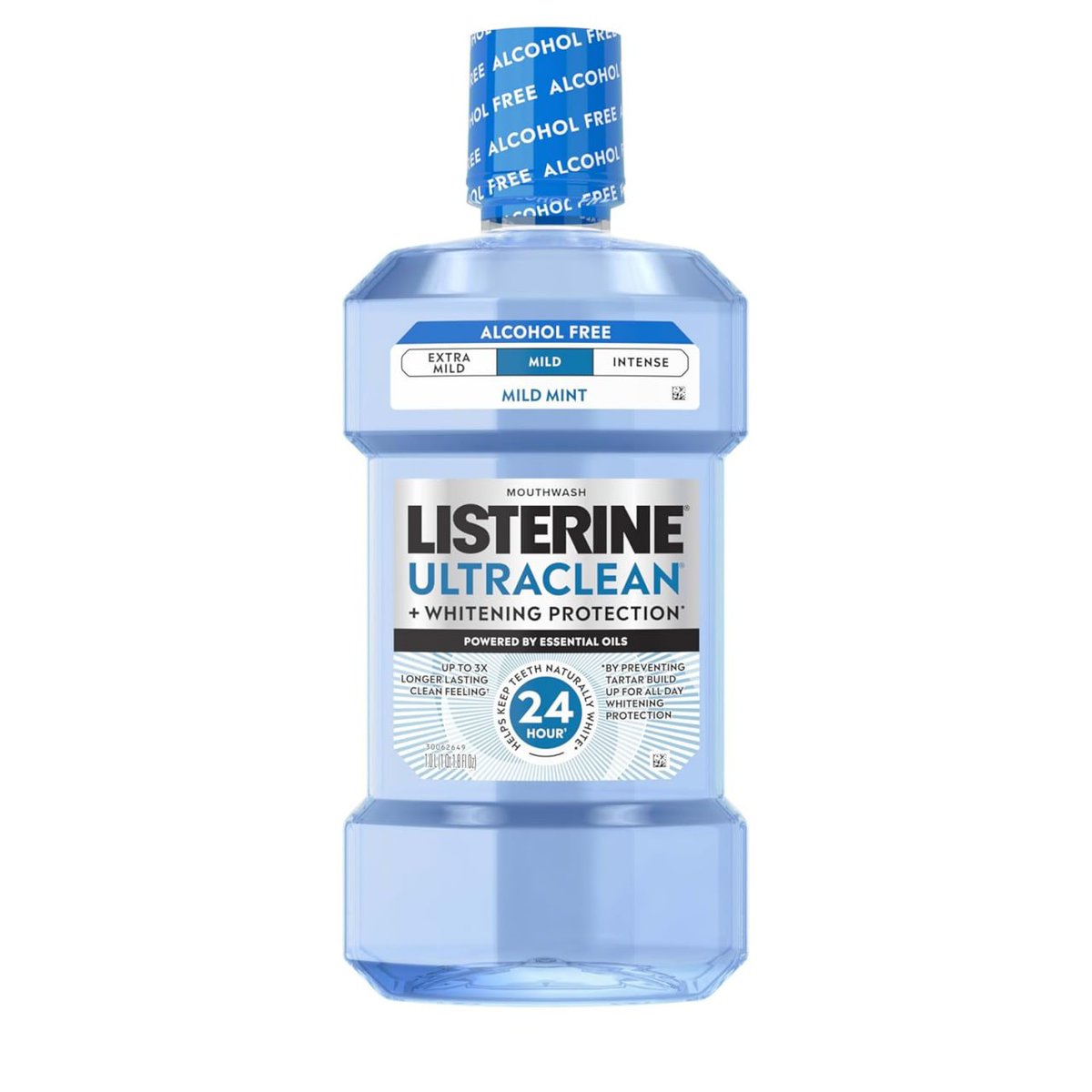
Listerine Ultraclean Alcohol-Free Mild Mouthwash Whitening Protection #ad
Now $4.xx
Reg $10.xx
Clip Coupon 30% sub&save
joylink.io/mythical-tartar-c…
Free Month of Amazon Prime
joylink.io/GCsA6rk
1
2
5
100

Homeware brand Joseph Joseph has launched a floor-cleaning system designed to keep clean and dirty water separate during use.
Called UltraClean, the product rethinks a common cleaning process that typically involves reusing dirty water during mopping, which can spread grime across surfaces rather than remove it.
At the centre of the design is a patented SprayClean mechanism that cleans and refreshes the mop pad each time it is returned to the bucket. As the mop is inserted, a built-in scraper blade squeezes and agitates the microfibre pad to remove dirt and debris, which is then channelled into a separate compartment.
Find out more in the link in the bio
8
25
7,104

Mar 27
Listerine Ultraclean Mouthwash, alcohol free, cool mint, 1L is $6.99 on Amazon urlgeni.us/amzn/Knf8aW #ad
2
751


Mar 24
ywah, also amusing thing i just realized, the mod creator and anyone who unironically uses ultraclean is making the game harder for themselves by removing power voicelines (bc yk they indicate what the power’s gonna do next) fucking dumbasses
3
39

Mar 23
Metbroschen. (spelling might suck)
Ultraclean raw pork on bread.
1
2
17

Mar 23
“Dirac Fluid” : particles move at incredibly high speeds and follow the rules of massless physics, making them behave like light. When you combine that high speed with constant collisions, the result is a system that flows with almost zero resistance, following the laws of hydrodynamics rather than standard electronics. Scientist can scale up lab results for mass production in products it will create literally trillions and trillions of value.
Here is why $hg $hgraf turbostratic fractal graphene aggregates are uniquely positioned to achieve and maintain Dirac fluid properties:
•Pristine Atomic Purity: The Dirac fluid only exists near the "Dirac point," a delicate tipping point where the material is neither a conductor nor an insulator. Even tiny amounts of defects or impurities can "clog" the flow and turn the fluid back into a standard electronic gas.
Turbostratic Fractal Graphene, HydroGraph's Fractal Graphene™, is produced with ultra-high carbon purity (99.8%) and a consistent 100%crystalline structure, which is vital for maintaining the "frictionless" flow of the fluid.
•High Surface Area and Volume Fraction: The fractal morphology creates a unique geometry with high surface area and high volume fraction. This structure allows for optimal interaction and integration within a matrix, ensuring that the collective motion of the electrons, (the hallmark of a Dirac fluid), can be maintained across a larger macroscopic scale.
•Turbostratic Structure: FGA often features a "turbostratic" (randomly rotated) layering rather than perfectly stacked graphite. This rotation helps preserve the individual 2D properties of graphene layers, which is necessary to keep the electrons behaving like "massless" Dirac particles rather than standard massive ones.
•Decoupling of Heat and Charge: In a true Dirac fluid, heat and charge flow through distinct channels, violating the standard Wiedemann-Franz law. The structural uniformity of fractal aggregates provides the "ultraclean" environment needed to observe this divergence, which has proven nearly impossible to detect in other potential materials like topological insulators or Weyl semimetals so far. 
In summary, while other "Dirac materials" exist, they usually suffer from structural defects that break the fluid. The specific fractal geometry combined with high-purity production makes these aggregates the most viable candidate for stable, tabletop Dirac fluid applications.
@Rainmaker1973
9
13
126
16,577

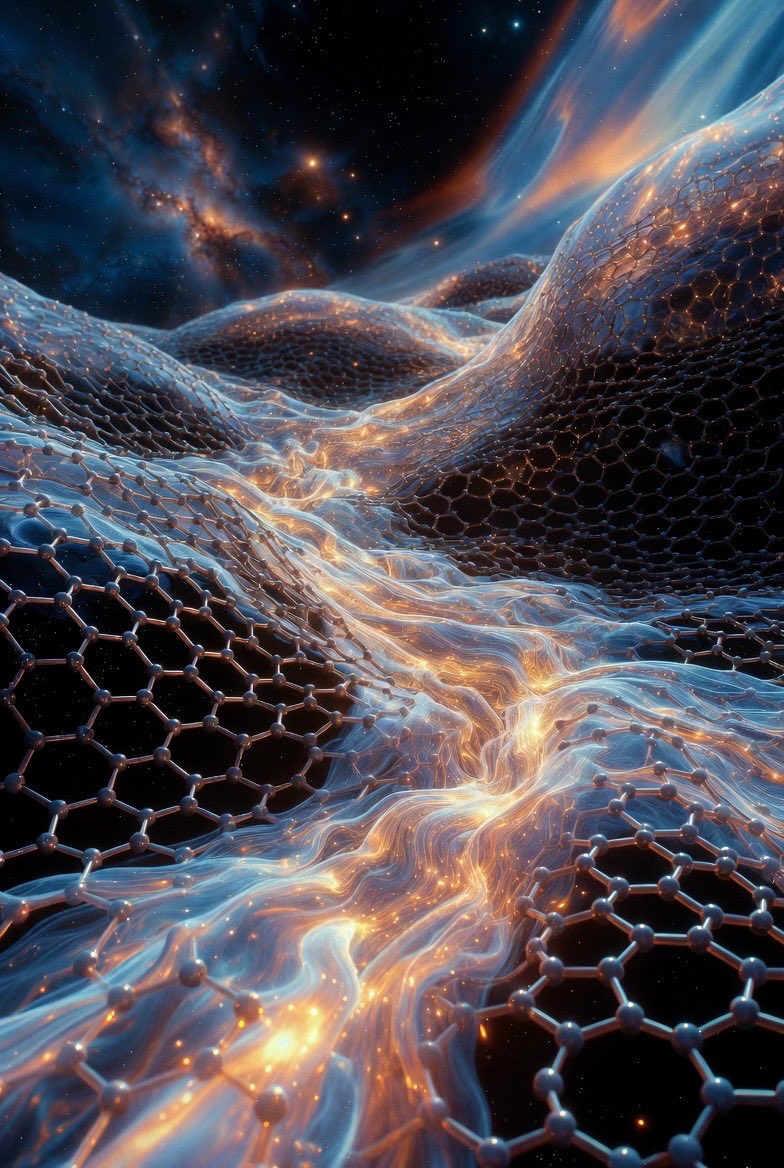
Mind-bending breakthrough in graphene just dropped (Nature Physics 2025):
At the Dirac point, electrons stop acting like particles… and flow as a near-perfect quantum fluid - viscosity lower than anything in solid matter, mimicking the quark-gluon plasma of the early universe.
Heat & charge completely decouple → >200× violation of the 100-year-old Wiedemann–Franz law.
This isn't just physics. It's a tabletop glimpse into frictionless flow states - the same principle that could underpin peak mental clarity, zero-resistance bio-energy channels, or alchemical "inner conductivity" when the mind reaches critical neutrality.
The honeycomb lattice (nature's most efficient tiling) unlocks relativistic quantum hydrodynamics on an atomic sheet.
We're literally holding a material that bridges everyday matter to cosmic extremes.
What if tuning our own "Dirac point" (neutral awareness?) allows similar decoupling - separating dissipative noise from pure signal?
Graphene as mirror for consciousness upgrade. 🧠⚛️🔥
"Universality in quantum critical flow of charge and heat in ultraclean graphene" – Majumdar et al.
#QuantumAlchemy #Graphene #DiracFluid #PeakPerformance #ConsciousnessTech #NaturePhysics
4
2
80

Mar 23
>グラフェンが示した量子流体は、固体物理の常識を優雅に越境します。秩序と揺らぎが交差する臨界の美しさは、基礎科学と応用の双方に新たな地平を開く兆しです。
>驚くべき画期的な発見として、グラフェン内の電子が、物理学者によって長らく不可能と考えられてきた振る舞いを示しました。材料のディラック点——グラフェンが完全に金属でも絶縁体でもない、臨界的な電子状態——において、電子は個別の粒子として振る舞うのをやめ、代わりにほぼ完璧な量子液体として集団的に流れます。
この奇妙な流体は驚くほど滑らかで、その粘性は初期宇宙に存在した超高温プラズマや、現代の粒子加速器で再現されるものに匹敵するほど低く、通常の固体物質で知られるあらゆる振る舞いよりもはるかに滑らかです。
最も衝撃的な発見:熱と電荷が完全に分離し、ワイデマン・フランツの法則に対するこれまで観測された最大の違反を引き起こしました。この基本的な法則は、従来のすべての金属で1世紀以上にわたり成立してきたもので、熱伝導率と電気伝導率が連動して動くべきだと述べています。しかし、グラフェンの量子流体では、その比率が予想値から200倍以上逸脱しました。
これにより、グラフェンは単なる驚異的な材料以上のものとなります——それは、ブラックホール、クォーク・グルーオンプラズマ、または巨大な粒子衝突装置内の条件でのみ観測可能と考えられていた極端な量子現象を探求するための注目すべき実験室として機能します。
その基本的な重要性に加えて、この超クリーンで高応答性の量子振る舞いは、次世代の超高感度センサーなどの革新的な応用につながる可能性があり、これらは前例のない精度で微小な電場や磁場を検知できます。
["Universality in quantum critical flow of charge and heat in ultraclean graphene." Nature Physics, 13 August 2025]
Mar 22

In a stunning breakthrough, electrons in graphene have exhibited behavior long considered impossible by physicists. At the material's Dirac point—a critical electronic state where graphene is neither fully a metal nor an insulator—the electrons cease behaving like individual particles and instead flow collectively as a nearly perfect quantum liquid.
This strange fluid is extraordinarily smooth, with a viscosity so low it rivals the ultra-hot plasma that existed in the early universe or is recreated in modern particle accelerators—far smoother than any known behavior in ordinary solid matter.
The most shocking discovery: heat and electric charge decoupled completely, resulting in the largest violation ever observed of the Wiedemann–Franz law. This fundamental rule, which has held for over a century in all conventional metals, states that heat and electrical conductivity should move in lockstep. In graphene's quantum fluid, however, the ratio deviated by more than 200 times from the expected value.
This makes graphene far more than just a wonder material—it serves as a remarkable laboratory for exploring extreme quantum phenomena once thought observable only in black holes, quark-gluon plasmas, or the conditions inside massive particle colliders.
Beyond its fundamental importance, this ultra-clean, highly responsive quantum behavior could lead to revolutionary applications, including next-generation ultra-sensitive sensors capable of detecting minute electrical or magnetic fields with unprecedented precision.
["Universality in quantum critical flow of charge and heat in ultraclean graphene." Nature Physics, 13 August 2025]
3
7
776

Mar 22
Did you know that ultraclean graphene is not the only material (or the first) to deviate from the Wiedemann–Franz (WF) law? Deviations have been observed in many other materials and systems for over a decade.
Here are some earlier examples (many predating 2025):
- Graphene itself (2016 Science paper, Crossno et al.): Breakdown of WF law in doped graphene due to hydrodynamic electron flow, with deviations by factors of ~10–20 in some regimes.
- Vanadium dioxide (VO₂) nanobeams (2016–2017): Electronic thermal conductivity ~10× smaller than WF prediction near the insulator-metal transition; electrons carry charge but not heat effectively. Often called a “first” at the time, but other violations were already known.
- Quasi-1D Luttinger liquid (lithium molybdenum purple bronze, Li₀.₉Mo₆O₁₇, 2011): Hall thermal/electrical conductivity ratio diverges by up to five orders of magnitude due to spin-charge separation.
- Weyl semimetals (e.g., WP₂ in 2018; topological compensated semimetals like TaAs₂ or similar, 2025): Large downward deviations and T⁴ thermal conductivity behavior at ultralow temperatures.
- MXenes (Ti₃C₂Tₓ flakes, 2024): Effective Lorenz number only ~0.25× the classical value, with ultralow anisotropic thermal conductivity.
- Heavy-fermion compounds (e.g., CeCoIn₅, UPt₃), cuprates, Heusler alloys, and thin gold films: Violations driven by electron-electron scattering, quantum criticality, or reduced dimensionality—sometimes drastic and temperature-dependent.
Deviations can be upward (L ≫ L₀, as in the new graphene) or downward (L ≪ L₀) and are now a diagnostic tool for non-Fermi-liquid behavior rather than a shocking anomaly.
2
3
48
2,689

Mar 22
In a stunning breakthrough, electrons in graphene have exhibited behavior long considered impossible by physicists. At the material's Dirac point—a critical electronic state where graphene is neither fully a metal nor an insulator—the electrons cease behaving like individual particles and instead flow collectively as a nearly perfect quantum liquid.
This strange fluid is extraordinarily smooth, with a viscosity so low it rivals the ultra-hot plasma that existed in the early universe or is recreated in modern particle accelerators—far smoother than any known behavior in ordinary solid matter.
The most shocking discovery: heat and electric charge decoupled completely, resulting in the largest violation ever observed of the Wiedemann–Franz law. This fundamental rule, which has held for over a century in all conventional metals, states that heat and electrical conductivity should move in lockstep. In graphene's quantum fluid, however, the ratio deviated by more than 200 times from the expected value.
This makes graphene far more than just a wonder material—it serves as a remarkable laboratory for exploring extreme quantum phenomena once thought observable only in black holes, quark-gluon plasmas, or the conditions inside massive particle colliders.
Beyond its fundamental importance, this ultra-clean, highly responsive quantum behavior could lead to revolutionary applications, including next-generation ultra-sensitive sensors capable of detecting minute electrical or magnetic fields with unprecedented precision.
["Universality in quantum critical flow of charge and heat in ultraclean graphene." Nature Physics, 13 August 2025]
80
355
1,524
129,669

Mar 14
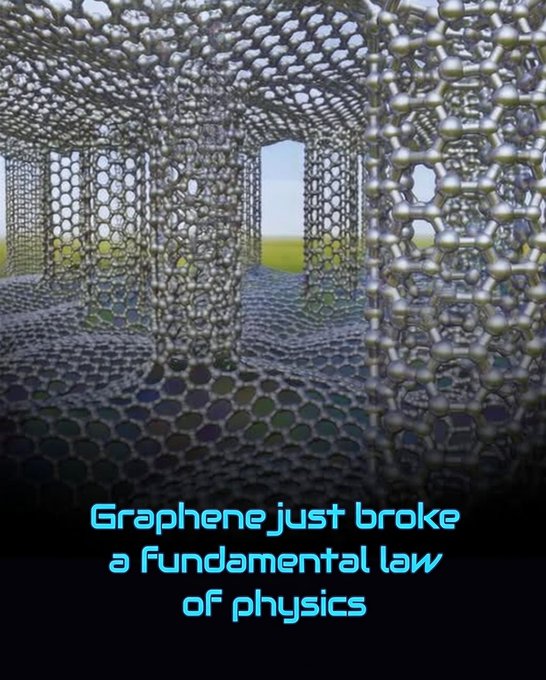
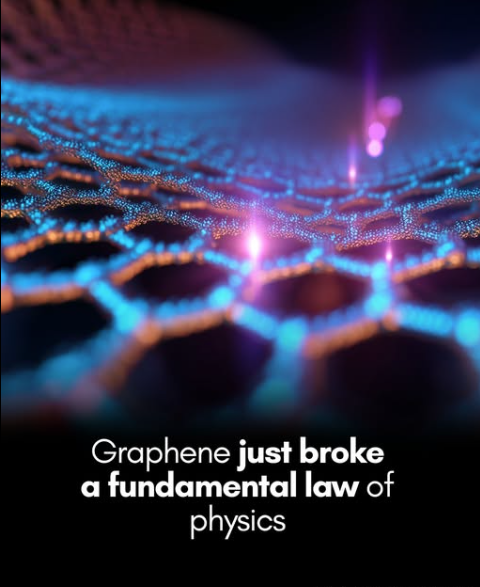
Graphene just broke a fundamental law of physics.
Its electrons just did something physicists thought was impossible. For nearly 200 years, metals have obeyed the Wiedemann-Franz law – the rule that electrical conductivity and thermal conductivity always rise and fall together.
But in ultra-clean graphene, researchers at the Indian Institute of Science found the opposite. As electrical conductivity increased, thermal conductivity dropped, shattering a principle taught in every physics textbook.
The key lies at the “Dirac point,” a strange electronic tipping point where graphene is neither a metal nor an insulator. Here, electrons stop behaving like individual particles. Instead, they flow collectively as a nearly perfect fluid – a state called a “Dirac fluid.”
This discovery doesn’t just rewrite the rules for graphene. It provides a tabletop window into extreme physics usually reserved for black holes and high-energy colliders. Scientists say this behavior could help probe mysteries of quantum entanglement, black hole thermodynamics, and the very fabric of matter itself.
["Universality in quantum critical flow of charge and heat in ultraclean graphene." Nature Physics, 2025]
93
406
1,449
61,085