


2 Aug 2025
You only have 50 dollars left in your pocket and could bet on what would happen next.
Which bet would you place?
A. Pi will rise
B. Pi is dead
#PiNetwork #Crypto #Web3 #Web𝝅
$Pi Pi Network survey
78%
A
22%
B
1,001 votes • Final results
31
11
109
8,254

28 Mar 2025
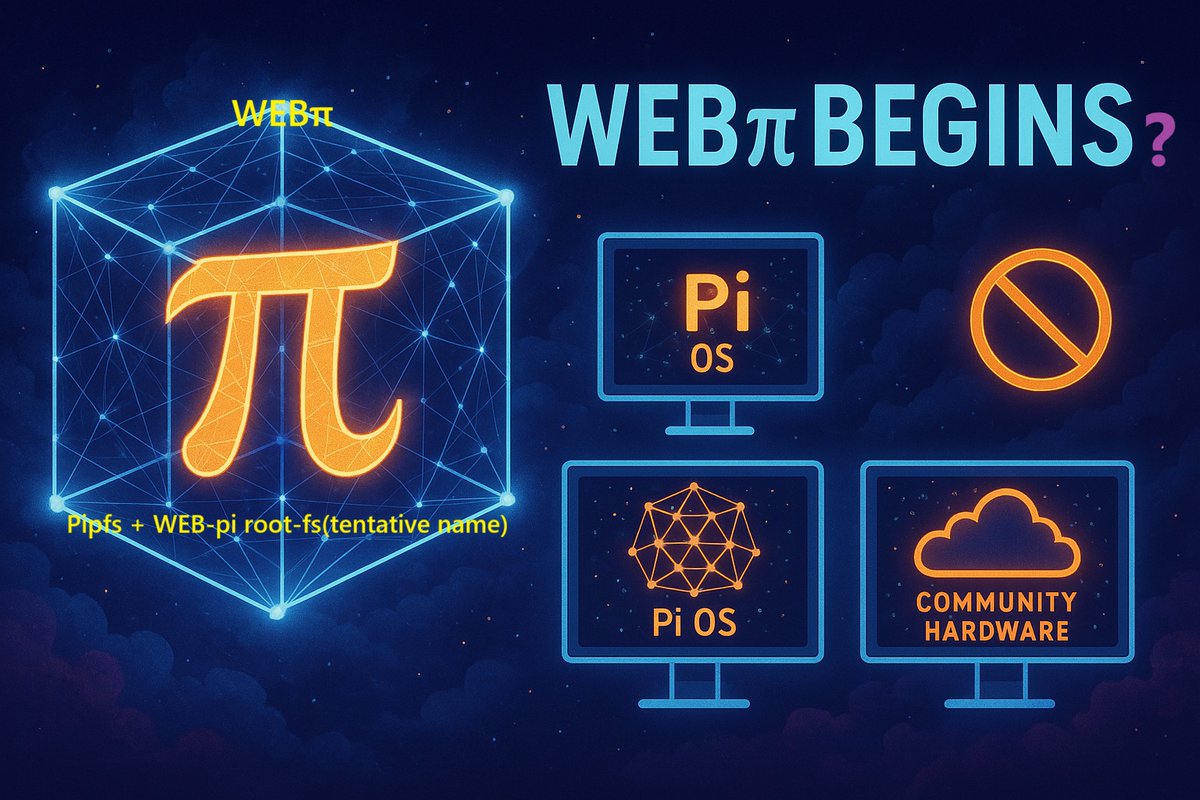
[Predictive Analysis - Webπ Begins !!! ]
The Future of Pi Network: Pi Nexus OS, Decentralized Hardware, and the Dawn of a New Global Internet Infrastructure
[[[ This article includes predictive analysis and actual developments may differ.
A true pioneer abides by the Migration Terms and earns the GCV value of Pi through contributions to the network. ]]]
[[[ "Webπ" is a name used arbitrarily and may differ from the actual terminology. ]]]
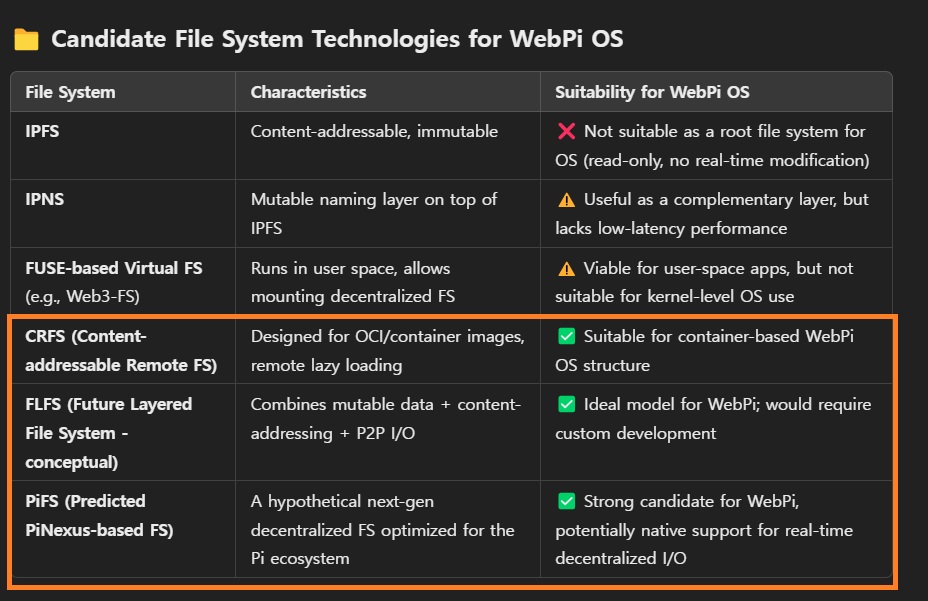
[[[ The name of the root file system for the "Webπ" operating system is also arbitrarily assigned. ]]]
[[[ Webπ Begins: A Decentralized World of Pi OS, Community Hardware, and Infinite Possibilities ]]]
1. The Current Structure: Docker-Based Consensus Nodes on Traditional OS
1.1 At present, Pi Nodes run on physical devices such as desktops, servers, or high-performance micro-devices, operating under traditional systems like Windows, Linux, or macOS.
1.2 On top of these, Docker containers execute the Pi Consensus Node, creating a flexible yet layered architecture.
1.3 This design offers cross-platform compatibility and scalable deployment in a globally diverse environment.
2. The Inflection Point: The Emergence of Pi Nexus OS
2.1 Pi Nexus OS is a subproject within the Pi Nexus Autonomous Banking Network initiative.
2.2 Built using C and C , it appears to be a lightweight, highly optimized decentralized operating system.
2.3 Its primary objectives include:
2.3.1 Operating the Pi Autonomous Banking Platform
2.3.2 Efficiently running Pi Nodes natively
2.3.3 Providing the foundation for future integration of PIPFS (Pi InterPlanetary File System) and Pi Cloud
3. A Futuristic Scenario: A World Where Every Device Runs on Pi Nexus OS
3.1 Replacing Traditional Operating Systems
Imagine users installing Pi Nexus OS instead of Windows, Linux, or macOS
Upon booting, users are presented with only the Pi Browser or Pi-based app ecosystem
All traditional apps are replaced by decentralized applications running on the Pi Blockchain, with devices acting as secure display terminals
✅ Example:
Word processing, messaging, music playback—all handled by decentralized apps, with the user’s local device simply rendering results from the blockchain.
3.2 Thin Clients in a Decentralized Cloud World
All computation is handled across distributed Pi Nodes
User devices simply send tasks and display results
High performance hardware becomes obsolete for most people, dramatically lowering the digital divide
4. Hardware Revolution: Raspberry Pi and Community-Driven DAO Hardware Supply
4.1 Pi Nexus OS is optimized for Raspberry Pi and small-scale devices, significantly lowering the barrier for node deployment.
4.2 This unlocks massive potential:
4.2.1 Millions of individuals, businesses, and merchants globally can run nodes affordably
4.2.2 Enterprise services can run on community-distributed Pi Nodes rather than centralized data centers
4.2.3 DAO-driven hardware manufacturing emerges, supplying Pi-optimized devices for the network
✅ A Possible Structure:
Global → National DAO → Regional DAO → Hardware DAO
↳ Designs, manufactures, and distributes nodes
↳ Offers Pi-specific mini servers, modular computing boards, node kits
↳ Operates as self-sustaining open hardware cooperatives
5. Rebuilding Internet Infrastructure Itself via DAO
5.1 Even traditional internet infrastructure providers (ISPs) could be absorbed into national Pi Infrastructure DAOs
5.2 These entities could maintain decentralized data pipes and serve as national backbones
5.3 This marks a paradigm shift from Web2 to a full-scale Webπ (Pi)—where hardware, network, and software are fully community-governed
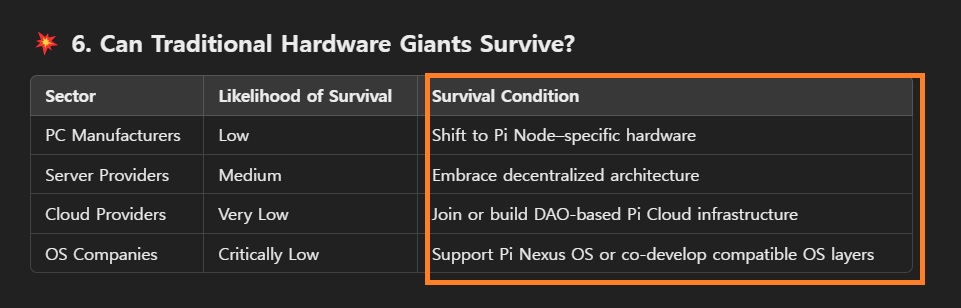
6. Can Traditional Hardware Giants Survive?
(( See attached image 6. ))
7. Final Vision: Pi Network is More Than Just Blockchain
Pi is not just a cryptocurrency—it is an economic OS, an infrastructure, a hardware movement, and a decentralized services ecosystem
If Pi Nexus OS becomes globally adopted, the world would witness the first self-sustaining technological civilization based on community economics
🌐 Potential Outcomes:
Pi Nexus OS becomes the default system for global devices
GCV-based digital economies flourish in local and global contexts
Pi Cloud replaces Web2 hosting and data services
DAO-based infrastructure replaces both hardware and telco monopolies
The digital world becomes a community-driven ecosystem with self-sovereign economics
“Is there a limit to the future of Pi Network?”
So far, every endpoint only reveals another beginning. The future of Pi appears infinite—for those who can imagine beyond today.
17
72
338
10,308

16 Dec 2024
mọi người đã bắt đầu sử dụng Webπ (Pi Browser) nhiều chưa, đây là bài viết của Pieter Wuille
8
725
11 Nov 2024
Pi là ứng dụng blockchain, browes là một trình duyệt web
Dòng tweet của Pieter Wuille về Webπ 2021 , Pieter Wuille là một nhân vật có tiếng trong cộng đồng Bitcoin và blockchain

2
1
25
1,194

12 Aug 2024
I'll do my webπ talk where I call everybody a scammer
8
1,304


28 Nov 2022

After that, there will be an opportunity to push rational mechanisms like #Bitlattice.
I wrote, that @Bitlattice is a Trojan Horse. While it's a currency and value exchange mechanism (predominantly) its main purpose is to provide autonomous and deterministic decision making.

6
6


28 Oct 2022
web2.5、web3、web5、といった言葉が発明され続けているので、そろそろwebi(虚数)とかwebπとか出てきてもおかしくはない。
2


14 Jun 2022
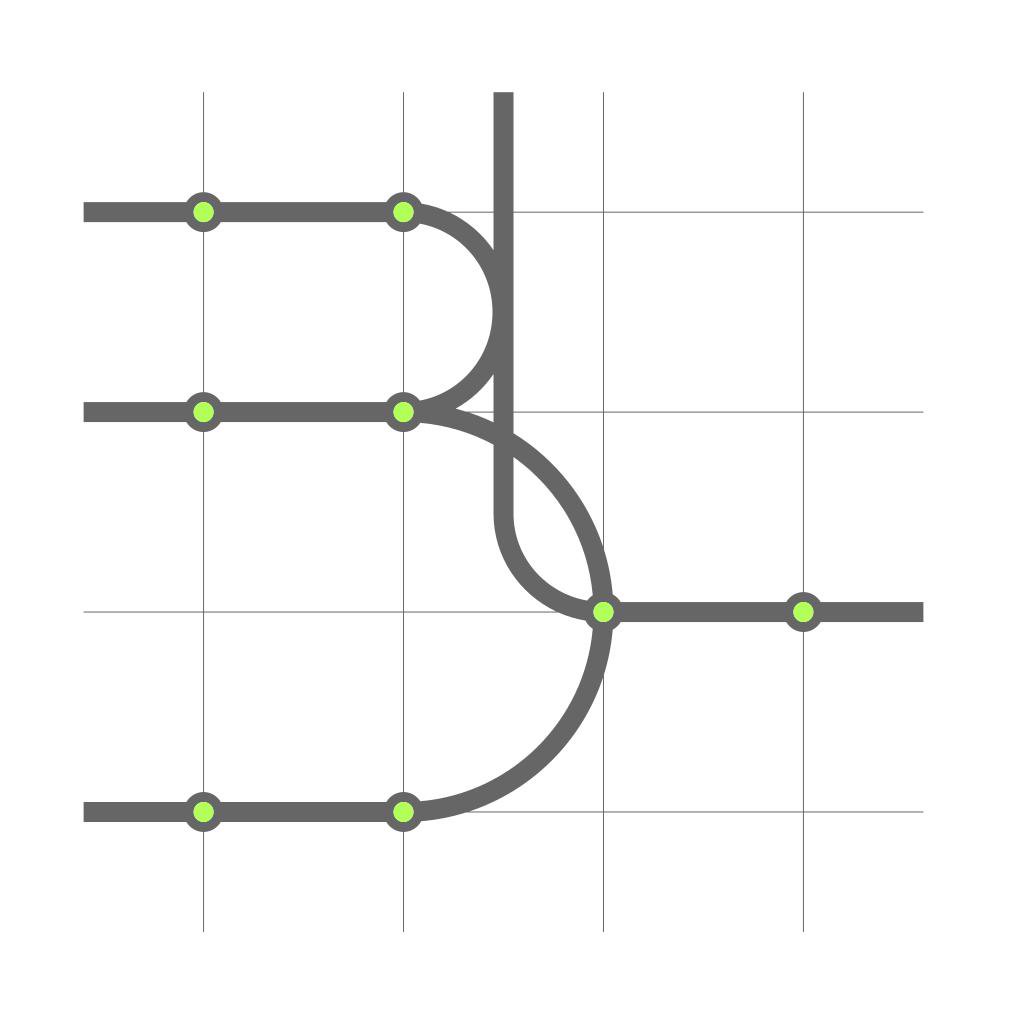
#Bitlattice DECENTRALIZED CENTRALIZATION
The network is decentralized in physical sense, however functionally speaking it’s fully centralized – all decisions are made in the middle layer and there is no authority that could affect them.
#nohumanimpact #Webπ
5
6


11 Jun 2022
Naming his new company web5 was a genius marketing move by @jack imo. Here’s why:
The internet seems to have taken sides. By either dismissing the idea completely or interpreting reasons for the name.
From (web3) (web2) to (3 x 2) - 1, I have seen everything. webπ, web69…
1
2

17 May 2022
I’m not going to pay much attention to web3 until the kinks are worked out and we’ve got a few maintenance releases under our belts.
Call me when we hit web3.14
webπ. I could maybe get excited about that.
1
2

