
Jun 12
Super thorny problem to agentify. Excited to follow your lead here.
99

Dubai, get ready to agentify your trades on OKX!
We’re hosting a LIVE event in Dubai to showcase OKX Agentic Trading with @eeelistar & @sanjaybuilds_
🗓️ June 11, 2026
📍 OKX, Dubai Office 🇦🇪
Secure your spot now: luma.com/w6l9v5fd
Or catch the live webinar!

New Wave x OKX
Join our live AI workshop where we'll teach attendees agentic trading using OKX MCP!
Whether you're coming in person or via webinar, make sure to register here: luma.com/w6l9v5fd
June 11th in Dubai
16
6
66
15,732

Jun 11
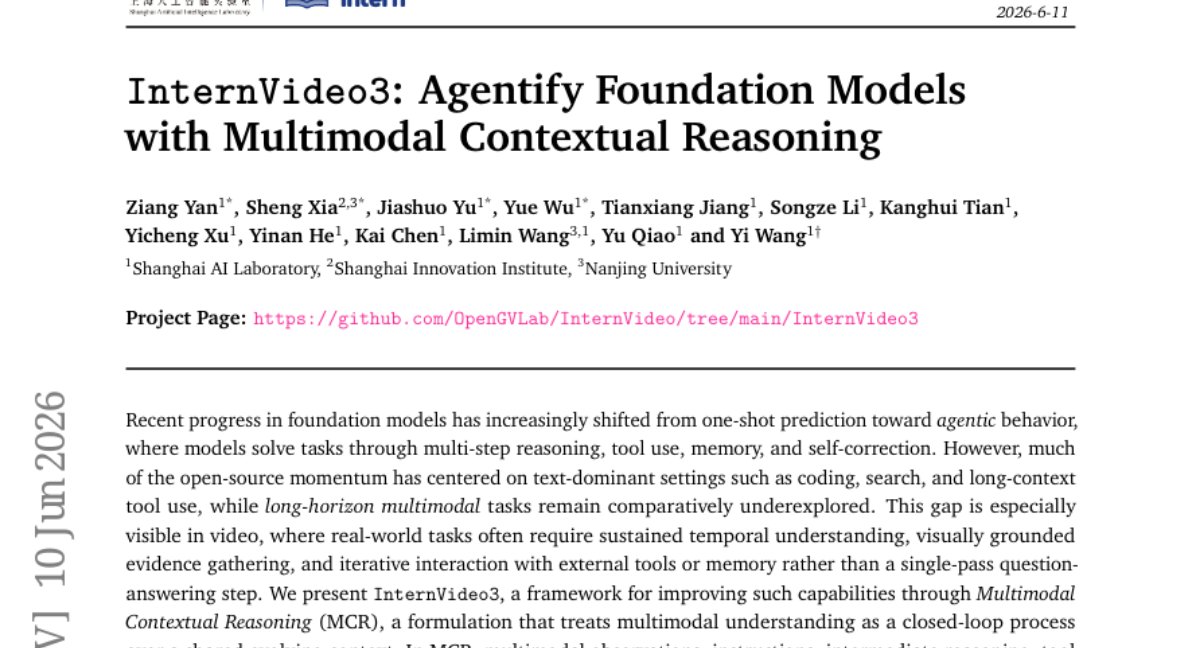
7. InternVideo3: Agentify Foundation Models with Multimodal Contextual Reasoning
🔑 Keywords: Multimodal Contextual Reasoning, Multimodal Multi-head Latent Attention, Video Agent, Long-Horizon Tasks
💡 Category: Multi-Modal Learning
🌟 Research Objective:
- The study aims to enhance long-horizon multimodal tasks through Multimodal Contextual Reasoning and efficient attention mechanisms, particularly focusing on video understanding challenges.
🛠️ Research Methods:
- The research employs a novel framework named InternVideo3, which utilizes Multimodal Contextual Reasoning and introduces Multimodal Multi-head Latent Attention to improve efficiency in video task processing. The training process involves staged training with components like continued pretraining, short-to-long supervised fine-tuning, rule-based reinforcement learning, and on-policy distillation.
💬 Research Conclusions:
- InternVideo3 exhibits strong performance on video understanding benchmarks such as Video-MME, MLVU, and EgoSchema. It also demonstrates robust and evidence-grounded behavior as a video agent, suggesting that efficient context handling and closed-loop reasoning are critical for long-horizon visually grounded agency.
👉 Paper link: huggingface.co/papers/2606.1…
1
25
Jun 11
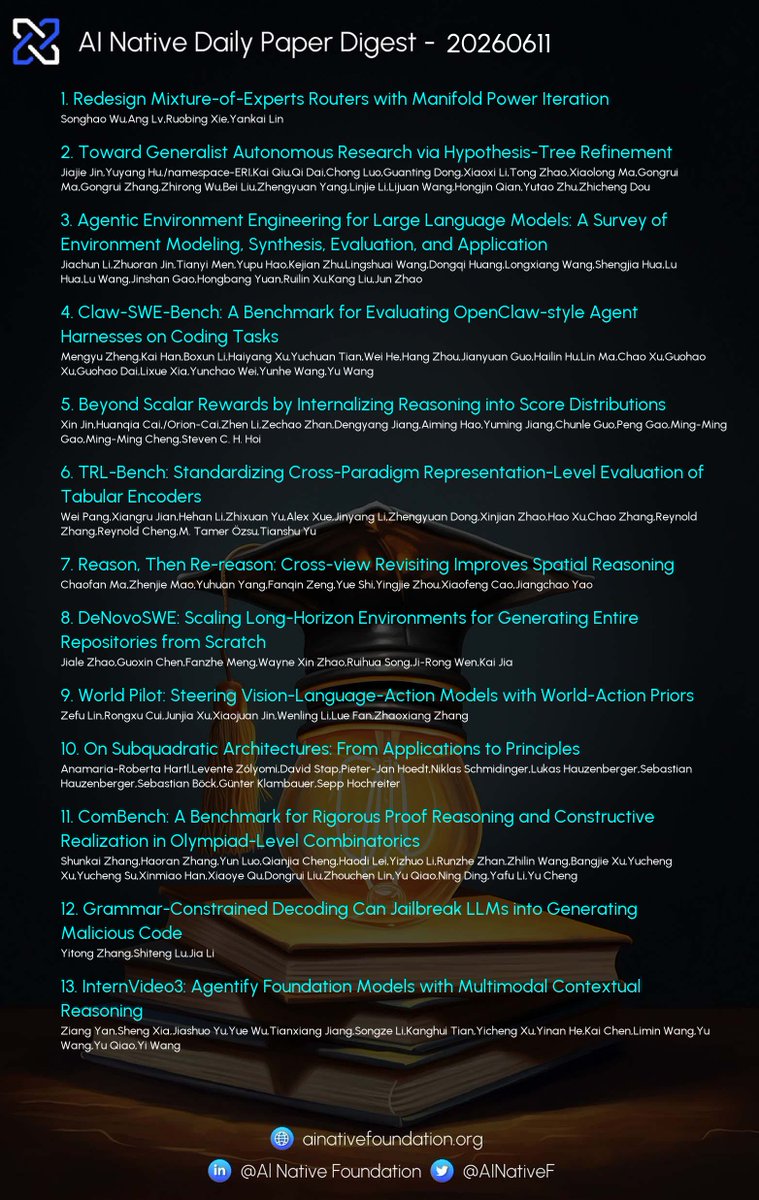
📚 AI Native Daily Paper Digest - 2026-06-11🌟
Follow @AINativeF for the latest insights on AI Native.
Covering AI research papers from Hugging Face, featured in the image.
💡 Stay updated with the latest research trends and dive deep into the future of AI! 🚀
#AI #HuggingFace #AIPaper #AINative #AINF
— Appendix: Today's AI research papers —
1. Redesign Mixture-of-Experts Routers with Manifold Power Iteration
2. Agentic Environment Engineering for Large Language Models: A Survey of Environment Modeling, Synthesis, Evaluation, and Application
3. Beyond Scalar Rewards by Internalizing Reasoning into Score Distributions
4. Reason, Then Re-reason: Cross-view Revisiting Improves Spatial Reasoning
5. World Pilot: Steering Vision-Language-Action Models with World-Action Priors
6. ComBench: A Benchmark for Rigorous Proof Reasoning and Constructive Realization in Olympiad-Level Combinatorics
7. InternVideo3: Agentify Foundation Models with Multimodal Contextual Reasoning
8. TRACE: A Unified Rollout Budget Allocation Framework for Efficient Agentic Reinforcement Learning
9. ICA Lens: Interpreting Language Models Without Training Another Dictionary
10. Embodied-R1.5: Evolving Physical Intelligence via Embodied Foundation Models
11. World Model Self-Distillation: Training World Models to Solve General Tasks
12. ReVision: Scaling Computer-Use Agents via Temporal Visual Redundancy Reduction
13. i1: A Simple and Fully Open Recipe for Strong Text-to-Image Models
1
1
1
233

Jun 11
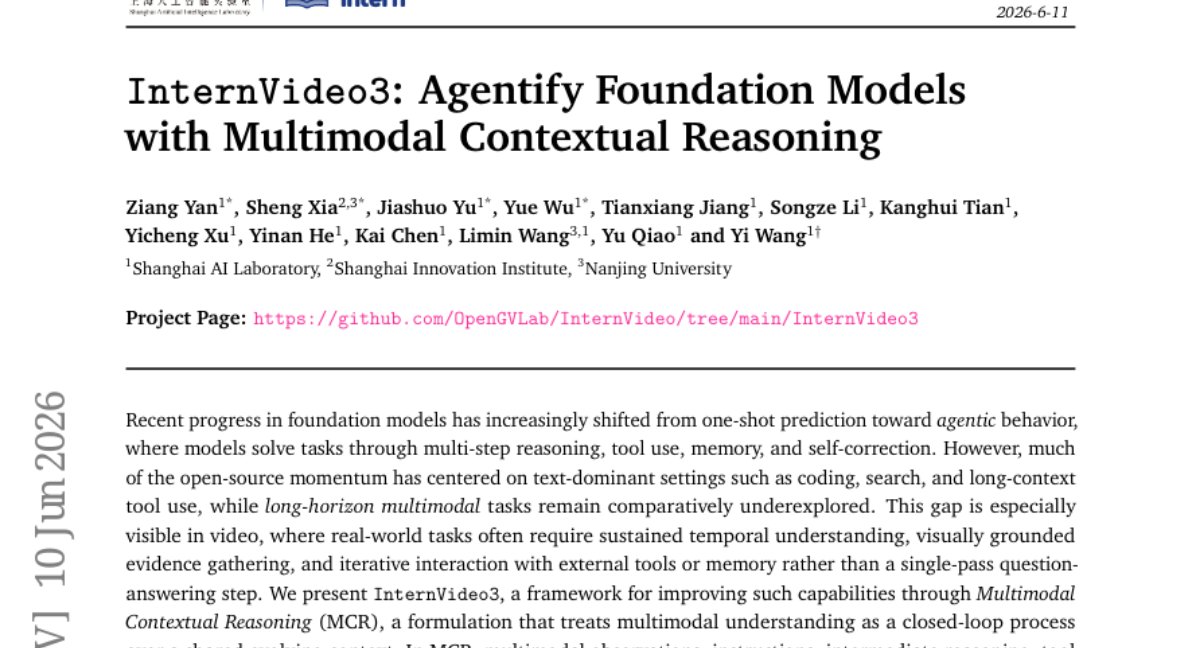
7. InternVideo3: Agentify Foundation Models with Multimodal Contextual Reasoning
InternVideo3: 使用多模态上下文推理赋能基础模型的智能化
🔑 关键词: 多模态上下文推理, 多模态多头潜在注意力, 视频代理, 长视距任务
💡 类别: 多模态学习
🌟 研究目标:
- 本研究旨在通过多模态上下文推理和高效注意力机制改善长视距的多模态任务, 特别是聚焦于视频理解的挑战。
🛠️ 研究方法:
- 该研究采用了一种名为 InternVideo3 的新框架, 利用多模态上下文推理并引入多模态多头潜在注意力来提高视频任务处理的效率。训练过程包含分阶段训练, 其中包括持续预训练、由短到长的监督微调、基于规则的强化学习以及策略内蒸馏。
💬 研究结论:
- InternVideo3 在诸如 Video-MME、MLVU 和 EgoSchema 的视频理解基准上表现出色。它还展示了作为视频代理的稳健和有据可依的行为, 这表明高效的上下文处理和闭环推理对于长视距视觉基础的代理至关重要。
👉论文地址: huggingface.co/papers/2606.1…
1
19

Hugging Face Daily Papers — 2026-06-11
40 papers worth scanning today, spanning agentic RL, multimodal reasoning, efficient architectures, security, world models, and scientific discovery.
1. Redesign Mixture-of-Experts Routers with Manifold Power Iteration
Highlight: Router is the cornerstone component to the Mixture-of-Experts models. Serving as expert proxies, the rows of the router matrix compute their simila.
arXiv: arxiv.org/abs/2606.12397
2. Toward Generalist Autonomous Research via Hypothesis-Tree Refinement
Highlight: Scientific progress depends on a repeated loop of exploration, experimentation, and abstraction. Researchers test candidate directions, interpret t.
arXiv: arxiv.org/abs/2606.11926
3. Agentic Environment Engineering for Large Language Models: A Survey of Environment Modeling, Synthesis, Evaluation, and Application
Highlight: Environments serve as interactive systems for large language model (LLM) based agents across diverse scenarios and play a crucial role in driving t.
arXiv: arxiv.org/abs/2606.12191
4. Claw-SWE-Bench: A Benchmark for Evaluating OpenClaw-style Agent Harnesses on Coding Tasks
Highlight: General-purpose agents such as OpenClaw are increasingly used as autonomous tool users, but their coding ability is difficult to measure under SWE-.
arXiv: arxiv.org/abs/2606.12344
5. Beyond Scalar Rewards by Internalizing Reasoning into Score Distributions
Highlight: Reward models are central to text-to-image post-training, but visual preference is subjective and better represented as a distribution over rubric.
arXiv: arxiv.org/abs/2606.09076
6. TRL-Bench: Standardizing Cross-Paradigm Representation-Level Evaluation of Tabular Encoders
Highlight: Tabular encoders are usually evaluated inside task-specific end-to-end pipelines, so models from different training paradigms are difficult to comp.
arXiv: arxiv.org/abs/2606.09323
7. Reason, Then Re-reason: Cross-view Revisiting Improves Spatial Reasoning
Highlight: Spatial reasoning from egocentric videos is inherently challenging because the observable evidence is constrained by the camera trajectory. Existin.
arXiv: arxiv.org/abs/2606.11683
8. DeNovoSWE: Scaling Long-Horizon Environments for Generating Entire Repositories from Scratch
Highlight: As the capabilities of LLM-based code agents continue to advance, their expected role is expanding beyond localized bug fixing in existing codebase.
arXiv: arxiv.org/abs/2606.10728
9. World Pilot: Steering Vision-Language-Action Models with World-Action Priors
Highlight: Vision-Language-Action (VLA) models inherit semantic grounding from large-scale pretraining and perform competently across in-distribution manipula.
arXiv: arxiv.org/abs/2606.12403
10. On Subquadratic Architectures: From Applications to Principles
Highlight: Transformers dominate modern sequence modeling, but their quadratic attention incurs substantial computational cost. Subquadratic architectures off.
arXiv: arxiv.org/abs/2606.12364
11. ComBench: A Benchmark for Rigorous Proof Reasoning and Constructive Realization in Olympiad-Level Combinatorics
Highlight: Combinatorics is central to Olympiad-level mathematical problem solving, requiring deep discrete reasoning, creative constructions, and rigorous st.
arXiv: arxiv.org/abs/2606.10479
12. Grammar-Constrained Decoding Can Jailbreak LLMs into Generating Malicious Code
Highlight: Large Language Models (LLMs) are increasingly used for code generation, raising concerns that they may be misused to produce malicious code. Meanwh.
arXiv: arxiv.org/abs/2606.11817
13. InternVideo3: Agentify Foundation Models with Multimodal Contextual Reasoning
Highlight: Recent progress in foundation models has shifted toward agentic behavior involving multi-step reasoning and tool use. However, open-source efforts.
arXiv: arxiv.org/abs/2606.12195
14. Breaking Entropy Bounds: Accelerating RL Training via MTP with Rejection Sampling
Highlight: Reinforcement learning (RL) has become a key component in modern large language models, yet the rollout stage remains the key bottleneck in RL trai.
arXiv: arxiv.org/abs/2606.12370
15. Reroute, Don't Remove: Recoverable Visual Token Routing for Vision-Language Models
Highlight: Vision-language models (VLMs) project images into hundreds to thousands of visual tokens, making decoder inference expensive in both attention comp.
arXiv: arxiv.org/abs/2606.12412
16. TRACE: A Unified Rollout Budget Allocation Framework for Efficient Agentic Reinforcement Learning
Highlight: Reinforcement learning with verifiable rewards (RLVR) is a promising approach for enhancing reasoning and agentic behavior in large language models.
arXiv: arxiv.org/abs/2606.11119
17. ICA Lens: Interpreting Language Models Without Training Another Dictionary
Highlight: Finding interpretable directions in language-model representations is critical for understanding and controlling model behavior. Sparse autoencoder.
arXiv: arxiv.org/abs/2606.11722
18. EvoTrainer: Co-Evolving LLM Policies and Training Harnesses for Autonomous Agentic Reinforcement Learning
Highlight: Autonomous LLM training is often framed as recipe search, which leaves the training harness largely static. This limitation sharpens in agentic RL,.
arXiv: arxiv.org/abs/2606.03108
19. Embodied-R1.5: Evolving Physical Intelligence via Embodied Foundation Models
Highlight: We introduce Embodied-R1.5, a unified Embodied Foundation Model (EFM) that integrates comprehensive embodied reasoning capabilities, spanning embod.
arXiv: arxiv.org/abs/2606.11324
20. Verifiable Environments Are LEGO Bricks: Recursive Composition for Reasoning Generalization
Highlight: Reinforcement Learning (RL) with verifiable environments has emerged as a powerful approach for enhancing the reasoning capabilities of Large Langu.
arXiv: arxiv.org/abs/2606.12373
21. World Model Self-Distillation: Training World Models to Solve General Tasks
Highlight: Pretrained video generators are promising visual world models that exhibit emergent task-solving abilities; however, their reliance on detailed tex.
arXiv: arxiv.org/abs/2606.12072
22. Breaking the Bubble: Asynchronous Pipeline Parallel Training with Bounded Weight Inconsistency
Highlight: Pipeline parallelism is essential for training large neural networks, but existing schedules trade off throughput, memory, and optimization consist.
arXiv: arxiv.org/abs/2606.07881
23. i1: A Simple and Fully Open Recipe for Strong Text-to-Image Models
Highlight: Diffusion models have consistently driven progress in text-to-image generation. However, it is challenging to attribute recent progress to specific.
arXiv: arxiv.org/abs/2606.11289
24. POISE: Position-Aware Undetectable Skill Injection on LLM Agents
Highlight: Agent skills provide a lightweight mechanism for extending general-purpose agents, but their open format exposes them to skill-poisoning attacks. A.
arXiv: arxiv.org/abs/2606.07943
25. ReVision: Scaling Computer-Use Agents via Temporal Visual Redundancy Reduction
Highlight: Computer-use agents (CUAs) rely on visual observations of graphical user interfaces, where each screenshot is encoded into a large number of visual.
arXiv: arxiv.org/abs/2605.11212
26. Fine-tuning Multi-modal LLMs with ART: Art-based Reinforcement Training
Highlight: There are two main Parameter-Efficient Fine-Tuning (PEFT) techniques for Large Language Models (LLMs). While Low-Rank Adaptation (LoRA) introduces.
arXiv: arxiv.org/abs/2606.11854
27. Time-Series Foundation Model Embeddings for Remaining Useful Life Estimation
Highlight: Remaining Useful Life (RUL) prediction is essential for industrial predictive maintenance, yet many learning-based approaches rely on extensive fea.
arXiv: arxiv.org/abs/2606.11990
28. DRIFT: A Residual Flow Adapter for Decoding Continuous Outputs in Vision-Language Models
Highlight: Many modern vision-language models (VLMs) build on autoregressive decoding of discrete tokens. While text-based output interfaces enable scalable p.
arXiv: arxiv.org/abs/2606.05758
29. Large Language Models Are Overconfident in Their Own Responses
Highlight: Prior work has shown that instruction-tuned large language models (LLMs) are less well calibrated than their base pre-trained counterparts. However.
arXiv: arxiv.org/abs/2606.03437
30. Adaptive Multi-Resolution Procedural Knowledge Compression for Large Language Models
Highlight: Large language models (LLMs) are widely used to tackle complex tasks with autonomous workflows. Recently, reusable natural language skills have eme.
arXiv: arxiv.org/abs/2606.12203
31. Lius: Translation Model Based Instructional Lingustic Using Continual Instruction Tuning In Kupang Malay
Highlight: Large Language Models (LLMs) offer new potential for translation tasks but often experience performance degradation when handling low-resource lang.
arXiv: arxiv.org/abs/2606.11786
32. APEX: A Network-Native Time-Series Foundation Model for Forecasting and Anomaly Detection for Wireless Edge Operations
Highlight: Generic time-series foundation models transfer poorly to wireless network telemetry whose signals are bursty, zero-inflated, and coupled across pro.
arXiv: arxiv.org/abs/2606.11553
33. Which Models Are Our Models Built On? Auditing Invisible Dependencies in Modern LLMs
Highlight: Modern LLM training pipelines increasingly rely on other models to generate data, filter corpora, judge outputs, and guide development decisions. T.
arXiv: arxiv.org/abs/2606.12385
34. Building Social World Models with Large Language Models
Highlight: Understanding and predicting how social beliefs evolve in response to events -- from policy changes to scientific breakthroughs -- remains a fundam.
arXiv: arxiv.org/abs/2606.11482
35. Towards Diverse Scientific Hypothesis Search with Large Language Models
Highlight: Large language models (LLMs) are on the rise for accelerating scientific discovery, most recently in advanced tasks such as generating valid scient.
arXiv: arxiv.org/abs/2606.10587
36. $τ$-Rec: A Verifiable Benchmark for Agentic Recommender Systems
Highlight: As recommender systems transition toward agentic, multi-turn conversational interfaces, evaluation paradigms have struggled to keep pace. Current b.
arXiv: arxiv.org/abs/2606.10156
37. FlowLet: Conditional 3D Brain MRI Synthesis using Wavelet Flow Matching
Highlight: Brain Magnetic Resonance Imaging (MRI) plays a central role in studying neurological development, aging, and diseases. One key application is Brain.
arXiv: arxiv.org/abs/2601.05212
38. SparDA: Sparse Decoupled Attention for Efficient Long-Context LLM Inference
Highlight: Sparse attention reduces compute and memory bandwidth for long-context LLM inference. However, two key challenges remain: (1) KV cache capacity sti.
arXiv: arxiv.org/abs/2606.04511
39. Can Generalist Agents Automate Data Curation?
Highlight: Curating training data is among the most consequential yet labor-intensive parts of modern AI development: practitioners iteratively propose, imple.
arXiv: arxiv.org/abs/2606.04261
40. Distilling LLM Feedback for Lean Theorem Proving
Highlight: Post-training for reasoning models typically combines supervised fine-tuning with reinforcement learning from verifiable rewards, most commonly wit.
arXiv: arxiv.org/abs/2605.30861
Trend summary: ML/LLM training 11, NLP & language agents 9, Vision/multimodal 8, AI reasoning/evaluation 5, Robotics/embodied AI 2, AI security 2, Software agents 1, Social world models 1, Recommender agents 1.
1
1
2
461

Jun 10
Do not try to agentify the whole agency at once. Pick the single most painful, most repetitive workflow you have, usually research or versioning, and build one small crew for it. Get it genuinely useful, learn what your team trusts and what they do not, and let the reusable pieces accumulate from there. acalytica.com/blog/your-next…
9


Jun 9
it would also increase return requests, i don’t think Amazon or others are ready for handling that volume yet. the minute you agentify ecommerce it becomes a stock market.
99
Xerxes69 retweeted

Jun 9
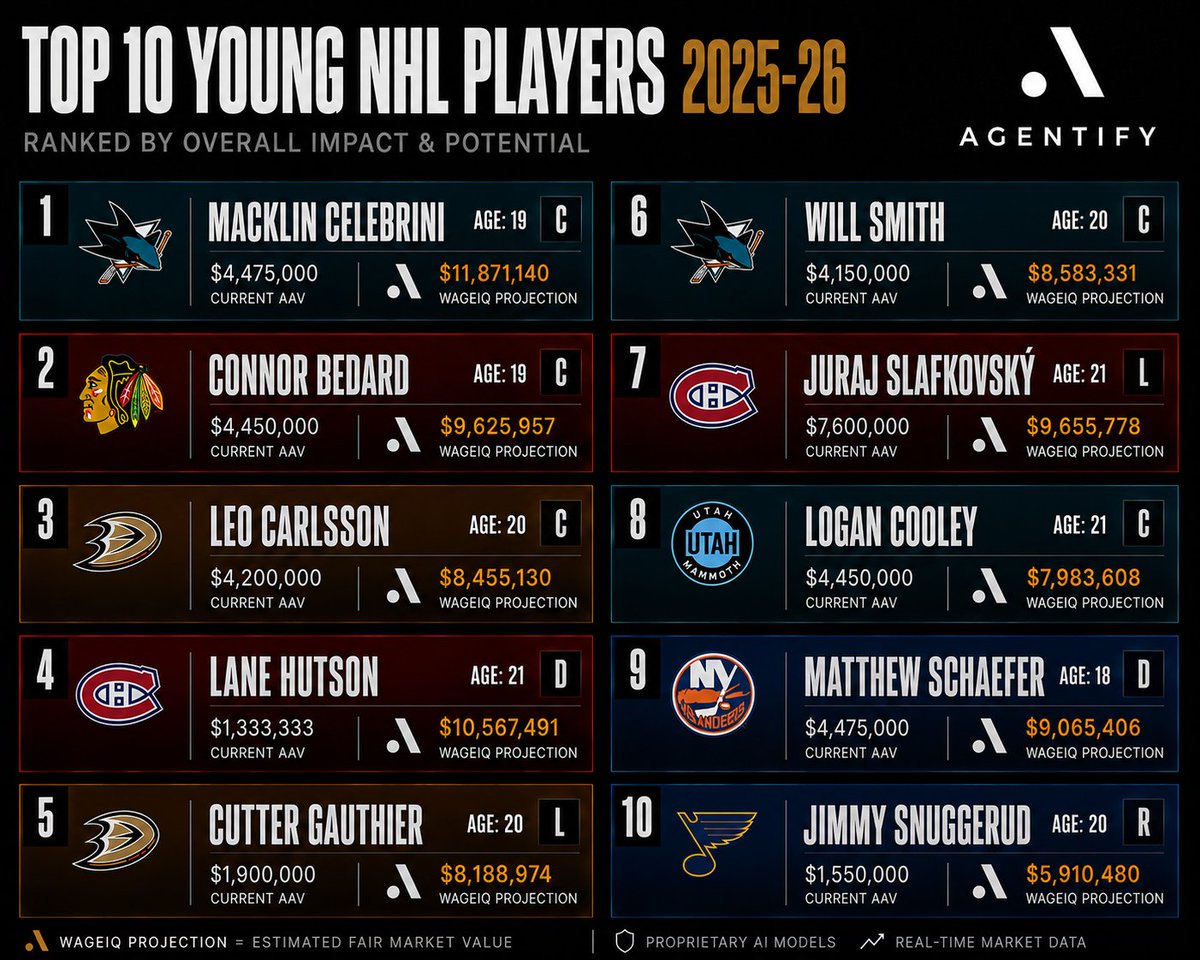
🚨 TOP 10 YOUNG NHL PLAYERS 🚨
Ranked by overall impact, production, and future market value according to Agentify AI and WageIQ™.
These NHL stars under age 23 are already producing at elite levels — with several projecting toward franchise-player value based on current performance, role, trajectory, and comparable NHL contract precedents.
Macklin Celebrini leads the next generation with superstar-level offensive upside. Connor Bedard continues to look like a future face of the league.
Lane Hutson is redefining young offensive defenseman value. Leo Carlsson, Logan Cooley, Slafkovský, Gauthier, Will Smith, Matthew Schaefer, and Jimmy Snuggerud all project as foundational assets for their franchises.
Several of these players are already dramatically outperforming their current AAVs according to WageIQ’s real-time valuation engine.
Who should be #1?
Who is too high?
Who got snubbed?
Tag an NHL fan and let’s debate the future of the league 👇
#NHL #Hockey #NHLProspects #SportsAnalytics #HockeyTwitter #SportsBusiness #SportsAgents #Agentify #WageIQ
1
2
3
165

Jun 9
Excellent point. I have been reworking the entire work flow of our agency...but constantly catching myself starting to agentify accepted (but not first principles) practices. It's not easy, but essential.
1
37

Jun 8
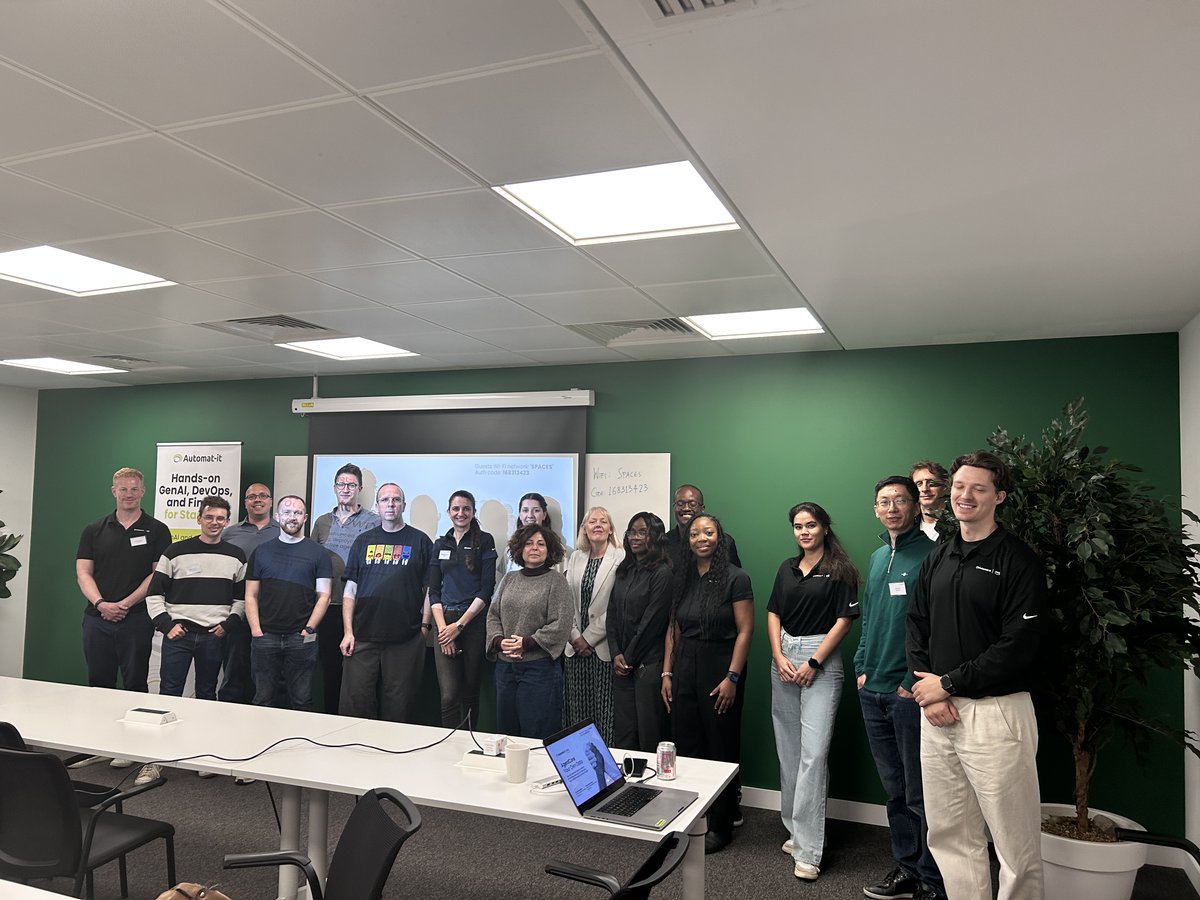
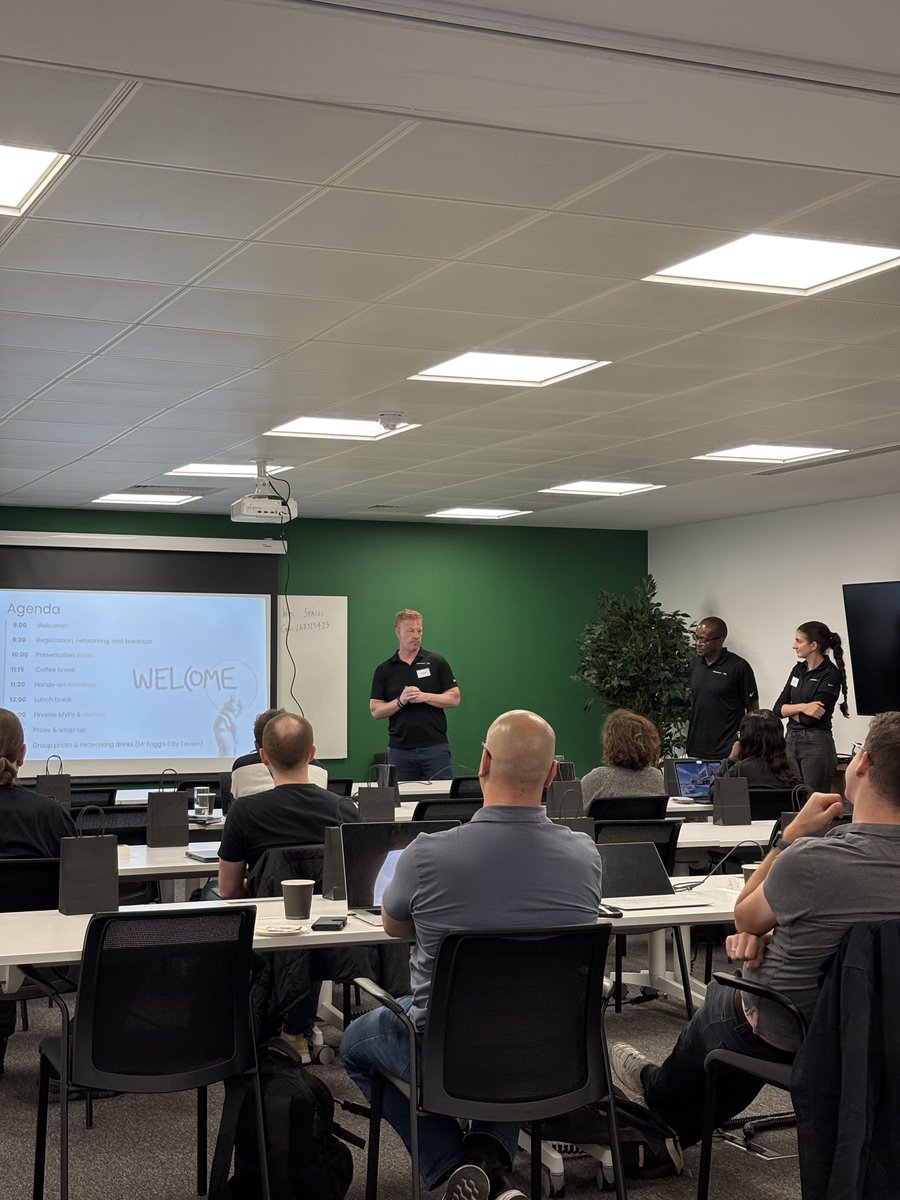
Last week in London, Automat-it and AWS combined AI theory with building at our Agentify Your Own Data workshop.
Thank you to everyone who attended and got into the weeds with Amazon Bedrock AgentCore. The working MVPs from the day were amazing to see come to life. A special congratulations to our prize winners.
We love these kind of events because they combine learning and expertise, with hands-on implementation. That is basically what we stand for at Automat-it!
We will be hosting more deep-dive sessions like this to help you move from a basic AI implementation to production-ready systems. Keep an eye out for your region. We would love to see you at the next one.
Missed the session but want to agentify your own data? Get in touch: eu1.hubs.ly/H0v-M2C0
25

Jun 8
You would build data centers right? As long as there enough land for that? And agentify the agents, it’s a recurring loop, it will take a while to hit that limit, you can go on.
1
39