

Jun 11
Graphw00f is a handy reconnaissance tool for GraphQL endpoints.
It fingerprints the underlying GraphQL implementation (Apollo, Hasura, Graphene, AppSync, and more), helping security researchers understand the technology stack before deeper testing.
GitHub: github.com/dolevf/graphw00f
#BugBounty #GraphQL #Recon #AppSec #CyberSecurity #InfoSec
6
20
709

A production-ready app this my typical architecture:
• Frontend: React Native / Next.js
• APIs & Backend: GraphQL Serverless Functions
• Data Layer: DynamoDB S3
• Auth & Permissions: Cognito RBAC
• Infrastructure: AWS (Lambda, AppSync, S3, CloudFront
1
2
162

Jun 11
In 2015, a small team asked one question:
What if deploying to AWS Lambda was as simple as
one YAML file and one command?
46,900 GitHub stars later — Serverless Framework is still
the answer most teams reach for first.
@goserverless has been shipping since before "serverless"
was even a common word. And in January 2026, it got
significantly more powerful.
Here's what one serverless.yml gives you:
→ Deploy to AWS Lambda, Azure Functions, Google Cloud Functions,
and more from a single configuration file
→ Auto-scale to any load — zero management, zero capacity planning
→ Zero cost when idle — pay only for what actually runs
→ Managed Instances — new in Jan 2026, persistent serverless state
→ Durable Functions — long-running workflows, built in
→ Built-in AppSync and Prune plugins — shipped January 2026
→ AWS Login and SSO support — one command auth setup
→ Local invocation and testing — debug before you deploy
→ Stages and environments — dev, staging, prod from one config
→ 11,500 example templates across every language and use case
→ Hundreds of community plugins — extend anything
→ Free for individuals and orgs under $2M revenue
→ MIT licensed core — 5,700 forks, updated yesterday
serverless deploy.
That's the whole workflow.
Discovered on OSSphere : ossphere.dev/serverless/serv…
Are you running serverless in production — and would you go
back to managing servers? Drop it below 👇
#Serverless #OpenSource #AWS #Lambda #BuildInPublic #CloudComputing #DevOps
1
42


Is this the bill of the CSWAP dex?
tl;dr it feels a bit high.
w/o knowing your architecture, I can try to guess how you using each service.
EC2 for node and db sync, maybe two of each? Are you running w/ ondisk utxo set to save on memory?
Now AppSync DynamoDB feels alot. I mean you either put the workload on EC2 w/o appsync dynamo, or, if you really like dynamo appsyc to serve FE traffic, you can't spend 700$ on ec2 instances.
I took a look at the website, I can't see trading features like token trends etc. I would expect 80% of the traffic coming from aggregators, so if my guess is correct I would largely slim the presentation layer and shave down appsync/dynamo costs.
With all the EC2 you have, you could implement a couple of microservices and ditch lambda.
Happy to see KMS! The money best spent.
Also I'm curious at the utilization of these ec2 instances?
Have you considered running node/dbsync on a provider which offer bare metal solution? Heztner/Scaleway/server4you.de and even contabo now has dedicated solutions in eu and us. You can allow just the aws instance to connect to this host on dedicated firewalled port etc.
I stopped using dbsync a long time ago and I moved to @satran004 yaci store, scoped indexer, meaning I can very quickly scan the chain and ONLY index what I care into a psql. PSQL which also has now very powerful KV no-sql like support w/ json blobs etc, so again ditch dynamo db.
If you don't like java, you can use oura/carp/scrolls or whatever the rust alternative is. Now from the ashes of Acropolis you have something very similar in rust.
Also, for the batcher, if you have redundancy on the cloud, have you considered having one instance in the cloud and one bare metal at home? For 600-1000 $ you can buy a workstation and have your redundant (or even main!) batcher running at home. Alternativerly for 60 to 80 euro a month an "elastic cloud" instance on any of hetzner/contabo/scaleway.
Now that you have the dapp up and running, try to optimise your product to run cheaper by adopting consolidated OS solutions like kubernetes and containerised workload with help maximising usage of ec2 instances.
Hope this helps a bit.
1
2
227

Jun 3
limited pretty much just means “major pain in the ass to work with” now. there’s also obviously no appsync unified equivalent
1
5
1,828

Jun 3
好き(になれそうだけどまずは友達から始めたい)AWSサービスはAppSyncです
理由はSyngUp!と名前が似てるけど本家よろしく取り扱いが難し…大変そうだから
なんかIAM認証とかCognito認証をスキーマに書けるの面白いですね(初心者並感)
1
3
586

Jun 2
Images go to S3, then hit ingest to start the processing pipeline. Monitoring happens throughout the process. This streamlines the scenario when a user searches for an item. #aws #ecommerce #appsync #lambda #educloudacademy
1
4
377

May 10
AppSyncについて勉強したので記事にしてみましたー!
Amplifyで何気なく使ってたけど、良いはたらきをするすごいやつでした✨
qiita.com/jus1730/items/a55d…
4
24
1,951

Apr 29
You want to build a live sports scoring app that supports 100K individual users by broadcasting separate WebSocket message to each user.
Is this a good idea? Let's dive into this:
The main issue is that a single server instance is trying to push the same message to 100K individual WebSocket connections - sequentially.
This will saturate the CPU, network buffers, and the event loop. It doesn't matter even if the payload is tiny.
We should ideally use "pub/sub wit horizontal fan-out". Instead of one server owning all connections, we should deploy multiple stateless WebSocket servers behind a load balancer. Ever server subscribes to a Redis pub/sub channel or a Kafka topic.
When a score event comes, we publish it "once" to Redis. Every server instance receives the message and forwards it "only" to the local clients it holds. This converts an O(n) broadcast into O(instances) with constant effort per server. This scales linearly as we add more instances.
For a purely server-to-server client feed like live scores, we should also consider replacing WebSocket with Server Sent Events (SSE) which is a simpler (unidirectional, automatic reconnection, native browser support), allows multiplexing and efficient use of a single TCP connection. This reduces overhead per client.
Finally, we must offload the heavy lifting to a managed real-time service if we don't want to build an operate an in-house fan-out layer such as Ably, Pusher, AppSync, etc.
This is the pragmatic choice when ops cost exceeds integration cost.
Apr 29

You're building a live sports score app. 100K users are watching same game. Broadcasting individual WebSocket messages to each user crashes your server.
How will you optimize?
[Asked at ESPN interview]
4
150


Apr 20
🟡Why @GOVUK APIs are changing to @GraphQL and how you can get involved
🟡Your AI Agent Doesn't Need to Research. It Needs to Know @DaleSeo @apollographql
🟡Securing GraphQL APIs with @AWS AppSync Lambda Authorizers in .NET
graphqlweekly.com/issues/412
4
10
1,398

記事を投稿しました!今更AWS AppSync GraphQLに入門する on #Qiita
qiita.com/ry-harada/items/78…
5
14
1,401

LWAのおかげでSingle Purpose Lambda構成から一気にLambdalith構成にスイッチしてきたなぁという印象です。ローカル検証、ECS移行のしやすさ、導入の楽さなど本当に素晴らしいツールです
Appsync Events活用したインテグレーションテストはどこかでやってみたい!AIでTerraform優勢な気持ちもわかる...

2026年、知っておくべき最新サーバレスTips10選の資料公開しました!これを抑えておけばこれからのAWSの実装も完璧👍
speakerdeck.com/slsops/serve…
#jawsug #jawsugyokohama
1
11
1,588

Apr 15
AWS has 200 services.
Here's the only ones that actually matter after building for 6 years:
𝐒 𝐭𝐢𝐞𝐫
→ Lambda, S3
𝐀 𝐭𝐢𝐞𝐫
→ EventBridge, ECS, EC2, CloudFront, IAM
𝐁 𝐭𝐢𝐞𝐫
→ API Gateway, SQS, AppSync, Bedrock Agent Core, RDS
𝐂 𝐭𝐢𝐞𝐫
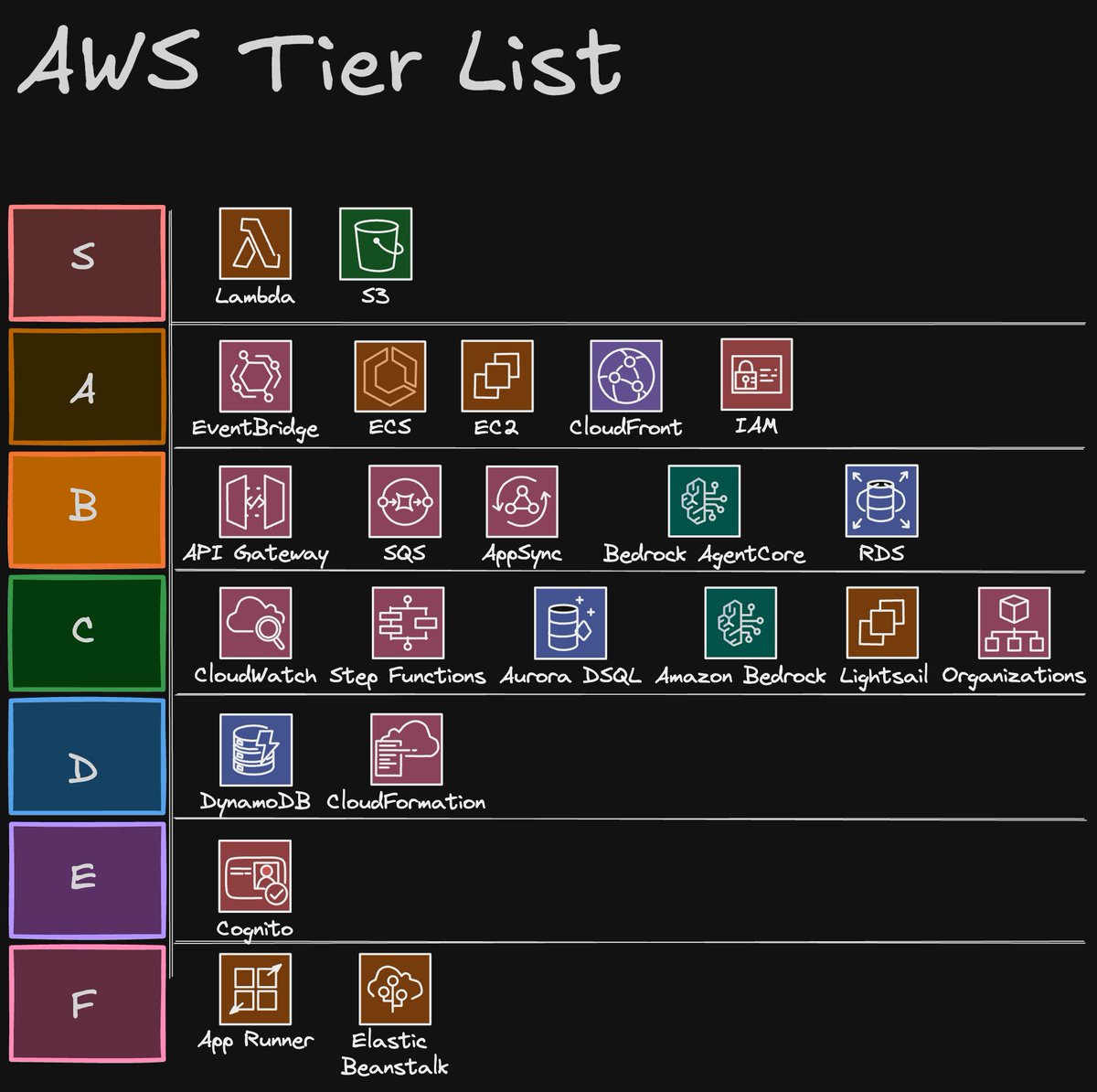
1
2
474

Apr 15
The Technical Deep-Dive
The Breakdown: * The Edge: CloudFront WAF S3. Unkillable static hosting that secures the origin before a byte hits the backend.
The Data Glue: AppSync (GraphQL) as the orchestrator. It pulls from DynamoDB, OpenSearch, and Neptune in one go.
Zero-Trust: All heavy lifters (Graph DBs & Fargate) are locked in a Private Subnet. No public IPs.
The FinOps Loop: Steps 10-12 are an automated Athena pipeline for Cost & Usage Reporting. Architecting for ROI is mandatory in 2026.
I sketch by hand because it forces focus on the logic over the formatting.
1
5
1,307