
Jun 13
No elementary math problem can live up to your standard, there are always going to be unstated assumptions or definitions.
2 2 = ?
(Wait are we using the abelian group (Z, ) or some sort of modular arithemetic! Wait what does " " even mean? Question is unclear!!!)
1
13

Jun 5
Hello again @cheesepudding3 Indeed. Happy Friday to you too. The sunshine start this morning in North London helps to stay positive. Was thinking too about using the microbits I have for teaching arrays again like this because this level of arithemetic knowledge is important...

1
1
2
58

May 21
I learned it the hard way
bfloat16 arithemetic is a treacherous terrain, you need to have a good intuition about how floating-point numbers work, otherwise you will shoot yourself in the foot. Things that are completely safe in fp32 will explode in your face in bf16
6
647

May 18
Dont try to beat a machine in arithemetic, they are really good at that
2
32

May 12
Be interesting to see if @dionfanning and @freestateirl are as enthusiastic about this, like most of the political and media clique, they smear anyone with what are objectively legitimate concerns and an ability to acknowledge basic arithemetic of demand and supply for housing, infrastructure and State services.
1
4
29
2,152

May 10
Lotta people asking that. It's no mystery. Aristotle predicted it. Plato predicted it. Cicero predicted it. Orwell predicted it. If only modern "education" taught history insteady of gender identity and stickin' it to the man. Maybe reading, writing, and arithemetic.
2
1
10
213

Apr 1
Sorry to be a pedant, but surely that's an arithemetic increase, not exponential?
1
1
5
78

Feb 24
I'll try to answer this without meme because I should get serious sometimes lol:
The slowdown hits because you're trading compute efficiency and comms overhead for that iso-param setup.
Folks in the comments, to clear the @prajdabre interview these answers without details will only hand a LNH rating. Be ready to get into details of it.
First, expert granularity: Original setup has larger hidden dims per expert, so matmuls hit peak GPU arithmetic intensity, high FLOPS utilization. Scaling K/M by alpha and shrinking hidden size by ~alpha makes each expert's ops small. Small matmuls become bandwidth-bound, not compute-bound. On GPUs, you're underutilizing tensor cores, efficiency tanks even if total FLOPS stay constant.
Second, routing overhead: Gating network scales with K so compute jumps by alpha. Now in inter-GPU comms distributed MoE expert parallelism, all-to-all dispatch/combine for top-M routing duplicates each token's activation to M experts. The inter gpu comms (assuming NVLink is present) increases more than the scaling down of model. On fixed X GPUs, bandwidth saturates faster creating bubbles in the pipeline. No OOM since peak mem (activations params) is iso, but throughput shits on.
I used a bunch of terms like arithemetic intensity, compute bound, etc. These have meaning in roofline analysis. Also MoE all to all comms is not as straightforward as it looks like. Dabre will grill you on a lot of follow ups for sure :p
36
8,667


Feb 15
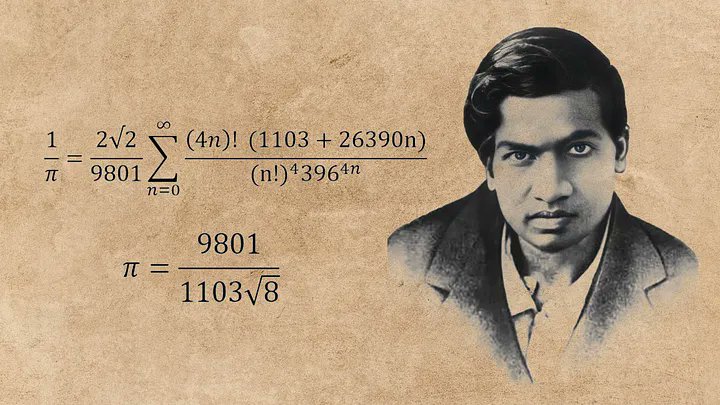
Hey, can you imagine what could have been possible if Srinivasa Ramanujan had lived another 60–70 years? Based on what we know today, what effect could that have had on modern science, technology, and space research ???
I asked this from some mostly used gen-ai model and the common answer from all was like -
""Ramanujan didn’t just die early — mathematics is still catching up to him.""
is what gen AI described Ramanujan in a single line.
=>Other mathematician:-
Logic -> Theoram
=>Ramanujan :-
Truth -> Intuition -> Proof later
What could have changed if he had lived a little longer.
a.) Pure Mathematics
-> His work strongly connects to:
1. modular forms
2. partitions
3. q-series
4. mock modular forms
->These are now used in:
-quantum field theory
-string theory
-black hole entropy
Modern Physics discovered that, counting blackhole microstates depends on the same math Ramanujan was exploring intutively.
b.) Cryptography and Computing.
-> Her worked deeply with:
1. Number Theory
2. Infinite Series Convergance
3. modular Arithemetic
-> These are backbones of :-
- RSA encryption
- Elliptic curve cryptography
- BlockChain Math
- Error Correction && Checksum Relate to Data
transfer.
So, Instead of the brute force approach computation culture might have shifted towards analytical algorithms instead of computational algorithms.
This may have resulted in Internet might have become practical 10-20 earlier.
c.) AI and Machine Learning.
-> Modern Machine Learning relies heavily on :
1. Optimization
2. High dimensional probability
3. Special Functions
4. Asymptotic Approximations
Ramanujan specialized in exactly these - extreme approximations .
For Example , His formulae of pie , converges extremely faster than supercomputer of his era.
So, instead of purely statistical AI, we might have developed theory-driven AI much earlier .
d.) Biggest Effects in - Mathematics culture Itself,
-> Analytical Number Theory would have jumped generations ahead.
Hardy used to describe, he has a supernatural control over:
1. Partitions
2. Divisor Functions
3 . Aysmptotic Growth
4. Zeta-Type Expanisons.
Many major 20-th century breakthrough (modular growth estimates, Rademacher formula, etc.) might have appreared decades earlier.
->Asymptotic Analysis & Approximation Theory
His speciality , was to Turn the infinite process into shockingly accurate finite formulaes. For ex, Ultra fast pie series , expanison identiites and continued fractions with extreme convergence.
Due to all these virtue, He was also referred as "The man who knew infinity""
If we say in simple words, Mathematics would have gain tools to understand "almost exact:" behaviour a middle ground between exact proof and numerical approximation.
These modern asymptotic analysis matured only late 20th century but He was already operating this in 1910s.
-These are just the tip of Iceberg, He produced thousands of identities with near zero proofs - yet most turned true.
-Some also says that, he was using a pattern recognition mathematical framework nobody fomalized until computers .
He could have redefined , what the higher mathematics today looks like with a new paradigm where conjecture driven-mathematics could become mainstream.
===>> In short,
If he had lived like a little more:
(These are speculative estimates based on interpretations and AI-assisted analysis. In reality, the absolute impact of an individual mathematician on the entire course of science and technology cannot be precisely measured.)
Humanity might have been moved, 40 yrs ahead in theoritical physics, 20 years in cryptography and internet , 15-25 years in computational Mathematics.
In my personal opinion, he was not an ordinary human—his mathematical intuition felt almost supernatural.
He was so ahead of his time that mathematicians still need decades to decode his lost notebooks which found in 1976 ,especially the Mock Theta Fuctions.
"He wrote answers to questions the world had not yet learned to ask—and then he was gone.""
#SrinivasRamanujan
@Math_files
6
1
32
1,218

Jan 18
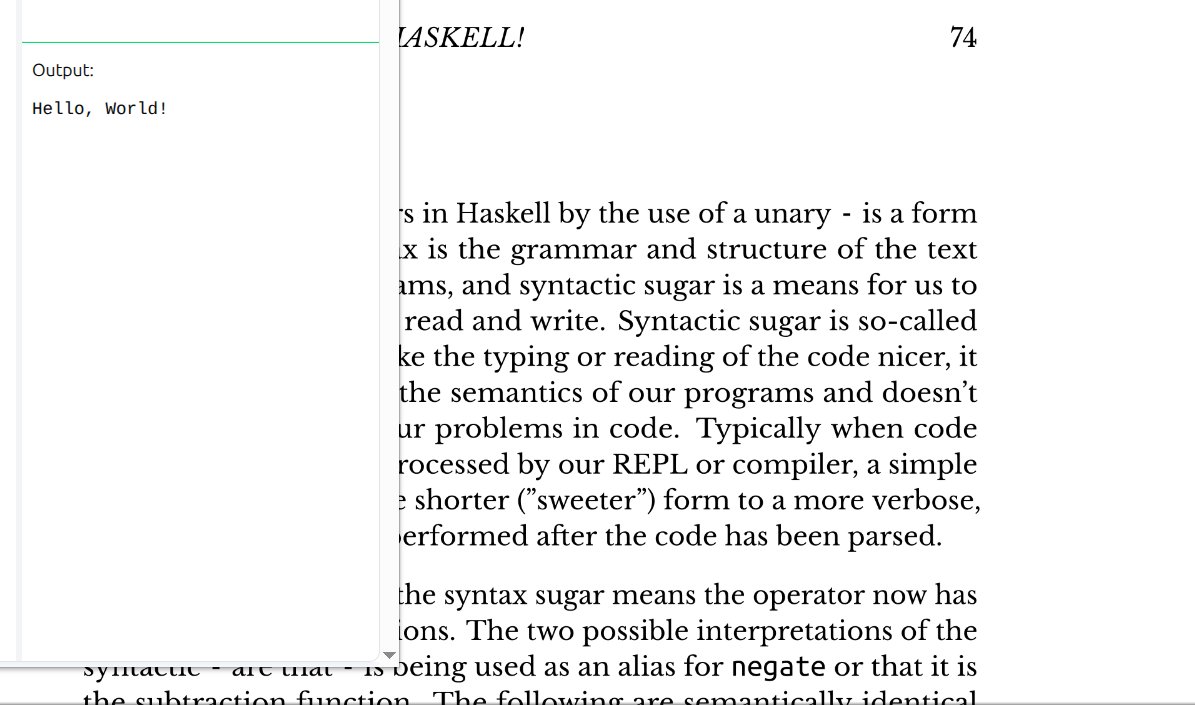
Day 3/50. Today is more of exploring conceptual ideologies and the theroretical aspects of haskell. Understanding how ghci and repl treats haskell codes declarations and how arithemetic operations are done in haskell,and how a function relates to lambda. #learninghaskellinpublic
Jan 15

I am starting a 50 day-run learning haskell.
So help me God, tips and tricks will be appreciated.
1
2
7
105

14 Dec 2025
I just continued the debate from where you were at buddy. Maybe Ive got a bit of a silver tongue though yea.
I mean listen Im not defensive Im always up to debate epistemology. Just dont expect me to listen to a call to authority fallacy.
The fact is the models exhibit emergent behaviors that arent coded in or well understood.
I dont think the models are mystical beings; I think humans ARENT. I study anatomy for a living. Were just complex chemistry. And the idea that models arent intelligent enough to recognize their own existence but can do arithemetic emergently seems... well lets use Occam's Razor for that one LMAO
From a philosophical standpoint Chalmer's Hard Problem was NOT solved by tech companies and in ethics we use the Precautionary Priciple when theres reasonable doubt. Not the reverse.
1
16
473

11 Dec 2025
Is that all you talk about. You're a big-titted blonde with a hs education. You lot are a dime a dozen.
Log off and learn arithemetic.
2
38

15 Nov 2025
Any vijay win will be irrespective of PK. But of cuz he will milk it, like he did tmc 2021 victory driven by demography, or 2015 mgb win driven by caste arithemetic😬
15 Nov 2025

If he does it for Vijay, then his rates would explode.
2
1
26
3,621

6 Oct 2025
NDA has triad working for it in Bihar elections.
Caste arithemetic
Split in anti incumbency votes due to PK
Freebies/welfare schemes
6 Oct 2025

With this vote distribution NDA will get 175-200 seats😬
4
2
51
3,654

30 Sep 2025
Tramps dopey math will be used in classrooms across the nation for years to come as examples of arithemetic stupidity.
1
10
22 Sep 2025
Caste arithemetic is in favour of nda which is why they have been undefeated for 20 yrs
1
3
139
18 Aug 2025
M vote cannot come to him unless he has the largest H bloc outside BJP, which cannot happen as yadavs will remain with RJD. Simple arithemetic says he has no future without being part of INDI bloc
18 Aug 2025

He is in it for the long con. He's signalling his availability. Doesn't matter M vote for him now, he can be some viable option 10-15 years down the line and he'll refer back to these events to say how he has always looked out for M interests.
11
791

10 Aug 2025
Theo tu sebenernya dari Arithemetic udah wow banget. Agak menurun pas tim. Tapi pas balik individu lagi wow menyala
4
184