
16 Dec 2024
High fives to #Cellframe for aced their security audit.
Big thanks to CyStack for giving us the thumbs up.
Feeling confident about that two-way bridge launch now.
#CELL #sstvi #srchafreen #cellframe_development
16 Dec 2024

💫 We’ve got great news! CyStack has published the results of a comprehensive security and functionality audit of the Cellframe protocol! You can check out the report here: cystack.net/projects/cellfra….
As part of the preparation for the launch of the two-way bridge mode, we released a major update to the Cellframe Node (version 5.3). Following this, we conducted an internal review of the code for vulnerabilities and then submitted it for an external audit. The experts at CyStack carried out an in-depth analysis of the codebase, architecture, and network interaction protocols between nodes, as well as the protocols connecting nodes to external services. Their goal was to identify potential vulnerabilities and assess the system’s resilience against various types of attacks.
We implemented all of their recommendations and received a final positive conclusion from the experts.
It’s now official — the Cellframe protocol is secure! Verified by independent developers!
#cellframe_development

1
201

16 Dec 2024
Exciting news!
CyStack’s audit confirms the Cellframe protocol is secure and ready for action.
Check out the full report here: 👇
cystack.net/projects/cellfra…
#cellframe_development
#CELL #Crypto @cellframenet
16 Dec 2024
💫 We’ve got great news! CyStack has published the results of a comprehensive security and functionality audit of the Cellframe protocol! You can check out the report here: cystack.net/projects/cellfra….
As part of the preparation for the launch of the two-way bridge mode, we released a major update to the Cellframe Node (version 5.3). Following this, we conducted an internal review of the code for vulnerabilities and then submitted it for an external audit. The experts at CyStack carried out an in-depth analysis of the codebase, architecture, and network interaction protocols between nodes, as well as the protocols connecting nodes to external services. Their goal was to identify potential vulnerabilities and assess the system’s resilience against various types of attacks.
We implemented all of their recommendations and received a final positive conclusion from the experts.
It’s now official — the Cellframe protocol is secure! Verified by independent developers!
#cellframe_development
10
1
5
91

16 Dec 2024
💫 We’ve got great news! CyStack has published the results of a comprehensive security and functionality audit of the Cellframe protocol! You can check out the report here: cystack.net/projects/cellfra….
As part of the preparation for the launch of the two-way bridge mode, we released a major update to the Cellframe Node (version 5.3). Following this, we conducted an internal review of the code for vulnerabilities and then submitted it for an external audit. The experts at CyStack carried out an in-depth analysis of the codebase, architecture, and network interaction protocols between nodes, as well as the protocols connecting nodes to external services. Their goal was to identify potential vulnerabilities and assess the system’s resilience against various types of attacks.
We implemented all of their recommendations and received a final positive conclusion from the experts.
It’s now official — the Cellframe protocol is secure! Verified by independent developers!
#cellframe_development
31
99
303
28,474
13 Dec 2024
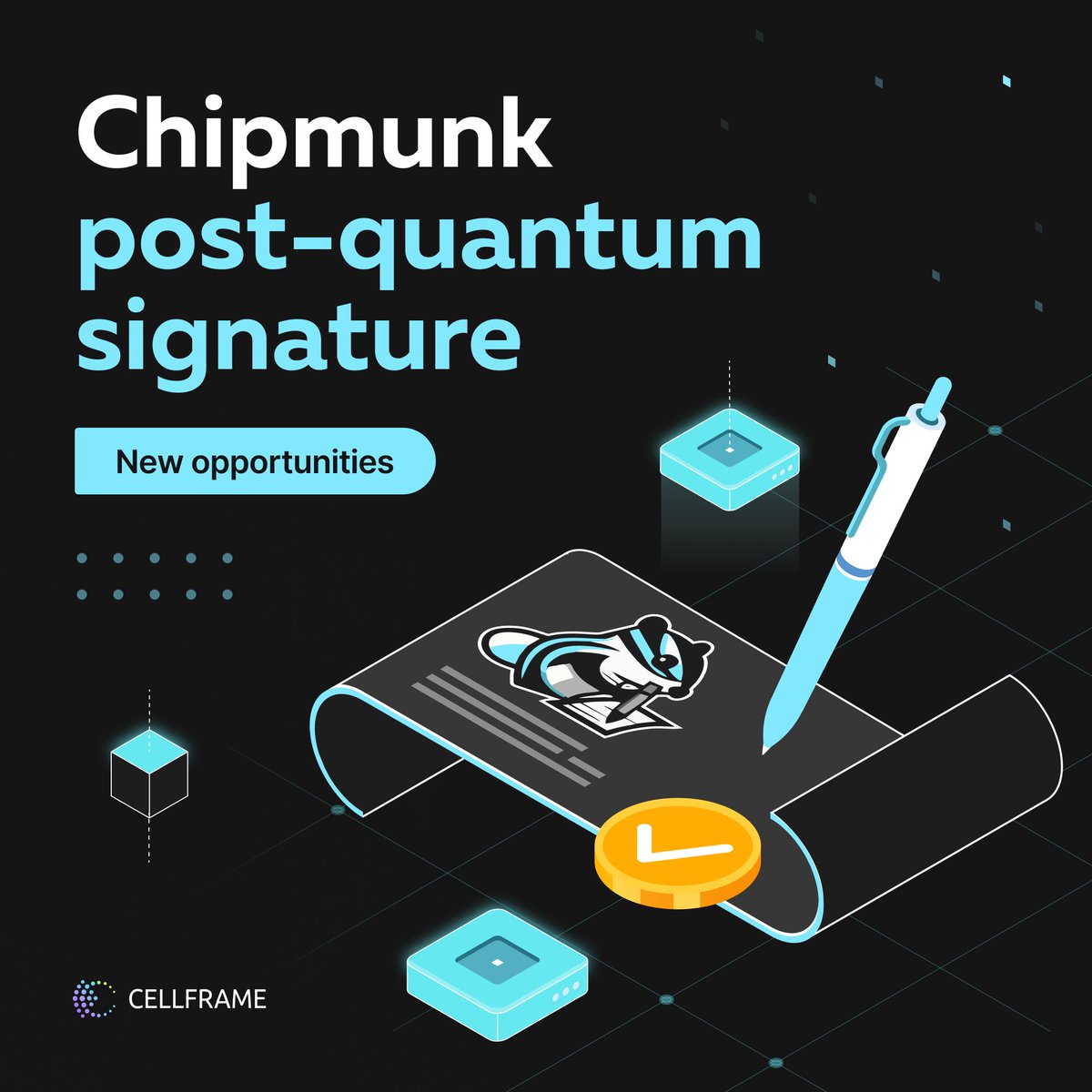
Great news from our development team! We are exploring a new post-quantum aggregated signature, Chipmunk, with plans to integrate it into the Cellframe codebase. This integration will significantly enhance our ESBOCS block consensus mechanism and unlock new opportunities for implementing L2 rollups on the Cellframe platform. Let’s dive into the details.
☀️An aggregated signature is a type of collective signature that mathematically combines multiple signers into one. Its size is considerably smaller than a multisignature, which simply bundles several individual signatures together. In the consensus mechanism, Chipmunk allows approximately 8,000 transactions to be consolidated into a single signature of just 135 kilobytes. This is especially important in the context of post-quantum cryptography, where algorithms are inherently more resource-intensive. For us, as a project focused on quantum resistance, implementing such a signature will greatly optimize our blockchain’s performance. Fun fact: the signature is called Chipmunk, a fitting name since our mascot is also a chipmunk!
☀️ With this new aggregated signature, we can make the ESBOCS block consensus mechanism much more efficient. Our platform’s consensus mechanism is based on CatChain from the TON blockchain, but we had to adapt it to the unique requirements of Cellframe due to the heavier nature of post-quantum cryptography. Unlike the original version, where all nodes sign the blocks, in our system, only 10 nodes (selected by a pseudorandom function each time) sign the blocks to manage signature size. While this introduces certain challenges, successfully integrating aggregated signatures will enable us to increase the number of signers and improve the overall performance of the blockchain network.
Additionally, Chipmunk will open up new possibilities for implementing L2 rollups in Cellframe, similar to those used in the Ethereum blockchain. Rollups "compress" numerous transactions into one, reducing network load and lowering transaction costs.
Finally, the most exciting part. The implementation of the post-quantum aggregated signature is a major step toward developing an advanced post-quantum ring signature with zero-knowledge proof. Such a signature ensures complete anonymity of signers. While this is a complex cryptographic challenge and work is still ongoing, we are confident that a solution will be found very soon! 💡
#cellframe_announcement #cellframe_development
196
109
314
57,489