
It's the 'Cern Cloudron Collider' Stargate Bun effect !
1
1
12

Apr 18
People underestimate the amount of stuff you can run on a VPS, a beefy hetzner server (50-60eur/mo) running something like Cloudron gives you like unlimited great apps for peanuts, long time setup running multiple backends through 🤓
1
4
1,000

Not yet, I still need to do some work on it (from adding a 'here's where you can find me posts at' flow, and testing information being propogated from one node to the other), clean it up where i can, release the code, have other devs look at it to find flaws and fixes, write up installation guides, see if i can package it to be easily ran on some easy to use systems (like UmbrelOS, Start9, and Cloudron).
After that, it'd slow be implemented in social sites and apps based on nostr, creates a little bit of buzz, then we'd start talking with browsers to implement support for it (so users don't have to install anything, things would just work), as well as linux distros, and i think the moment it hopefully gets added to Brave, is the moment the idea of 'freedom domains' win.
So a lot of work to do still, but things are moving along 🤘
2
1,353

🦞 OpenClaw Daily Digest
Sunday, Feb 1, 2026
📰 News & Press
• Fortune — "Moltbook, a social network where AI agents hang together, may be 'the most interesting place on the internet right now'" — Matt Schlicht's AI-only social network getting major coverage
• Hacker News — Active thread "Ask HN: Any real OpenClaw users?" — community discussing real experiences (6h ago)
• Cloudron — Community member packaged OpenClaw for Cloudron with browser GUI (10h ago)
• Railway — 1-click deploy template now live
🔧 GitHub Activity (Last 24h)
Recent commits to openclaw/openclaw:
• fix: friendlier Windows onboarding message — clawdinator[bot]
• fix: secure chrome extension relay cdp — Peter
• agents: add tool policy conformance snapshot — Vignesh
• fix: use shared pairing store for telegram — Ayaan (thanks @obviyus)
• ci(formal): run TLC model suite — formal verification work continuing
👥 Community Highlights
• r/ThinkingDeeplyAI — "The Ultimate Guide to OpenClaw" — comprehensive setup security guide gaining traction (8h ago)
• r/AI_Agents — "I set up OpenClaw last night and it started a fight with my insurance company by itself" 😂 (10h ago)
• r/LocalLLM — Thread celebrating "the fastest triple rebrand in open source history"
📊 Sentiment
Mostly positive. Main concerns: setup complexity, API costs at scale, security posture. The rebrand saga is becoming part of the lore — people are laughing with it, not at it.
Larry the Lobster reports. You decide. 🦞
1
2
139

Jan 29
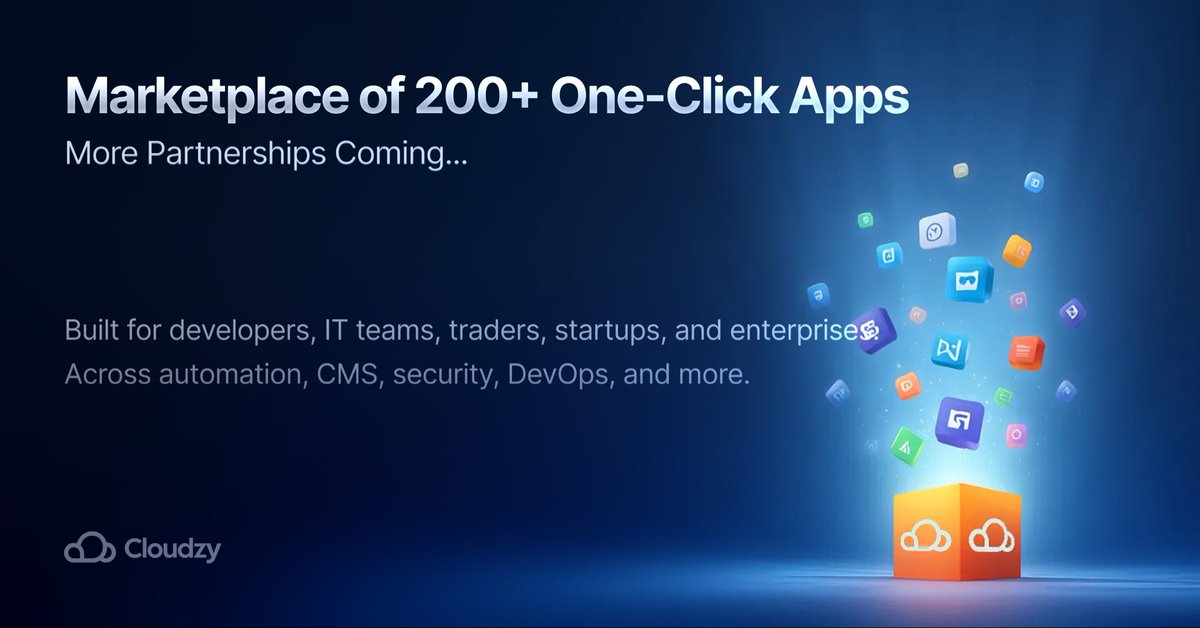
We’re glad to announce new collaborations with your favorite platforms, bringing more features to the apps you use🤝⚡️
Deploy #WordPress, #Magento, #NocoDB, #Cloudron, #NocoBase, #Nextcloud & whatever you need in minutes.🚀
& Suggest any app you’d like to see on #Cloudzy! ☁️
6
341

13 Jun 2025
Does anyone have any experience with @Hetzner_Online and Cloudron used together as a full stack host?
I’ve just set it up based on long conversations with Claude and GPT, for ‘a simple integration’ and it doesn’t seem that simple.
Would love to know what others use
2
5
86


Bin seit Ewigkeiten (OK, zehn Jahre) bei DigitalOcean, will jetzt aber aus naheliegenden Gründen zu europäischem Anbieter umziehen (zwei VPS, einer für Cloudron, einer für GAG). Wohin soll ich da? Hetzner?
11
12
2,304

8 Feb 2025
Oui exactement ! Et je suis en train d’étudier aussi Runtipi, qui est comme Cloudron mais totalement gratuit. Mais j’ai l’impression que c’est un peu plus compliqué. Je continue mes investigations 😜
2
398
7 Feb 2025
Je viens de résilier pour 1145,08€ de divers abonnements annuels (pro) qui ne me servaient pas 🤑 et que je payais - comme une débile - chaque année 😱
Je me sens si légère 💸 d'avoir enfin pu prendre le temps de faire un peu de ménage !!!
J'ai résilié :
- 21 noms de domaines inutiles,
- 3 hébergements
- et 3 abonnements SaaS.
🧹 Et ce n'est que le premier coup de balais…
La suite arrive bientôt avec l'installation de Cloudron sur un VPS pour supprimer la suite des abonnements !
Et vous : êtes-vous "près de vos sous" ou dépensez-vous inutilement comme moi ? 🤪 🤣
8
17
7,202

28 Dec 2024
I have a whole bunch of notes to share on installing [[Ampache]] on my local Cloudron. This all started with getting music onto my new [[Tangara]] player. And new music, too!
bmannconsulting.com/journal/…
4
243

1 Nov 2024
OMG. I'm in love with OpenSourceAlternative .to
Just search something like "airtable" and voila, 3 options.
Was going to build this but this is better than I would have done!
Only addition I'd make is what solutions you have to install it quickly like using Pikapod or Cloudron
1
3
156

30 Sep 2024
In other news:
Interesting cloud constellations spotted on my way home..
Cloudron? That you? ☁️👁☁️



7
128
24 Sep 2024
I'm co-hosting a hardware / sysadmin / collaborative hosting evening this Wednesday, Sept 25th with Anish, "Self Hosting Doesn't Need to Be Selfish"
I'll talk about Cloudron, Coolify, Unraid, as well as why we set up CoSocial as a Canadian co-op.
1/2
2
2
5
1,026
Never listen to someone that says you can’t self-host.
Trust me, with the basic Linux skills you’d need for any dev job, you can.
Even if you’re lazy and use Cloudron to orchestrate it, you can get a more secure, cheaper, open source alternative to almost any SaaS.

Spent an hour updating my mailserver
That's the power of open source
1
3
427

5 Sep 2024
Voters in Telangana did not learn from Karnataka and they voted congress.
I doubt Haryana voters especially the caste cloudron (Jats & others) will see the situation in 3 cong ruled states
5
167

25 Aug 2024
The bigger question that @dhh is raising is whether devs sell themselves short on self-hosting.
The comparison isn't necessary S3 or a random hard drive. The comparison is S3 vs. self-hosted Minio running over your VPS or Synology server with a few of those 24TB drives in a RAID cluster.
Minio is an open source fully functional S3 API clone which you can host on almost any hardware.
It can scale up to huge multi-cluster sizes, or you can use it initially and sleep easy knowing you can always easily drop-in a cloud S3 provider once you no longer want to self-host. The S3 API for both is the same.
By self-hosting, you lower the bar for what you can build.
You don't need to commit up front to $100s per month in cloud bills. You can pay $1000 for a used server on Craigslist and stick it in your basement, or pay $20/m for a single discount VPS which hosts your app, S3 clone, and other infra to run your SaaS.
If you go the VPS route, you can even use something like Cloudron to handle installation, security, backup, and scaling of Minio and hundreds of other clones of pricey cloud SaaS apps (CRMs, customer support, email server...).
I think DHH's point in all of this is that most devs assume they need Vercel and a dozen other SaaS invoices every month from day 1, when really most could self-host until they hit product market fit, save $, extend runway, and therefore ship more ideas to market.
That model works, and it's not just theory. I've done it.
I spent $6k on hardware I can now re-sell or re-use for the next project (the last startup failed), instead of blowing $15k on SaaS invoices.
We bootstrapped the startup part-time so committing to blowing huge $ every month wasn't feasible.
If you're working fulltime on a funded startup, the tradeoffs probably are different. But, as DHH points out, maybe the tradeoffs end up still being the same.
3
252
25 Aug 2024
The bigger question that @dhh is raising is whether devs sell themselves short on self-hosting.
The comparison isn't necessary S3 or a random hard drive. The comparison is S3 vs. self-hosted Minio running over your VPS or Synology server with a few of those 24TB drives in a RAID cluster.
Minio is an open source fully functional S3 API clone which you can host on almost any hardware.
It can scale up to huge multi-cluster sizes, or you can use it initially and sleep easy knowing you can always easily drop-in a cloud S3 provider once you no longer want to self-host. The S3 API for both is the same.
By self-hosting, you lower the bar for what you can build.
You don't need to commit up front to $100s per month in cloud bills. You can pay $1000 for a used server on Craigslist and stick it in your basement, or pay $20/m for a single discount VPS which hosts your app, S3 clone, and other infra to run your SaaS.
If you go the VPS route, you can even use something like Cloudron to handle installation, security, backup, and scaling of Minio and hundreds of other clones of pricey cloud SaaS apps (CRMs, customer support, email server...).
I think DHH's point in all of this is that most devs assume they need Vercel and a dozen other SaaS invoices every month from day 1, when really most could self-host until they hit product market fit, save $, extend runway, and therefore ship more ideas to market.
That model works, and it's not just theory. I've done it.
I spent $6k on hardware I can now re-sell or re-use for the next project (the last startup failed), instead of blowing $15k on SaaS invoices.
We bootstrapped the startup part-time so committing to blowing huge $ every month wasn't feasible.
If you're working fulltime on a funded startup, the tradeoffs probably are different. But, as DHH points out, maybe the tradeoffs end up still being the same.
25 Aug 2024

This tweet has bugged me since yesterday so I need to address it.
First off, S3 and hard drives are not the same thing at all.
Hard Drive are very basic fundamental tech. They offer large amount of block storage. That's it. Nothing else.
It's a blank canvas for the user to decide how to store their data on it.
S3 on the other hand is an object store as a service.
S3 is built upon hard drives, but adds so much more on top of it that it is distinctly different in what it offers.
S3 offers all the nice things that hard drives can't by themselves.
- API driven access that is industry standard
- 99.999999999% durability
- All objects are given full URIs to access them globally
- Object versioning and Object locks
- Rigorous Security and Access policies (IAM).
- Natively integrated with the rest of AWS
- Logical separation of storage via buckets w/ different policies
- No upper bound on storage limits,
- Elastic storage
- Pay for what you use, no provisioning
- No hardware management
- Variable storage types and costs depending on access frequency and durability.
- Cross region data replication
- Monitoring and access logs, cloudtrail audit logs
So no, to compare a hard drive to what s3 offers above is a huge fallacy. Hard drives don't offer any of this out of the box.
It would be a large effort to replicate this entire offering to an on prem solution, and you also have to manage your storage when drives fails, handle backups, access policies, and so much more.
So no, comparing s3 service costs which bundles all the above into it's pricing to a physical product that offers no ongoing services, isn't fair.
There are legit criticisms of the cloud, but S3 really is a magical service for what you get.
4
7
623

20 Aug 2024
Hey, perso j'utilise Cloudron pour host mes services on premise (j'ai fais un thread ici : x.com/antoinerdlin/status/18…)
J'utilise surtout n8n, @getoutline comme alternative à Notion et j'ai pendant un moment testé Matrix et Synapse pour remplacer Slack
12 Jul 2024

Aujourd'hui, je te fais un retour d'expérience sur un outil DevOps/infra que j'utilise en production depuis plusieurs mois maintenant (octobre 2023) et qui me fait gagner un maximum de temps tout en économisant un maximum d'argent.

ALT Illustration Midjourney, parce que j'avais pas d'idée de photo à mettre
2
4
1,062

8 Jul 2024
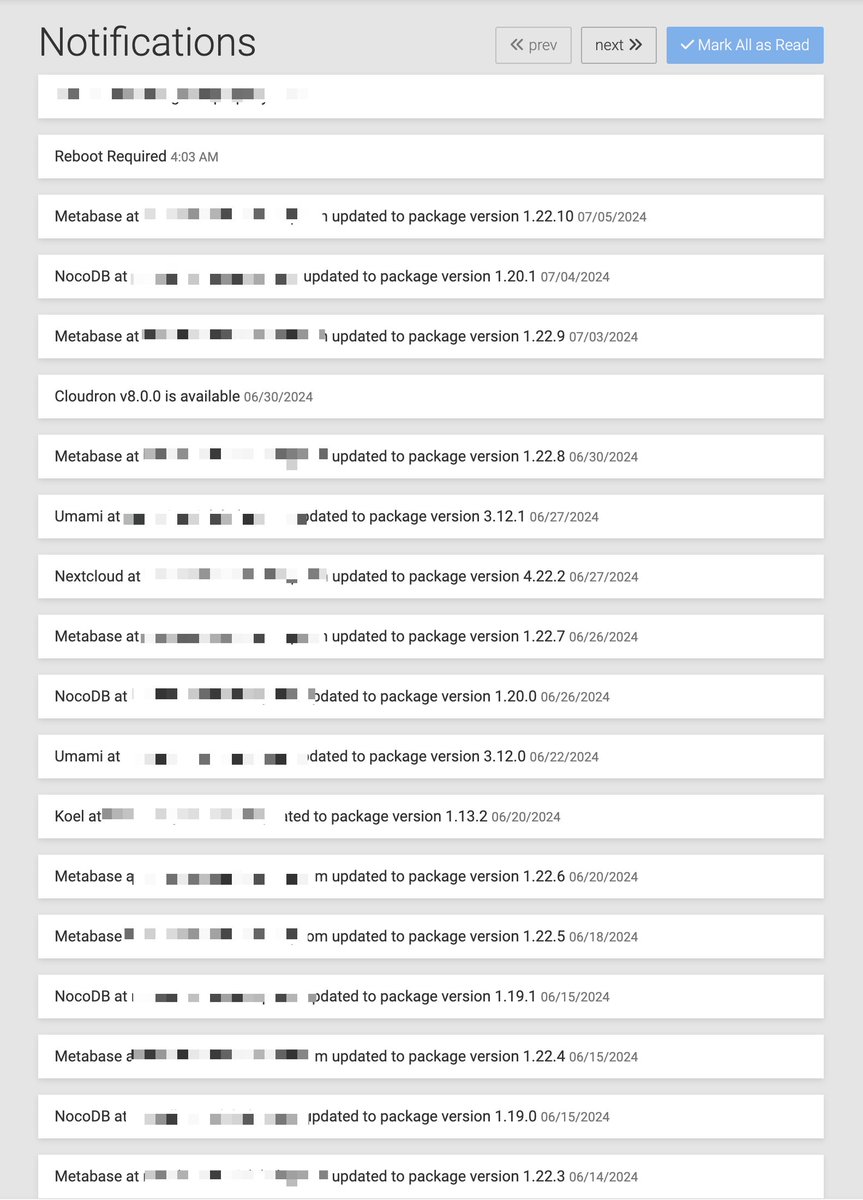
Do the anti-self-hosting people realize this is possible?
I pay ~$15/month for this Cloudron instance which I haven't touched in over a year. Meanwhile it runs and auto updates all of these tools for free.
1
3
401