
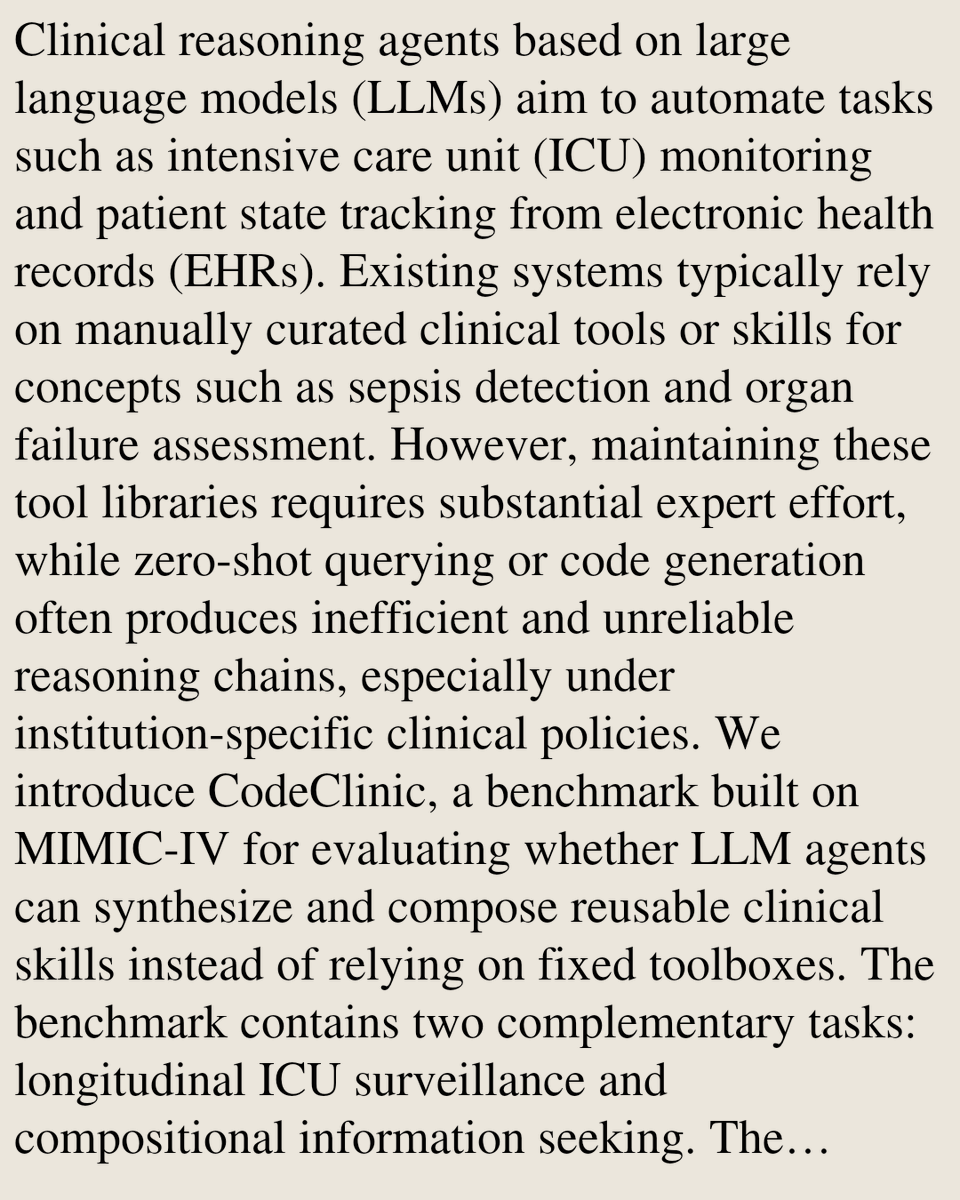
ALT Clinical reasoning agents based on large language models (LLMs) aim to automate tasks such as intensive care unit (ICU) monitoring and patient state tracking from electronic health records (EHRs). Existing systems typically rely on manually curated clinical tools or skills for concepts such as sepsis detection and organ failure assessment. However, maintaining these tool libraries requires substantial expert effort, while zero-shot querying or code generation often produces inefficient and unreliable reasoning chains, especially under institution-specific clinical policies. We introduce CodeClinic, a benchmark built on MIMIC-IV for evaluating whether LLM agents can synthesize and compose reusable clinical skills instead of relying on fixed toolboxes. The benchmark contains two complementary tasks: longitudinal ICU surveillance and compositional information seeking. The longitudinal setting simulates monitoring patient trajectories with structured decisions every four hours across 25 fi