
May 20
I have realised that I don't have to put up with incomplete and inconsistent lipidomics data in MS-DIAL. Claude has decoded the internal .lbm2 lipidomics library and is writing me a parser so that I can add new data.
#VibeCoding #CompMS #Lipidomics #Metabolomics
1
1
67

Apr 28
⏳ 1 week left to apply! Seeking proteomics data analysis wizards that are eager to push beyond the current boundaries of biology. Please RT 🙏 #PlantBiology, #Proteomics, #CompMS, #PlantSciJobs, @plantpostdocs, #Bioinformatics, #MassSpec, #PlantSci, tinyurl.com/pdcyzheb
Apr 5

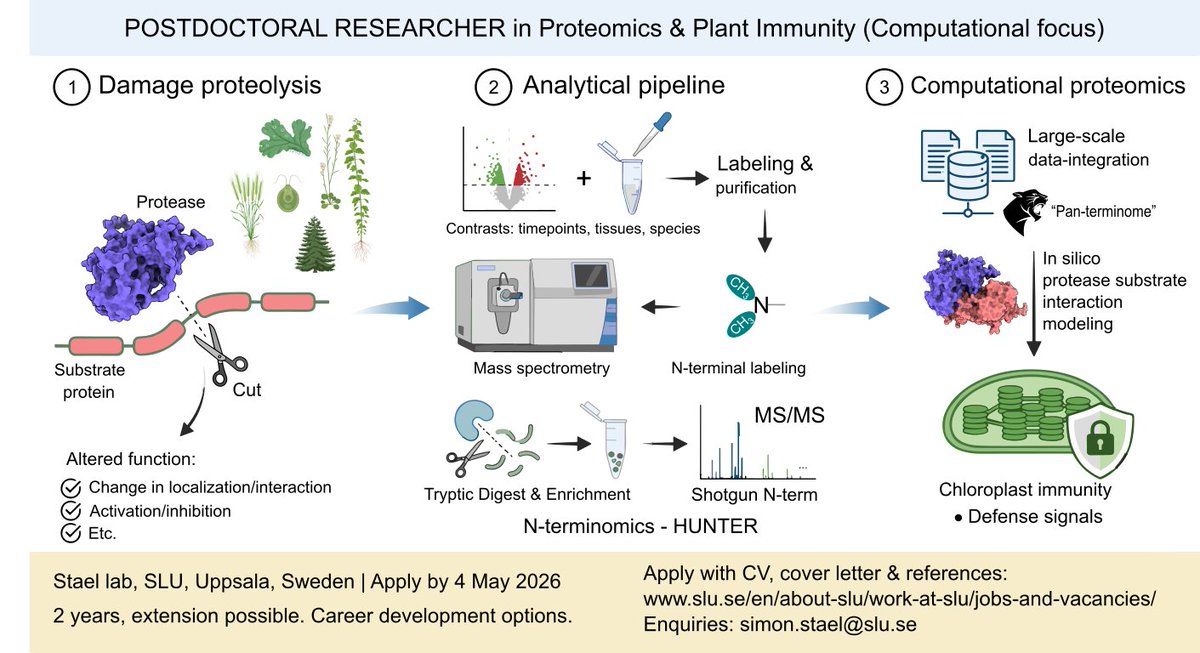
Job alert🚨 Postdoc (Computational Proteomics × Plant Immunity) 🌱
Join us to build a cross-species plant pan-terminome & study proteolysis in immunity🤝 with excellent collaborators: Bernhard Kuester, @wilhelm_compms, Pitter Huesgen, @Patrick14342109 , @Patrick18287926
11
31
4,402
Apr 28
Extremely cool new #CompMS #Metabolomics preprint. from the team at Metabolomics Australia. Worth checking out for the compound name standardisation feature alone, but offers lots more.
chemrxiv.org/doi/full/10.264…
1
22
Apr 5
#PlantScience, #PlantSci, #PlantBiology, #PlantSciJobs, @plantpostdocs, #ComputationalProteomics, #Proteomics, #Bioinformatics, #MassSpec, #StructuralProteomics, #CompMS
Apr 5
Job alert🚨 Postdoc (Computational Proteomics × Plant Immunity) 🌱
Join us to build a cross-species plant pan-terminome & study proteolysis in immunity🤝 with excellent collaborators: Bernhard Kuester, @wilhelm_compms, Pitter Huesgen, @Patrick14342109 , @Patrick18287926
4
16
1,874
Mar 19
This is the most amusingly misinterpretatable paper title I think I've ever come across.
#Metabolomics
#CompMS
#Python
#NoNotThatPython
nature.com/articles/s42255-0…
1
3
65

puji Tuhan BA dapet 1.0 bahkan dapet empfehlungsschreiben juga dari wilhelm, emang good decision pilih compMS🥰🙏🏻
17

💻 The CompMS Community of Special Interest fosters collaboration in computational mass spectrometry through the annual ISMB CompMS track and the CompMS Slack workspace at compms.slack.com
1
57
2 Dec 2025
eMZed 3: flexible and interactive development of scalable LC-MS/MS data analysis workflows in Python
arxiv.org/abs/2510.21484
#Python #CompMS #MassSpec #metabolomics
1
47

15 Sep 2025
🤔 How do you align program outcomes, evaluations, and student work to EPAs? What are some strategies to support accreditation with real-time competency data?
Join @COREHigherEd, Tuesday at 3:00 p.m. ET, to explore how their enhanced CompMS helps pharmacy schools streamline the complex process of competency tracking and turning it into actionable data for accreditation and continuous improvement.
🔗: ow.ly/sKuG50WWZYt

246
9 Sep 2025
📊 Competency-Based Education (#CBE) isn’t new to pharmacy, but the demand to operationalize it with clear, measurable outcomes is reshaping how programs design #curricula and measure student readiness.
In this Sept. 16 webinar, explore how @COREHigherEd's enhanced CompMS helps #pharmacyschools map program outcomes, experiential evaluations, and student-submitted tasks directly to EPAs.
📅: Sept. 16
🕒: 3:00 p.m. ET
🔗: ow.ly/xoSK50WTUKX

1
192

31 Jul 2025
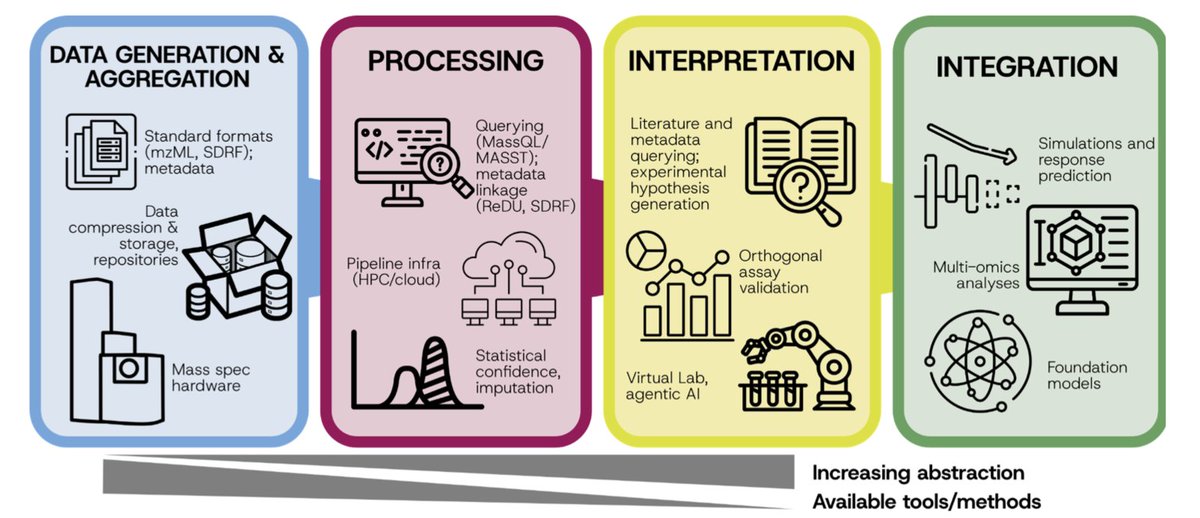
Perspectives in Computational Mass Spectrometry: Recent Developments and Key Challenges
1. This comprehensive review highlights the pivotal role of mass spectrometry (MS) in modern molecular biology, emphasizing its applications in proteomics, metabolomics, lipidomics, and glycomics. The authors discuss how advancements in instrumentation, acquisition strategies, machine learning, and scalable computing are reshaping the field of computational MS.
2. The article underscores the growing importance of machine learning in MS data analysis, particularly in predicting peptide properties, improving spectrum matching, and enhancing de novo peptide sequencing. It also highlights the need for robust statistical confidence estimation, especially in metabolomics where mature strategies are lacking.
3. One of the key challenges discussed is data harmonization across different instruments, batches, and omics modalities. The authors suggest that deep learning could be a potential solution for harmonizing MS data, preserving biological signals while removing technical variation.
4. The review also addresses the increasing demand for scalable computational resources to handle the large datasets generated by modern MS instruments. Cloud-based computing environments are highlighted as a flexible alternative to traditional local infrastructure, enabling high-throughput workflows and reproducible analyses.
5. Another critical issue is the integration of multi-omics data, which promises a more holistic understanding of biological systems. The authors emphasize the need for methods that can capture dependencies and interactions between different omics layers, moving beyond simple overlap analyses.
6. The article also touches on the importance of metadata quality and the need for standardized reporting to improve data reuse and interoperability. Efforts such as FAIR compliance and the development of standardized MS query languages are highlighted as steps towards more effective data integration.
7. The review concludes by discussing the role of the Computational Mass Spectrometry (CompMS) Community of Special Interest in fostering collaboration and innovation. The community’s efforts to support early-career researchers and promote best practices in machine learning application are particularly noteworthy.
📜Paper: doi.org/10.26434/chemrxiv-20…
#MassSpectrometry #ComputationalBiology #MachineLearning #MultiOmics #DataHarmonization #Proteomics #Metabolomics
1
460
31 Jul 2025
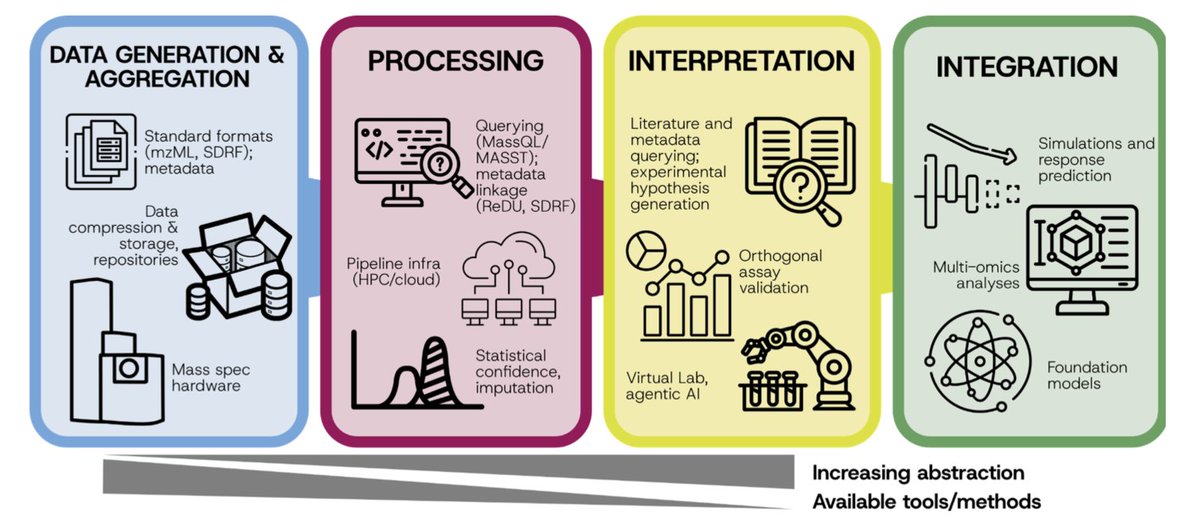
Perspectives in Computational Mass Spectrometry: Recent Developments and Key Challenges
1. This comprehensive review highlights the pivotal role of mass spectrometry (MS) in modern molecular biology, emphasizing its applications in proteomics, metabolomics, lipidomics, and glycomics. The authors discuss how advancements in instrumentation, acquisition strategies, machine learning, and scalable computing are reshaping the field of computational MS.
2. The article underscores the growing importance of machine learning in MS data analysis, particularly in predicting peptide properties, improving spectrum matching, and enhancing de novo peptide sequencing. It also highlights the need for robust statistical confidence estimation, especially in metabolomics where mature strategies are lacking.
3. One of the key challenges discussed is data harmonization across different instruments, batches, and omics modalities. The authors suggest that deep learning could be a potential solution for harmonizing MS data, preserving biological signals while removing technical variation.
4. The review also addresses the increasing demand for scalable computational resources to handle the large datasets generated by modern MS instruments. Cloud-based computing environments are highlighted as a flexible alternative to traditional local infrastructure, enabling high-throughput workflows and reproducible analyses.
5. Another critical issue is the integration of multi-omics data, which promises a more holistic understanding of biological systems. The authors emphasize the need for methods that can capture dependencies and interactions between different omics layers, moving beyond simple overlap analyses.
6. The article also touches on the importance of metadata quality and the need for standardized reporting to improve data reuse and interoperability. Efforts such as FAIR compliance and the development of standardized MS query languages are highlighted as steps towards more effective data integration.
7. The review concludes by discussing the role of the Computational Mass Spectrometry (CompMS) Community of Special Interest in fostering collaboration and innovation. The community’s efforts to support early-career researchers and promote best practices in machine learning application are particularly noteworthy.
📜Paper: doi.org/10.26434/chemrxiv-20…
#MassSpectrometry #ComputationalBiology #MachineLearning #MultiOmics #DataHarmonization #Proteomics #Metabolomics
2
499

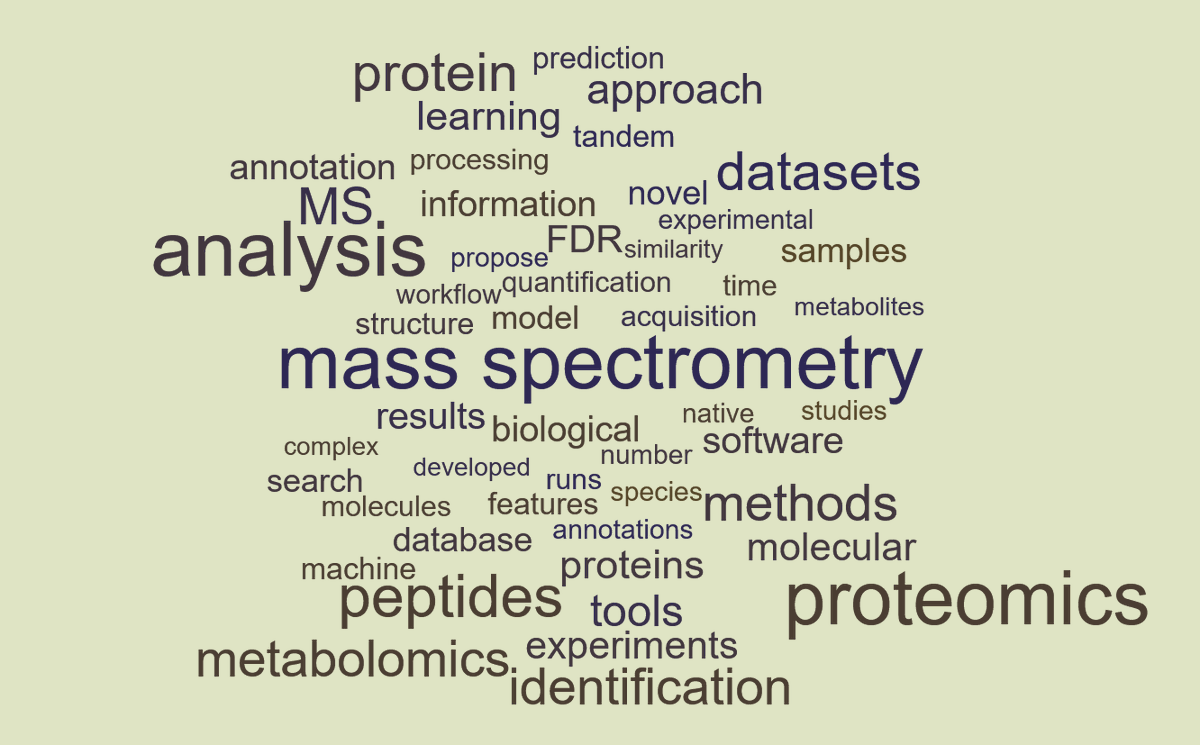
Bringing together researchers from proteomics, metabolomics, and related fields, CompMS bridges experimental and theoretical research to improve data integration and drive new discoveries in mass spectrometry.
Learn more about the CompMS COSI and discover ways to engage with the community: iscb.org/cosis/info
2
179
17 Dec 2024
41
9 Dec 2024
It took just 11 minutes to parse 57 million lines of text into 1.1 million MS/MS spectra from my big .msp library and filter it with matchms. Impressive. #CompMS
2
3
410
17 Nov 2024
Hi, @jjjvanderhooft. Do you know an easy way to predict formula from MS1 isotope distribution in Python? I've tried running MS-FINDER from the command line but it's quite complicated. There must be an easier way.
#CompMS
4
1
4
1,043

4 Nov 2024
See you Tomorrow, 5 pm CET / 8 am PST. Sign up for free and join the mzmine webinar and discussions. Learn more about mzmine and its interactive statistics and molecular networking dashboards.
#CompMS #metabolomics #lipidomcs #massspectrometry
30 Oct 2024

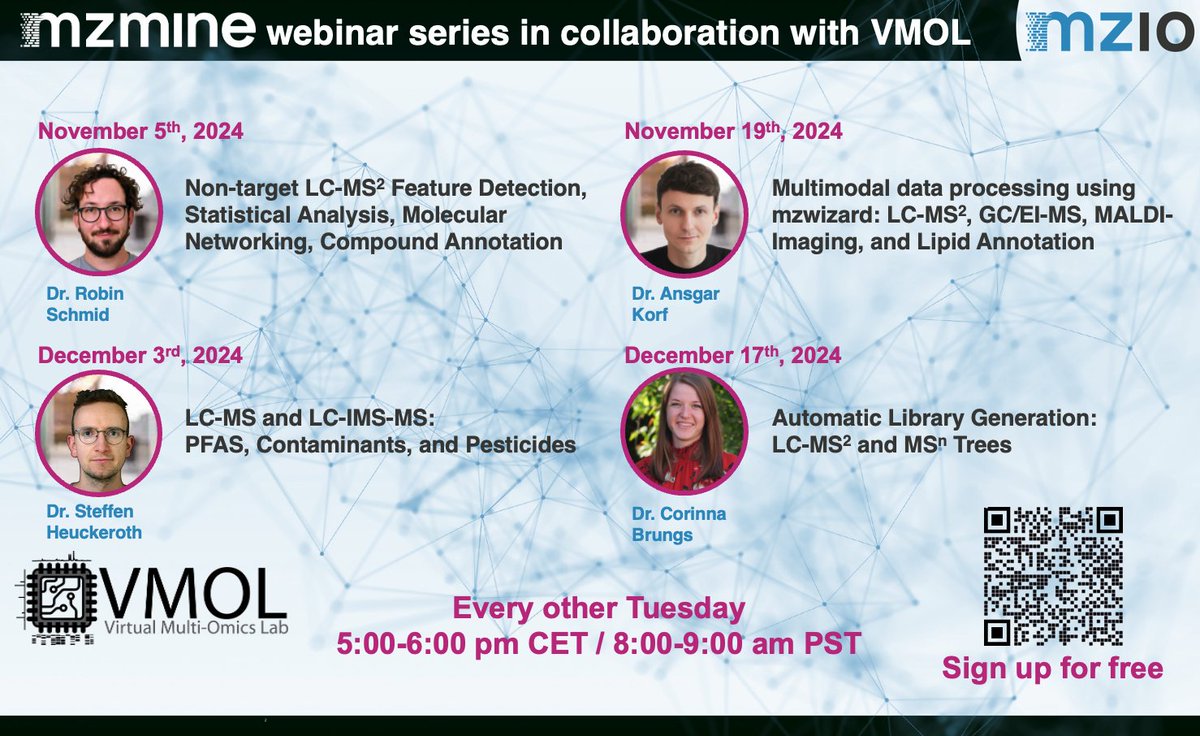
Join our free @mzmine_project webinar series together with VMOL. Starting off with mzmine 4 for #chromatography #LCMS #massspectrometry #CompMS #metabolomics.
November 5th (next Tuesday)
Register with VMOL to receive updates and the zoom link: docs.google.com/forms/d/e/1F…
10
24
2,139

30 Oct 2024
Join our free @mzmine_project webinar series together with VMOL. Starting off with mzmine 4 for #chromatography #LCMS #massspectrometry #CompMS #metabolomics.
November 5th (next Tuesday)
Register with VMOL to receive updates and the zoom link: docs.google.com/forms/d/e/1F…
23
57
5,422