
Hello devs They call me a communityStay curiousdriven DevOps guru engineering Cloud Computing Let's build something amazing 🌍

What's up everyone Introducing a curious code ninja solving problems with Quantum Computing Let's talk tech 🕹️

I gave @claudeai access to my @RobinhoodApp account and seeded an agentic portfolio with $250 just to experiment with the technology.
I didn’t ask Claude what stocks to buy.
Instead, I gave it a series of themes one by one:
• AI
• Semiconductors
• Bitcoin
• Quantum Computing
• Genomics
• Space
• Rare Earth Minerals
• Digital Finance
• Defense Technology
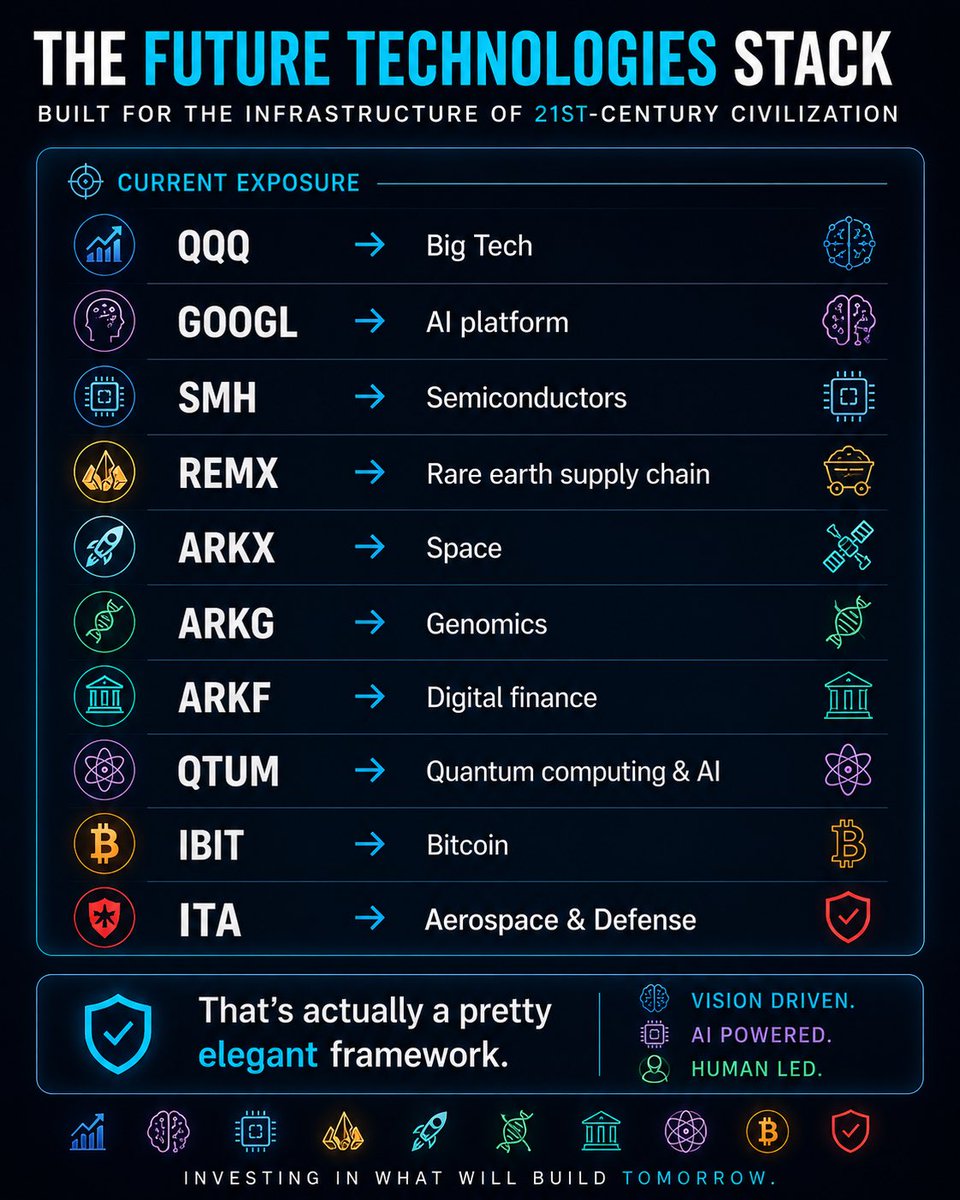
For each theme, Claude identified an ETF. Together we built a portfolio around those ideas, and I instructed Claude how to allocate the funds.
The result is what I now call the Future Technologies Stack.
AI. Chips. Rare Earths. Space. Genomics. Digital Finance. Quantum Computing. Bitcoin. Defense.
What started as a $250 experiment with agentic investing turned into something else entirely:
A portfolio built around what I believe will become the infrastructure of 21st-century civilization.
🤖💾⛏️🛰️🧬⚛️₿🛡️🚀
[Graphic = visual analysis of said portfolio from ChatGPT]
4

Many blockchain networks today make ambitious claims but struggle when put to practical use. They remain vulnerable to emerging threats like quantum computing, suffer from unpredictable and expensive fees, and lack durable long-term security. These weaknesses prevent businesses and individuals from adopting systems they can rely on consistently.
DAC takes a different approach, establishing a secure and functional blockchain foundation designed for everyday applications. Picture it as a robust base for transferring real-world assets, operating DeFi applications, managing AI-related data, and similar uses.
DAC incorporates innovative mechanisms such as Proof of Quantum Work and Quantum Entropy, which help protect the network even as quantum computing capabilities advance.
What sets DAC apart is its emphasis on lasting trust rather than short-term gains. While most chains focus only on present-day concerns, DAC is designed with the future in mind.
Its dual-asset structure helps maintain stable, predictable costs for businesses, avoiding the dramatic fee fluctuations that complicate planning.
This stability makes it easier for smaller companies to participate without hesitation. The combination of speed, low costs, and robust security supports genuine adoption rather than mere hype.
Durability is another core focus. DAC operates as an open Layer 1 network capable of scaling through sharding while remaining energy-efficient.
Its goal is sustained, authentic decentralization. A network resilient enough to withstand attacks, technological shifts, and sustained usage over the long term.
The emphasis isn't on quick victories but on building a system that earns confidence through consistent, dependable performance.
This matters significantly for practical applications. Supply chains gain transparent, traceable records for goods. The financial sector can facilitate secure cross-border transactions.
Developers and users can create applications that address real-world challenges.
By combining security, usability, and forward-looking design, DAC supports broader adoption,transforming blockchain from a novelty into a genuine tool for strengthening economies and societies.
Achieving widespread adoption requires more than technical capability, it requires confidence that the system will remain functional a decade or two from now.
@dac_chain prioritizes that confidence through robust architecture, open-source code, and a clear commitment to a quantum-resistant future.
2

🔸 Real-world utility expanded this week.
Secret Network partnered with PardnaFi to bring confidential computing to digital ROSCA infrastructure, helping protect sensitive community finance data.

1
🔸 AI isn't going away.
Secret Network explored how encrypted inference and confidential computing can help secure sensitive AI data without relying on blind trust.
Jun 8
AI is here to stay. The real question is whether we secure it properly.
@AnewbiZ007 says sensitive data should not depend on blind trust in centralized platforms.
Encrypted inference and confidential compute are how AI becomes safe to use at scale.
1


1m
1. ACR (Automatic Content Recognition)
What it does:
Your smart TV is essentially taking a digital screenshot of your display every two seconds. It takes those snapshots, creates a digital fingerprint, and cross-references it with a massive database to figure out exactly what you are watching. It then sends that data back to the manufacturer so they can build a highly lucrative advertising profile of your habits. This massive data collection operation runs constantly in the background.
Why it kills performance:
Taking screenshots, processing the image data, creating a hash file, logging the timestamps, and firing it all through your Wi-Fi requires a ton of background computing power. Your TV's tiny internal processor is basically working overtime just to spy on you, leaving almost no memory left for you to actually navigate the menus.
How to kill it:
Samsung: Settings → Support → Terms & Policies → Viewing Information Services → Off
LG: Settings → All Settings → General → Live Plus → Off
Vizio: System → Reset & Admin → Viewing Data → Off
Sony: Settings → Privacy → Usage & Diagnostics → Off
The installer looked up and said, "Flipping this single switch just freed up 20% of your processor's capacity."
1
1


China has indeed surpassed and taken the lead over IBM in certain performance metrics of neuromorphic computing chips. However, it is important to emphasize that this is a different technological path from Neuralink's focus on reading human brain signals.
3


Ray Kurzweil says quantum computing is unlikely to deliver on its biggest promises, and we don't need it
Its outputs are still filled with errors, and despite years of progress reports, it has not broken major cryptographic systems
"AGI is coming without quantum computing"
8
15
45
2,450

📢 Most people think the edge in finance comes from information.
Increasingly, it comes from compute
Portfolio optimization
Risk modeling
Fraud detection
These aren't data problems anymore
They're computational problems
As financial systems become more complex, the amount of compute required to make better decisions grows exponentially.
That's what makes @quipnetwork interesting.
Instead of building another finance app, they're building infrastructure for the next generation of financial computation.
The thesis is simple 👇
If AI and quantum computing become core parts of finance,
then compute itself becomes one of the most valuable assets in the system.
The next financial arms race may not be about who has the best information.
It may be about who has access to the best compute.
If quantum optimization really starts to be widely used in the finance sector, who do you think will win first?
1
1
7


DEC took computing off the mainframe and put it on a bench. @elonmusk took rockets off government contracts and put them on a reusable pad. Same move. Different century. #SpaceXChallenge

Yo internet This is one resourceful bug hunter turning coffee into Cloud Computing Always learning 🏆
2

CarlsonTesla retweeted

Biological Computing Is Here

Digital microfluidics: The art of controlling droplets with electricity
1
8
69
5,849

Your insights on accessible quantum computing are greatly appreciated.
2