
Jun 14
Good day LAB! 🧪
We’re still small.
Maybe we always will be.
But thanks to you, our heart has always been bigger than our size. 💚🎩
#cardano #gratitude #crypto #cryptomuseum #cryptoart #art #digitalart
1
43
50
367
Nino Brodin retweeted

19 Dec 2021
This covert infrared communication device was confiscated in 1984 by West-German authorities (BfV). It was used by Agent 'J' for communication with the East-German Stasi. cryptomuseum.com/covert/opto…
6
8
Nino Brodin retweeted
20 Nov 2021
This extremely rare British spy radio set was used during WWII by the French Resistance organisation Jade-Amicol in Paris, and was recently rediscovered. The Mk XV, or Mark 15: cryptomuseum.com/spy/mk15/in…
1
3

Jun 9
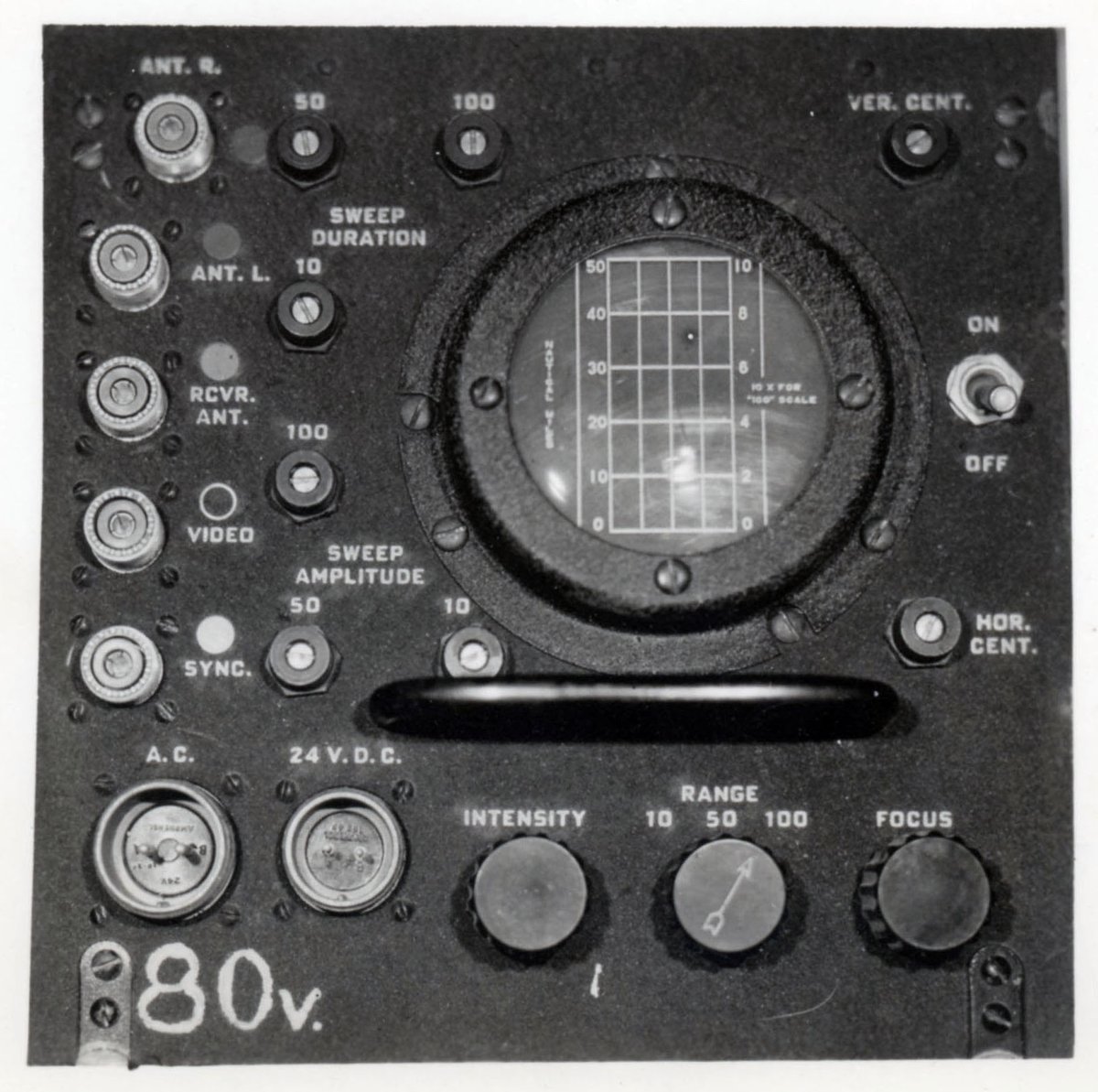
Portable radar transponder
Rebecca/Eureka
Portable radar transponder - this page is a stub
Rebecca/Eureka was a WWII transponding radar system, developed between 1940 and 1943 at the Telecommunications Research Establishment (TRE) by Robert Hanbury Brown, John William Sutton Pringle and Charles Bovill. It was used for dropping-off airborne forces and their supplies, and later also for other purposes. The system consisted of two parts: and airborne transceiver with two highly directional antennas (Rebecca) and a ground-based transponder (Eureka).
The Rebecca unit was basically an adaption of an existing ASVradar, whilst the Eureka part was an all-new development. The portable Eureka transponder was delivered to resistance groups in Europe from 1943 onwards, after which it was used to guide airplaines (with a Rebecca unit) to the dropping zones. This way, weapons and other supplies were delivered to resistance fighters.
The units were manufactured in the UK from 1943 onwards. The US Air Force followed slighly later with interoperable units. Apart from guiding droppings, the systems were also used for other purposes, such as blind-bombing, airfield approach and blind-landing .
1. The name Rebecca was derived form the phrase Recognition of beacons.
2. The name Eureka is a Greek word which means I have found it!
Crypto
Spy radio
Burst encoders
Intercept
Covert
Radio
Telex
Telephones
Agencies
Manufacturers cryptomuseum.com/radar/eurek… via @cryptomuseum
58

Apr 21
Nicely explained, I would spend a lot with "how it worked", hahahaha! Cryptomuseum webpage have a good visual explanation of how it worked.

2
34

Apr 5
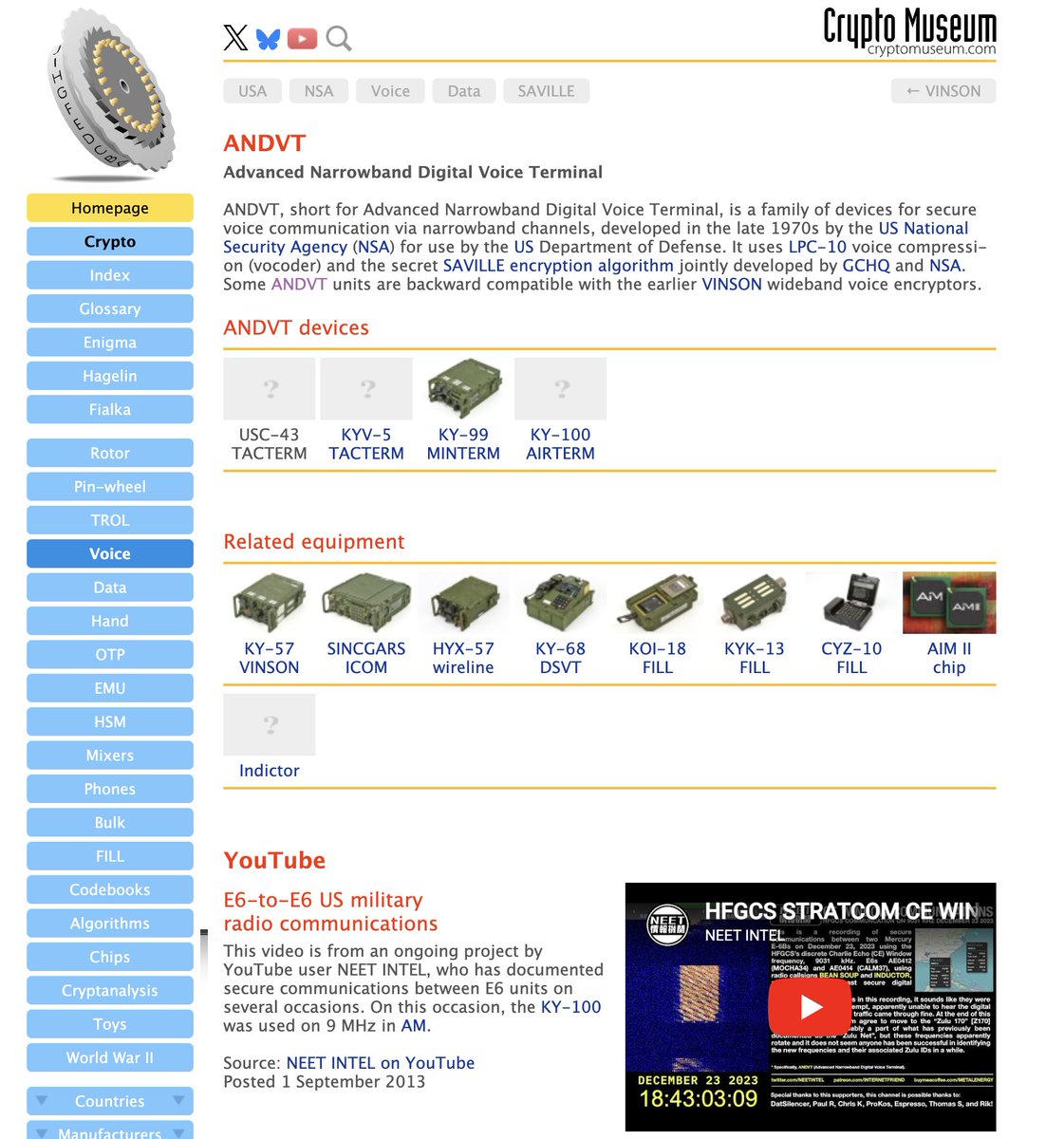
It is perhaps ANDVT, or what I sometimes call "ANDV-like", since it seems it's been so long since there was any sort of direct documentation to support that identification.
@cryptomuseum is more certain than I am, unambiguously identifying it as ANDVT.
cryptomuseum.com/crypto/usa/…
1
1
7
1,423
Released today: Virtual Schlüsselgerät 41
This cipher machine, based on Hagelin C-38 but WAY more complex was set to replace Enigma.
Over a year of work & research & it's ready for you to try for yourself.
sg41.virtualcolossus.co.uk
@tnmoc @GCHQ @bletchleypark @cryptomuseum @threejs
2
12
26
1,306

Feb 19
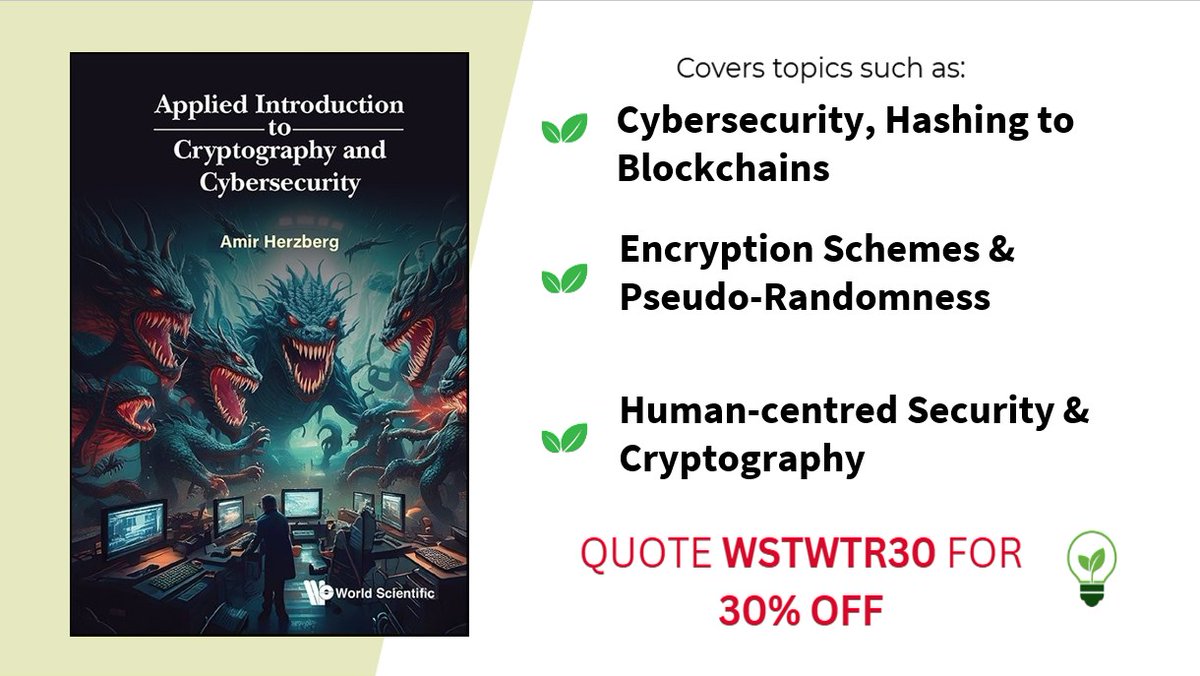
🔐💥 How do encryption, hashing, PKI, and quantum-resilient protocols secure our digital world?
Applied Introduction to Cryptography and Cybersecurity delivers a unified foundation in both fields—bridging theory and hands-on labs with zero assumed prior knowledge.
📘 What’s inside:
✅Shared-key & public-key cryptosystems
✅Hashing, Merkle trees, blockchains & digital signatures
✅TLS, SSL, PKI, certificate transparency
✅Message authentication, signature schemes, resilience to corruption
✅Human-centered & (post)quantum cryptography
✅Course-ready labs & real-world protocols
🔍 Explore topics like:
Cybersecurity, Cryptography, Integrity, Authentication, Encryption Schemes, Blockchain, Quantum Security, PKI, TLS, Secure Web Protocols, Applied Computer Science
🎯 Ideal for:
• Undergraduate & graduate students in cybersecurity
• Computer science educators & course developers
• IT professionals learning modern applied crypto
📖 Book link: worldscientific.com/worldsci…
💸 Use WSTWTR30 for 30% off now!
👥 Join the academic conversation with:
@IEEEorg @BlackHatEvents @rsaconference @defcon @cryptoeprint @ACM_Advancing @IACRcrypto @cyber @CybersecuritySF @StanfordCyber @MIT_CSAIL
@CyberSecMonth @Infosec @IETF @NISTcyber @CERT_Division @CloudSecForum @HashiCorp @Cloudflare @TheHackersNews @IEEEComSoc @cryptomuseum
#Cybersecurity #Cryptography #TLS #Blockchain #PKI #SSL #DigitalSecurity #Encryption #CyberSecEdu #PostQuantumCrypto #Infosec #AppliedCryptography #ComputerScience
2
252

21 Dec 2025
Previously unknown instructions & settings sheets for the SG-41 have been discovered in Czech archives! Thanks to Eugen Antal, Carola Dahlke & Robert Jahn who published them in Cryptologia.
I've been working to bring these into Virtual SG-41
@tnmoc @bletchleypark @cryptomuseum
2
6
118
22 Nov 2025
I've completed the last model for Virtual SG-41! It's ALL there & working, a 1940s technical marvel lives again! It's taken nearly a year; 378 models drawn by hand on CT scans from @DeutschesMuseum then animated with @threejs. End in sight! @tnmoc @bletchleypark @cryptomuseum
1
3
218

17 Nov 2025
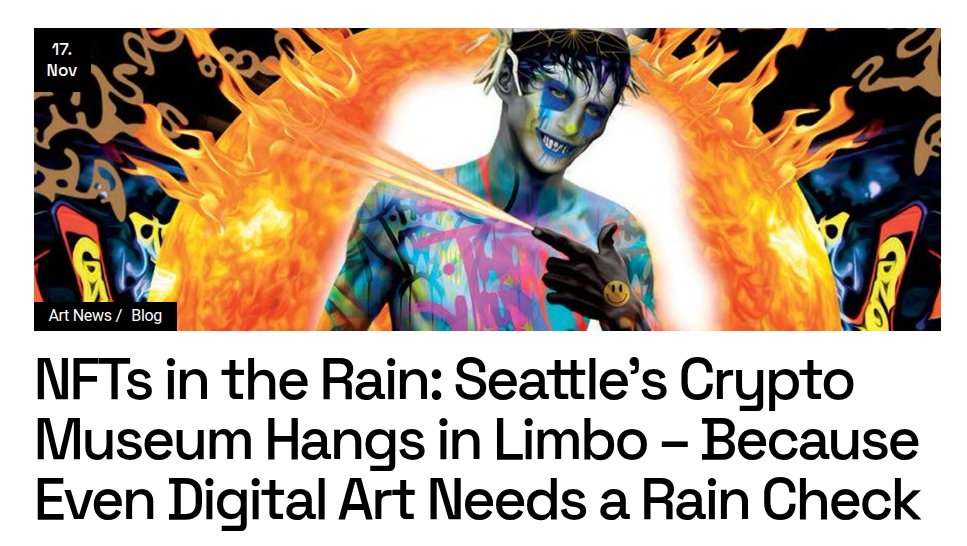
Ever wondered why Seattle's NFT museum is on a "strategic pause" like a bad crypto breakup? My new blog spills the hilarious tea: From boom-time Beeple bliss to glitchy VR raves in limbo. Rainy days, resilient art—lessons for us all! ☔🎨🖼️
pjpart.com/nfts-in-the-rain-…
#NFTArt #CryptoMuseum #Web3
1
4
8
277
15 Nov 2025
This week, I've started working on the paper tape reels which are held in the base of the SG-41. Two tapes can be fitted; one for the cipher text and one for the plain text to be printed. @tnmoc @bletchleypark @cryptomuseum @threejs
3
125
9 Nov 2025
We are getting so close now! This week sees the completion of the final part of the actual SG-41 mechanism; the ink cartridge & upper paper feed rollers. So is that it ... all done? Not quite, there's one important part missing. @tnmoc @bletchleypark @threejs @cryptomuseum @GCHQ
1
11
2,128
25 Oct 2025
Virtual Schlüsselgerät 41 (SG-41). Another week and yet another mess of levers in the CT scans that do something .. but what? One of those cases where I'm just going to have to model & animate them in @Blender & @threejs to find out. @tnmoc @bletchleypark @GCHQ @cryptomuseum
3
131
27 Sep 2025
It's time to fill out some of the metalwork that holds everything together. It's no wonder the SG-41 weighed in at around 13kg especially as Germany were running out of lighter metals by the end of the war.
@tnmoc @bletchleypark @cryptomuseum @GCHQ @threejs
2
1
12
3,205
31 Aug 2025
I've been continuing work on the paper feed mechanism after a very exciting visit which has helped a huge amount (more on that soon). The paper feed lever allows you to extract your printed cipher/plain text from the SG-41. @tnmoc @bletchleypark @cryptomuseum @threejs
1
9
326

9 Aug 2025
This looks so good! And it is begging for a mixed-reality version like @DominicPajak did with the BBC Micro
29 Mar 2024

xr.bbcmic.ro v1 is now out! It's a free immersive sim of the 8-bit BBC Micro you can play in your Meta Quest 3 or (hopefully!) Apple Vision Pro browser 👾🕹️
#webXR @threejs @MetaQuestVR #AppleVisonPro #retrocomputing
1
2
57
9 Aug 2025
As well as working on modelling & animating the complex paper feed mechanism, I've been having a play adding a few extra visuals. Some useful (hiding specific parts of the mechanism to see how it works) and some just eye candy!
@tnmoc @bletchleypark @threejs @cryptomuseum
3
4
30
3,162
29 Jul 2025
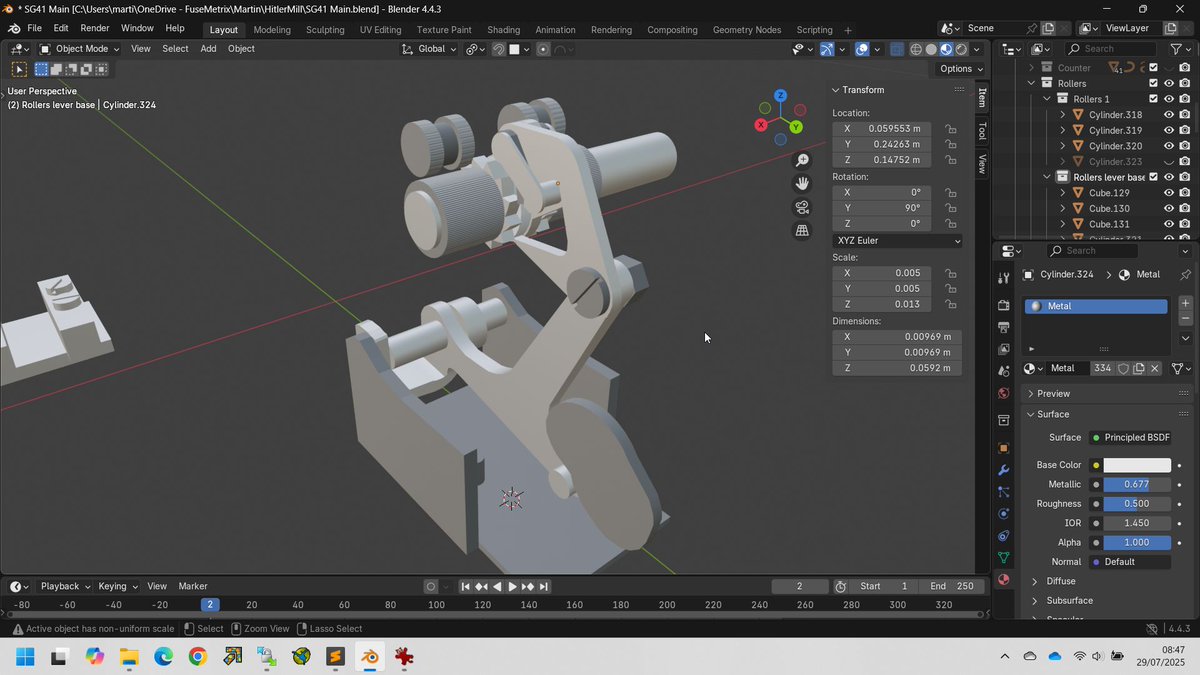
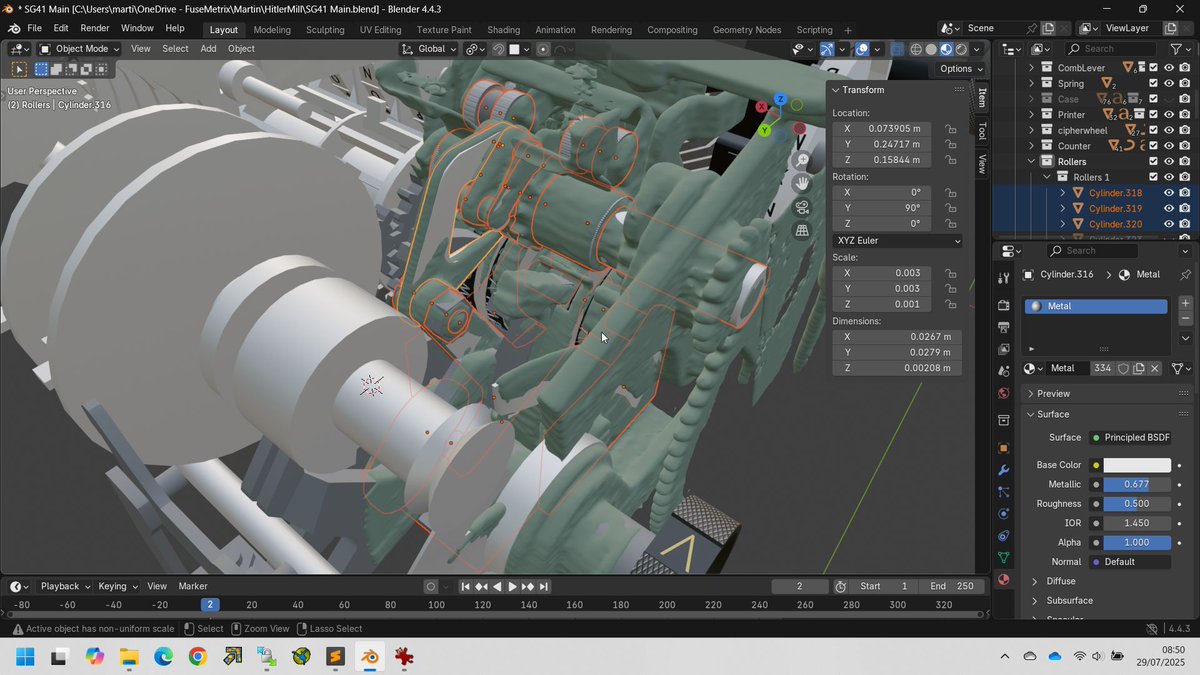
Just when I thought I'd got past the most complex bits for Virtual SG-41, I find the paper feed mechanism. It's buried in deep on the left-hand side and includes a cam, 3 levers & 2 ratchet/pawls all which need to be modelled & animated! @tnmoc @bletchleypark @cryptomuseum
1
9
129
13 Jul 2025
I broke more than fixed this week! I'd placed a few items in the machine out of line so last few bits didn't fit in. Had to check scan and correct placing. All fixed now! The question to answer today - "What happens if you run out of paper?" @bletchleypark @tnmoc @cryptomuseum
1
12
433