
Jun 15
need jasa rapihin skripsi (dapus, dapis, penulisan, turnitin) #joki #jokiskripsi #zonauang #zonajajan DROP PL
17
9
651


May 20
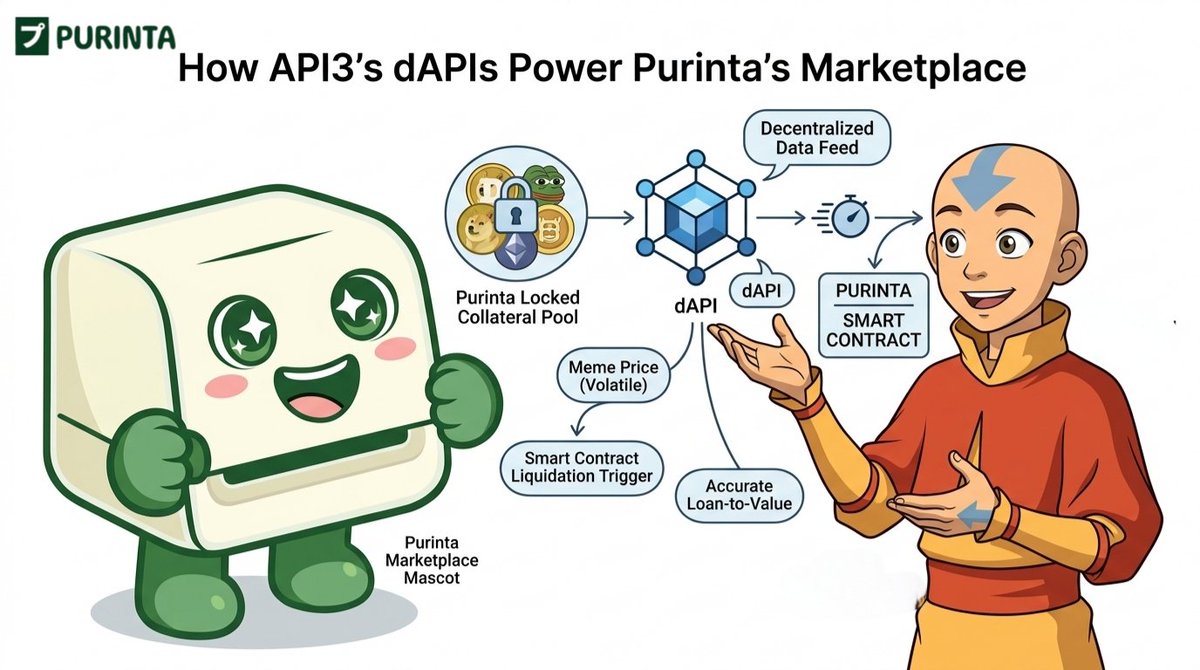
Purinta operates as as a decentralized marketplace where users can lock up their memecoins as collateral to borrow other digital assets.
Because the prices of memecoins are incredibly volatile and change by the second, @purintaxyz requires an ultra-reliable, lightning-fast stream of data to track exactly what these coins are worth at any given moment.
This is where API3 comes in. API3 provides decentralized data feeds, known as dAPIs, which stream real-time price updates directly from first-party data sources to the Purinta platform.
By cutting out middleman nodes, API3 delivers data that is both highly secure and highly accurate.
@purintaxyz relies on this constant, precise price info to safely manage its lending pools. It tells the platform how much a user can borrow against their memecoins and lets the system instantly trigger liquidations if a memecoin's value suddenly crashes, keeping the whole marketplace safe from bad debt.
5
13
97

May 8
Quien es mas idiota Pirry o los qué se tragan todos los dapis y le dicen Doctora a una persona que es bachiller pero maneja Colombia y esta de representante de una universidad sin tener un título universitario. Este país está loco...
6
421

Apr 11
12 new tools just dropped on MadeOnSol 🛠️
🔗 API & Data
→ @Covalent_HQ — unified multi-chain data API
→ @reservoirtools — NFT liquidity & trading API
→ @parsiq_net — real-time blockchain event streaming
⚡ SDKs
→ @seahorse_lang — write Solana programs in Python
→ @anza_xyz Pinocchio — zero-dep, up to 95% CU reduction
→ @getlumos — type-safe Rust↔TypeScript schemas
→ @thirdweb — full-stack Web3 SDK for Solana
→ @litprotocol — decentralized key management & token gating
🔮 Oracles
→ @API3DAO — first-party oracle dAPIs on Solana
→ @UMAprotocol — optimistic oracle for any on-chain data
🔥 Also added
→ @CiaoTool
→ @SolBundler_app
Discover them all 👉 madeonsol.com
1
2
117

kata dapis anak kecil kalo mau tidur didongengin cerita rakyat, kalo aktivis dibacain Jakarta Method
1
4
175

Feb 2
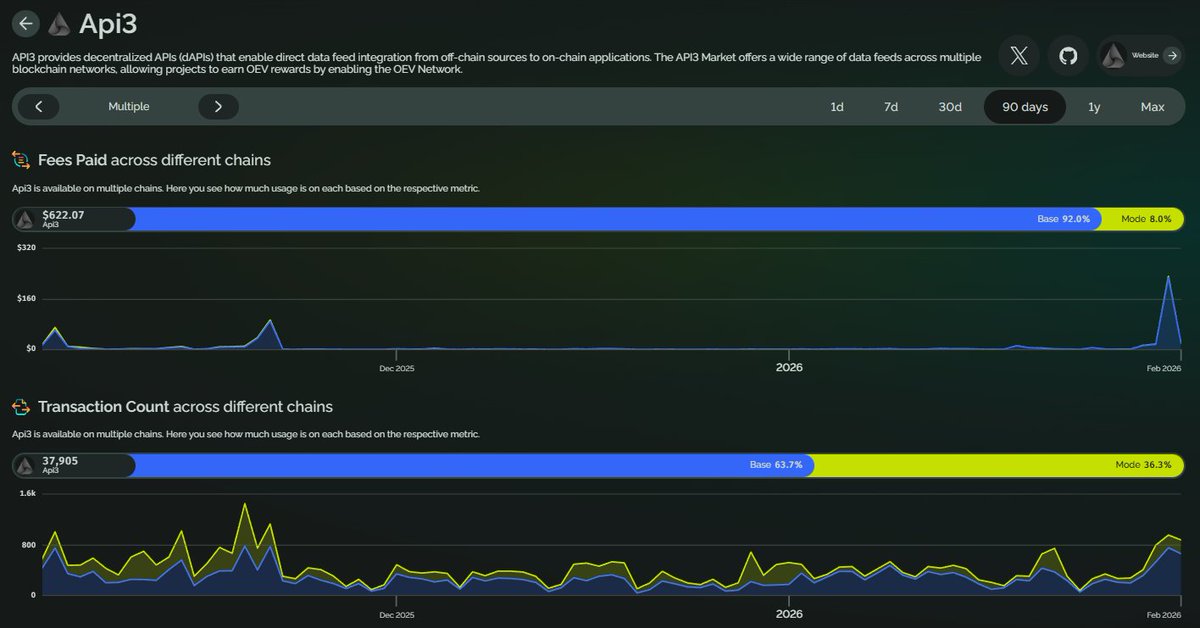
In the age of low transaction costs it's interesting to watch what is still being paid for during fee spikes. @Api3DAO is one such example - even with relatively consistent transaction counts, we see fee spike from less than $1 daily to over $200. It makes sense that data, including price feeds, is extremely valuable during periods of volatility.
So what is Api3:
Api3 provides decentralized APIs (dAPIs) that enable direct data feed integration from off-chain sources to on-chain applications. The API3 Market offers a wide range of data feeds across multiple blockchain networks, allowing projects to earn OEV rewards.
We would love to get more Api3 contracts tagged on @open_labels so we can track them.
1
9
824

API3 Brings First-Party Oracle Price Feeds to Arbitrum
What usually goes through your mind when a smart contract pulls in external data?
Most builders assume the price feed is “there,” but don’t always think about where that data actually comes from, who controls it, or how many trust assumptions sit in between. When something breaks, those details suddenly matter a lot.
That’s the gap @Api3DAO is addressing and it’s now available directly on @arbitrum.
Why Data Origin Matters More Than Ever
In DeFi, price feeds are foundational. Lending, perps, RWAs, & derivatives all depend on them. Yet many oracle systems still rely on layers of intermediaries, off-chain aggregation, or cross-chain bridges that introduce risk and opacity.
API3 takes a different approach. Instead of relying on third-party node operators, first-party oracle nodes are operated directly by the data providers themselves. This gives developers full on-chain verifiability over where the data originates.
You’re not trusting an abstraction. You’re consuming data from the source.
What API3 dAPIs Actually Are
dAPIs are API3’s decentralized price feeds powered by multiple first-party oracles. These oracles are run by the data providers, not middlemen, and their values are aggregated natively on the chain where they’re used.
On Arbitrum, this means smart contracts can now access decentralized price feeds that are:
✅ Maintained on-chain
✅ Operated by reputable data providers
✅ Aggregated without cross-chain bridges
All of this is delivered as a managed solution, so developers don’t need to run infrastructure or manage oracle updates themselves.
What “Managed” Really Means for Builders
With managed dAPIs, once a feed is deployed and activated, any smart contract in the ecosystem can read the value. There’s no per-project setup or custom integration required.
Developers simply reference the feed and consume the data. Maintenance, updates, & oracle operations are handled by API3 & the first-party providers.
This reduces complexity while improving security.
Who the Data Comes From
The feeds available on @arbitrum pull data directly from well-known providers, including: dxFeed, Kaiko, Nodary, New Change FX, Coinpaprika, Finage, and Twelve Data.
That means onchain contracts are now consuming price data sourced and signed by the same entities that provide data to traditional finance and large crypto platforms.
Coverage & Feed Specifications
There are currently 120 feeds live across crypto, forex, commodities, & equities, with configurations such as:
🔹0.25% deviation with 2-minute heartbeat
🔹0.25% deviation with 24-hour heartbeat
🔹0.5% deviation with 24-hour heartbeat
🔹1% deviation with 24-hour heartbeat
This gives builders flexibility depending on how sensitive their application is to price movement & update frequency.
Why Native Aggregation on Arbitrum Matters
#dAPIs use native-chain aggregation, meaning data is aggregated directly on Arbitrum itself. There’s no need to rely on bridges to import oracle values from another network.
That design choice removes an entire class of risk and makes dAPIs particularly well-suited for applications that require strong security guarantees.
How Builders Can Get Started
Builders can browse and activate feeds through the API3 Market, where managed dAPIs are listed and maintained: market.api3.org/dapis
For hands-on guidance, API3 also provides a developer getting-started video & full documentation covering integration & usage: docs.api3.org
Support is available through the API3 Discord for teams that need technical help.
My View
As #DeFi matures, oracle design is shifting from speed to provenance and trust minimization. API3’s first-party model fits that shift.
With dAPIs live on Arbitrum, builders get verifiable data without extra trust layers an upgrade not just in tooling, but in how onchain data is treated.
#Arbitrum #Oracles #Web3Developers
2
30
510

API3 brings reliable oracle data to @arbitrum, helping projects there get accurate prices without middlemen. Its dAPIs run on Arbitrum chains for smooth DeFi use. Recent DAO activity shows strong growth in staking and rewards.
@Api3DAO now has over 7200 members taking part in decisions. They completed 120 proposals so far. This community helps guide the project on Arbitrum. Staking pool sits at 57 million tokens.
Current staking epoch pays 0.89% rewards with 46.5% APR. Last epoch minted almost 495,000 API3 tokens. Staked amount grew to 56.7 million tokens by end. APR keeps rising to draw more on Arbitrum.
DAO staking target stands at 63.7 million tokens. Total supply reached 159 million with 140 million circulating. Governance locks 6.6 million tokens. Rewards lock holds 12.5 million more for Arbitrum users.
API3 tracker shows steady epoch progress. Epoch 2926 just started with higher APR. Past epochs added hundreds of thousands in minted tokens. This setup keeps API3 active in Arbitrum ecosystem.
Arbitrum benefits from API3 dAPIs for price feeds in DeFi apps. Multiple oracle nodes ensure data comes straight from sources. No bridges needed, so security stays high for chain projects.
Staking rewards encourage holders to lock tokens long term. Target not met yet, so APR climbs 1% each time. This draws more capital to support API3 operations on Arbitrum.
API3 focuses on oracle services that fit Arbitrum needs. DAO members vote on upgrades that improve data feeds. Higher staking means better rewards and stronger network for everyone. (27 words)

1
2
19
561

14 Dec 2025
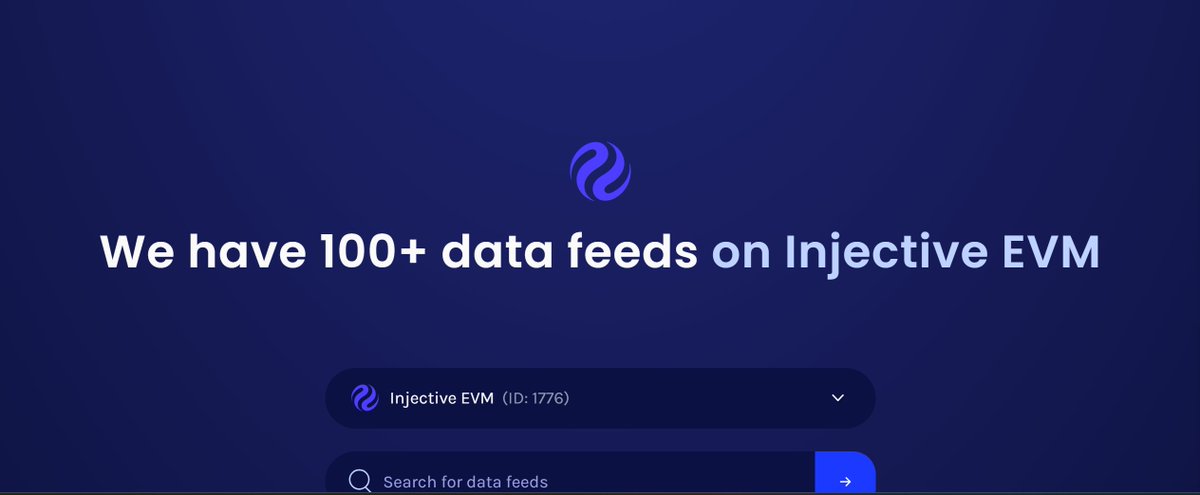
API3 plays a quiet but important role in the @injective ecosystem.
@Api3DAO brings real-world data onchain using decentralized oracles called dAPIs.
Instead of middlemen, data providers run their own nodes and deliver prices directly.
That makes the data more accurate, transparent, and harder to manipulate.
For Injective, this matters a lot.
Perps, derivatives, prediction markets, and other DeFi apps rely on clean price feeds to work properly.
API3 helps keep trades fair, liquidations accurate, and markets stable even during high volatility.
For builders, it unlocks new products without extra trust assumptions.
For traders, it reduces risk in fast-moving markets.
Reliable data is invisible when it works and API3 helps @injective move fast without breaking.
19
9
419

10 Dec 2025
🔥 #API3 (#API3) is the real deal for everything #Web 3.0. Tired of intermediaries and all these centralized approaches? #API3 is leaving them in the dust with dAPIs — fully decentralized, blockchain-native APIs that allow blockchain apps to access real-world data directly, no middlemen required. 🏴☠️
📊 Current stats:💵 Price: ~$0.51📊 Market Cap: ~$44.19M💸 24h Volume: ~$11.96M🔄 Circulating Supply: 86.42M API3
🛒 Where to buy: #HTX, #Binance, #Upbit, #OKX, #BitMart.
🔑 Bottom line: If you want to build real decentralized infrastructure, API3 is your move. Straight-up speed and direct data connections without the hassle. Jump in before it’s too late. 💥
3
283

8 Dec 2025
We’re on it, Dapis! Our team will follow up when we have an update. Thanks for waiting! 💚 - BB
1
27

7 Nov 2025
API3 delivers decentralized APIs (dAPIs) that provide smart contracts with access to real-world data in a secure and transparent manner. @River4FUN app.river.inc
1
96

2 Nov 2025
API3 delivers decentralized APIs (dAPIs) that provide smart contracts with access to real-world data in a secure and transparent manner. @River4FUN app.river.inc
2
2
78

1 Nov 2025
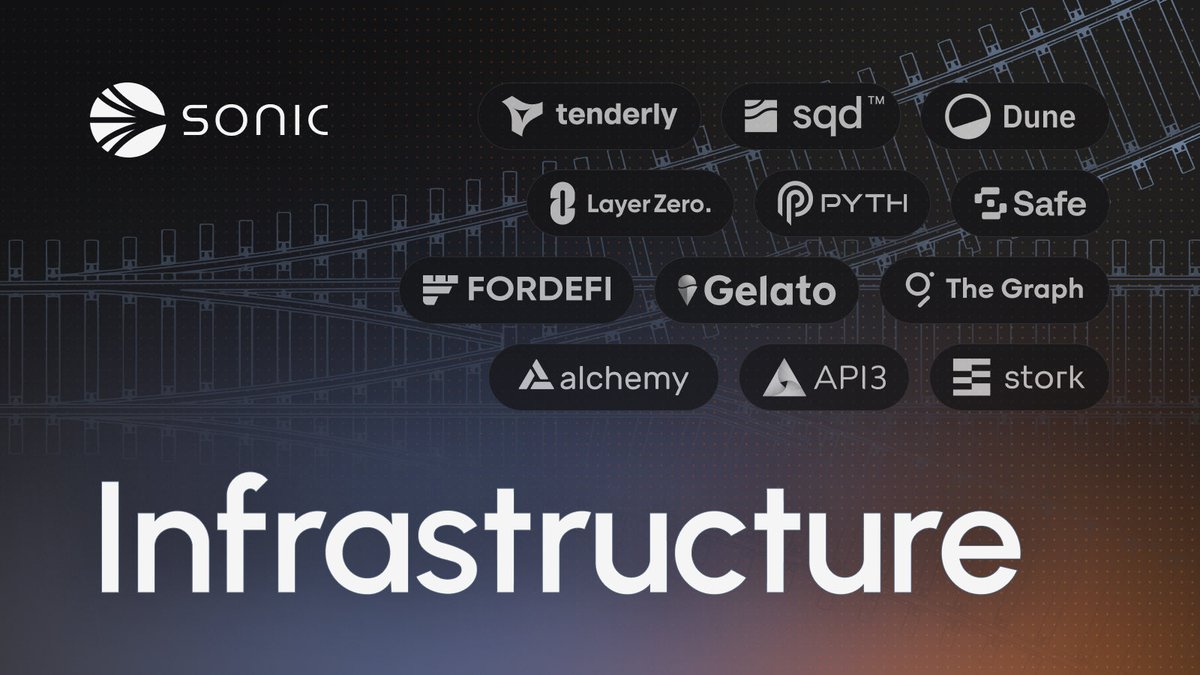
ORACLES ON @SonicLabs : Pyth Chainlink DIA
>Chainlink: Sonic joined the Chainlink Scale program in 2024
>Pyth Network: Provides low latency financial market data on Sonic
>API3 DAO:, trust minimized dAPIs run by data providers themselves.
>RedStone
>DIA
>Stork Oracle
2
6
681

30 Oct 2025
temennya dapis 😂
30 Oct 2025

Emang anj dapin 😮💨
1
2
1,132

20 Oct 2025
GM Somniacs🌞💜💙 happy monday
let's power through the week on Somnia
Maineet party ends today Final showdown with @NeuroGuardians last chance to join at 14:00 utc on the somnia discord
@Somnia_Network x @NeuroGuardians drops Oct 22 4.444 NFTs .
WL 22 $SOMI , public 30 $SOMI . Mint 13:00 UTC
@Api3DAO live on somnia - dAPIs via airnode,governance & staking rewards on ETH , Base
Liquidity Program : earn hourly points, pool multipliers & loyalty boosts . top pool now @tokos_fi
@playvariance NFTs floor hits 150.90 $SOMI now the price is 147.50 $SOMI
New partners:
@pimlicoHQ (gas sponsorship)
@security_xyz (audit grant $100K)
@HubzzHQ (social entertainment )
stay with somnia 💙💜
believe on somnia 💜💙
play with somnia 💙💜

18 Oct 2025

GM Somniacs🌞
We're approaching the grand finale of this 8-week Odyssey - just two more weeks before it all transitions into the next exicting phase! S5 seems to be closing right on schedule leading straight into S6 and beyond.
The market's been a rollercoaster lately , yet $SOMI keeps proving its resilience staying within a strong price zone and showing hints of revival. Once the last waves of selling fade away , that's when the true party begins.
Those who kept their conviction through the noise , those who BELIEVED in the dream your patience is about to pay off big time. The next chapter feels like it's written in gold
So tell me, legends are you still adding more $SOMI before the tide turns
@Somnia_Network
#Somnia #SomniaOdyssey

5
5
81

20 Oct 2025
Big news @Api3DAO is now live on @Somnia_Network another major move from the Somnia team, and here’s why it matters.
API3DAO is transforming how smart contracts access real world data.
Instead of relying on third party oracles, data providers can deliver their APIs directly to the blockchain via Airnode.
Why this is huge
• True decentralized APIs (dAPIs) for smarter, trustless apps
• Token holders earn governance and staking rewards
• Integrated across multiple chains: Ethereum, Base, Kava
Developers now have access to accurate, reliable data for DeFi, NFTs, and more all without intermediaries.
25
2
27
301

28 Sep 2025
dapis klo masuk itb tahun kemarin

19 Oct 2024

dulu sih “warnain rambut kyk frank ocean kalau masuk itb” ga masuk si any
2
236