
26 Aug 2025
Multi-Domain Distribution Learning for De Novo Drug Design
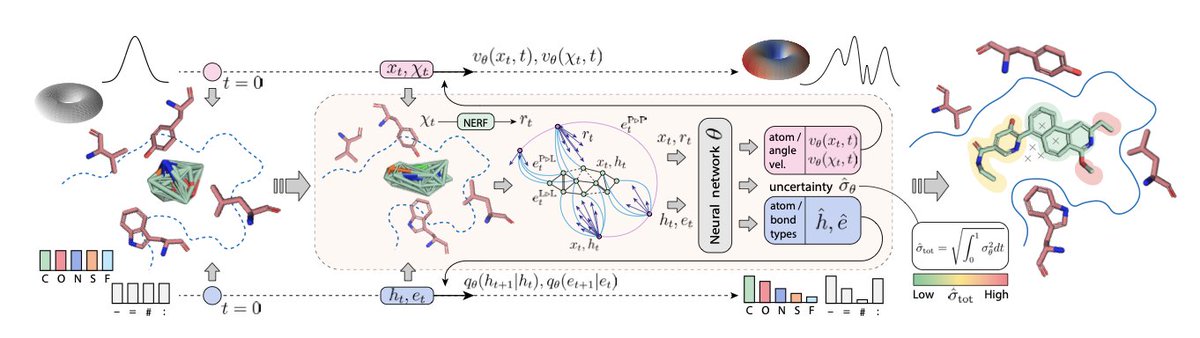
1. The article introduces DRUGFLOW, a novel generative model for structure-based drug design that integrates continuous flow matching with discrete Markov bridges. This model demonstrates state-of-the-art performance in learning the chemical, geometric, and physical aspects of three-dimensional protein-ligand data.
2. DRUGFLOW incorporates an uncertainty estimate that can detect out-of-distribution samples, enhancing the robustness of the model. This feature is crucial for identifying samples that deviate from the training distribution, ensuring more reliable predictions.
3. The model proposes a joint preference alignment scheme applicable to both flow matching and Markov bridge frameworks. This allows for the enhancement of the sampling process towards regions with desirable metric values, making it more efficient for practical applications.
4. An extended version of the model, FLEXFLOW, explores the conformational landscape of proteins by jointly sampling side chain angles and molecules. This innovation enables the model to sample probabilistic ensembles of possible binding modes, even for targets in unbound conformations.
5. DRUGFLOW outperforms other methods in learning the distribution of protein-binding molecules across various metrics. It achieves state-of-the-art distribution learning capabilities, making it a powerful tool for de novo drug design.
6. The model also includes an adaptive size selection method that discards excessive atoms during sampling. This feature allows the model to dynamically adjust the size of the molecule, improving its ability to generate realistic drug candidates.
7. DRUGFLOW demonstrates strong performance in learning the conditional size distribution of molecules given protein pockets. It effectively removes redundant atoms to avoid steric clashes, enhancing the quality of generated molecules.
8. The article presents comprehensive experiments that validate the model's ability to learn the training data distribution accurately. DRUGFLOW shows significant improvements in various metrics, including molecular properties, binding efficiency, and protein-ligand interactions.
9. The study concludes that DRUGFLOW can be retrained on curated datasets to steer the generation of samples towards desired regions of the chemical space. This flexibility makes it a versatile tool for medicinal chemists aiming to optimize molecules for specific design objectives.
📜Paper: arxiv.org/abs/2508.17815
#DrugDesign #GenerativeModel #MachineLearning #ProteinLigand #DeNovoDesign #DistributionLearning
4
29
1,813

8 Aug 2024
Check out our latest blog post on "Deep Clustering via Distribution Learning". This work provides a theoretical analysis to guide the optimization of clustering via distribution learning. Learn more at bit.ly/3WBjTQm. #deeplearning #clustering #distributionlearning
1
23