
Jan 15
Lightning talk! A Datomic Entity Browser for Prod — Clojure Conj 2025 #ElectricClojure
2
5
32
3,654


1 Dec 2025
If you haven't checkout #electricClojure by @dustingetz you absolutely should.
Great thread.
1
3
148

4 Oct 2025
Datomic Cloud does not play well with @ElectricClojure. Only Pro works for my use-case. I’m tempted to build my own Datomic-like that only supports index access with different tuple semantics, because tuples are tricky.
1
2
71

17 Jun 2025
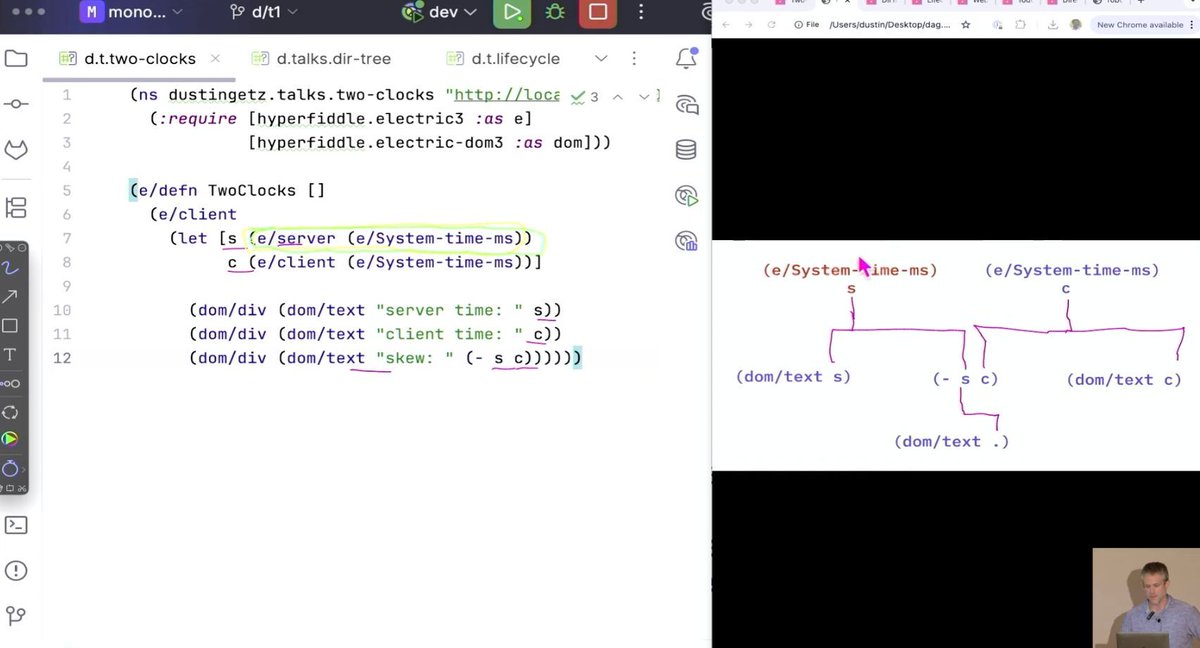
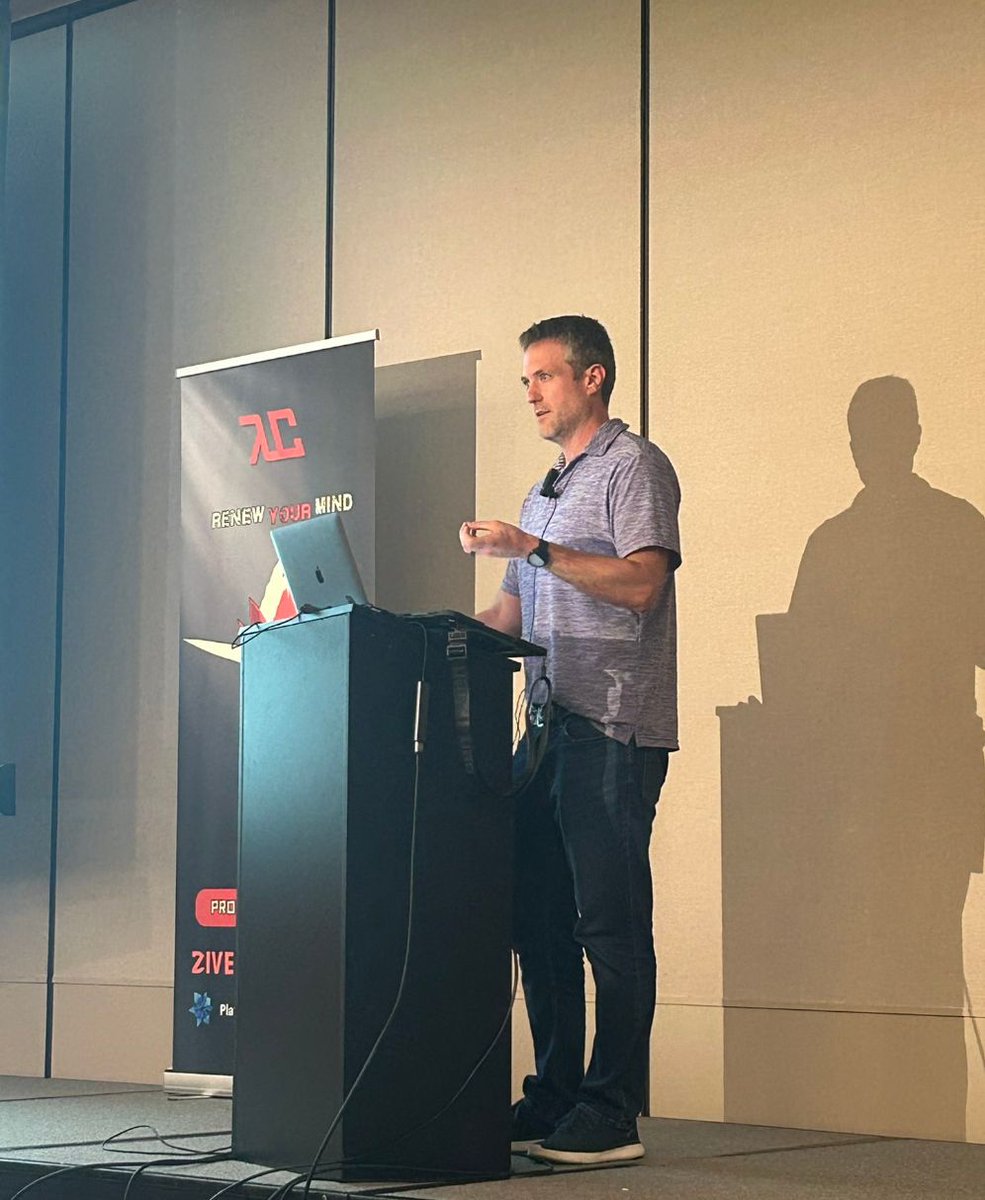
And with the amazing @dustingetz we have a spectacular close to Day 1 of #LambdaConf2025 💪
You truly cannot miss Dustin's keynote on Electric Clojure: Differential Dataflow for UI ⚡
Check out the full talk in the link below!
#ElectricClojure

1
7
29
3,861
7 Jun 2025
m.youtube.com/watch?v=QIam96… @dustingetz 's keynote on $ElectricClojure is up. This is the way web UI should be built.

1
1
7
455
13 May 2025
Two weeks until ReClojure in London! I’ll be talking about #ElectricClojure, join us! reclojure.org/
12
572
1 May 2025
check out #ElectricClojure; a direct-style compiler for Clojure syntax to reactive signals based on functional effects, it uses a unified client/server AST to choreograph the frontend backend boundary at the expression level
4
110
30 Apr 2025
I’ll be at the LambdaConf pre-conf hike, great time to hang out! And don’t miss the #ElectricClojure keynote on Monday!
30 Apr 2025

'Fancy a gallop?' the LambdaConf unicorn asked, majestically.
All #LambdaConf2025 attendees are invited to gallop together through a wonderful hike at Estes Park on Sunday, May 11th. However, you must fill out this form to make sure your lunch bag is taken care of.
Please fill out this form by this Sunday:
buff.ly/O10yOJT
Want to join the hike but haven't bought a ticket? Giddy up:
buff.ly/QH2pqDj

1
4
11
1,779
29 Apr 2025
"It’s truly a paradigm shift to be able to prototype/develop an app with the backend at the same speed that you would mock it in the frontend with a frontend db."
Indeed! #ElectricClojure
1
21
661
26 Apr 2025
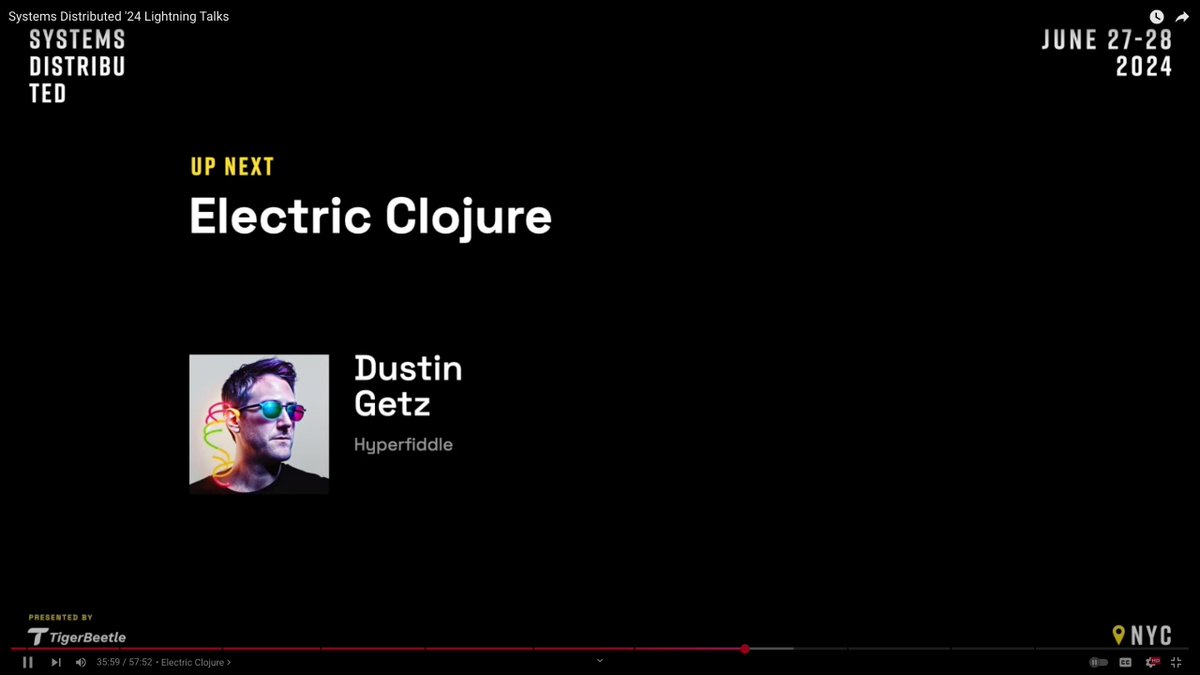
Lighning talk! Electric Clojure in 5 minutes — Systems Distributed 2024
share.descript.com/view/nJkF… #ElectricClojure
1
13
61
10,600

28 Mar 2025
@dustingetz's #ElectricClojure looks especially cool in this respect because it lets you put server and client code in the same function.
1
2
134
26 Feb 2025
Oooohhh. Nice. I'm going to look at that. I'm on the same quest sort of. Settling on #electricclojure for building the backend and fronted. This could be a very good option to add to it.
2
48
17 Feb 2025
better entity navigation ux coming soon to the datomic-browser demo - #ElectricClojure
19
1,022
11 Feb 2025
Watch @36Rleonoel's talk on Missionary, the functional effects & streaming system powering @ElectricClojure: youtube.com/watch?v=xtTCdT6e…
8 Nov 2024

there are now 4 interesting things in web development:
1. @ElectricClojure
2. Rama by @nathanmarz
3. Datomic by @cognitect
4. @cursor_ai
the models still hallucinate a lot, though, but it's the worst it'll ever be 🤷♂️
3
1,001
6 Feb 2025
One thing that sync engine advocates miss imo is that backends run in the edge now, and the edge is really close. Here from my home office, our prod app is literally 8ms away. When I virtual scroll over a 10k record collection, the timings are:
FIRST PAGE LOAD:
8ms: send scroll offset to closest edge server
70ms: get from edge network to database in AWS (50ms for cross-continental, 100ms for cross-atlantic)
200ms: run database query once, return all 10k records to edge
0ms: retain result on session in edge
0ms: subvec over collection to read page
0ms: serialize one page of records
8ms: send one page of records to client
0ms: deserialize one page of records
=286ms from user interaction to initial table load
SUBSEQUENT SCROLL OFFSET CHANGE:
8ms: send scroll offset to edge
0ms: subvec over retained collection in memory
0ms: serialize one page of records
8ms: send one page of records to client
0ms: deserialize one page of records
= 16ms from user scroll to next results
That's 1 frame at 60 FPS! 60FPS virtual scroll over remote objects! This is why, with #ElectricClojure, we can stream results while hitting typical response latency of 20-30ms—gasp, horror, 1.5 animation frames—it is plenty! Those are pro gaming latency numbers! In video chat we consider this realtime!
And Electric, being a reactive computation, auto-memoizes your edge computation for FREE! This performance for FREE!
4
1
24
1,667
21 Jan 2025
Hey @dustingetz I have zero idea if this applies to #ElectricClojure, but it might.
21 Jan 2025

This has been a long time coming!
Have you ever wondered what lenses and UI programming have in common?
Can we recreate React, Elm, and Redux entirely using pure category theory?
Read this series to find out.
2
76
21 Jan 2025
See you at @lambda_conf! #ElectricClojure
21 Jan 2025

Can't wait to see keynotes by @Jonathan_Blow, @bobzhang1988 (creator of @moonbitlang), @chriskrycho, @dustingetz, and dozens of talks by other luminaries in distributed systems, functional programming, PLT, math, and AI.
Grab your early bird ticket today! 👇
1
2
21
1,612
18 Jan 2025
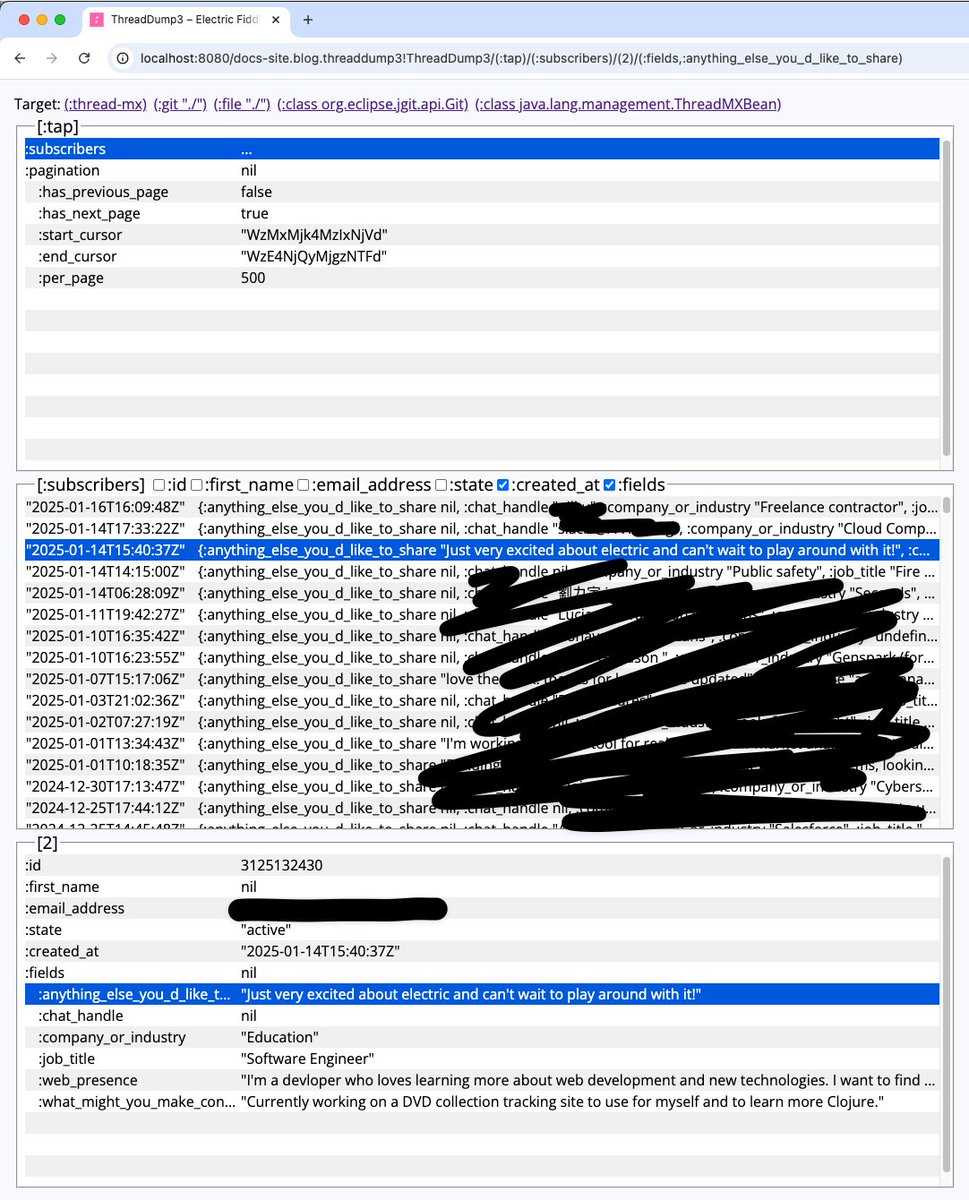
Not even 30 minutes later, browsing the #ElectricClojure beta waitlist via convertkit API
1
2
843
18 Jan 2025
Streaming HN client scrolling over stories and comments. Resolving content over HTTP to the CDN (visible rows only), as you scroll! #ElectricClojure
2
1
12
538