
Ergativity is one of those concepts you feel is v easy until you start to explain it so someone
May 26

A key concept in both the Circassian and Georgian grammar is "Ergativity" which is something I have tried to understand dozens of times and only really got once, over lunch, after a couple of beers.
1
23
1,822

May 26
It's funny cause I suspect ergativity was the norm in west eurasia before Indo-Europeans and Semites took over. Sumerian, Hurro-Urartian, Basque have ergativity as well.
1
17
966

The fact that Northeast, Northwest, and South Caucasian languages are all mutually unrelated yet exhibit ergativity is cool.
3
874

May 26
A key concept in both the Circassian and Georgian grammar is "Ergativity" which is something I have tried to understand dozens of times and only really got once, over lunch, after a couple of beers.
5
3
101
8,561

May 20
Very interesting, we have ergativity and we also have Ez unlike other sorani dialects.
Ez is Emin.
Min is min.
2
49


May 5
I have a very incomplete project that was “what if Greek survived in Central Asia and developed ergativity and sht” but I haven’t touched that in a while XP
5
51


Mar 24
... relic split-ergativity:
tʰile ‘1.ᴘʟ.ɪɴᴄʟ’
⇐ stʰitalyēbʰiḣ ‘ɪɴsᴛ.ᴘʟ’
tʰila ‘3.sɢ’
⇐ stʰitalyakaḣ ‘–ka.ɴᴏᴍ.sɢ’
tʰile ‘3.ᴘʟ’
⇐ stʰitalyēbʰiḣ ‘ɪɴsᴛ.ᴘʟ’
1
2
69

If you want to reach the most number of people in India, learn Hindi, of course. But, on the other hand , if you want to get in touch with any Indian language that is grammatically easier (no gender, no irregular verbs, no noun declensions, no split-ergativity, no diglossia, etc…) , then go east and learn Bengali. You can still reach a lot number of people and get in touch with authentic Hindu culture without having to endure irregular verbs, diglossia, and declensional classes.
Mar 22

was thinking about learning an indian language, just in case
hindi feels obvious
but i’m told it’s not the one
what should i actually learn, just in case?
9
11
182
18,703

フィリピン言語学の泰斗リカルド・ノラスコ先生の記念論文集 Philippine languages and education reform: Papers in honor of Ricardo Ma. Duran Nolasco に使役と受身の関係について書きました。
Reflexive causative construction in Tagalog
This paper examines the Actor Voice reflexive causative construction in Tagalog, focusing on its semantic and syntactic properties. It argues that the magpa-reflexive causative construction encodes a specific middle situation type, in which an action is carried out for the benefit of, or in the interest of, a causer. Notably, this construction promotes P to S, exhibiting a quasi-passive function, yet it is not fully passive as the causer is construed as a human being responsible for the situation. The analysis supports Nolasco’s ergativity framework for Philippine languages, demonstrating that the pivot in these constructions represents the most affected entity in a clause.
1
2
4
736


Typology of Hurrian:
- r/l disallowed initially
- no phonemic voicing
- (very mild) vowel harmony
- agglutination: ~14 cases, possessive suffixes, Suffixaufnahme
- 3 tenses, but complicated mood and negation
- positional nouns, double marking
- ergativity (only weakly split)
1
32
1,970

Feb 1
2. Ergative Structure and Physical Causality
Kurdish—particularly Kurmanji—exhibits ergative alignment in certain grammatical contexts, especially in past-tense transitive constructions. In ergative systems, the agent of a transitive verb is marked differently from the subject of an intransitive verb, while the patient of a transitive verb aligns with the intransitive subject. Linguistic descriptions of Kurdish highlight this ergative pattern as a defining grammatical feature.
Some theoretical perspectives suggest that such grammatical structures may reinforce clarity in causal reasoning. In physics, the distinction between the agent applying a force and the object affected by that force is fundamental. Ergative alignment linguistically encodes this distinction by explicitly differentiating the “doer” (agent) from the “affected entity” (patient). While empirical evidence directly linking ergativity to enhanced causal reasoning remains limited, theories of linguistic relativity propose that habitual linguistic patterns can influence cognitive schemas.
For Kurdish-speaking students, the grammatical salience of agent–patient distinctions may facilitate the conceptual separation between force-exerting bodies and force-receiving bodies. Consequently, principles of Newtonian mechanics or broader causal frameworks may be cognitively scaffolded by the language’s grammatical structure. In this sense, ergativity may offer a subtle but meaningful linguistic support for understanding physical causality.
3. Mother-Tongue Instruction and Cognitive Load Theory
Cognitive Load Theory (Sweller et al.) emphasizes the limited capacity of working memory. When learners are introduced to new material, any extraneous cognitive demand—such as processing a non-native language—reduces the mental resources available for conceptual understanding. In contexts where mathematics or physics is taught in a second language, students must simultaneously decode linguistic input and grasp abstract concepts, increasing cognitive load.
Empirical research supports this claim. Studies indicate that exposure to new academic content in a foreign language, without adequate linguistic support, tends to hinder rather than facilitate learning. The mental effort expended on translation and interpretation competes with the effort required for conceptual reasoning.
In contrast, instruction in the mother tongue eliminates this linguistic barrier. Cognitive resources are allocated directly to understanding the subject matter, leading to deeper comprehension and more efficient learning. For example, a study conducted in Spain compared mathematics instruction delivered in Spanish (the students’ first language) and English (a foreign language). First-grade students taught in their native language outperformed their peers in solving everyday mathematical problems, as they were not burdened by additional linguistic processing.
The pedagogical advantages of mother-tongue education can be summarized as follows:
Reduced cognitive load: The absence of linguistic decoding allows learners to focus fully on conceptual reasoning.
Improved academic performance: Experimental data consistently show higher achievement in mathematics and science when instruction is delivered in the learner’s native language.
Faster internalization: Concepts learned in the mother tongue are more rapidly transferred to long-term memory, promoting understanding over rote memorization.
Enhanced engagement: UNESCO reports emphasize that mother-tongue education increases learner confidence, participation, and socio-emotional well-being.
1
11
189

если покопаться то можно даже найти нечто напоминающее эргативное выравнивание:
у них в город уехано, у волков тут хожено, у кошки уже рыба стащена
вводим проект split-ergativity для русского!
7
316

Jan 25
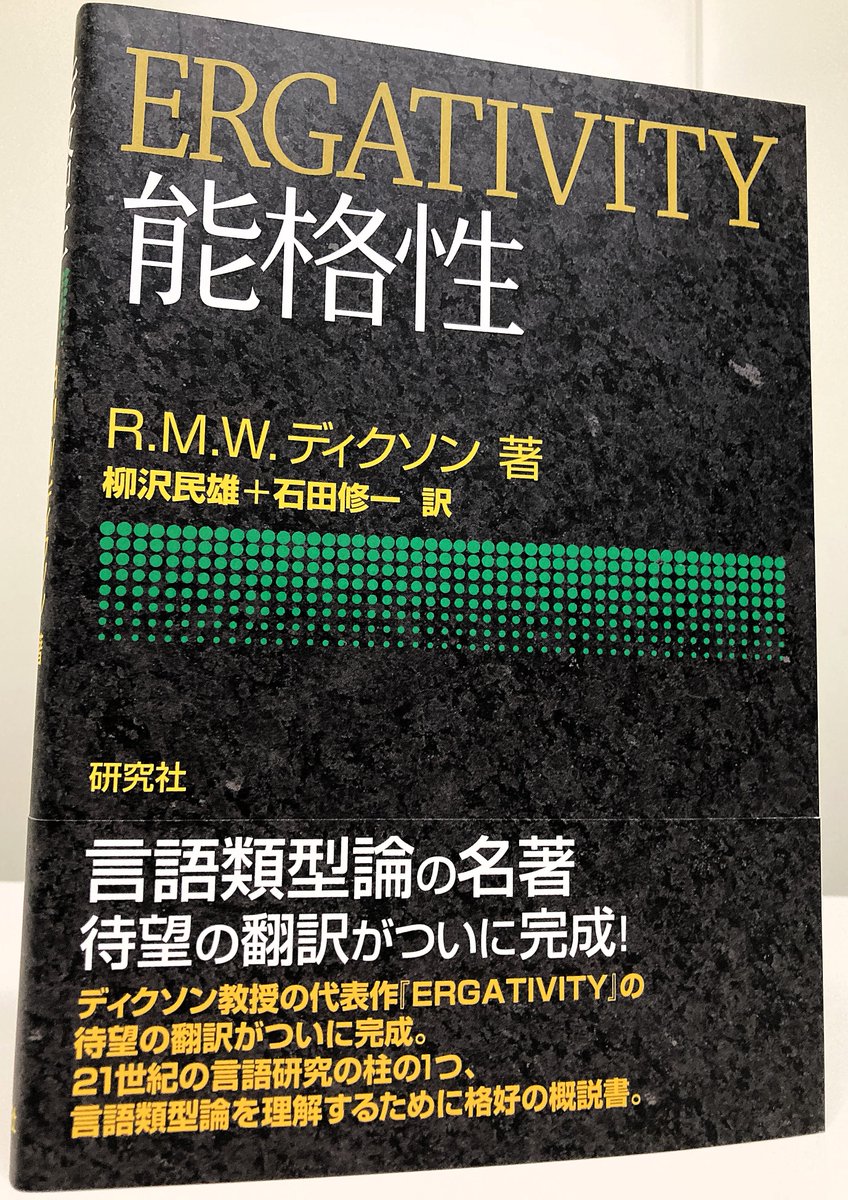
本日は言語学者R・M・W・ディクソン教授 87歳の誕生日です。小社では『能格性』R. M. W. ディクソン〔著〕柳沢民雄、石田修一〔訳〕を刊行しております。未知言語の記述文法で世界的に評価の高い教授の代表作『Ergativity』待望の翻訳書。言語類型論を理解する格好の入門書としてお読みいただけます。
2
13
47
4,613

29 Dec 2025
Coghill’s monograph ‘The rise and fall of ergativity in Aramaic’ has such a catchy title that I advertently use “the rise and fall of ergativity” in regular speech whenever talking about the history of ergativity in Indo-Aryan.
1
6
399

30 Nov 2025
The Kavir or Biabānaki dialects are essential for understanding the historical development and classification of NCS Kurdish and Balochi within the broader Northwestern Iranian linguistic framework. In what follows, I provide a brief historical overview and highlight several key linguistic features of interest. The most up-to-date understanding of the Kavir languages comes from the work of academic linguists Esfandiar Taheri and Habib Borjian, who build extensively on the lexical material collected by Sādeq Kiā and the early descriptions recorded by Richard Frye. This is the first in a series of posts I will be making on the many Iranian languages, both historic and modern.
Introduction
The desert region of Biabānak, located along the southern edge of the central Iranian plateau, is home to a group of highly distinctive Western Iranian languages collectively known as the Biabānaki varieties. Among these, the Farvi and Khuri dialects are the most linguistically revealing. Once treated as peripheral Central Plateau dialects (CPD), they are now recognised as a separate subgroup that preserves layers of North-western, with heightened South-western Iranian contact much like NCS Kurdish and Balochi. Farvi is spoken in the village of Farvi in Khur and Biabānak county. Khuri is spoken in Khur and its associated settlements.
Farvi linguistic background
The language contains six vowel phonemes along with two falling diphthongs, ua and ia. These diphthongs originate through historical interactions with a lost consonant h and through internal vowel shifts. The quality of final vowels varies considerably, with final a often realised as a raised or fronted vowel. The consonant system is similar to Persian in size but distinctive in structure. Farvi lacks the phoneme ž, which Khuri retains, and uses j in its place. The uvular q alternates with a fricative intervocalically or word-finally. Postvocalic n regularly disappears, leaving a nasalised vowel, though it reappears before enclitics or affixes. A recurrent phonological pattern is the insertion of g to break hiatus, an innovation which explains why many inherited words retain final g derived from older suffixal elements.
These basic phonological traits are complemented by several historical sound developments. Farvi displays both North-western and Southwestern reflexes of Old Iranian, often in the same semantic domain. For example, Proto-Iranian ś appears as s in words such as kas(su) meaning small and pas meaning goat, a trait shared with Parthian and Baluchi. In contrast, the reflexes of Old Iranian ź and śu̯ show both North-western and Perside outcomes. North-western patterns appear in zomā meaning son-in-law and espej meaning louse, while Southwestern-type developments can be seen in forms such as duj meaning yesterday, dušaw meaning last night, bāhu meaning arm and song meaning dog. A major Old Iranian feature aligning Farvi with Southwestern languages is the reflex of *θr as s, visible in words such as pus meaning son, sa meaning three, āwes meaning pregnant and āsiaw meaning mill. These exact lexical examples reveal the coexistence of multiple historical strata inside the language.
Middle Iranian developments reinforce this mixed profile. Several North-western traits appear as the realisation of inherited č as j, as in tij meaning sharp, nuāj meaning prayer, and ji or jen meaning woman. Other features reflect a Southwestern orientation. For example, the shift of *rd to l appears in biyal meaning spade.
The change of *dw to d appears in dije meaning other, aligning Farvi with Middle Persian, Kurdish and Baluchi. The change of *y to j appears in words such as jaw meaning barley and āji meaning there.
Farvi also exhibits several later sound changes that align it with Iranian languages in historic Kerman such as Northern Bashgardi and Baluchi. The most striking is the development of initial *w- to g-, found in a wide range of vocabulary including gaid meaning bad, giahtar meaning better, gištar meaning more, gazar meaning big, gā meaning wind, gāyem meaning almond and gis meaning twenty. This change is so regular that forms with initial v are suspected to be loanwords. Another historic Kermani trait is the retention of final -g derived from Middle Iranian -ka, seen in words like mošg meaning mouse, nafk meaning navel, barašg meaning palm leaf and esbelūk meaning spleen. Iranica also documents the vocalisation and affrication of final š in forms such as espej meaning louse, mij meaning ewe and harguj meaning rabbit, as well as a chain shift in final segments where -j becomes -č and -č becomes -rč, seen in sāruč meaning lime plaster, kajj meaning skewed and morč meaning wrist. These details are essential for understanding the internal phonological dynamics of Farvi.
The treatment of consonant clusters is also distinctive. Farvi reduces several inherited clusters in predictable ways, such as fr becoming hr in niahrin meaning curse, xr becoming hl in tahl meaning bitter and suahr meaning red, and xt becoming hd in duahd meaning daughter, al-sahd meaning weigh and al-gahd meaning pluck. These specific outcomes further differentiate Farvi from surrounding dialect groups. Nasalisation phenomena provide additional evidence of internal evolution. Postvocalic nasal loss results in nasalised vowels in words such as ajā meaning finish, aje meaning there and gešši meaning hungry. Intervocalic nasals also weaken or disappear in forms like nuoaj meaning prayer. These patterns illuminate the pathways through which Farvi developed its characteristic vowel system.
The nominal system is structurally straightforward but rich in detail. Plurals are formed through suffixes such as -ũ after consonants, -gũ after most vowels and -vũ after final â. The definite suffix -ū attaches directly to the noun, and the sequence ya plus -ī can indicate an indefinite noun. The Ezafe construction appears in limited contexts and seems to be reinforced by Persian influence. Pronouns distinguish human from non-human referents in the third person. Human forms include av for he or she and avũ or emũ for they, while inanimate forms rely on demonstratives such as õ meaning that or it and ânũ meaning those. Enclitic pronouns are used for possession, direct objects and ergative agents. These enclitics, such as -e for the third singular and -eĩ or -yũ for the third plural, parallel Kurdish in both form and function. Reflexivity is expressed with fa or fe, often combined with enclitic pronouns.
The verbal system retains the traditional division into present and past stems. Many verbs have irregular past forms that reflect older participial endings, for example uas meaning sleep with the past stem faft-, or fer meaning eat with the past stem fārd-. Regular verbs form past stems through -ây or -ī. Farvi has a morphological passive marked by -eh in the present and -ây in the past, and also an analytic passive using bo meaning become. Preverbs such as he-, al- and ar- modify aspect and meaning. Verb conjugation uses two sets of endings. Present and intransitive past verbs use one set, while transitive past verbs use another set that functions as ergative agent markers. Iranica provides examples such as dīgini meaning you see, bīdiyat meaning you saw and pī-at či-e bigūt meaning what did your father say. These examples illustrate both the structure of past tense ergativity and the movement of agent clitics onto preceding constituents, a phenomenon also attested in Khuri.
Khuri, although sharing these general characteristics, has a more transparently ergative past tense system. Its agent clitics frequently attach to objects and adverbs, revealing a syntactic mobility that belongs to older West Iranian patterns. Khuri also uses a wide set of preverbs and demonstrates more consistent fronting of clitics. These similarities strengthen the view that Farvi and Khuri belong to the same historical stratum, even though each expresses the inherited system differently.
Summary
From a historical linguistic perspective, the evidence points to a layered classification. Farvi is rooted in the North-western Iranian branch, as demonstrated by its reflexes of Old Iranian s, z and j. At the same time, it has absorbed several old Southwestern developments that bring it close to Persian, Kurdish and Baluchi. This includes the reflex of y- as j-, the development of *θr as s, the change of *dw to d and various lexemes that correspond more closely to Middle Persian than to typically North-western languages. Older contacts with Iranian languages in Kerman introduced further changes, such as the shift of *w to g and the retention of final g. Such layered evidence highlights the linguistic complexities of the southern Iranian plateau in historic times, and especially before the rise of new Persian. The combination of these aforementioned layers makes Farvi a transitional Western Iranian language whose structure cannot be explained through a single genealogical model, much like Kurdish and Balochi, and to a lesser extent CPD, among other Iranian languages.
3
3
19
3,207