
Jun 1
1915 June 1: T.S. Eliot's “The Love Song of J. Alfred Prufrock,” first published in "Poetry" magazine. “Let us go then, you and I,/When the evening is spread out against the sky/Like a patient etherized upon a table…” tinyurl.com/bdcu68bn #histmed #medicalhistory

2
44

May 31
We assail conservatives for failing to propose anything “new,” but they are more honest than progressives, who gnaw at the present and name the erosion “novelty.” They strip paint from the limestone and call it fresh polish.
Progressives flatten peaks into plateaus to make lebensraum for the many. They would deprive a reticent few of their lofty abodes to secure a temperate, modest existence for the mass. Such a disposition aims at this destruction of rank—the swallowing up of all scarcities until all men lay, line by line, etherized upon the ground. Every patch of dirt shall be occupied by a heaving, sweltering body. All lungs shall breathe the same humid air.
We do not create “the future” ex nihilo; we draw on the past, we yank latent possibilities from its loosened grasp. The risk-averse conservative, the Burkean pedant, clings to familiar structures for fear of the future, but he is justly perturbed by the vengeful optimism of his opposite, who confuses uprooting for sowing.
He is right to detest the despiser who faces the present in repulsion and runs backwards into the future, trampling over green shoots and fresh soil. Such a disputant is conjoined hand and foot to the past, that object of his enmity—and can never move an inch beyond it. He is nearer to the past than the reactionary, who knows when to bury the dead—and though incapable of reviving the damned, has the conscience to bed graves. The despiser can never remember; he can only anticipate. Such a grave-robber marches leftward, hoisting corpses over his shoulder in stubborn pursuit of specters. The past is always before him, an omnipresent obstacle—a poised foe.
It is the progressive who does not know when to end a battle—and it is he who entombs and seals off the future… all while cursing the past. Tradition carries forth in his curses and nightmares. The conservative, ever impotent, is dragged along by his ankles. He arrives always too late, as Benjamin’s angel of history, driven back by a westward gale. He guards only ruins; a soldier who stirs awake to a sacked city. He makes his way out of the barracks only after the castle’s gates have been breached—for he can only defend what has already passed from hiddenness into presence, and from presence into peril. He is no coward; that which he loves is hidden from him, and so he roams cemeteries.
1
10
688

May 26
The adversary known as Ahriman is only given power to thrive and reign through the imbalanced Ahrimanic impulse of humanity manifested through our digital avatars (electronic doppelgängers), which may be understood as double that allows us to navigate subnatural spaces in new forms as the eighth sphere slowly bleeds into our organic reality.
This is the polar opposite of the building of our Higher body known as the “resurrection” body, the “rainbow” body, the “glorified” form, etc. Our Higher form is organic, and represents a fully etherized (Spiritualized) form manifested as true Spiritual advancement—allowing us certain “abilities” that material tech promises but can never fully replicate. This resurrection body allows us to occupy *Higher* planes. If we look at the impulses of Christ, Ahriman, and Lucifer on a scale, the goal would be to balance these scales in order to prevent tipping past the point of “no return”—aka the “Fall” into the eighth sphere.
The balance between maintaining an organic timeline and fostering a healthy relationship with technological progress is a tricky one, and relies on the efforts of each individual to balance this first within themselves. It isn’t that technology is evil and must be avoided. Rather, we must build up the Spiritualized form and create a foundation based on embodiment, not disembodiment. Material tech will always lead to dissociation and detachment when this foundation isn’t present. Dissociated individuals cannot, in reality, be good stewards of the material realm—and certainly not of the subnatural realms.
When we lack awareness and embodiment, we become the analogy of the frog sitting in a pot of water as the heat is slowly increased….before he knows it, the water is boiling and there is no way out…🌟

4
3
29
549

May 24
Angus stuns in new selfie while a pregnant mother of 4 lies etherized on the table just out of frame
1
5
105

May 23
Prufrock reminds me of TS Eliot. "Let us go then you and I, when the evening is spread out against the sky like a patient etherized upon a table..."
1
1
2
45

May 23
Prufrock...
Let us go then, you and I,
When the evening is spread out against the sky
Like a patient etherized upon a table;
Let us go, through certain half-deserted streets,
The muttering retreats
Of restless nights in one-night cheap hotels
And sawdust restaurants with oyster-shells:
Streets that follow like a tedious argument
Of insidious intent
To lead you to an overwhelming question....
I suppose it would a grim question for the machine, should it attain sentience.
1
1
8
1,824

May 11
"Let us go then, you and I,
When the evening is spread out against the sky
Like a patient etherized upon a table;
Let us go, through certain half-deserted streets,
The muttering retreats
Of restless nights..."
May 11

I actually can't imagine the amount of insensitivity needed to think Eliot's verse lacks metre and music.
Ever since I first began exploring Eliot, I was filled by a higher sense of rhythm, which I couldn't at all explain. I wanted to describe the poetry as prosaic, because so many did and it looked like it - but I couldn't.
The only other English-language poet of the 20th century who can rival Eliot in his knowledge of music and metre is, in my opinion, Yeats - though in a very different way.
If you are interested in this topic, I would recommend three wonderful texts: Eliot's 'The Music of Poetry' and Gardner's 'Auditory Imagination' & 'The Music of Four Quartets' (both from The Art of T. S. Eliot).
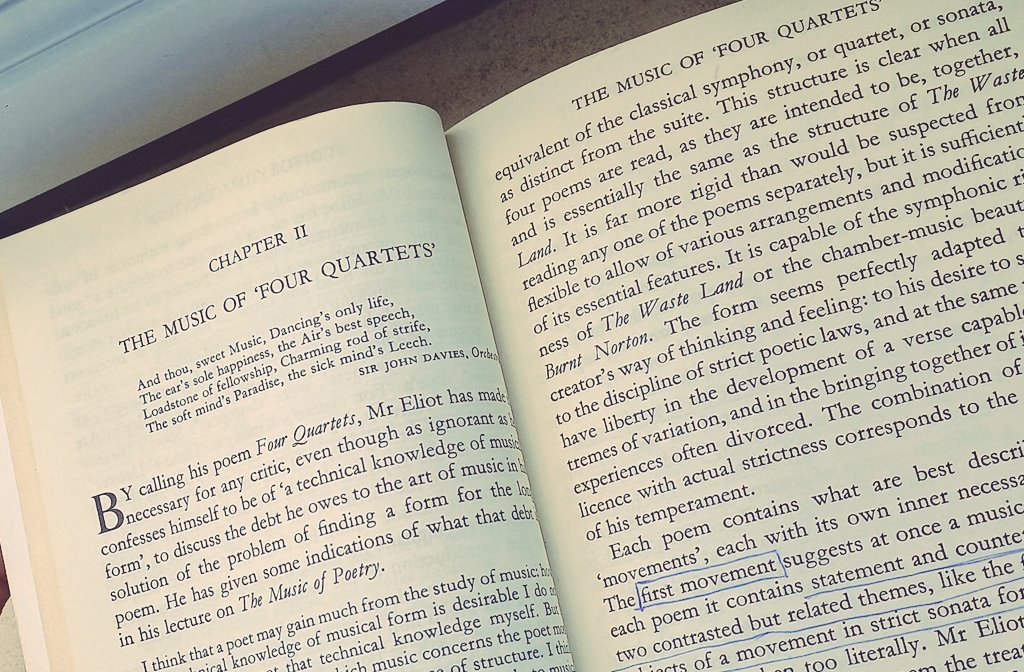
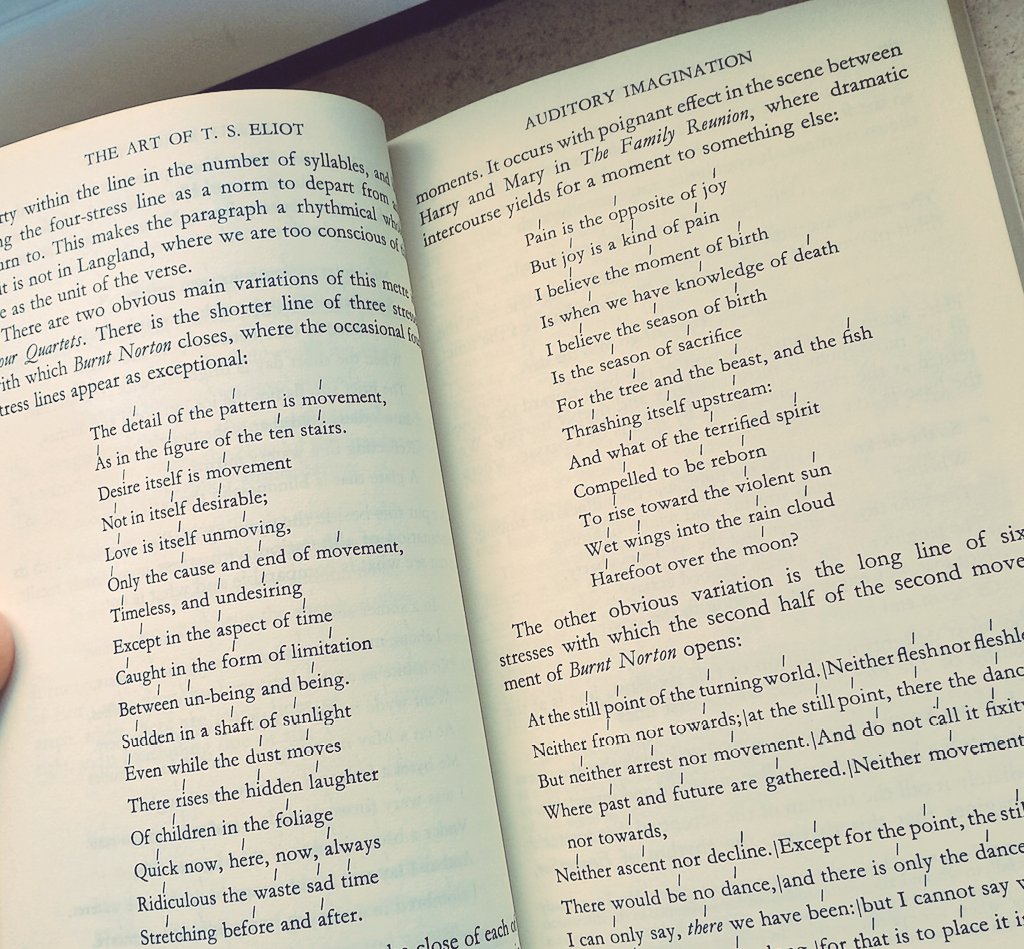
1
4
180

May 5
"When the evening is spread out against the sky
Like a patient etherized upon a table;
... And the light is pale, and the moon is dancing." TS Eliot

1
9
59

Let us go then, you and I,
When the evening is spread out against the sky
Like a patient etherized upon a table;
Let us go, through certain half-deserted streets,
The muttering retreats
Of restless nights in one-night cheap hotels
And sawdust restaurants with oyster-shells:
Streets that follow like a tedious argument
Of insidious intent
To lead you to an overwhelming question
Oh, do not ask, “What is it?”
Let us go and make our visit
2
70

epey değişkenlik gösterir en sevdiğim ama kafamda yer edenlerden biri
Let us go then, you and I,
When the evening is spread out against the sky
Like a patient etherized upon a table;
Let us go, through certain half-deserted streets ...

En sevdiğiniz şiir?
4
175


Apr 19
Let us go there you and I
Like an evening spread out against the sky
Like a patient etherized upon a table
- Ts Eliot
7
105

Apr 11
Let us go then, you and I,
When the evening is spread out against the sky
Like a patient etherized upon a table;
…
For I have known them all already, known them all:
Have known the evenings, mornings, afternoons,
I have measured out my life with coffee spoons;
-T. S. Eliot

2
3
27
401

Let us go then, you and I, when the evening is spread out against the sky, like a patient, etherized upon a table.
3
55

Let us go then, you and I,
When the evening is spread out against the sky
Like a patient etherized upon a table;
……
2
150

Apr 6
Let us go then, you and I,
When the evening is spread out against the sky
Like a patient etherized upon a table
1
4
32

I feel “like a patient etherized on a table” that Eliot wrote about.
1
6
119

tashoishi.bandcamp.com/album… absolute steamroller of a record. golden age pcm (& its sense of pranksterism and plasticity), senni when he's writing etherized hands-up, accelerated versions of zun's touhou soundtracks, the dopamine din of pachinko machines. just plain joyful
1
7
313

Mar 14
Let us go then, you and I,
When the evening is spread out against the sky
Like a patient etherized upon a table;
Let us go, through certain half-deserted streets,
The muttering retreats
Of restless nights in one-night cheap hotels
And sawdust restaurants with oyster-shells:
Streets that follow like a tedious argument
Of insidious intent
To lead you to an overwhelming question . . .
Oh, do not ask, “What is it?”
Let us go and make our visit.
1
3
61

Mar 7
Tebow's Tasks
Let us go then, you and I,
When the culture spreads its fog across the sky
Like a patient etherized upon the screen.
In the room the women come and go
Talking of Charlie Kirk and @TimTebow .
Kirk storms the stage with brass and righteous fire,
A turning point of sharpened tongue and blade.
Tebow kneels in silence on the field,
Scripture in eye-black, faith that does not fade.
And still the question haunts: “Do I dare?”
I who measured life with Heisman dust and prayer
Athlete, not orator and hesitant to wear
The mantle waiting in the evening air.
I have seen my moment flicker, seen it pale.
I am no prophet, only witness, only man.
Yet now the dry bones rattle in the vale.
Tim Tebow, rise.
The cloak of leadership lies on the sand.
Assume the mantle.
Take your stand.
The rest is prayer.
1
72