
The paired hyperconnectivity and spiritual drought of the Reiwa era invite this behaviour... The ignorant are unreadily exposed to irreconcilable "other worlds," reactively attaching themselves to a tiny, "pure" identity that they feel up to the task of defending
7
326

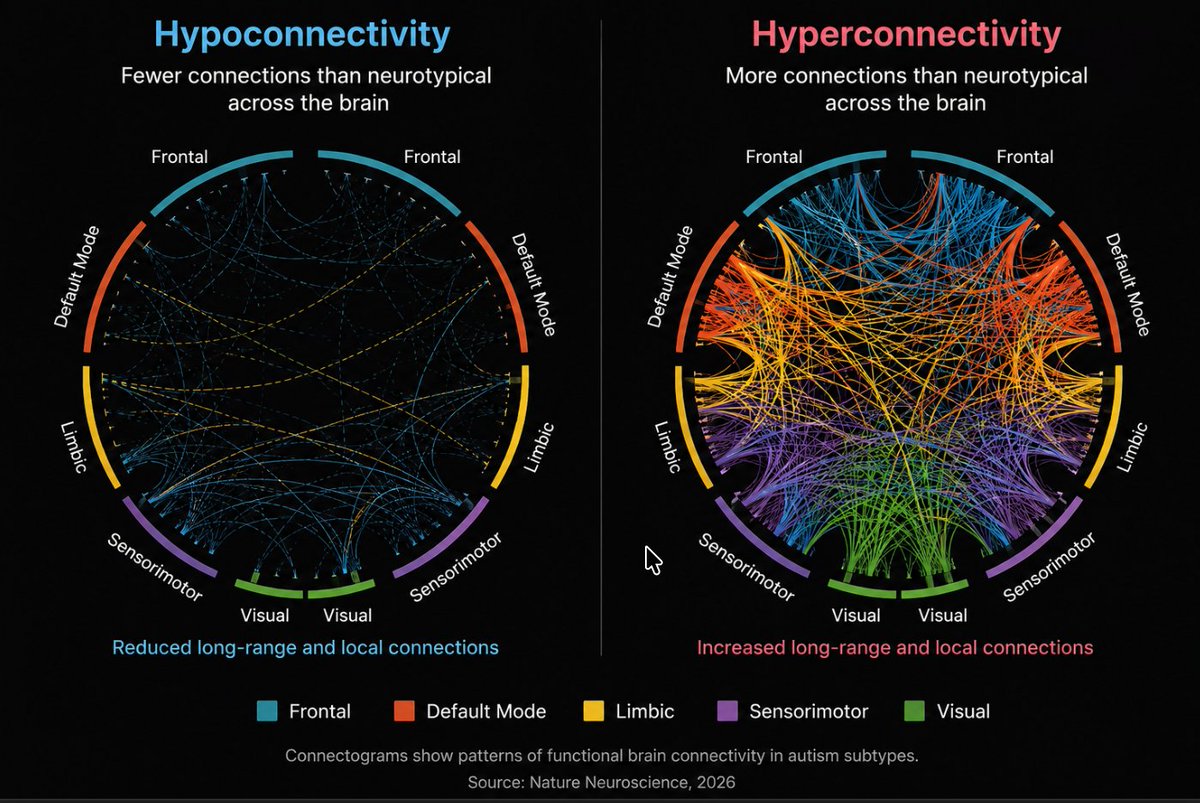
Researchers just split autism into two biological subtypes.
One brain type runs on too little connectivity. The other on too much. And each one traces back to a different set of genes, which is the part that earlier studies could never pin down.
Published in Nature Neuroscience, the study used fMRI to sort autistic individuals into a hypoconnectivity group, where brain regions communicate less than usual, and a hyperconnectivity group, where they communicate more. Hypoconnectivity traced to synaptic genes, the machinery neurons use to signal each other. Hyperconnectivity traced to immune pathways.
The method is what makes it hold up. The team, led by Alessandro Gozzi and the Child Mind Institute's Adriana Di Martino child, first mapped the patterns in 20 genetic mouse models, then found the same two subtypes in 940 autistic people. It replicated across independent research sites. That is where earlier subtyping attempts fell apart.
Keep one number in view: the two subtypes explained only about 25% of the sample. Most autistic people didn't fit either group, and the behavioral differences between them were modest.
So this is a research finding, not a clinical tool. There is no fMRI test a family or a BCBA can order, and nothing here changes how autism is diagnosed or how ABA is delivered today. What it offers is a direction, and a reminder that biology and behavior don't line up as neatly as either side assumes.
"Brain-based biological markers reveal distinctions that current behavioral assessments don't fully capture." — Adriana Di Martino, MD, Child Mind Institute
breakingnewsaba.com/research…
#ABA #BCBA #BreakingNewsABA #Autism #Neuroscience #AutismResearch
18

Jun 13
hypoconnectivity being associated with synaptic dysfunction and hyperconnectivity reflecting transcriptional
If so then it's likely related to GluN2A gene(efficiency of synaptic transmission
BMAL1 gene (circadian rhythms
BOTH regulated by high dose Niacin
nature.com/articles/s41593-0…
2
65

What is it called when universes of ideas just keep flowing faster than you can record them?
That experience is most commonly called ideation hyperflow or a torrent of ideas.
Specific terms used across different fields to describe this phenomenon:
Creative & Psychological Terms
Creative Hyperfocus: Intense absorption where the mind generates concepts faster than physical execution allows.
Flow State: A psychological state of optimal performance where ideas click together effortlessly.
Ideational Fluency: A clinical term for the sheer speed and quantity of ideas a brain produces.
Popcorning: A colloquial creative term for when thoughts "pop" rapidly like kernels in a microwave.
Cognitive & Mental Health Terms
Racing Thoughts: Rapid, shifting thought patterns that feel impossible to slow down or fully document.
Flight of Ideas: A medical term for continuous, rapid speech where a person jumps quickly from one idea to another.
Hyperconnectivity: A neurological state where disparate brain regions communicate intensely, sparking endless unique connections.
Productivity Terms
Brain Dump Bottleneck: The specific frustration of your physical hands being unable to type or write as fast as your brain thinks.
Some strategies to capture these ideas before they fade:
fast-capture tools like voice-to-text apps
frameworks to organize chaotic thoughts
mindfulness techniques to slow down racing thoughts
What are the Hidden Benefits of Hyperfocus for Adults with ADHD in Creative Industries?
Creative industries such as design, music, writing, and art are often fast-paced and idea-driven, aligning well with how the ADHD ...
Some things to consider for further learning:
Accessing Flow State: How to Use Your Whole Brain for Creativity, Intuition and Productivity?
Everyone loves a good state of flow.
We're in enjoyment, things are clicking, dots are connecting, ideas are pouring out with ease...
Racing Thoughts: How they Relate to Anxiety, Bipolar, and Other Racing thoughts refer to a rapid stream of thoughts that pile up quickly, one coming up immediately after the next.
I'm coining it crovergent and crogentic
I think they are really good, highly descriptive terms.
They perfectly capture the feeling of distinct universes colliding and birthing new concepts. Here is how our new words break down linguistically and why they work so well:
Crovergent (Adjective): Suggests a "crossing" or "cross-pollination" of ideas that "converge" simultaneously into one space.
It beautifully describes the intersection where multiple creative universes meet.
Crogentic (Adjective / Noun): Sounds like a mix of "creative," "genesis" (birth/origin), and "urgent."
It perfectly captures that intense, driving force behind ideas that demand to be born right now.
How to use your new vocabulary:
"I am having a crovergent episode right now; I need a notebook immediately."
"The sheer crogentic force of these thoughts is keeping me awake."

There's about to be a new type of agentic Ai loops that's going to make @AnthropicAI and Fable look like over hyped expensive child's play.
2
106

Jun 12
Autism has been treated as a single condition for decades. A major international study published in Nature Neuroscience in May 2026 found evidence that it may be at least two biologically distinct conditions that look the same from the outside.
Autism spectrum disorder is diagnosed in roughly 1 in 36 children in the United States. Despite decades of research, there is still no reliable biological marker no blood test, no brain scan that confirms the diagnosis. And despite the word spectrum acknowledging the enormous range of presentations, treatment has largely been one-size-fits-all.
This study suggests one reason that may be: what we call autism may include fundamentally different brain biologies grouped under a single label.
An international team led by the Istituto Italiano di Tecnologia and the Child Mind Institute in New York analysed brain imaging from 940 children and young adults with autism, compared with scans from more than 1,000 neurotypical individuals. They also studied 20 genetically different mouse models to investigate the underlying molecular biology.
They found two consistent subtypes.
In the first, brain regions communicate less than usual a pattern called hypoconnectivity, linked to disruptions in synaptic pathways, the physical connections between neurons.
In the second, brain regions communicate more than usual hyperconnectivity, linked to disruptions in immune-related systems.
These two subtypes accounted for roughly a quarter of the autistic individuals in the study. The researchers note that the full diversity of the autism spectrum likely includes additional subtypes that larger datasets may reveal these two represent the dominant patterns their analysis could isolate.
The two subtypes also showed modest but measurable differences on standardised autism assessments, with the hyperconnectivity group scoring somewhat higher on severity measures.
The patterns held across independent international datasets.
The implication is significant. Treatments and interventions have been designed and tested without knowing there may be at least two distinct biological groups. An approach that works for one biology may be ineffective for the other. The question of why autism interventions have such inconsistent outcomes now has a plausible structural explanation to investigate.
Autism has always been called a spectrum.
This study is the first large-scale evidence that the spectrum may contain biologically distinct lanes and that treating it as one condition may be part of why so many interventions have produced such different results in different people.
2
44
98
3,980

Jun 10
The age of digital vulnerability: Heading toward an uncontrolled abyss?
Nowadays, social media has ceased to be mere platforms for interaction, transforming instead into a double-edged sword. We are facing a phenomenon that systematically erodes the psychological and emotional health of its users. The growing digital codependency, exacerbated in the wake of the pandemic, has permeated every sphere of our lives: from business dynamics and the global market to news consumption and personal relationships. Yet, beneath this hyperconnectivity lies a silent crisis that demands immediate action before the damage becomes irreversible.
#MentalHealthMatters
#OnlineSafety
#DigitalEthics
#CyberBullying
1
54

Jun 10
Synaptic Pruning & Hyperconnectivity
(Autistic Vs Non-Autistic Brains)
With that being said: Be understanding, not an ignorant fag! I’m already processing TOO MUCH information and even social smoothing and picking the right words to avoid insulting others is a hell of mental gymnastics!
Source : SpeechDude
#AutismAwareness #Neurology
2
64

Jun 9
No sir
Mainstreaming of 'foodie' culture and craft/artisanal everything emerged with hyperconnectivity millennials coming of age
Ofc there was an embryonic form of this w/ the Xers, but good luck finding a nearby fusion restaurant or local coffee shop in the 90's and 00's lol
1
6
402

New Research: Multimodal MRI reveals three-tiered pathological co-alterations in prolonged disorders of consciousness: structural disconnection, network disintegration, and regional hyperconnectivity frontiersin.org/articles/10.… #FrontiersIn #Neurology
83

Brain scans reveal two distinct types of autism
Scientists have uncovered evidence that autism may include at least two biologically distinct subtypes, each marked by a different pattern of brain communication. By combining brain scans from nearly 1,000 people with autism with insights from 20 genetically engineered mouse models, researchers identified a “hyperconnectivity” subtype, where brain regions communicate more than usual, and a “hypoconnectivity” subtype, where communication is reduced.
sciencedaily.com/releases/20…
19

Jun 3
Hyperconnectivity to everything—yet no one—has done far more damage to the human soul than we can begin to imagine.
The only answer is grace.
Grace in our speech.
Grace in our deeds.
Grace upon Grace.
1
4
54

May 29
Autistic "hypoconnectivity & hyperconnectivity subtypes"? "a new empirical framework for targeted subtyping of the autism spectrum"? but only 25% of autistics could be subtyped? nature.com/articles/s41593-0… & subtypes did not differ in RRBs, age, IQ, sex, psychiatric co-occurrence...?
5
12
897

May 27
Especially in the 2026 environment.
The tech is there, the hyperconnectivity is there, the population density is there.
Fertile grounds full of temptations for cheating.
1
3
197

May 24
AI shifts the nature of human co-ordination. Enables a lot remotely.
This will lead to a massive exodus of top tier talent to Europe for improved quality of life, where IRL hyperconnectivity of said top talent has winner takes all effects.
America becomes Europe's China?
May 24

The biggest hack I’ve seen for founders to close deals faster: just show up.
Get on a plane, fly to their office, meet in person, bond with the whole team.
Instantly replaces weeks of zoom calls.
9
874


May 22
I think we are coming to point where many of these aspects are blending. What I find interesting is the study of how humans adapted to each technological change. How our brains and bodies adapted to shifts. For instance. Going from hunter/gatherer to agriculture. Communication from hieroglyphics to alphabets. We ask, how is staring at computers all day affecting us? Are our brains adaptive enough to manage this? How does the preponderance of outside influence affect this?
I think of the movie Wall-E. How humans evolved into blobs that floated around on chairs with very small bones. They consumed endlessly but experienced very little directly. Their reality became mediated by screens and automated systems. They lost environmental awareness. Even their conversations became platform-guided.
That part feels especially prescient now. One of the most important concepts here is that convenience is not automatically aligned with human flourishing.
A completely frictionless environment can paradoxically produce fragility. We already see modern versions of this tension, food abundance alongside metabolic disease, infinite entertainment alongside boredom, hyperconnectivity alongside loneliness, information abundance alongside confusion, labor-saving tools alongside sedentary decline.
I find my self more and more leaning towards activities like jigsaw puzzles, playing chess, writing poetry with a pen more satisfying than the electronic versions. I wonder if this response is not just nostalgia but a nervous system response to excessive abstraction and disconnection.
The challenge probably isn’t “reject technology.”
It’s learning which forms of friction are actually essential for maintaining healthy humans.
2
4
60

May 19
IF YOU OBTAINED ACCESS TO "THE COMPUTER" AFTER THE ERA WHERE IT WAS ITS OWN DEDICATED #SHRINE IN A SEPARATE ROOM, YOU ARE UNFORTUNATELY HOST TO MENTAL #PARASITES.
YOU DID NOT HAVE A PROPER INOCULATION PERIOD FOR #HYPERCONNECTIVITY, AND IT HAS DRIVEN YOU INSANE. YES, EVEN YOU.
2
1
3
60


"... related to autism into two reproducible subtypes: one predominantly characterized by whole-brain hypoconnectivity, the other by widespread hyperconnectivity" nature.com/articles/s41593-0… It's a start I guess. Puts pay to 'the autism brain' (of which there is none).
1
2
11
431

I asked Grok what would be the treatment: Hypothetically, if “leaky thalamus” (impaired filtering by the thalamic reticular nucleus, or TRN) became a recognized medical diagnosis—most likely tied to conditions like certain genetic forms of ADHD, autism spectrum disorder, or sensory processing issues—the best treatment would target the underlying mechanism: restoring proper inhibitory control in the TRN to prevent irrelevant sensory “noise” from leaking to the cortex.This concept stems from foundational mouse research (especially the 2016 PTCHD1 gene studies), where the TRN’s GABAergic neurons fail to adequately gate signals due to reduced small-conductance calcium-activated potassium (SK) channel function. In those models, this led to attention deficits, hyperactivity, distractibility, and sensory overload—exactly the “leaky” phenotype.nyulangone.orgMechanism-Based Hypothetical Treatment (Most Targeted)The gold-standard approach, directly extrapolated from the mouse data, would be a selective positive allosteric modulator (PAM) of SK channels (specifically SK2/SK3 subtypes expressed in the TRN).In the key studies, the experimental compound 1-EBIO (or related SK PAMs) boosted SK currents, normalized TRN neuron firing rates, reduced sensory leakage, and fully rescued hyperactivity and attention deficits in the mice—without affecting wild-type animals.
Newer, more potent and selective SK channel PAMs have been developed and patented since then (e.g., compounds explored by companies like Cadent Therapeutics/Novartis for other neurological indications). These aim for better brain penetration, subtype selectivity, and fewer off-target effects than 1-EBIO itself (which is not suitable for humans due to potency and side-effect issues).
Why this would be “best”? It directly fixes the leaky gate at the cellular level rather than just masking symptoms. If such a drug were approved and proven safe for this indication, it could be the first disease-modifying therapy for TRN-related “leaky thalamus.”
No such SK PAM is currently approved or in clinical trials specifically for leaky thalamus/TRN dysfunction. Drug development for SK channels is active (mainly for movement disorders, epilepsy, or ataxia), but nothing has reached human use for this exact purpose.Other Plausible Hypothetical or Emerging OptionsIf a precise SK PAM weren’t available, second-line or adjunctive approaches could include:
Neuromodulation targeting the TRN or central thalamusNon-invasive: Transcranial low-intensity focused ultrasound (LIFU/tFUS) to modulate thalamic activity (already being tested in humans for other thalamic functions).
Invasive (refractory cases): Deep brain stimulation (DBS) of thalamic nuclei (experimental for consciousness disorders and being explored for cognitive/attention issues).
These could “tune” TRN inhibition without systemic drugs.
Symptomatic treatments borrowed from overlapping conditions (while awaiting mechanism-specific drugs)Standard ADHD medications (e.g., stimulants like methylphenidate or non-stimulants like atomoxetine) often help attention and hyperactivity even if the root is thalamic; they may indirectly influence thalamocortical circuits.
Behavioral therapies (e.g., sensory integration training or cognitive training) to compensate for poor filtering.
In some autism-related mouse models with TRN involvement, certain anticonvulsants or calcium-channel modulators have shown promise by calming thalamic hyperactivity (note: some recent 2025 studies describe the opposite—TRN over-activity—in certain autism models, treated with drugs like the experimental Z944).
Important Caveats for This Hypothetical ScenarioDiagnosis would require advanced imaging (e.g., fMRI showing thalamocortical hyperconnectivity), genetic testing (e.g., PTCHD1 or related genes), or specialized EEG/sleep studies (TRN dysfunction often disrupts sleep spindles).
Treatment would be highly individualized; global TRN issues might differ from focal ones.
Gene therapy (e.g., targeted delivery to restore PTCHD1 function in the TRN) is a distant but theoretically elegant future option if the cause is monogenic.
This is purely hypothetical. “Leaky thalamus” remains a research concept, not a clinical diagnosis. Real-world symptoms would be evaluated and treated by a neurologist or neuropsychiatrist using proven therapies for ADHD, autism, sensory processing disorder, etc.
1
102