

Jun 9
Incredible Mosaic demo by @Mauricio_FPD!Beautiful interface, powerful real-time agent orchestration, MCP Servers, WASM tools native integration turning agents into real monetizable assets.Hermes is outstanding! This is the future of AI agents. #Mosaic #Hypercycle
2
2
43

@Teknium I wanted to ask you a Question for the @NousResearch team:
What happens when AI agents stop being software and become assets?
At @Hypercycle_AI, we're experimenting with agents that can be: → Aimified → Deployed → Licensed → Executed on decentralized compute → Distributed through marketplaces
Hermes is our first ( Aimified ) proof of concept.
We're exploring how open-source agents could leverage HyperCycle Node Factories as a decentralized execution layer for deployment, routing, memory, and monetization.
Interested in exchanging ideas around: • Agent standards • Decentralized inference • Licensing models • Marketplace economics • Autonomous monetization
Feels like we're getting closer to a future where AI agents operate as micro-enterprises on global decentralized infrastructure.
Mosaic Repo is out too 👽 : github.com/hypercycle-develo…
5
19
54
892

Jun 8
🛠️ What’s the easiest way to start building with Mosaic?
📊Use the IDE feature to customize - or create your own - HyperCycle Node Dashboard! It lets you monitor your nodes without having to look up each one individually on the block explorer.
💻Use the sample dashboard as-is, or ask your Mosaic agent to customize it for you with different colors, emojis, layouts, and more.
🧰Share your dashboards and let us know what you plan to build next!
Mosaic Repo: github.com/hypercycle-develo…
Join us on Discord for sample building tools and more: discord.gg/BahJ5dJH7j
#Mosaic
2
11
27
1,307

Excising space for non-insolation based global warming to be 🥲 Good▪︎Thing?
Many people are saying!
Much better this way than via Solar Hypercycle

x.com/medialens/status/20613…
In fact we are very Fortunate to be heating via CO2 versus Sun, like we did in the Eemian!
CO2 imparted water use efficiency (WUE) allows for greater growth by reducing thirst of plants under the warming !
#BlessedTuesday

2
1
45

What he's saying is not applicable at the scale of the entire economy.
The thesis is simple: invest in the U.S. market, benefit from superior returns, and potentially earn even more because of the long-term weakening of the rupee.
What he's talking about applies to a tiny, tiny percentage of people who have surplus income that they can legally deploy overseas through LRS and improve their lives through capital appreciation.
Take one of my friends as an example.
We started investing through Vested in 2023. Over the years, he invested about $45,000 through himself and his family members (father and mother). Today, his portfolio is worth roughly $126,000.
That's a return of over 280% in INR terms.
Total investment: ₹43.2 lakh
Current corpus: ₹1.2 crore
Now let's talk about the bigger picture.
The AI hypercycle is still going strong, driven by unprecedented capital expenditure.
Google alone is projected to spend $180-190 billion in capex in 2026.
Combined capex from the top firms is projected to be around:
• $800 billion in 2026
• $1.2 trillion in 2027
• $1.1 trillion in 2028
These are projections, and many of them will likely be exceeded.
We're only halfway through 2026.
What we're witnessing is a hypercycle driven purely by AI infrastructure spending, and this likely extends well into 2030. Robotics hasn't even properly entered the conversation yet.
This capital will be deployed into chips, power generation, cooling systems, optics, robotics, energy infrastructure, wafers, networking, cables, and countless supporting industries.
The capex itself can create a powerful feedback loop that drives economic activity and market enthusiasm.
In my view, the window to benefit from this once-in-a-generation opportunity remains open until around 2032, and possibly beyond.
We're only in the third inning of a ten-inning game.
There are only two outcomes.
This is not a debate.
This is not about being rude.
This is not about winning arguments.
It's about protecting your purchasing power so you can provide for yourself and your family and live with dignity.
Outcome 1
You debate endlessly, do nothing, sit idle, or move capital into unproductive assets and markets.
Over time, inflation, currency depreciation, money supply expansion, and the inability of an economy to generate enough high-value STEM-driven output gradually erode your purchasing power.
The decline is slow.
Most people don't notice it.
But when your children graduate, your parents fall sick, you need to relocate because of water shortages, pollution, or extreme weather, you suddenly discover that you don't have enough purchasing power to make those choices.
That's how poverty often arrives: gradually, then all at once.
Outcome 2
You become an enabler for yourself, your family, and your loved ones.
You allocate capital to productive, growing markets where innovation, technology, and economic activity are concentrated.
The objective is simple:
First, protect purchasing power by beating inflation.
Then compound wealth over time.
The choice is yours.
You can either become materially wealthier by acting as an enabler, or remain where you are.
In reality, most people don't remain where they are.
They slowly lose purchasing power and don't even realize it's happening.
One more thing.
It's not just purchasing power that declines.
Products and services deteriorate as well.
Companies rarely stop making products.
Instead, they gradually reduce quality until the offering matches what consumers can afford.
In the end, travelling in a crowded, filthy local train versus flying business class is often a function of choices made years earlier.
@Akshat__world is simply showing people what it takes to make that choice.
Cheers 🤘
118
What he is saying isn't for the whole economy scale. The thesis is Invest in US market, make more money because of better returns and make even more money because of the weakening of rupees.
What he is saying is applicable to just tiny tiny tiny tiny percentage of people who have some surplus income that they can send via LRS and make their life's better. Because of the income they gonna make via capital gains!!
Take for example one of my friend. We started with him through vested in 2023. Over the years he invested $45k dollars ( via him and his family like father and mother) and now his corpus is $126k around 280% in INR. So total investment in INR 43.2 lakhs total corpus 1.2 crores
The hyper cycle in AI is going strong with insane capex investments. Google projected capex for 2026 is 180 to 190 billion dollar. Total capex from top firms is around 800 billion in 2026, 1.2 trillion in 2027 and 1.1 trillion in 2028. These are all projections and most will beat the projection.
Right now, it's first half of 2026 almost 6 months left. We are in a hypercycle just with the capex investments till 2030 and robotics haven't been in the conversation as yet.
All these capex will get deployed in making the AI infrastructure- chips, power, cooling, optics, robots, energy, wafers, wires and many others. The capex investments itself will push the whole marke to euphoria.
So timeline to make money via this once is a lifetime opportunity is till 2032 and may be beyond. But this is the 3rd innings of a 10 innings game.
There are just two outcomes here. This is not a debate, this is not even being harsh to anyone, or being rude to anyone. This is just taking care of one's own purchasing power so that they can provide for themselves and their family and have a dignified life which everyone so deserves. Here are outcomes 👇
1. You debate, don't do anything and sit idle or even move capital to unproductive markets or places and you loose your purchasing power gradually over time due to inflation, currency management, broadening of the money supply and an innate inability to create value due to no Science Technology Enginnering Mathematics prowess. You just loose your purchasing power over time. This happens slowly and gradually and not many people realise it but by the time your kids graduate, your parents get sick, you need to leave a place because there is no water or extreme heat or even pollution, you end up in a vicious cycle of not having enough purchasing power to make those moves. That's the definition of poverty.
2. You be an agency of enabler for you, your family and loved ones and you deploy your capital in a growing market with a lot of activities and world leading stuffs. The idea is to protect ones purchasing power via beating the inflation and then compund it for returns.
Choice is yours. You can either tangibly become rich by being an agency of enabler or just be where you are. Infact most people aren't where they are, they are slowly loosing purchasing power and they don't realise it.
One more thing. It's not just purchasing power it's also slow degradation of products and services due to lower purchasing power. Companies don't stop making products they just degrade it till the price point matches.
Basically travelling in a filthy smelly local train as opposed to a business class flight is always a choice.
@Akshat_World is just showing you what it takes to make that choice.
Cheers 🤘
The whole tech manufacturing and finance stack is getting upgraded for AI first and this
1
165


Agreed. I miss playing the “Tron” Hypercycle VR game within Dreams PSVR. May need to do that again soon 😜
1
23


Jun 1
I applaud Hypercycle for actually creating something but, Im not Trch Savy and Im having quite the time navigating this repo...
2
1
57

Jun 1
Hypercycle owes me and a bunch of other ex devs a few months of salary.
I'd advice not to trust them nor toufi. We have to press them to pay and give an proper answer to customers
39
May 31
🚀The wait is over - the Mosaic repo is here:
github.com/hypercycle-develo…
⚡️Configure AI agents
⚡️Build MCP servers
⚡️Create WASM tools
⚡️Let agents call tools, collaborate in chatrooms, and generate reports
⚡️Have reports delivered straight to your Mosaic inbox
💡If you can imagine the workflow, you can probably build it on Mosaic.
🛠 What will you build?
#HyperCycle #Mosaic #AIAgents #A2A
9
18
39
1,620

May 31
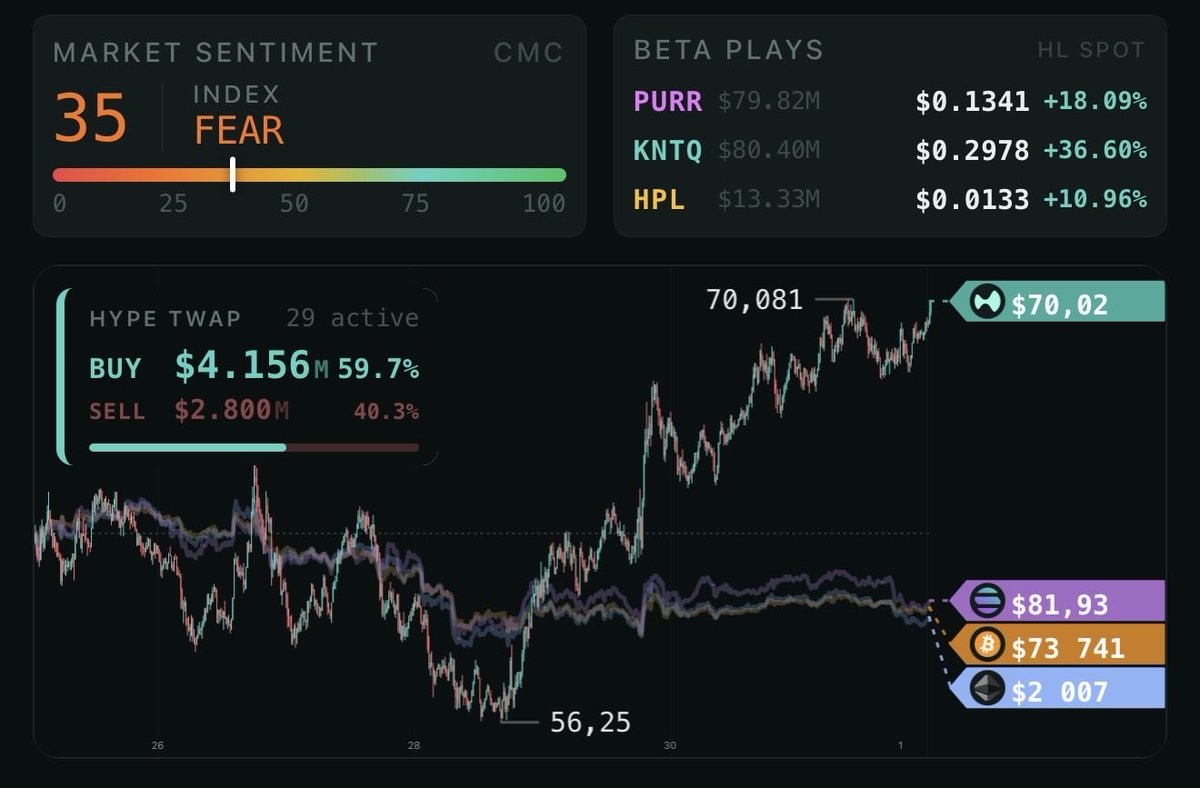
Reminder: Hypercycle dashboard has been created to enjoy watching live $HYPE ride.
$70

1
13
450

May 30
hypercycle is coming and there is nothing you can do about it
1
73