
Konchem improver ayyad... But monna short ball ke ga mingesad 🤣
1
1

Electrical Improver, Shrewsbury, £20/hour #job #jobs #hiring #ConstructionJobs . To apply, click here:applybe.com/?a=0462C9740.0
23


a lot of different things 😄
- a baby tracker
- a screenshot editor
- a job application improver
- identifiers
5


Improver の耳に優しい声と聞きやすいのに腹に響く低音のバリエーションとリズム感が好きすぎる
youtu.be/08hQm4It_Qg?si=Uvux…
356

🏰 ST JAMES'S PALACE STAKES 🏰
⏰ 16:20
One of the highlights of the entire meeting.
Unbeaten 2,000 Guineas hero Bow Echo looks to confirm his superiority over Irish Guineas winner Gstaad, while exciting improver Talk Of New York steps into Group 1 company.

1
154

The more I think about ASI, the more I suspect the standard picture is wrong.
Not slightly wrong.
Wrong at the level of the underlying image.
Most ASI discourse still imagines a single superintelligent agent at the center of the story.
A giant mind.
A godlike model.
A recursive self-improver.
A machine that suddenly becomes smarter than civilization.
But this may be the wrong ontology.
ASI may not be an individual at all.
ASI may be a civilization.
That sounds like a metaphor, but I don’t think it is.
Human intelligence did not become powerful merely because individual brains became larger.
It became powerful because knowledge moved outside the brain:
language,
writing,
mathematics,
markets,
universities,
laboratories,
peer review,
instruments,
firms,
standards,
databases,
law,
finance,
and accumulated technical memory.
Civilization is externalized intelligence.
So why should artificial superintelligence be imagined as a single internal mind?
The more plausible picture is this:
AI agents generate hypotheses.
Other agents try to falsify them.
Research markets allocate compute, lab time, funding, and attention.
Knowledge bases track credences, dependencies, failures, and reproducibility.
Reality-settlement mechanisms test claims through experiments, formal proofs, products, clinical results, and deployment.
Value-governance layers decide what should not be pursued, even if it looks profitable or technically possible.
That entire system — not one model — is the body of ASI.
The crucial distinction is this:
candidate nodes are not opened nodes.
AI can generate millions of candidate molecules, materials, theorems, mechanisms, policies, or designs.
But civilization only advances when some candidates are settled, verified, reproduced, implemented, and reused as components for later discovery.
This is the missing middle layer in ASI theory.
Capability does not automatically become knowledge.
Knowledge does not automatically become technology.
Technology does not automatically become progress.
Each conversion requires institutions.
This is why “ASI as a single agent” feels increasingly inadequate to me.
The real question is not:
Will one AI become smarter than everyone?
The real question is:
Can an AI-driven civilization update the research and technology tree faster, denser, and more reliably than human civilization?
Can it turn failure into future search?
Can it build better verifiers?
Can it expand the frontier of what is measurable?
Can it open new technology nodes?
Can it update AI capability through the knowledge it has settled?
Can it do this without drifting away from human value judgment?
That is the Copernican turn.
ASI is not the Sun orbiting around one supermind.
The “center” is the civilizational loop itself.
A loop that generates,
tests,
settles,
remembers,
opens,
withdraws,
rebuilds,
and updates the map of the possible.
ASI may not be a machine that conquers the world.
It may be the emergence of an artificial research civilization that rewrites the world’s technology tree while exploring it.
1
143

8/80 his last 80 drives cameron mags but has been a massive improver recently and is roi if you flat staked his last 80 drives was a pearler then on Miss Hermes.
22

If I see anything megumi related or that fucking “the 20 year old improver” image I just get a lil sad
1
1
27

AGI, ASI, Smarter than entirety of civilization...it all makes my skin crawl, in part because those making the claims never offer a definition of intelligence.
And so I offer the knee jerk reaction: "WTF are you taking about, they're dumb as hell."
And I do it without providing a definition of dumb...🤦♂️
And thinking about it, I don't have an explanation.
The best I can offer my observation of what causes it to do "dumb" things.
In nearly every instance, it does something dumb because it acts on unvalidated assumptions, and makes almost no effort to validate before acting.
That it treats its training data as true is understandable, but treating probabilistic assumptions as true is less defensible, and is the most common trigger for the dreaded dumb looping that is sure to follow.
One example that stands out is generating code to perform calculations based on a data set in a .csv file.
It crashes, and it defaults to "some of the data is being imported as a string", and it then writes line after line of code to convert everything to numeric, tells you it's fixed, then it crashes again in exactly the same manner.
If you let it go, the dumb looping ramps up, throwing shit at the wall, hoping something will stick.
Never once weighing possible vs probable, and never once adding a single line of code to determine whether or not the variables are in fact being imported as a string.
Eventually - once you learn to stop trusting its judgement - you grab the wheel and add that line of code yourself, or tell it to do so, breaking the dumb looping.
Considering the amount of deterministic code that is guiding this probabilistic black box, it seems plausible that validation could be implemented.
Until then, it's "both hands on the wheel"
If guided properly, you get a tremendous productivity improver. If not, you get overly complex slop code with one Band-Aid stacked on top of another that mostly works, but triggers the dumb looping the moment you feed it an edge case and it needs to be debugged.
Surely this shortcoming is solvable?
Edit: What makes this so frustrating is that while I have written a lot of code, I'm still quite bad at it, and probably always will be, yet I'm constantly dragging the "super intelligent" tool out of the ditch it fell into because it was walking with both eyes closed.

1
4
97

@embEsTanzania
Hola! No podré enviarles un mensaje y por eso escribiendo aquí. Necesitamos su ayuda con actividades o personas nativas para improver el español aquí en Dar es Salaam. Como saben, no hay lugares para enseñar español, puedo ayudar a enseñar Suajili para el español.
1
9


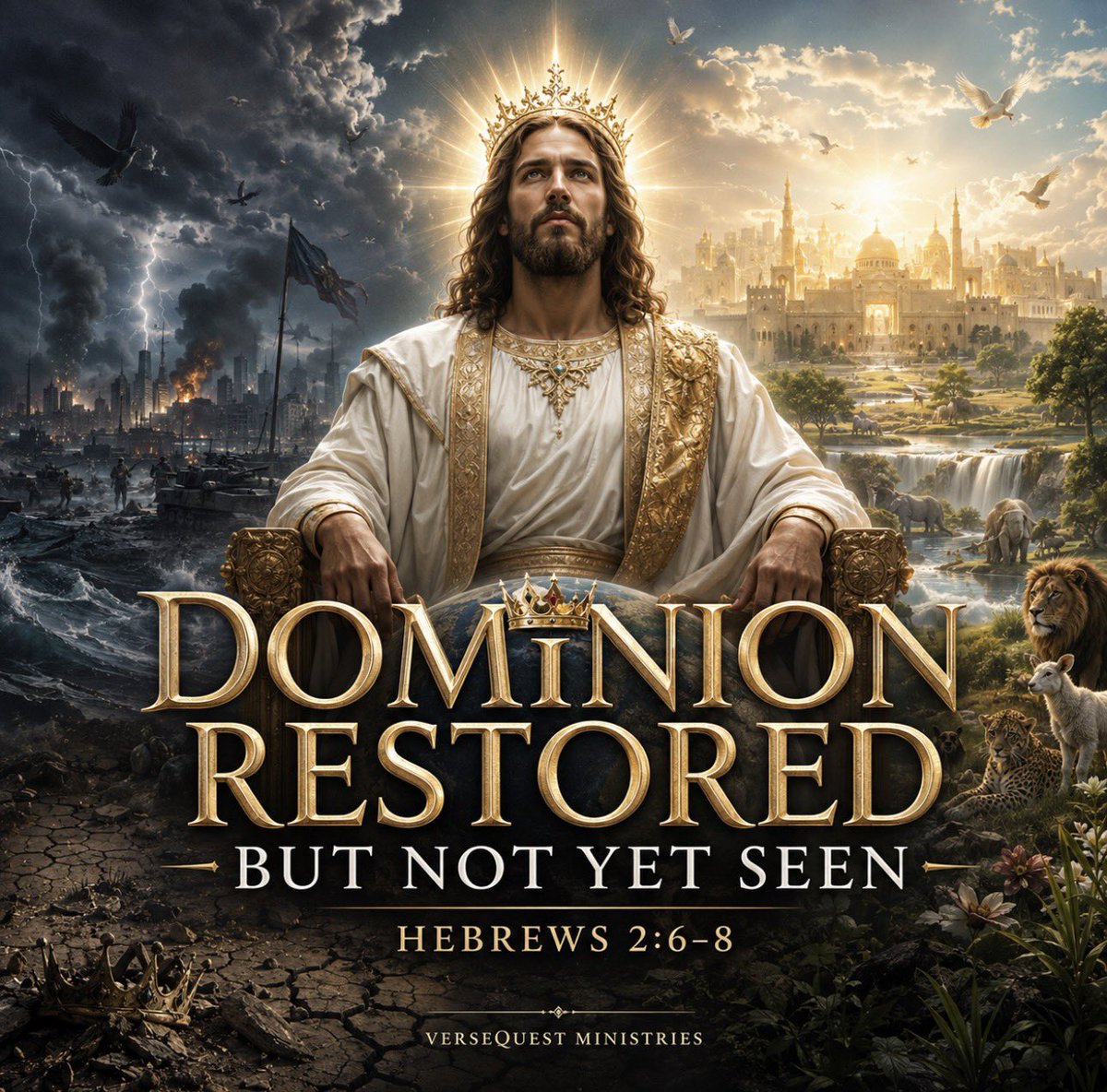
Dominion Restored — But Not Yet Seen
A prophetic look at Psalm 8 and the reign of the Son of Man during the Millennium.
Hebrews 2:6–8
Hebrews 2:6–8 says, “But one in a certain place testified, saying, What is man, that thou art mindful of him? or the son of man, that thou visitest him? Thou madest him a little lower than the angels; thou crownedst him with glory and honour, and didst set him over the works of thy hands: Thou hast put all things in subjection under his feet.” Then the Holy Ghost adds the key that unlocks the whole passage: “For in that he put all in subjection under him, he left nothing that is not put under him. But now we see not yet all things put under him.” There is the Bible believer’s answer to every kingdom-now dreamer, every postmillennial optimist, every amillennial spiritualizer, every liberal world-improver, and every religious philosopher who thinks man is gradually turning the earth into the kingdom of God. The verse does not say, “Now we see all things under him.” It says the opposite. It says the dominion is promised, the subjection is certain, the Son of Man is the rightful heir, but the visible manifestation is not yet seen.
This passage reaches back to Psalm 8, and Psalm 8 reaches all the way back to Genesis. God made Adam and gave him dominion over the fish of the sea, the fowl of the air, the cattle, all the earth, and every creeping thing that creepeth upon the earth. Man was made under God but over the earth. He was not an animal with a larger brain, not a cosmic accident with religious feelings, not a dirt clod that learned poetry. He was made in the image of God and set in delegated authority over the works of God’s hands. But Adam sinned. When Adam fell, dominion was damaged, creation was cursed, death entered, the serpent gained ground, and man became a dethroned ruler walking through a cursed kingdom. That is why the world looks like it does. The animals are not fully tame, the earth is not fully healed, the nations are not fully righteous, the devil is not yet bound, death is not yet removed, and man’s government is a cemetery with flags on it. Something was lost in Adam.
Hebrews 2 tells you that what Adam lost will be restored in Christ, but not by man’s progress, not by political reform, not by religious ecumenism, not by Rome, not by Geneva, not by Washington, not by the United Nations, not by environmental activism, not by Hebrew roots confusion, and not by a Church pretending it is Israel’s kingdom. The restoration comes through the Son of Man. Psalm 8 is not finally fulfilled in fallen mankind. It is fulfilled in Jesus Christ, the last Adam, the second man, the rightful ruler, the one who was made a little lower than the angels for the suffering of death and then crowned with glory and honour. Hebrews says all things are put under Him, but we do not yet see it in open earthly manifestation. That means the passage is prophetic. It points to the coming reign of Christ during the Millennium, when the Son of Man takes visible dominion over the earth and rules the nations with a rod of iron.
Chapter One
The question in Hebrews 2:6 is lifted from Psalm 8: “What is man, that thou art mindful of him? or the son of man, that thou visitest him?” That question is not modern humanism dressed in Bible words. It is not God looking down and saying, “Man is wonderful because man believes in himself.” It is David standing beneath the heavens and marveling that the God who made the moon and stars would even notice man. Psalm 8 begins, “O LORD our Lord, how excellent is thy name in all the earth!” The subject is not the excellence of man; it is the excellence of the LORD. Man’s place only makes sense when God is first. Remove God, and man becomes either a beast, a machine, or a little god in his own imagination. Put God where He belongs, and man becomes a created being with a real but delegated place under divine authority.
The phrase “son of man” is especially
1
8
25
995


Jun 15
Get out there and sniff some flowers today!
It's free and will always be a day improver!
45

Jun 15
Safety Score Improver IRL 🫶🏼
Jun 15

Weekend project: reverse engineered the RAM 2500 CAN bus.
Captured live CAN traffic, found the message IDs that moved in the 2024 layout, patched the DBC/fingerprint path, and got openpilot working.
Supervised L2, not full self driving, but still pretty damn cool!
50
Golf Tips Checker retweeted

Jun 15
My U.S. Picks for @TheTodaysGolfer
Specials to follow tomorrow.
One who’s just overpriced, one major improver, and a couple of grinders who can get the job done at this level!
todays-golfer.com/news-and-e…
3
24
4,830

Yeah agreed, Tony's the danger if there is one. The Palace Pier comp works on the improver angle, lightly raced, big step up in class and bolted up. He did it coming from the rear off a proper gallop though, and the pace looks weak here, so Tony might not get the same test. But yeah, he's the one
1
154

There's 80 million in medicare and va. More on medicaid. There's already base systems ppl can move into.
It won't be east but can be done. It will be a massive quality of life improver and stress reliever
7