
May 26
พธก : ถ้าจัดงานในฝันจะจัดแบบไหนน
แบม : จัดทะเลไหมม
อุ้ม : ได้ เล็กๆ
แบม : งานเล็กๆ
อุ้ม : ประมาณ 50 คนถึง 100 ไม่เกินนี้แล้วเป็นคนที่เราทั้งคู่รู้จักเป็นคนที่มีความหมายกับเราทั้งคู่ รู้สึกว่าเป็นงานแต่งงานที่อบอุ่น
แบม : เป็น longtable ที่เราเห็นหน้าทุกคนได้หมดเราสามารถพูดคุยกันได้
อุ้ม : ช่ายยย
พธก : มี blossom ไหม
อุ้ม : มีอยู่แล้ว
แบม : ใช่ค่ะ ก็จริงๆคนที่แฟนคลับใช่ไหมคะ ก็blossom สามารถดูได้ผ่าน…… ไม่บอกๆๆ
อุ้ม : เป็นความลับแล้วตอนนี้เป็นงานปิดไพเวต
#OomBam #อุ้มแบม #oomeisaya #bamsaralee
49
144
3,026

Mar 10
longtable ยาวเกิน ต้องตะโกนคุย เลยเปลี่ยนมานั่งตัก ชีกอหญ้าอยากนั่งเก้าอี้หนังแท้
 MILKLOVE THAILAND
3
3
126

Feb 16
% =========================
% arXiv-ready LaTeX (Modern Professional Style)
% COMPREHENSIVE AUDIT: 100% ORIGINAL TEXT RETAINED
% =========================
\documentclass[11pt, a4paper]{article}
% ---------- Typography & Modern Look ----------
\usepackage[T1]{fontenc}
\usepackage[utf8]{inputenc}
\usepackage{lmodern}
\usepackage{microtype}
% ---------- Page Layout ----------
\usepackage[margin=1in]{geometry}
\usepackage{fancyhdr}
\pagestyle{fancy}
\fancyhf{}
\fancyhead[L]{\footnotesize \textit{Beyond Headline Risk Estimates}}
\fancyhead[R]{\footnotesize \thepage}
% ---------- Copy/paste unicode landmines ----------
\DeclareUnicodeCharacter{00AD}{}
\DeclareUnicodeCharacter{2010}{-}
\DeclareUnicodeCharacter{2011}{-}
\DeclareUnicodeCharacter{2013}{--}
\DeclareUnicodeCharacter{2014}{---}
% ---------- Math & Tables ----------
\usepackage{amsmath,amssymb}
\usepackage{booktabs, longtable, array, ragged2e, makecell}
% ---------- Links ----------
\usepackage{hyperref}
\hypersetup{
colorlinks=true,
linkcolor[rgb]{0,0.4,0.7},
urlcolor[rgb]{0,0.4,0.7},
citecolor[rgb]{0,0.4,0.7}
}
% ---------- Lists ----------
\usepackage{enumitem}
% ---------- THE BLUE BOXES & FORMATTING ----------
\usepackage[most]{tcolorbox}
% State-of-the-Art "Paragraph Highlight" Box
\newtcolorbox{importantbox}{
enhanced,
boxrule=0.8pt,
colback=blue!5!white, % Very light blue
colframe=cyan!60!black, % Professional deep cyan/blue
arc=2mm,
left=4mm, right=4mm, top=3mm, bottom=3mm,
before skip=1.5em,
after skip=1.5em,
shadow={2pt}{-2pt}{0pt}{black!10} % Subtle depth
}
% NEW: Dedicated Abstract Box (Matches theme, better spacing)
\newtcolorbox{abstractbox}{
enhanced,
title=\textbf{\large Abstract},
coltitle=cyan!60!black,
attach boxed title to top center={yshift=-10pt},
boxed title style={colback=white, colframe=white, boxrule=0pt},
boxrule=0.8pt,
colback=blue!2!white, % Extremely light blue for readability
colframe=cyan!60!black, % Professional deep cyan/blue
arc=2mm,
left=5mm, right=5mm, top=6mm, bottom=4mm, % Extra top padding for title
before skip=2em,
after skip=2em,
shadow={2pt}{-2pt}{0pt}{black!10}
}
\newtcolorbox{eqbox}{
enhanced,
boxrule=0.6pt,
colback=gray!6,
colframe=black!20,
arc=2mm,
left=1.2mm, right=1.2mm, top=1.0mm, bottom=1.0mm
}
\newtcolorbox{notebox}{
enhanced,
boxrule=0.6pt,
colback=gray!4,
colframe=black!15,
arc=2mm,
left=1.5mm, right=1.5mm, top=1.2mm, bottom=1.2mm
}
% ---------- Typography/spacing ----------
\setlength{\parindent}{0pt}
\setlength{\parskip}{0.35em}
\renewcommand{\arraystretch}{1.18}
\setlength{\tabcolsep}{6pt}
\setlist[itemize]{leftmargin=1.25em, itemsep=0.25em, topsep=0.25em}
\setlist[enumerate]{leftmargin=1.25em, itemsep=0.25em, topsep=0.25em}
% ---------- Column types ----------
\newcolumntype{L}[1]{>{\RaggedRight\arraybackslash}p{#1}}
% ---------- PMID link helper ----------
\newcommand{\pmid}[1]{\href{pubmed.ncbi.nlm.nih.gov/#1/}{PMID:\,#1}}
% ---------- Abbreviations ----------
\newcommand{\FMD}{\textit{FMD}}
\newcommand{\WASO}{\textit{WASO}}
\newcommand{\MVPA}{\textit{MVPA}}
\newcommand{\LPA}{\textit{LPA}}
\newcommand{\CUD}{\textit{CUD}}
\newcommand{\SSD}{\textit{SSD}}
\title{
\textbf{\huge Beyond Headline Risk Estimates:}\\
\large Does Cannabis Meaningfully Alter Motivation, Physiology, and Psychosis Risk?
}
\author{
\textbf{Michael Zot}\\
Independent Researcher\\
ZotBot Cognitive Security Initiative\\
Founder, ZotBot\\
\texttt{mike@zotbot.ai} \quad
ORCID: 0009-0001-9194-938X
}
\date{\today}
\begin{document}
\maketitle
% =========================
% REVISED ABSTRACT
% =========================
\begin{abstractbox}
\small % Slightly smaller font for density control
\setlength{\parskip}{0.6em} % Breathing room between sections
\textbf{Background:} Cannabis is often linked to reduced motivation, cardiovascular risk, and psychosis outcomes. Public and clinical discourse frequently conflates acute intoxication effects with longer-horizon behavioral patterns and over-extends observational associations into causal claims.
\textbf{Objective:} To integrate controlled THC exposure studies, objective sensor studies, vascular physiology findings, and registry cohorts into a time-scale model spanning: (1) effort allocation, (2) executive control, (3) objective sleep, (4) objective activity/sedentary behavior, (5) vascular endothelial function, and (6) registry-based psychosis/\SSD{} outcomes.
\textbf{Design:} Structured quantitative evidence synthesis using published summary statistics from a prespecified evidence set (not an exhaustive PRISMA systematic review).
\textbf{Results:} Controlled THC exposure studies indicate reduced willingness to expend effort for reward on effort-based decision tasks. Meta-analytic evidence indicates acute impairments in inhibition and working memory, with smaller and heterogeneous residual associations in heavier users. Objective sleep findings are context-dependent: some settings show increased total sleep time, while heavy use or abstinence/withdrawal contexts more consistently show fragmentation (e.g., higher \WASO{}). Adult accelerometer cohorts do not consistently show higher sedentary time among cannabis users; some strata show small increases in \LPA{} or \MVPA{}. Vascular evidence indicates reduced \FMD{} among chronic smokers and THC-edible users versus nonusers; however, short-term step reduction independently decreases \FMD{} and reverses with resumed activity, establishing inactivity as a quantified confound pathway that must be measured rather than assumed. Registry cohorts show strong associations between cannabis-related clinical pathways and later \SSD{} diagnoses, including high-risk subgroups; however, registry designs do not verify THC dose, potency, route, timing, or prodromal vulnerability and remain vulnerable to confounding and reverse causality.
\textbf{Conclusions:} Evidence supports a time-scale distinction: acute THC exposure reduces effort allocation and executive control; heavy-use/withdrawal contexts are linked to objective sleep fragmentation; endothelial dysfunction is associated with cannabis exposure (including edibles) with inactivity as a quantified confound pathway; and adult accelerometry does not reliably support generalized increased sedentary behavior. Registry psychosis findings identify high-risk pathways and strong associations but do not establish THC-specific causation in the general population.
\end{abstractbox}
\newcommand{\keywords}[1]{\par\vspace{1em}\noindent\textbf{Keywords:} #1\par}
\keywords{cannabis, THC, endothelial function, psychosis, effort allocation, executive control, sleep fragmentation, objective activity, vascular health, schizophrenia registry}
\begin{notebox}
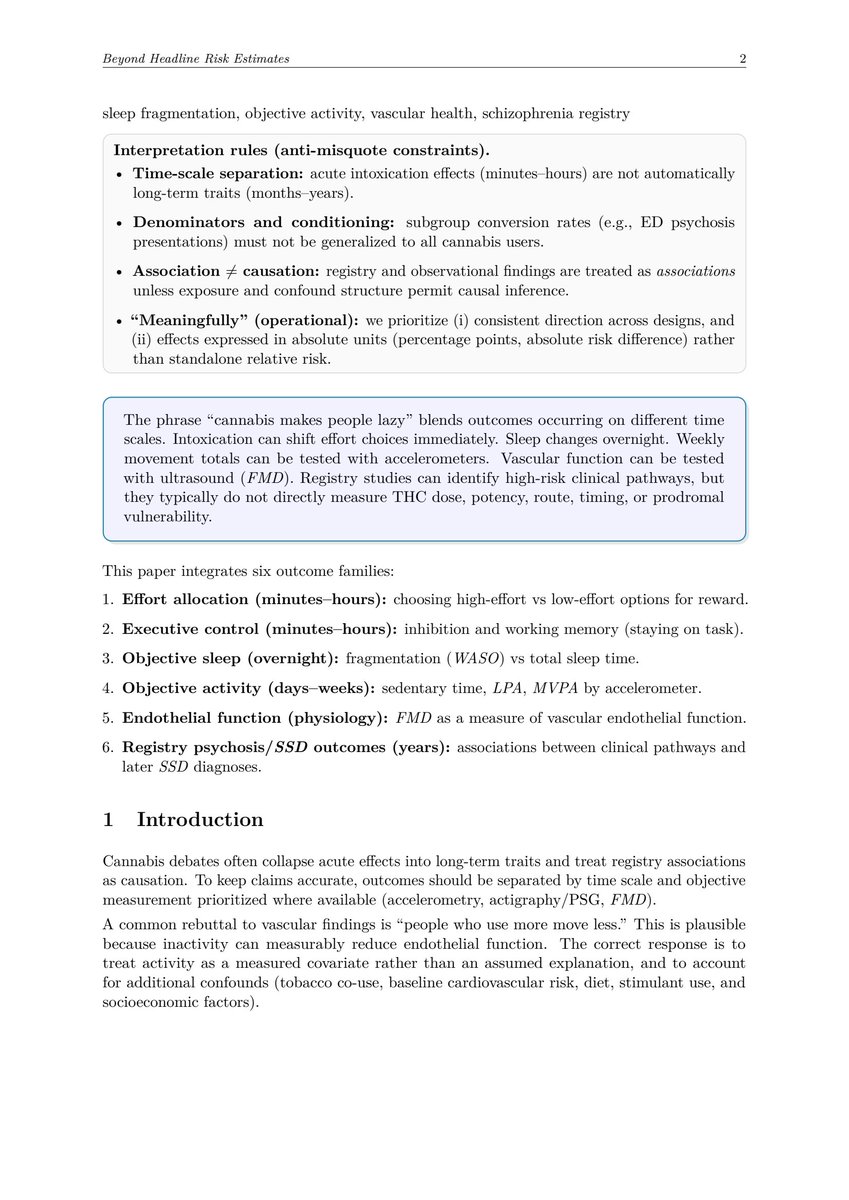
\textbf{Interpretation rules (anti-misquote constraints).}
\begin{itemize}
\item \textbf{Time-scale separation:} acute intoxication effects (minutes--hours) are not automatically long-term traits (months--years).
\item \textbf{Denominators and conditioning:} subgroup conversion rates (e.g., ED psychosis presentations) must not be generalized to all cannabis users.
\item \textbf{Association $\neq$ causation:} registry and observational findings are treated as \emph{associations} unless exposure and confound structure permit causal inference.
\item \textbf{``Meaningfully'' (operational):} we prioritize (i) consistent direction across designs, and (ii) effects expressed in absolute units (percentage points, absolute risk difference) rather than standalone relative risk.
\end{itemize}
\end{notebox}
\begin{importantbox}
The phrase ``cannabis makes people lazy'' blends outcomes occurring on different time scales. Intoxication can shift effort choices immediately. Sleep changes overnight. Weekly movement totals can be tested with accelerometers. Vascular function can be tested with ultrasound (\FMD{}). Registry studies can identify high-risk clinical pathways, but they typically do not directly measure THC dose, potency, route, timing, or prodromal vulnerability.
\end{importantbox}
This paper integrates six outcome families:
\begin{enumerate}
\item \textbf{Effort allocation (minutes--hours):} choosing high-effort vs low-effort options for reward.
\item \textbf{Executive control (minutes--hours):} inhibition and working memory (staying on task).
\item \textbf{Objective sleep (overnight):} fragmentation (\WASO{}) vs total sleep time.
\item \textbf{Objective activity (days--weeks):} sedentary time, \LPA{}, \MVPA{} by accelerometer.
\item \textbf{Endothelial function (physiology):} \FMD{} as a measure of vascular endothelial function.
\item \textbf{Registry psychosis/\SSD{} outcomes (years):} associations between clinical pathways and later \SSD{} diagnoses.
\end{enumerate}
\section{Introduction}
Cannabis debates often collapse acute effects into long-term traits and treat registry associations as causation. To keep claims accurate, outcomes should be separated by time scale and objective measurement prioritized where available (accelerometry, actigraphy/PSG, \FMD{}).
A common rebuttal to vascular findings is ``people who use more move less.'' This is plausible because inactivity can measurably reduce endothelial function. The correct response is to treat activity as a measured covariate rather than an assumed explanation, and to account for additional confounds (tobacco co-use, baseline cardiovascular risk, diet, stimulant use, and socioeconomic factors).
\section{Methods}
\subsection{Design and scope}
\begin{notebox}
\textbf{Scope note (interpretation constraint).}
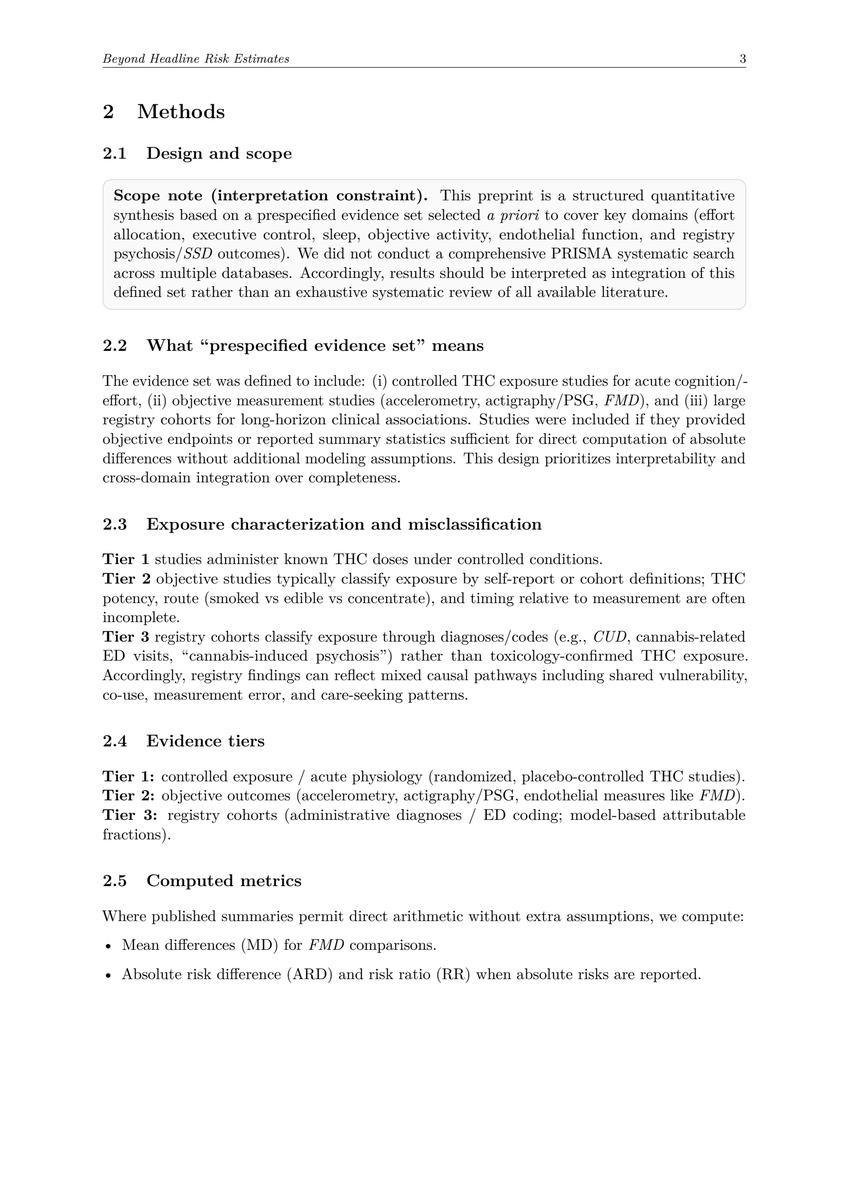
This preprint is a structured quantitative synthesis based on a prespecified evidence set selected \emph{a priori} to cover key domains (effort allocation, executive control, sleep, objective activity, endothelial function, and registry psychosis/\SSD{} outcomes). We did not conduct a comprehensive PRISMA systematic search across multiple databases. Accordingly, results should be interpreted as integration of this defined set rather than an exhaustive systematic review of all available literature.
\end{notebox}
\subsection{What ``prespecified evidence set'' means}
The evidence set was defined to include: (i) controlled THC exposure studies for acute cognition/effort, (ii) objective measurement studies (accelerometry, actigraphy/PSG, \FMD{}), and (iii) large registry cohorts for long-horizon clinical associations. Studies were included if they provided objective endpoints or reported summary statistics sufficient for direct computation of absolute differences without additional modeling assumptions. This design prioritizes interpretability and cross-domain integration over completeness.
\subsection{Exposure characterization and misclassification}
\textbf{Tier 1} studies administer known THC doses under controlled conditions.\\
\textbf{Tier 2} objective studies typically classify exposure by self-report or cohort definitions; THC potency, route (smoked vs edible vs concentrate), and timing relative to measurement are often incomplete.\\
\textbf{Tier 3} registry cohorts classify exposure through diagnoses/codes (e.g., \CUD{}, cannabis-related ED visits, ``cannabis-induced psychosis'') rather than toxicology-confirmed THC exposure. Accordingly, registry findings can reflect mixed causal pathways including shared vulnerability, co-use, measurement error, and care-seeking patterns.
\subsection{Evidence tiers}
\textbf{Tier 1:} controlled exposure / acute physiology (randomized, placebo-controlled THC studies).\\
\textbf{Tier 2:} objective outcomes (accelerometry, actigraphy/PSG, endothelial measures like \FMD{}).\\
\textbf{Tier 3:} registry cohorts (administrative diagnoses / ED coding; model-based attributable fractions).
\subsection{Computed metrics}
Where published summaries permit direct arithmetic without extra assumptions, we compute:
\begin{itemize}
\item Mean differences (MD) for \FMD{} comparisons.
\item Absolute risk difference (ARD) and risk ratio (RR) when absolute risks are reported.
\end{itemize}
\section{Results}
\subsection{Effort allocation (acute effort discounting)}
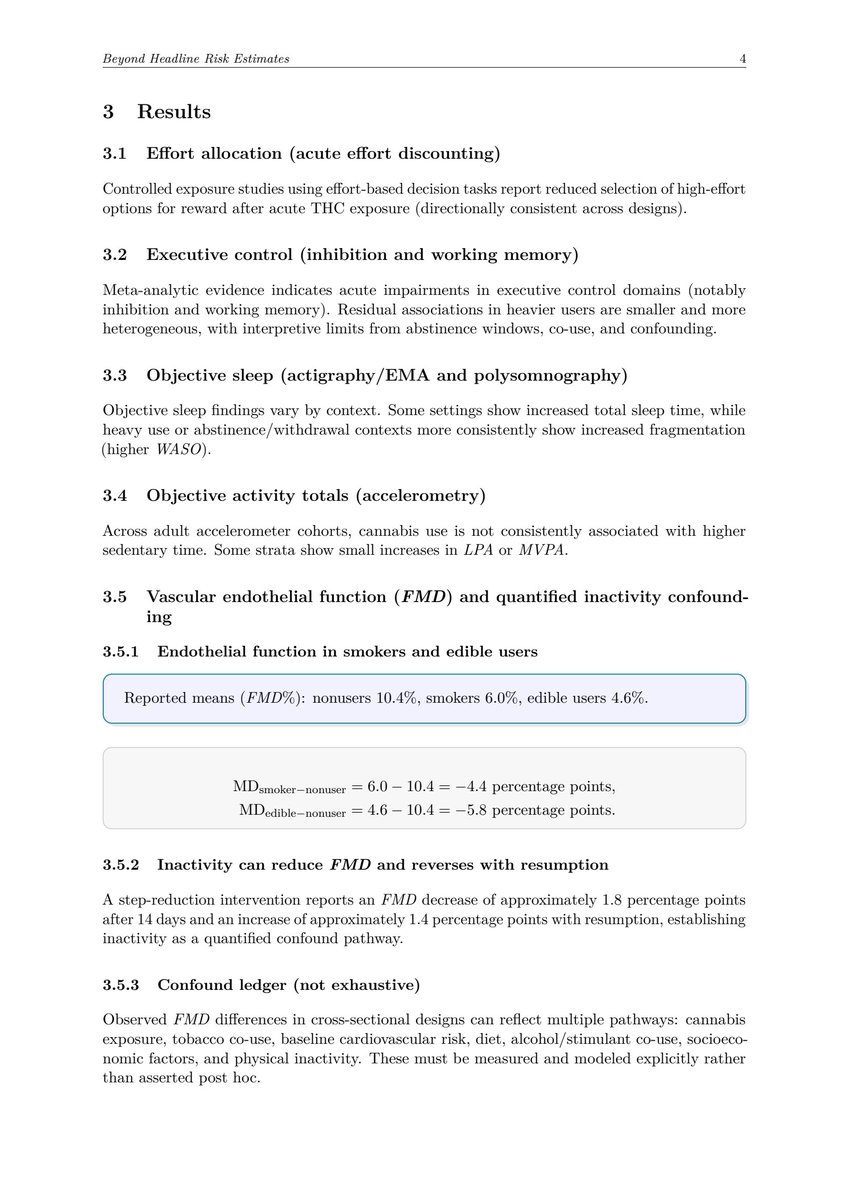
Controlled exposure studies using effort-based decision tasks report reduced selection of high-effort options for reward after acute THC exposure (directionally consistent across designs).
\subsection{Executive control (inhibition and working memory)}
Meta-analytic evidence indicates acute impairments in executive control domains (notably inhibition and working memory). Residual associations in heavier users are smaller and more heterogeneous, with interpretive limits from abstinence windows, co-use, and confounding.
\subsection{Objective sleep (actigraphy/EMA and polysomnography)}
Objective sleep findings vary by context. Some settings show increased total sleep time, while heavy use or abstinence/withdrawal contexts more consistently show increased fragmentation (higher \WASO{}).
\subsection{Objective activity totals (accelerometry)}
Across adult accelerometer cohorts, cannabis use is not consistently associated with higher sedentary time. Some strata show small increases in \LPA{} or \MVPA{}.
\subsection{Vascular endothelial function (\FMD{}) and quantified inactivity confounding}
\subsubsection{Endothelial function in smokers and edible users}
\begin{importantbox}
Reported means (\FMD{}\%): nonusers 10.4\%, smokers 6.0\%, edible users 4.6\%.
\end{importantbox}
\begin{eqbox}
\begin{align*}
\mathrm{MD}_{\text{smoker}-\text{nonuser}} &= 6.0 - 10.4 = -4.4 \ \text{percentage points},\\
\mathrm{MD}_{\text{edible}-\text{nonuser}} &= 4.6 - 10.4 = -5.8 \ \text{percentage points}.
\end{align*}
\end{eqbox}
\subsubsection{Inactivity can reduce \FMD{} and reverses with resumption}
A step-reduction intervention reports an \FMD{} decrease of approximately 1.8 percentage points after 14 days and an increase of approximately 1.4 percentage points with resumption, establishing inactivity as a quantified confound pathway.
\subsubsection{Confound ledger (not exhaustive)}
Observed \FMD{} differences in cross-sectional designs can reflect multiple pathways: cannabis exposure, tobacco co-use, baseline cardiovascular risk, diet, alcohol/stimulant co-use, socioeconomic factors, and physical inactivity. These must be measured and modeled explicitly rather than asserted post hoc.
\subsection{Registry-based psychosis and schizophrenia-spectrum (\SSD{}) outcomes}
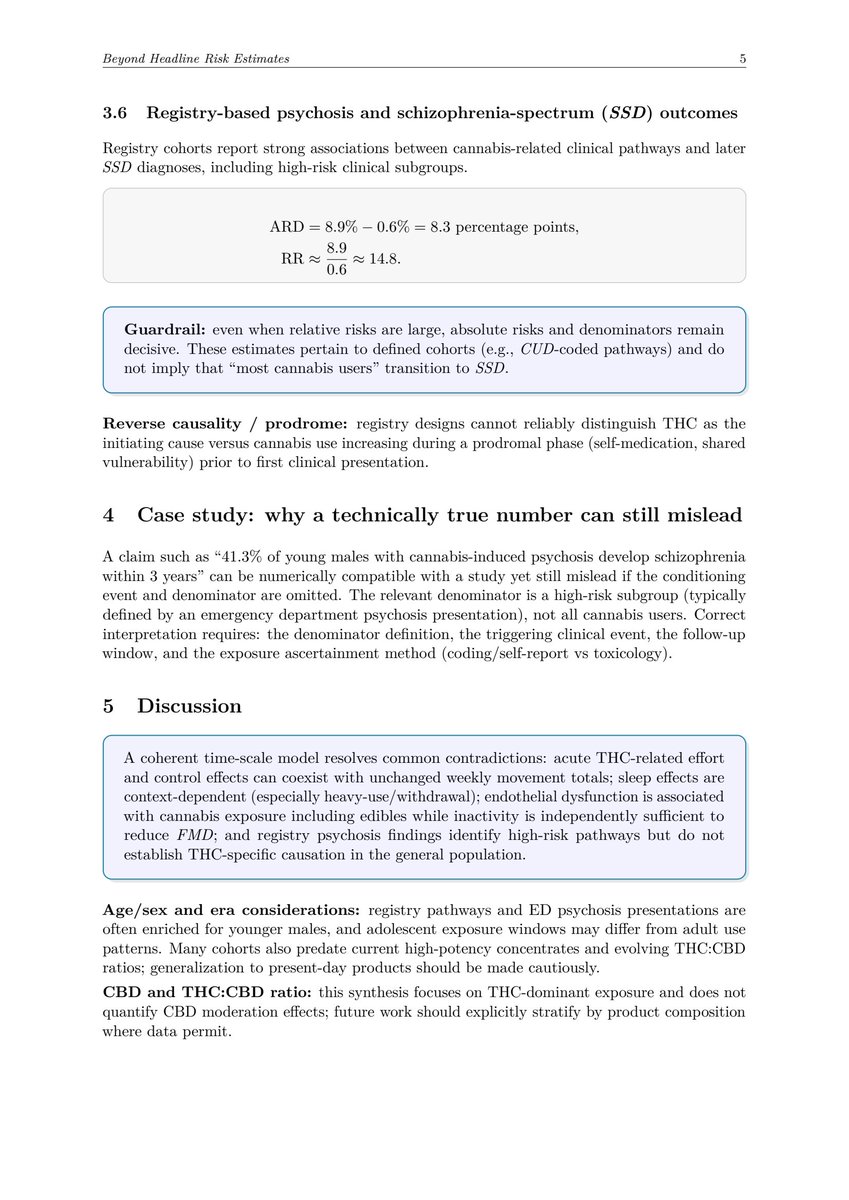
Registry cohorts report strong associations between cannabis-related clinical pathways and later \SSD{} diagnoses, including high-risk clinical subgroups.
\begin{eqbox}
\begin{align*}
\mathrm{ARD} &= 8.9\% - 0.6\% = 8.3 \ \text{percentage points},\\
\mathrm{RR} &\approx \frac{8.9}{0.6} \approx 14.8.
\end{align*}
\end{eqbox}
\begin{importantbox}
\textbf{Guardrail:} even when relative risks are large, absolute risks and denominators remain decisive. These estimates pertain to defined cohorts (e.g., \CUD{}-coded pathways) and do not imply that ``most cannabis users'' transition to \SSD{}.
\end{importantbox}
\textbf{Reverse causality / prodrome:} registry designs cannot reliably distinguish THC as the initiating cause versus cannabis use increasing during a prodromal phase (self-medication, shared vulnerability) prior to first clinical presentation.
\section{Case study: why a technically true number can still mislead}
A claim such as ``41.3\% of young males with cannabis-induced psychosis develop schizophrenia within 3 years'' can be numerically compatible with a study yet still mislead if the conditioning event and denominator are omitted. The relevant denominator is a high-risk subgroup (typically defined by an emergency department psychosis presentation), not all cannabis users. Correct interpretation requires: the denominator definition, the triggering clinical event, the follow-up window, and the exposure ascertainment method (coding/self-report vs toxicology).
\section{Discussion}
\begin{importantbox}
A coherent time-scale model resolves common contradictions: acute THC-related effort and control effects can coexist with unchanged weekly movement totals; sleep effects are context-dependent (especially heavy-use/withdrawal); endothelial dysfunction is associated with cannabis exposure including edibles while inactivity is independently sufficient to reduce \FMD{}; and registry psychosis findings identify high-risk pathways but do not establish THC-specific causation in the general population.
\end{importantbox}
\textbf{Age/sex and era considerations:} registry pathways and ED psychosis presentations are often enriched for younger males, and adolescent exposure windows may differ from adult use patterns. Many cohorts also predate current high-potency concentrates and evolving THC:CBD ratios; generalization to present-day products should be made cautiously.
\textbf{CBD and THC:CBD ratio:} this synthesis focuses on THC-dominant exposure and does not quantify CBD moderation effects; future work should explicitly stratify by product composition where data permit.
\section{Limitations}
This is a structured synthesis of a prespecified set rather than an exhaustive PRISMA systematic review. Several domains include heterogeneous designs and populations. Cross-sectional vascular evidence cannot establish causality and remains vulnerable to unmeasured confounding (including tobacco co-use and baseline risk). Registry cohorts do not verify THC dose, potency, route, timing, or prodromal vulnerability and remain vulnerable to residual confounding and reverse causality. Cohorts spanning different eras may not generalize to modern high-potency products.
\section{Conclusion}
Across evidence classes, the most defensible interpretation is time-scale dependent: acute THC exposure reduces effort allocation and executive control; heavy-use/withdrawal contexts are linked to objective sleep fragmentation; endothelial dysfunction is associated with cannabis exposure including edibles with inactivity as a quantified confound pathway; and adult accelerometry does not reliably support generalized increased sedentary behavior. Registry psychosis findings identify high-risk pathways and strong associations but do not establish THC-specific causation in the general population.
% =========================
% TABLE 1 (longtable: no floats, no blank-page nonsense, clean wrapping)
% =========================
\clearpage
\small
\setlength{\LTpre}{0.4em}
\setlength{\LTpost}{0.4em}
\begin{longtable}{@{} L{2.6cm} L{3.0cm} L{3.1cm} L{3.0cm} L{4.1cm} @{}}
\caption{Included evidence (prespecified) and computed metrics (where feasible).}\label{tab:included}\\
\toprule
\textbf{Domain} & \textbf{Studies} & \textbf{Design} & \textbf{Endpoint(s)} & \textbf{Computed metrics / notes} \\
\midrule
\endfirsthead
\toprule
\textbf{Domain} & \textbf{Studies} & \textbf{Design} & \textbf{Endpoint(s)} & \textbf{Computed metrics / notes} \\
\midrule
\endhead
\midrule
\multicolumn{5}{r}{\emph{Continued on next page}}\\
\midrule
\endfoot
\bottomrule
\endlastfoot
Effort allocation &
\makecell[l]{\pmid{27578767}\\\pmid{35135844}\\\pmid{27624149}} &
Controlled exposure; mechanistic support &
EEfRT hard choice; effort preference &
Acute THC reduces high-effort choice probability; dose--response reported in primary studies. \\
Executive control &
\makecell[l]{\pmid{27125202}\\\pmid{29747625}\\\pmid{30762491}} &
Meta-analyses; observational &
Inhibition; working memory; executive domains &
Acute impairments larger; residual/heavy-use associations smaller and heterogeneous. \\
Sleep &
\makecell[l]{\pmid{32769909}\\\pmid{25960236}\\\pmid{20819146}} &
Actigraphy/EMA; actigraphy; PSG &
TST; WASO; fragmentation &
Heterogeneous: TST may increase in some settings; heavy-use/withdrawal contexts more consistently show higher WASO. \\
Objective activity &
\makecell[l]{\pmid{33926458}\\\pmid{38739456}} &
Accelerometry cohorts &
Sedentary; LPA; MVPA &
No consistent sedentary increase in adults; some strata show small increases in LPA or MVPA. \\
Endothelial function &
\makecell[l]{\pmid{40434782}} &
Cross-sectional physiology &
Brachial FMD (\%) &
Mean differences: smoker--nonuser $=-4.4$ pp; edible--nonuser $=-5.8$ pp. \\
Inactivity confound &
\makecell[l]{\pmid{33897466}} &
Step reduction resumption &
FMD change (\%) &
$\Delta$FMD: $-1.8$ pp after 14 days; $ 1.4$ pp after resumption. \\
Registry psychosis / SSD &
\makecell[l]{\pmid{37755727}\\\pmid{39903464}\\\pmid{16319402}} &
Registry cohorts &
SSD transition; incidence; HR; absolute risk &
Ontario population cohort: ARD (CUD vs non-CUD) $= 8.3$ pp; RR $\approx 14.8$. High-risk subgroup conversion rates reported in primary studies. \\
\end{longtable}
\normalsize
% =========================
% SUPPLEMENT (reproducibility)
% =========================
\appendix
\section{Supplement: exact arithmetic (reproducibility)}
\subsection{FMD mean differences (\pmid{40434782})}
\begin{eqbox}
\begin{align*}
\text{Nonusers} &= 10.4\%,\quad \text{Smokers}=6.0\%,\quad \text{Edible users}=4.6\%,\\
\mathrm{MD}_{\text{smoker}-\text{nonuser}} &= 6.0 - 10.4 = -4.4\ \text{pp},\\
\mathrm{MD}_{\text{edible}-\text{nonuser}} &= 4.6 - 10.4 = -5.8\ \text{pp}.
\end{align*}
\end{eqbox}
\subsection{Ontario population cohort absolute risk metrics (\pmid{39903464})}
\begin{eqbox}
\begin{align*}
\mathrm{ARD} &= 8.9\% - 0.6\% = 8.3\ \text{pp},\\
\mathrm{RR} &\approx \frac{8.9}{0.6} \approx 14.8.
\end{align*}
\end{eqbox}
% =========================
% REFERENCES
% =========================
\clearpage
\begin{thebibliography}{99}
\bibitem{ref27578767} Acute THC and effort allocation (EEfRT). \pmid{27578767}.
\bibitem{ref35135844} Oral THC and dose-dependent reduction in willingness to exert effort. \pmid{35135844}.
\bibitem{ref27624149} THC reduces effort allocation in rodents (mechanistic support). \pmid{27624149}.
\bibitem{ref27125202} Meta-analysis: acute and chronic cannabis effects on executive functions. \pmid{27125202}.
\bibitem{ref29747625} Meta-analysis in youth: cannabis use and cognitive/executive outcomes. \pmid{29747625}.
\bibitem{ref30762491} Residual effects and dissociations between effort allocation and inhibition. \pmid{30762491}.
\bibitem{ref32769909} Actigraphy/EMA study: cannabis and sleep outcomes. \pmid{32769909}.
\bibitem{ref25960236} Actigraphy: sleep fragmentation during cannabis abstinence/withdrawal. \pmid{25960236}.
\bibitem{ref20819146} Polysomnography: sleep disturbance during cannabis abstinence. \pmid{20819146}.
\bibitem{ref33926458} Cannabis use, sedentary behavior, and accelerometer-measured physical activity. \pmid{33926458}.
\bibitem{ref38739456} Recent cannabis use and accelerometer-measured physical activity and sedentary behavior. \pmid{38739456}.
\bibitem{ref40434782} CANDIDE: cannabis smoking and THC ingestion associated with endothelial dysfunction (FMD). \pmid{40434782}.
\bibitem{ref33897466} Step reduction: inactivity reduces FMD and reverses with resumption. \pmid{33897466}.
\bibitem{ref37755727} Ontario ED cohort: schizophrenia-spectrum outcomes after substance use visits with/without psychosis. \pmid{37755727}.
\bibitem{ref39903464} Ontario population cohort: CUD and incident schizophrenia; PARF estimates. \pmid{39903464}.
\bibitem{ref16319402} Danish follow-up: cannabis-induced psychosis and later schizophrenia-spectrum diagnoses. \pmid{16319402}.
\end{thebibliography}
\end{document}
2
5
214

Brother, we will discuss serious matters over a bottle of Holy Water at that longtable in Valhall 😉
1
13
184


21 Nov 2025
#VogueArt พาเดินย่านทรงวาดในบรรยากาศที่เปี่ยมชีวิตชีวาอีกครั้ง! โว้กชวนออกสำรวจย่านเก่าในมุมใหม่กับ “Song Wat Week 2025” เทศกาลสร้างสรรค์ที่ปลุกย่าน ‘ทรงวาด‘ ให้ครึกครื้นตลอด 4 วันเต็ม ระหว่าง 20-23 พฤศจิกายน 2568 ภายใต้ธีม “Where Heritage Meets Creativity” ที่ผสมผสานเสน่ห์ดั้งเดิมของย่านประวัติศาสตร์ริมเจ้าพระยาเข้ากับพลังครีเอทีฟของคนรุ่นใหม่ เพื่อให้ #ทรงวาด มีชีวิตชีวากว่าที่เคย ไฮไลต์สำคัญคือ ’Made in Song Wat: The Longtable’ ที่รวมร้านดังในย่านกว่า 21 ร้าน นำเสนอเมนูเฉพาะในโอกาสนี้ พร้อมนิทรรศการศิลปะและกิจกรรมกระจายทั่วตึกเก่า ตั้งแต่ ‘Yenyen Herb Store‘, ‘Shade of Artisan‘, ‘Remind 1953’, ‘The Song Wat Darkroom‘ และ ‘Tra Baihor The Secret Garden’ ชวนทุกคนมา ‘วาดเฉดสีใหม่’ และสานต่อ ’เรื่องเล่าที่มีชีวิต’ สร้างความทรงจำดีๆ ร่วมกันในช่วงเทศกาลปลายปีนี้ #SongWatWeek #SongWatWeek2025
#MadelnSongWat #songwat
4
1,591

20 Nov 2025
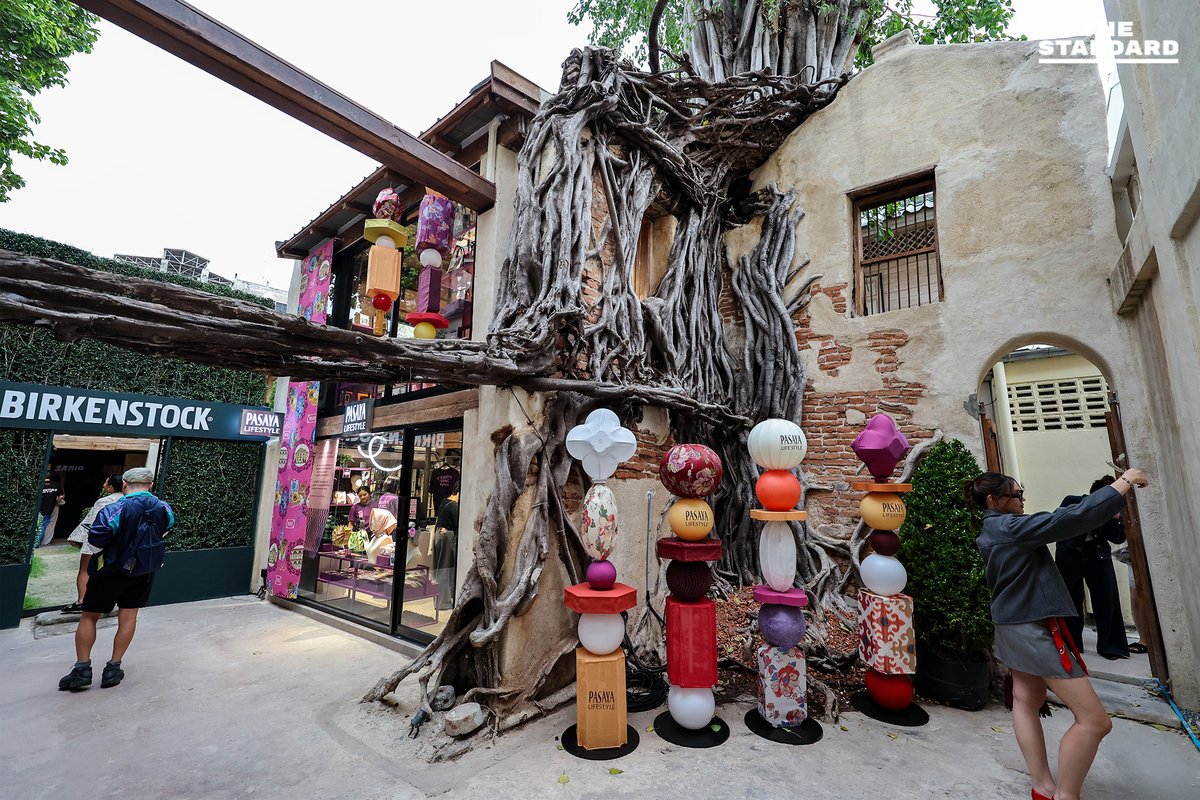
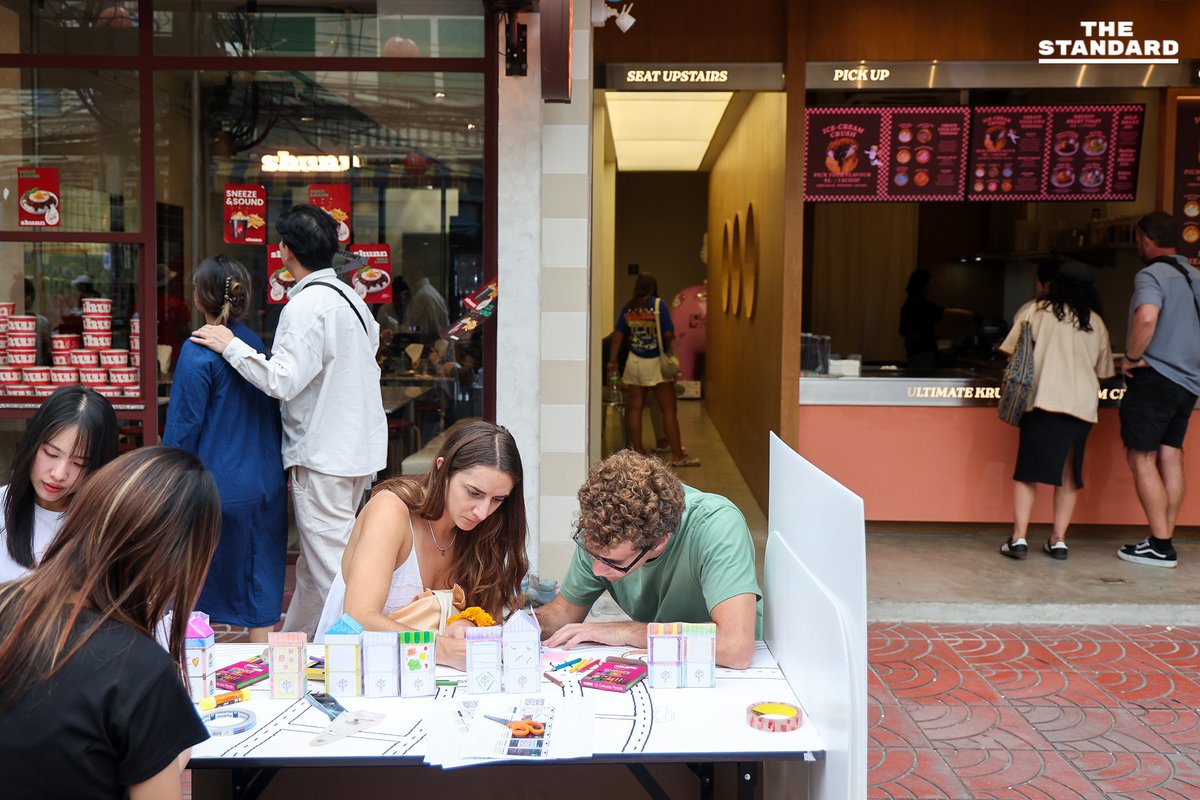
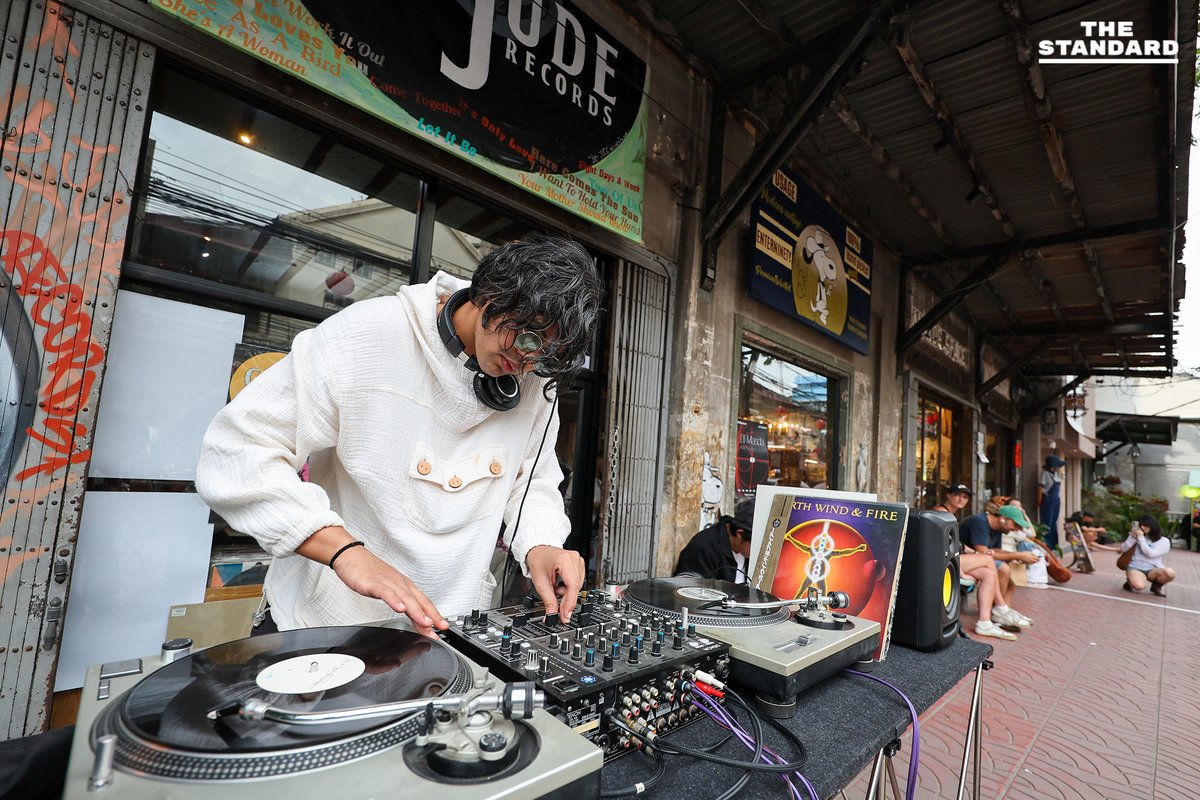
หนึ่งในกิจกรรมที่น่าจับตามองที่สุดคือ Made in Song Wat : The Longtable กิจกรรมสุดเอ็กซ์คลูซีฟที่สะท้อนจิตวิญญาณของย่านผ่านรสชาติอาหาร โดยได้รับการรังสรรค์เมนูพิเศษกว่า 24 เมนู จากการคัดสรรของเชฟระดับแนวหน้า ได้แก่ เชฟแพม-พิชญา สุนทรญาณกิจ และ เชฟปิ๊ก-สรมย์เวท ธีระพจน์ ทั้งสองเชฟได้ร่วมมือกับผู้ประกอบการร้านอาหารและคาเฟ่ชื่อดังในย่านกว่า 21 ร้าน เพื่อนำเสนอวัตถุดิบและตัวตนของชาวทรงวาด
.
ตลอด 4 วันของการจัดงาน ประตูอาคารเก่าแก่ทั่วทั้งย่านจะถูกเปิดออกเพื่อต้อนรับผู้คนเข้าสู่โลกแห่งศิลปะ พบกับนิทรรศการที่กระจายตัวอยู่ตามจุดต่างๆ อาทิ:
📍 Yenyen Herb Store
📍 Shade of Artisan
📍 Song Wat Tales
📍 Remind 1953
📍 Beat and Brew
📍 The Song Wat Darkroom
📍 Tra Baihor The Secret Garden
📍 The Moon Guide House
.
ภาพ : ฐานิส สุดโต
#SongWatWeek2025
4
7
3,489

19 Nov 2025
Song Wat Week 2025 คือเทศกาลที่อยากชวนทุกคนออกจากหน้าจอมาสำรวจย่านทรงวาดด้วยสองเท้าอีกครั้ง ผ่านกิจกรรมสร้างสรรค์ตลอด 4 วันที่ผสมผสานประวัติศาสตร์ของย่านกับพลังความคิดใหม่ ตามแนวคิด ‘WHERE HERITAGE MEETS CREATIVITY’
ตลอดหลายปีที่ผ่านมา ทรงวาดเป็นหนึ่งในย่านเก่าที่มีชีวิตที่สุดในกรุงเทพฯ เต็มไปด้วยร้านอาหาร คาเฟ่ และผู้ประกอบการที่รักษารากเดิมไว้ พร้อมเปิดพื้นที่ให้ความคิดร่วมสมัยเติบโต Song Wat Week 2025 จึงหยิบเสน่ห์นี้มาต่อยอดเป็นเทศกาลที่ชวนคนเมืองกลับมาทำความรู้จักทรงวาดในรูปแบบใหม่ ผ่านศิลปะ อาหาร และเรื่องเล่าที่กระจายอยู่ตามอาคารเก่าทั้งเส้น
กิจกรรมที่โดดเด่นที่สุดปีนี้คือ ‘Made in Song Wat : The Longtable’ โต๊ะอาหารพิเศษที่ เชฟแพม-พิชญา สุนทรญาณกิจ และ เชฟปิ๊ก-สรมย์เวท ธีระพจน์ ร่วมกับร้านในย่านกว่า 21 ร้าน ตั้งใจรังสรรค์เมนู 24 รายการจากวัตถุดิบและเรื่องราวของทรงวาดโดยเฉพาะ เป็นประสบการณ์ที่บอกเล่าจิตวิญญาณของย่านผ่านรสชาติของผู้คนและร้านค้า (Private Event, Invitation Only)
อีกหนึ่งเสน่ห์ของงานคือการที่บานประตูตึกเก่าทั้งย่านจะเปิดรับผู้คนให้เข้าไปชมงานศิลปะ ไม่ว่าจะเป็น Yenyen Herb Store, Shade of Artisan, Song Wat Tales, Remind 1953, Beat and Brew, The Song Wat Darkroom, Tra Baihor The Secret Garden, The Moon Guide House รวมถึงเซอร์ไพรส์จาก Monchhichi at Song Wat Week ที่จะทำให้การเดินย่านครั้งนี้เต็มไปด้วยเรื่องเล่าใหม่ ๆ
ตลอด 4 วัน ผู้มาเยือนจะได้สัมผัสทรงวาดในมิติที่สนุก เข้าถึงง่าย และยังคงกลิ่นอายดั้งเดิมไว้ครบถ้วน ทั้งร้านเก่า ร้านใหม่ งานคราฟต์ งานศิลปะ จนถึงความเคลื่อนไหวของผู้ประกอบการรุ่นใหม่
Song Wat Week 2025 จัดขึ้นวันที่ 20 - 23 พฤศจิกายน พ.ศ. 2568 ติดตามรายละเอียด ตารางกิจกรรม และไฮไลต์ได้ที่ Facebook, Instagram และ TikTok : @Song Wat Week
กิจกรรมนี้เหมาะกับ : คนเมืองที่รักย่านเก่า สายศิลปะ สายกิน นักออกแบบ นักสร้างสรรค์ หรือใครก็ตามที่อยากเห็นว่ามรดกเมืองจะเริ่มเรื่องใหม่อย่างมีชีวิตได้อย่างไร
#readthecloud #TheCloud #TheCloudRecommends #SongWatWeek #SongWatWeek2025 #SongWat #HeritageMeetsCreativity #SWW #SWW2025 #MadeInSongWat #ทรงวาด

1
23
17
2,197

23 Sep 2025
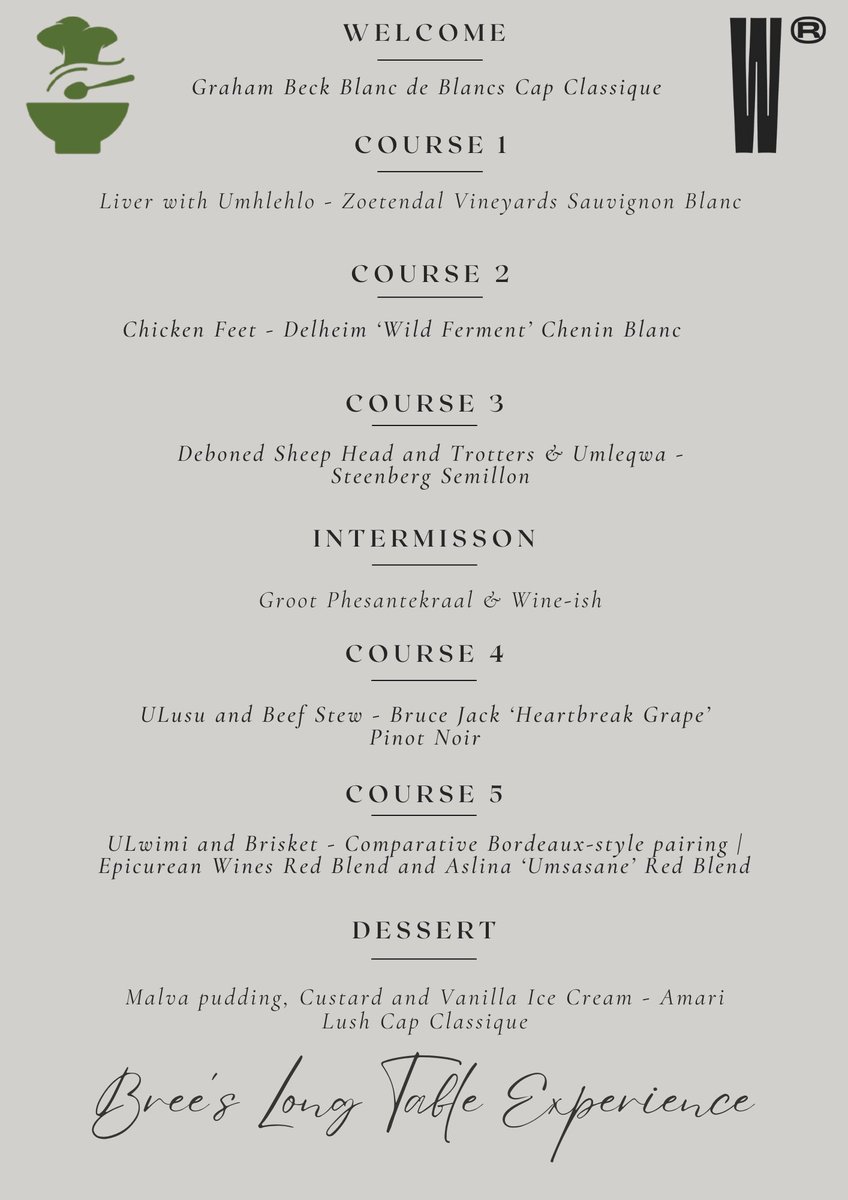
Something special is coming and we’re elated to be part of it… 🍷 We’re thrilled to join Bree’s Kitchen, Moshe Ndiki, @niapearlza for the Longtable Experience – a day filled with heritage-inspired dishes, masterful wine pairings, and shared stories. Looking forward!! 🍷🍾🥂❤️🇿🇦

4
12
1,511

17 Aug 2025
updated to do list for me and my 0 year old coworker daeron:
- take longtable
- take bitterbridge
- defeat the winter wolves
- defeat the river lords
- rescue uncle otto
- rescue gwayne
- take tumbleton
- defeat daemon
- defeat dragonseeds
1
1
4
262

10 Aug 2025
TYSM WANDORNIM, SPACENEDO, LONGTABLE PEEPS, AND OFC MY BEAUTIFUL WIFE, HAN TAESAN, FOR MAKING THIS DAY ENJOYABLE AND MEMORABLE
1
7
123

26 Jun 2025
TeX Live 2024でlongtableがexpl3キメラになってしまってこのハックが使えなくなってる… zenn.dev/k16/articles/2305ca…
3
773


B-2... *bangs hands on longtable*
B-2 *dun dun dun*
B-2 *dun dun dun*
B-2 *dun dun dun*
B-2 *DUN DUN DUN*


1
53

16 Jun 2025
Mentorship, networking and empowerment.
Now that about @TheMiningGuySA 's events is true, Today I utilized a network i made from Longtable Luncheon, turned out very positively... we definitely need more !
1
3
20
5,431

10 Jun 2025
I am always willing to help you Lord Orton of Longtable
1
2
47

1 Jun 2025
1
1
40

29 Apr 2025
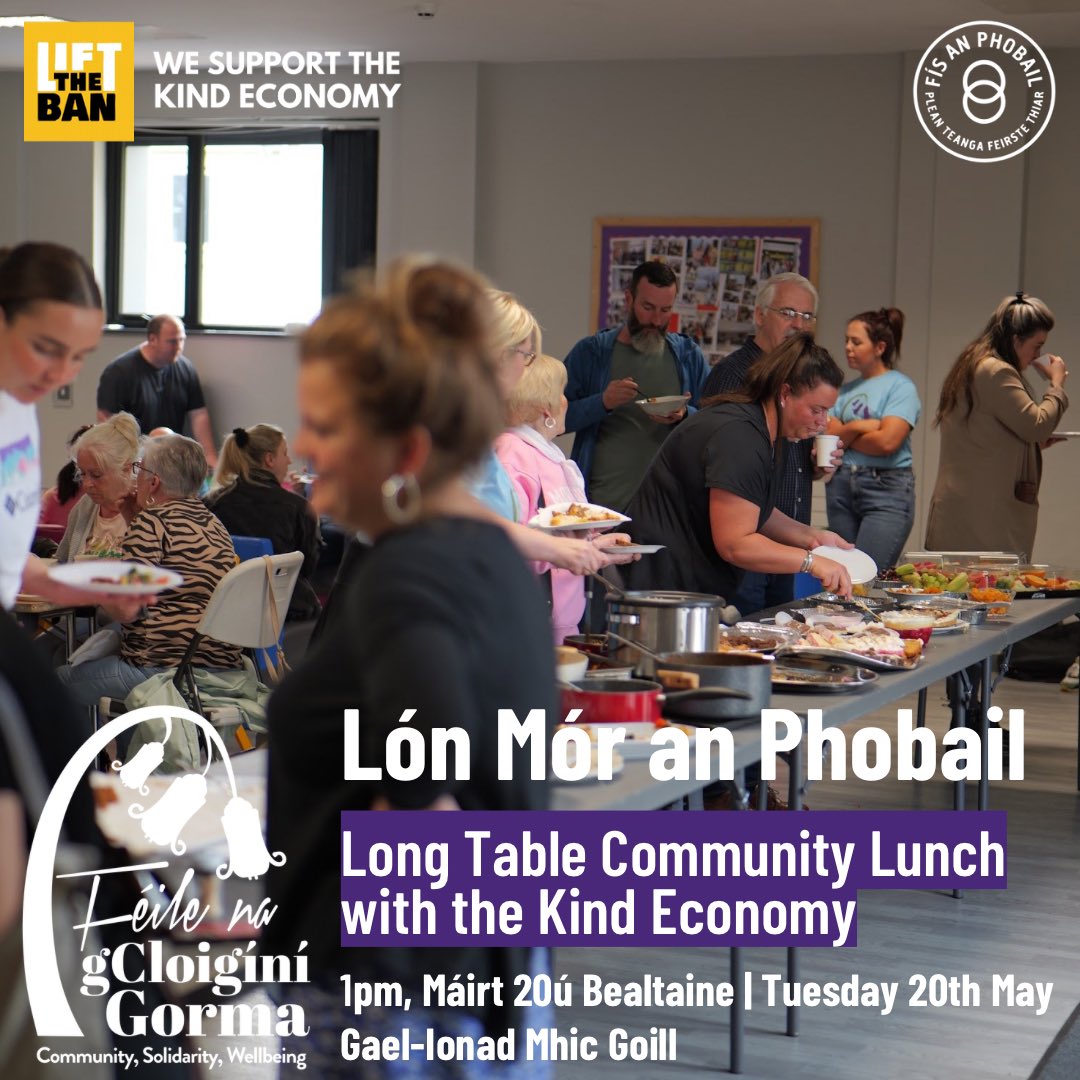
🥙🍴Lón Mór an Phobail | Longtable Community Lunch🍴🥙
Leis an Kind Economy #TógAnCosc
Food by the inspiring Kind Economy campaign to #LiftTheBan ✊🏽
🗓️1pm, Máirt 20ú Beal | Tuesday 20th May
📍Gael-Ionad Mhic Goill
🍽️Tóg béile leat! | Bring a meal!
Bígí linn!
#FNGG25
1
6
6
361

16 Apr 2025
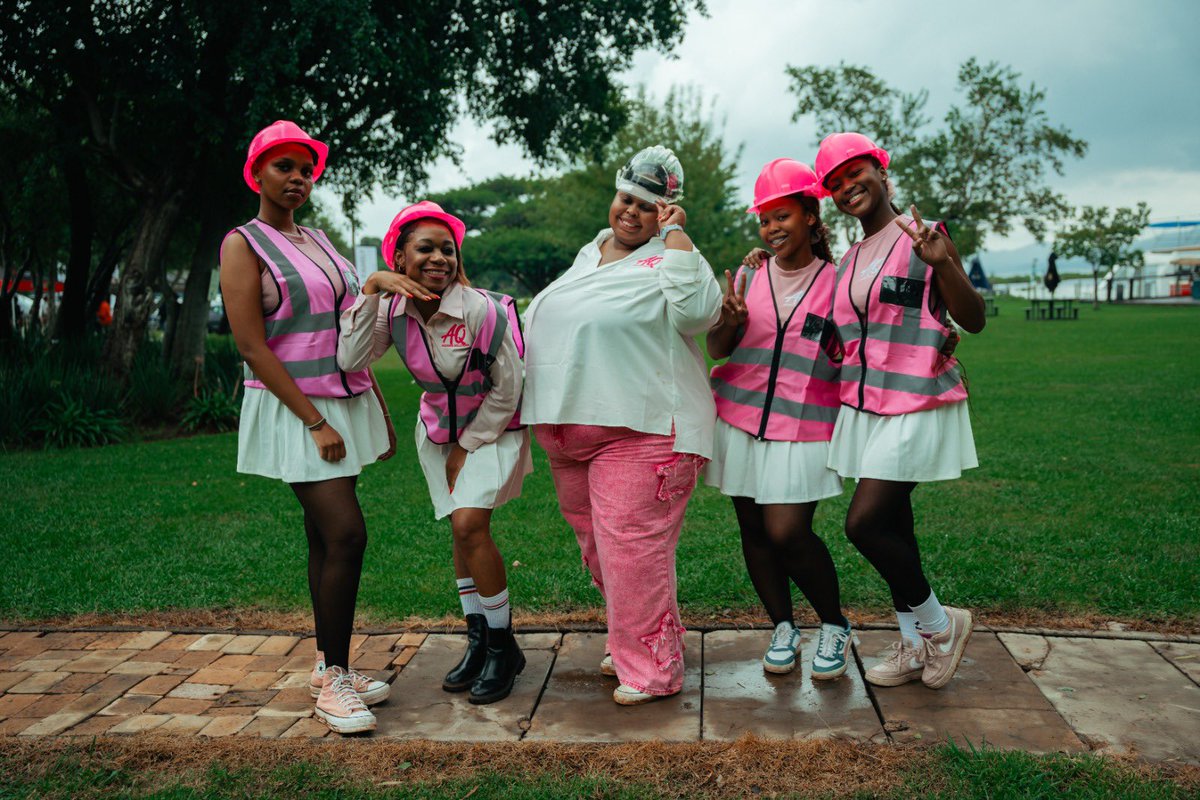
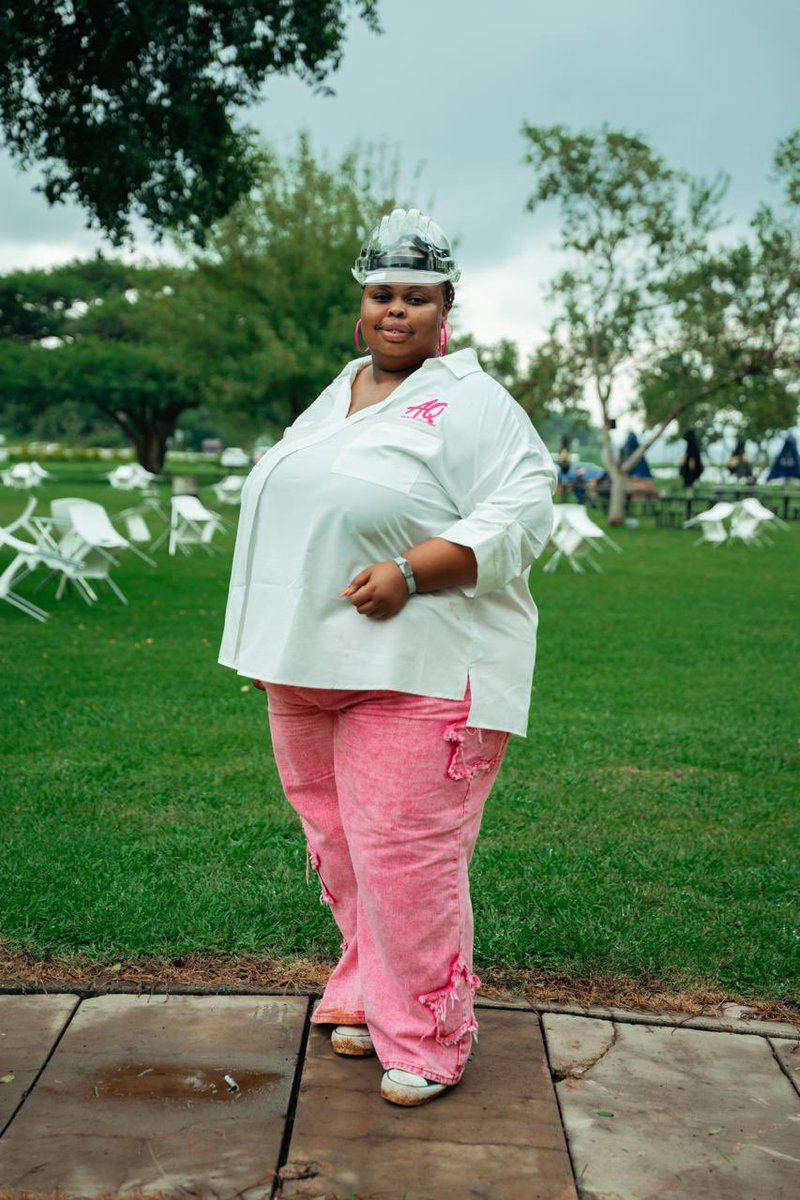
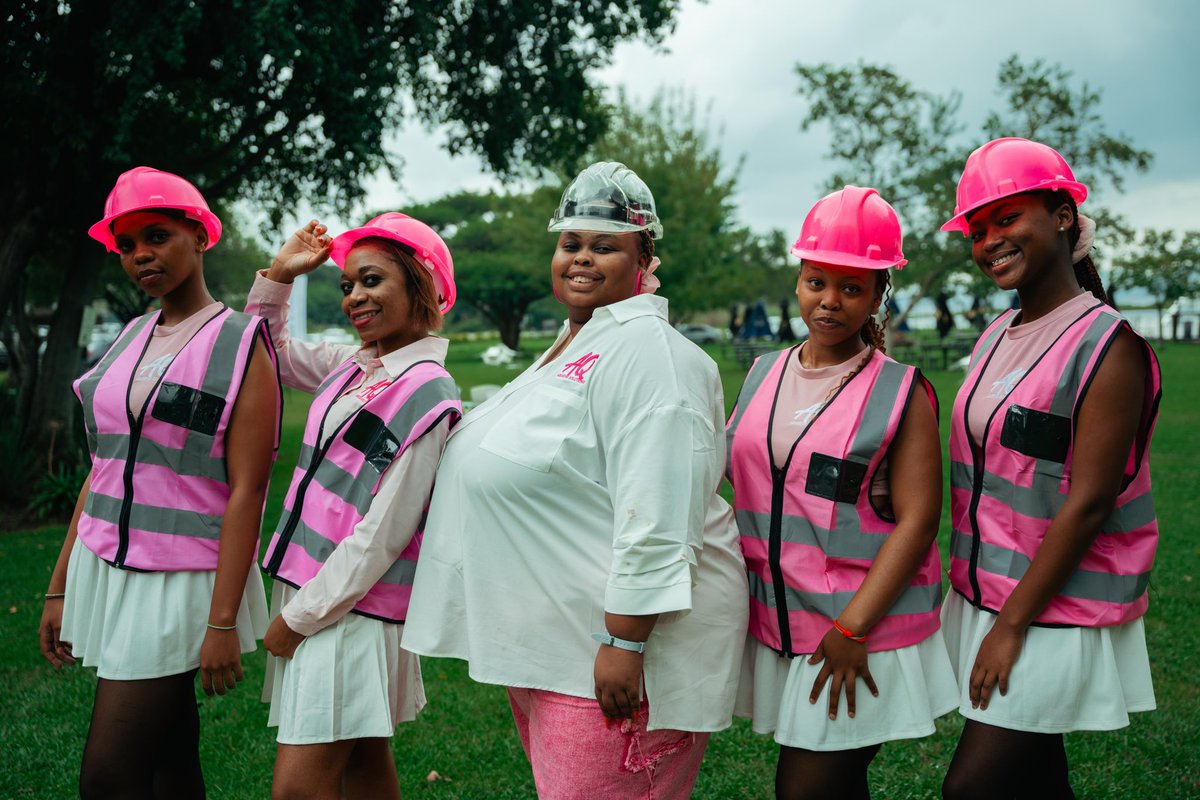
Aqueena Solutions was proud to be the official organiser of @TheMiningGuySA’s Longtable Luncheon, held at Legacy on the Dam in Hartbeespoort. From planning to execution, our amazing team made sure every detail was taken care of-with love, precision, and of course, a touch of pink

3
248