
Jun 13
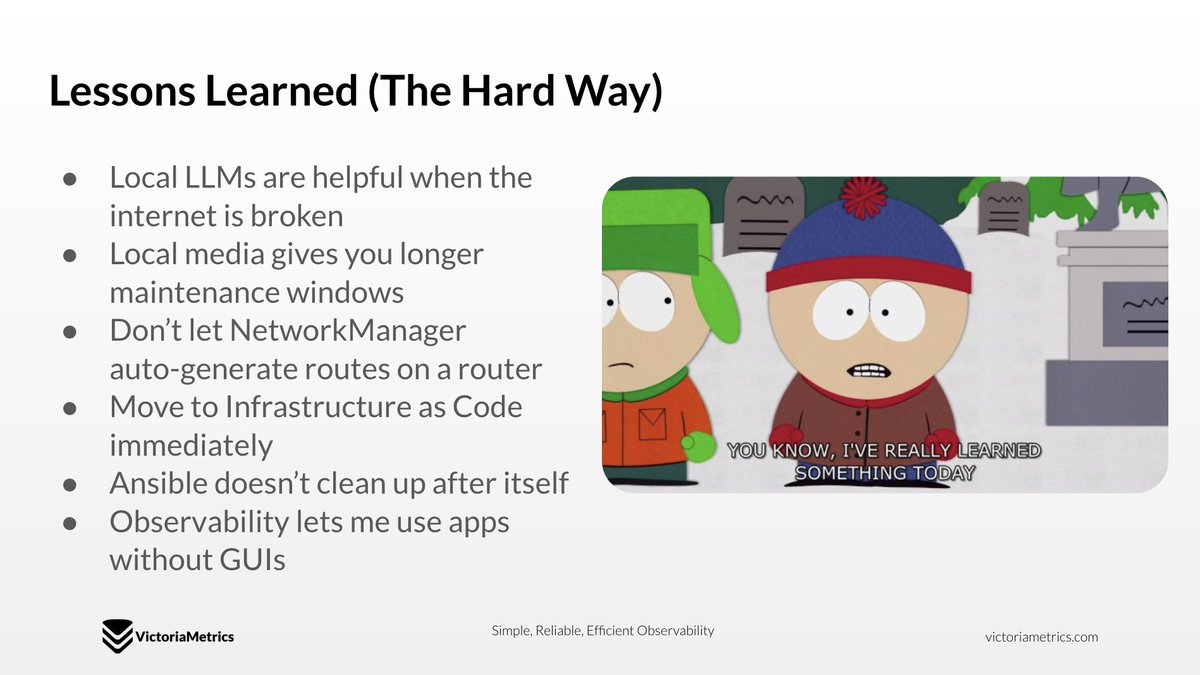
🎤 At @selinuxfest 2026, Mathias Palmersheim shares the lessons learned from building a router the hard way:
🤖 Local #LLMs are invaluable when the internet is down
💾 Local media gives you longer maintenance windows
⚠️ Don’t let NetworkManager auto-generate routes on a router
📝 Move to Infrastructure as Code immediately
🧹 Ansible doesn’t clean up after itself
📊 Observability lets you manage apps without relying on GUIs
Sometimes the best engineering lessons come from production mistakes. 😅
If you're in Charlotte, come talk with us about #Observability, #Metrics, #Logs, and #Traces.
#SELF2026 #VictoriaMetrics
1
152
Jun 13
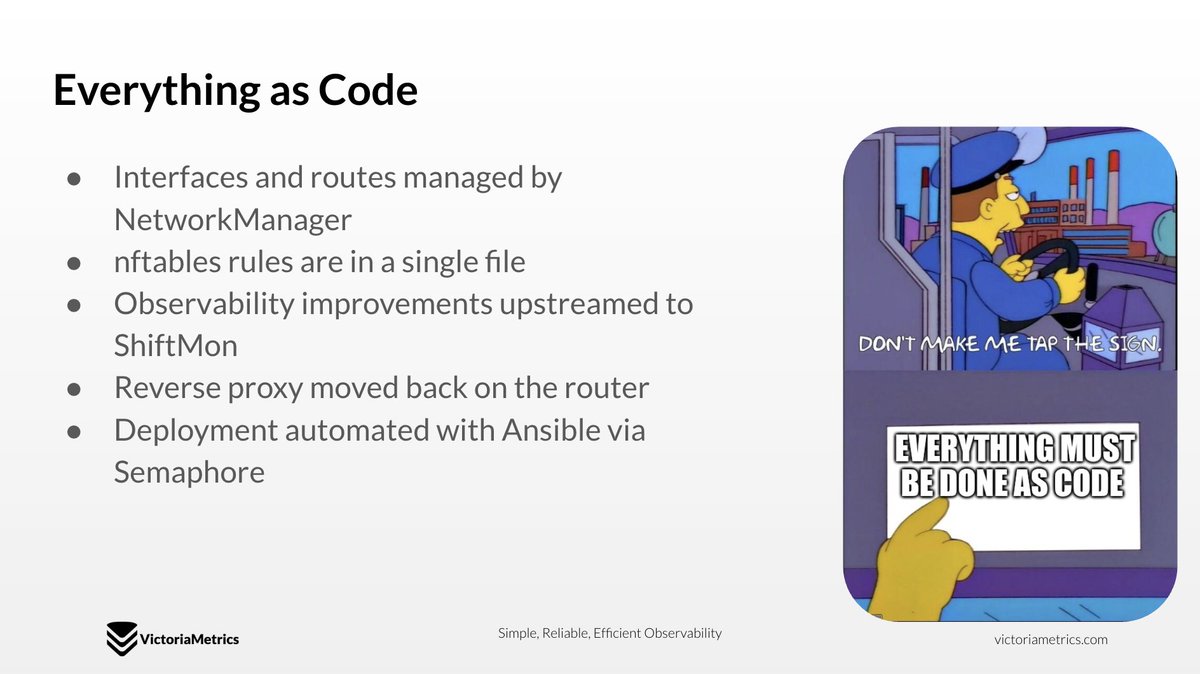
🎤 At @selinuxfest 2026, Mathias Palmersheim presents: "Do you want to build a router?"
Everything as Code:
🌐 Interfaces and routes managed by #NetworkManager
🛡️ nftables rules maintained in a single file
📊 Observability improvements upstreamed to ShiftMon
🔄 Reverse proxy moved back onto the router
🤖 Deployments automated with Ansible via Semaphore
If you're in Charlotte, stop by and talk with us about #Observability, #Metrics, #Logs, and #Traces.
#SELF2026 #VictoriaMetrics
4
197

Jun 11
Purpose-built for headless setups without NetworkManager — deploy boxes, home servers, that Pi humming in your closet. Also open source, so it doubles as a clean reference for Rust TUI dev.
1
13

Jun 11
Qse li minha história de hoje, a dif entre seu dia e o meu é que eu de fato havia substituído systemd.networkd por networkmanager mais cedo, o que quebrou algumas configs de rede. Qnd tudo estava funcionando vscode não logava, e ai lá vamos nos gastar hrs pra descobrir a era a Anatel me fodendo e não eu mesmo.
5
229

Jun 10
How to Restart Network without rebooting your PC
- On Windows: ipconfig /release then ipconfig /renew
- On Linux: sudo systemctl restart NetworkManager
1
5
37
1,277

Jun 8
🔧 nmcli أم nmtui؟ اختيار الأداة المناسبة يوفر وقتك ويزيد كفاءتك في إدارة الشبكات على Linux
📋 nmcli
• سطر أوامر (CLI)
• مثالي للأتمتة والـ Scripts
• مناسب للخوادم وبيئات DevOps
• أسرع للمهام المتكررة
📋 nmtui
• واجهة نصية تفاعلية (TUI)
• سهل للمبتدئين
• مناسب للإعدادات السريعة
• لا يحتاج لحفظ الكثير من الأوام
➡️ تريد أتمتة وإدارة احترافية؟ nmcli
➡️ تريد إعدادًا سريعًا وسهلًا؟ nmtui
💡 المعلومة الأهم: nmtui ليس أداة مستقلة، بل واجهة تفاعلية تعمل فوق NetworkManager لتسهيل ما يمكنك تنفيذه عبر nmcli.
13
532

May 30
아니 근데 농담이 아니라 들어봐 유틸은 GNU coreutils 쓰고 쉘은 배쉬쓰고 PID 1은 systemd쓰고 네트워크는 NetworkManager 쓰는데 얘가 메이저하지 않은 선택을 한 게 뭐가 있음? 홍대병 기분만 내고 싶은 홍대병 지망생들이나 쓰는거지
3
2
19
1,559

May 29
networkmanager seems to think it can connect to wifis without knowing the password, tries to, then hangs after realising it cant. doesnt bother to ask for the password, its like a 3yo trying to be independent but refusing help bcuz they wsnt to be independent
fun morning huh
1
5
217
May 28
cant tell if this is networkmanager being an ass or singbox just breaking hard
4
113

May 28
NixOS君 iwdでwifi繋いでたけど/var/lib/iwdが再起動の度に飛ぶのか毎回設定し直してで面倒なのでiwdなしでNetworkManagerでつなぐようにした。今後どうするかは未定。
1
1
2
260


May 27
computer suddenly won't go to sleep or hibernate
dmesg suggests it's caused by NetworkManager. I've disabled wake-on-lan for NetworkManager
awesome
1
2
106

May 24
おおう、RHEL 10.2、地味に自宅鯖に影響あるわ。
1. RHEL 10.2でGSSAPIDelegatedCredentials noが sshd_configで明示設定可能になった
2. RHEL 10.2 known issueに、ローカル非rootユーザーがsystem-wide NetworkManager profileを作成できる点
3. wget deprecated→curl使え
4. RHEL 10.2では新規インストール時の/boot defaultが2 GiBに増えてる
1
9
27
4,809


May 21
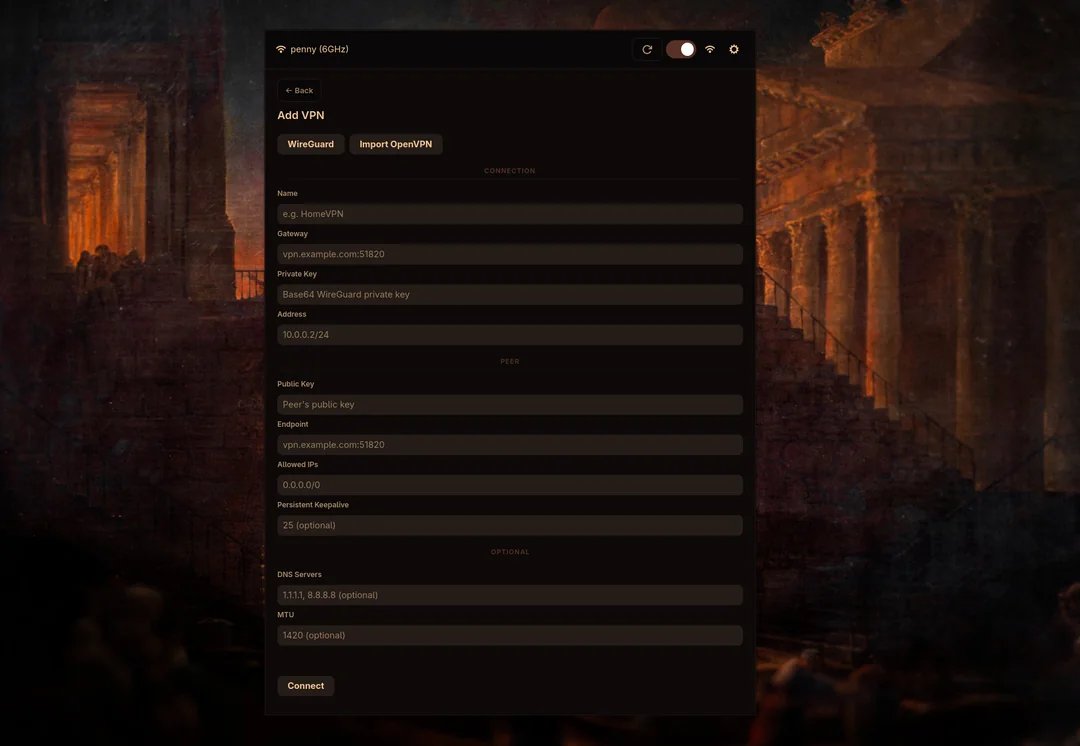
[OC] A proper, Wayland compatible, GUI for NetworkManager
Link: redd.it/1tjl6ke
#unixporn #linux #screenshot
3
10
1,134

May 20
I genuinely can't say much. Somehow my new USB keyboard wakes Debian as soon as it goes to sleep but it gets logged as coming from NetworkManager, and no amount of Acpi disabling for USB or networkmanager seems to prevent it other than physically unplugging the keyboard
1
4
3,583

May 18
You are not wrong, mine was a thought I just shot off and dhh also replied the normal boot is already quite optimized, but it looks like we could add a guarded masking for networkmanager wait online service in install migration, for which I will submit a PR today.
3
978

May 17
If you're getting held up by NetworkManager-wait-online, that's an indicator you have something wrong. Normal boot should only be ~20sec - 30sec
I'd like to compare the results of your systemd-analyze if you're seeing different.
Startup finished in 4.585s (firmware) 1.419s (loader) 10.978s (kernel) 9.899s (userspace) = 26.883s
1
8
2,711
May 17
I have some time tomorrow and I'll PR the guarded masking for networkmanager wait online service in install migration
1
17
3,166

GPT review:
Review: partly right, but the mkinitcpio claim is overstated for current Omarchy.
- Omarchy already uses mkinitcpio’s host-specific mechanism: autodetect.
- Current source sets:
HOOKS=(base udev plymouth keyboard autodetect microcode modconf kms keymap consolefont block encrypt filesystems fsck btrfs-overlayfs)
- The one defensive choice is keyboard before autodetect. Per mkinitcpio, hooks before autodetect are installed “in full”, so moving autodetect before keyboard would shrink the keyboard/HID module set.
- I tested temporary initramfs builds locally:
- current Omarchy-style order: ~375 modules, ~30M image
- autodetect before keyboard: ~171 modules, ~28M image
- without Plymouth: ~26M image / ~13.5M main compressed cpio
So yes, there’s cleanup possible, but not a 150MB → 15MB win on the normal Omarchy path. A 150MB image is likely a fallback/full image or UKI accounting, not the regular host-autodetected image.
The risky part: making the initramfs more host-only can break early boot in edge cases: external keyboards for LUKS, changed storage controller, moved disk, Thunderbolt docks, rescue/fallback
scenarios. Omarchy’s current broad keyboard choice looks intentional.
The NetworkManager-wait-online point is more actionable. Omarchy already masks systemd-networkd-wait-online.service, but not NetworkManager-wait-online.service. Since Omarchy doesn’t use NetworkManager
by default, adding a guarded mask for existing Arch installs that still have it would be low-risk and could prevent offline boot delays.
Recommendation:
1. Add guarded masking for NetworkManager-wait-online.service in install migration.
2. Do not blindly switch mkinitcpio to more aggressive host-only defaults unless tested on encrypted-root external keyboard/dock cases.
3. If we want the mkinitcpio optimization, make it opt-in or benchmark-driven.
3
83
35,506