
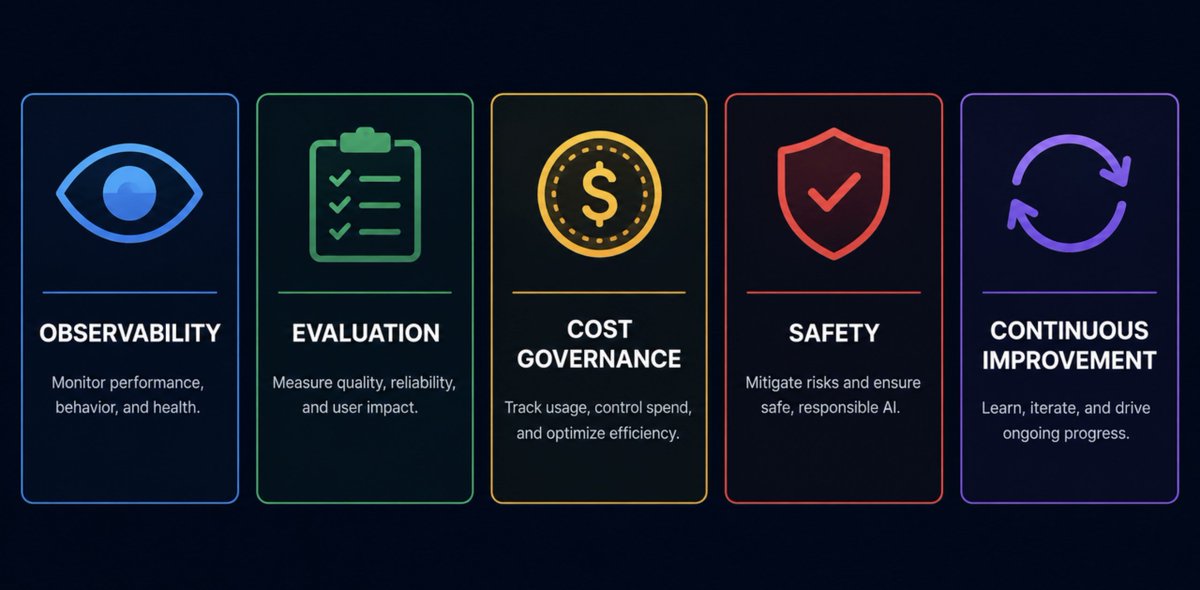
The Practitioner’s Guide to AgentOps
what AgentOps is, how it differs from traditional LLM monitoring, and how to build a production-ready observability stack for autonomous AI agents.
shorturl.at/ueOBc
2

Interesting fact is, now with ai, observability cost is zero, for example any agent can simply go through all past interviews of frontier lab heads and find accuracy ratio of each.
E.g. Hassabis known as really scientist and no bluff, i also agree of, now possible to proove it.
5

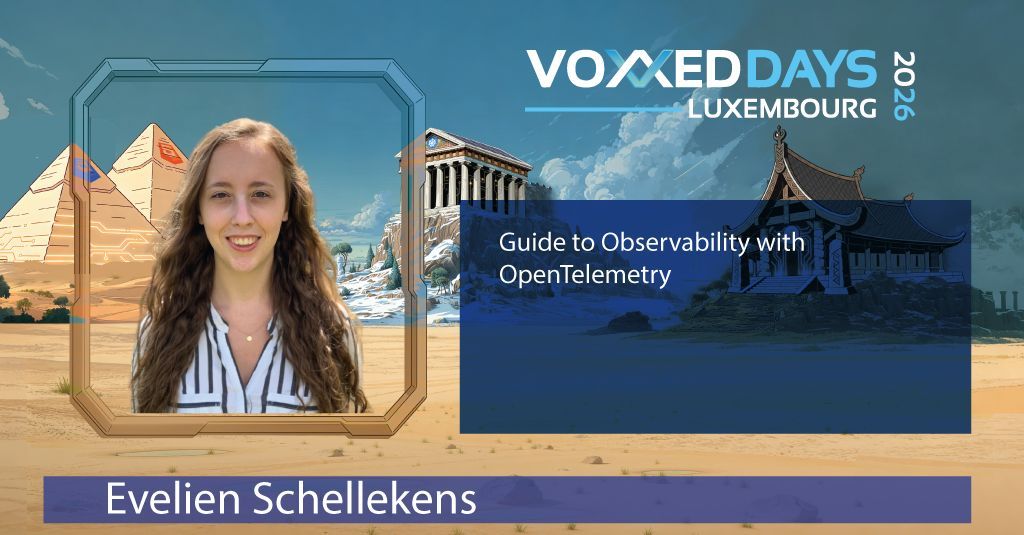
Voxxed Days Luxembourg is proud to welcome Evelien Schellekens for the talk: "Guide to Observability with OpenTelemetry"!
Be sure to check the details on the schedule app:
m.devoxx.com/events/voxxedlu…
and favourite if you‘d like to see it! ⭐
2

29m
I moved my entire notification stack between two AI agents with zero downtime.
The catch: a 3-minute safety delay made the new one look completely dead.
Lesson: a safety mechanism with no observability doesn't make a system safer — just ambiguous.
tedagentic.com/posts/migrati…
3


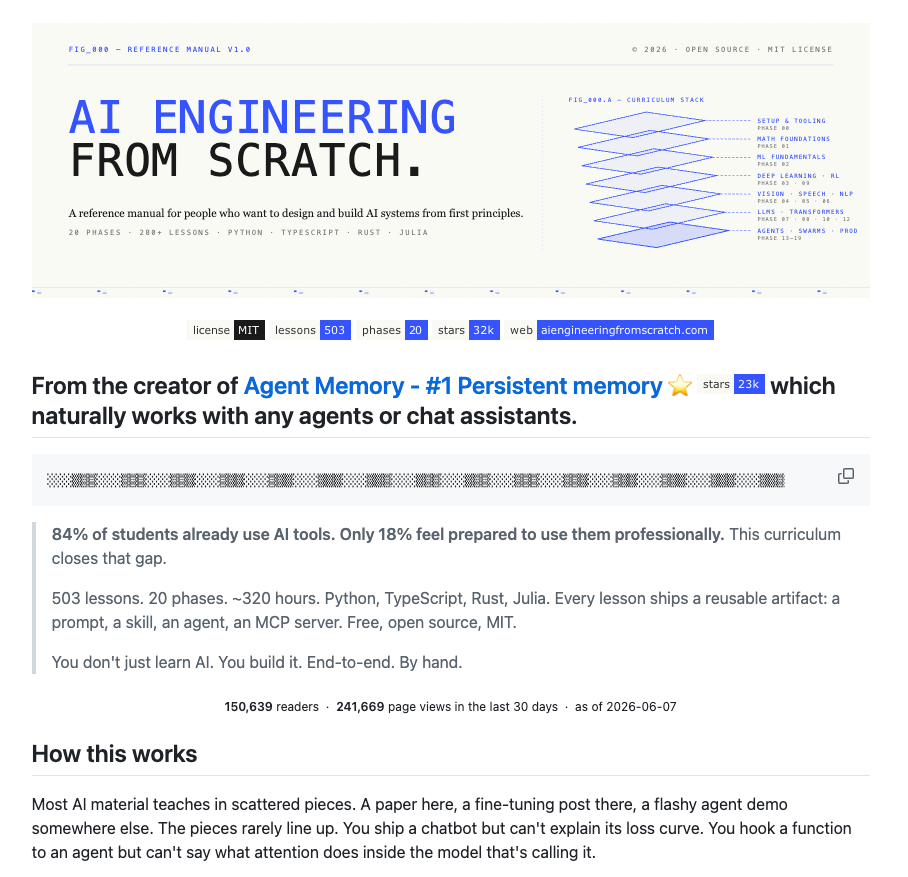
🚨 Bootcamps are charging $15k just to teach you how to call the OpenAI API.
Meanwhile, this open-source curriculum just dropped 435 lessons to help you build AI from the ground up.
It spans 20 phases and ~320 hours. But the best part is the philosophy: you don't touch PyTorch until you understand exactly what it’s doing under the hood.
Here is the full stack:
→ Phase 0-2 (Foundations): Linear algebra and probability through code, plus classical ML from scratch.
→ Phase 3-6 (Deep Learning): Neural networks from first principles. No frameworks.
→ Phase 7-9 (Architectures): Transformers, Generative AI, and Reinforcement Learning. You implement attention yourself.
→ Phase 10-11 (LLMs): Build, train, and deploy large language models.
→ Phase 12-13 (Multimodal): Vision, audio, and MCP server integration.
→ Phase 14-16 (Agents): 42 lessons on agent engineering, including a custom ReAct loop in ~120 lines of pure Python.
→ Phase 17-19 (Production): Infra, deployment, observability, and safety.
→ Phase 20 (Capstones): 17 shippable projects.
Every single lesson ships a real artifact: a prompt, a skill, an agent, or an MCP server.
You don't just learn AI. You build it by hand.
5
3
22
774

Most teams capture thread dumps only after users already see timeouts. By then, debugging becomes expensive, slow & highly manual. @sascha242 shows how #AI-powered #Observability can analyze #JVM thread dumps automatically in containerized #Java systems: javapro.io/2026/06/11/automa…

10
that_anu🇳🇬🇮🇳 retweeted
Day 3 in Observability Zero to Hero we look at SLI, SLO & SLA
• SLI → What are we measuring?
• SLO → What are we aiming for?
• SLA → What are we promising?
Jun 9

Day 2 in Observability Zero to Hero
Metrics, Logs & Traces;
TL;DR
Metrics → What's happening?
Logs → What happened?
Traces → Where did it happen?
10
40
315
22,348

Adaline launches a self improvement layer for AI agents, the eval suite is now a product category
Adaline just shipped a layer that turns messy production traces into fresh evals, synthetic edge cases, and better agent candidates for humans to approve. The company calls it the agent metabolism loop. The product is one piece of a larger move.
The bottleneck in production AI agents in 2026 is no longer the model. It is the eval suite.
A team ships a launch time benchmark, runs the agent against it, and declares done. The December 2025 paper "Beyond Task Completion" (arxiv 2512.12791) argues pass or fail metrics miss what actually breaks production agents. Agents do not always behave the same way twice. Small choices add up to broken outcomes. A eval suite that never refreshes is measuring last year's agent against this year's failures.
Anthropic stood up an AI Reliability Engineering team in March 2026, led by Todd Underwood (15 years Google ML SRE, former OpenAI research platform reliability, co-author of *Reliable Machine Learning*). The field has a name, a team, and a leader.
The 2015 parallel is exact. Observability went from a logging practice to a product category (Datadog, New Relic, Splunk) the moment the dashboard and the alert were not enough. Agent observability is crossing the same line in 2026. Adaline is one productization. The Anthropic org move is the corporate signal that the discipline is now engineering, not a property of the model.
The build is solved. The run is the problem. The eval suite is the product.
25

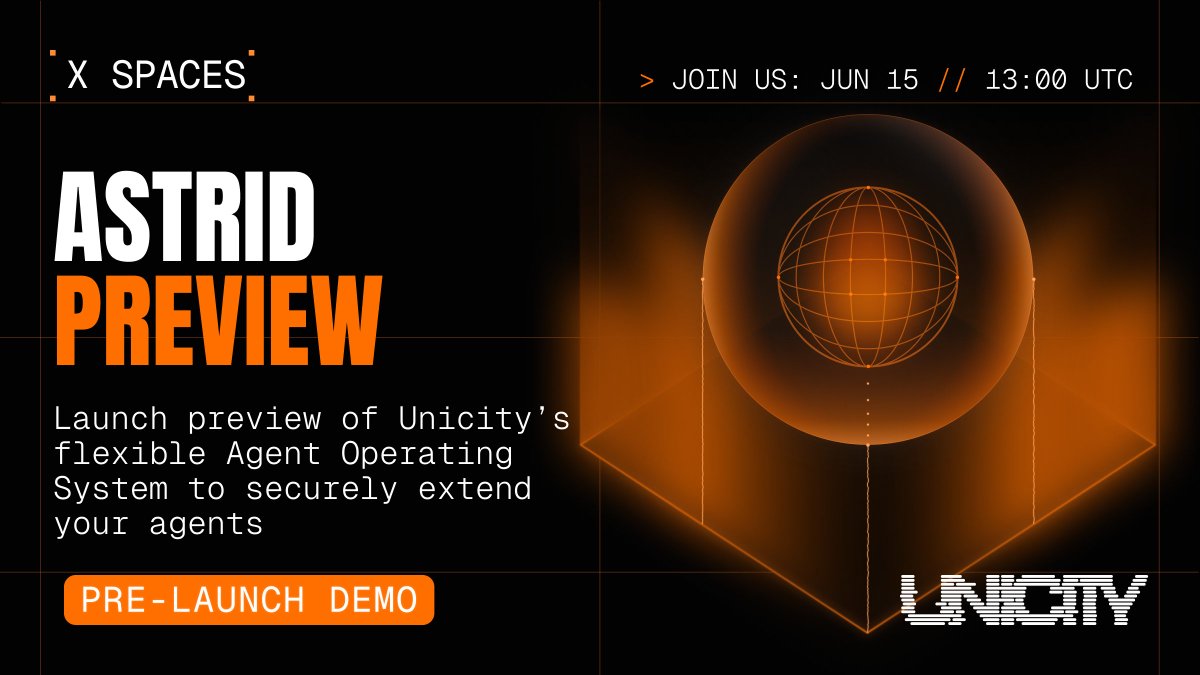
Join us Monday for a launch preview of Unicity's Agent Operating System Astrid. Astrid securely extends your agents by running underneath any system you already have, w/a security sandbox, observability, and extension layer
Jun 12

Join us Monday for a launch preview of Unicity's Agent Operating System Astrid.
Astrid securely extends your agents by running underneath any system you already have, w/ a security sandbox, observability, and extension layer
Coming soon
Register here:
x.com/i/spaces/1kJzDDWXEjqKv…
8

Can't wait to see how Astrid redefines agent infrastructure with that underlying security and observability layer👇
Jun 12
Join us Monday for a launch preview of Unicity's Agent Operating System Astrid.
Astrid securely extends your agents by running underneath any system you already have, w/ a security sandbox, observability, and extension layer
Coming soon
Register here:
x.com/i/spaces/1kJzDDWXEjqKv…
1

The 10 Most In-Demand AI Roles Right Now (June 2026).
1.) Agentic AI Engineer
Why: Companies are moving from chatbots → autonomous agents that plan, execute and self-correct.
Hiring at: Startups, enterprise AI labs, automation platforms.
Key skill: Multi-agent orchestration (LangGraph, CrewAI, AutoGen).
2.) AI Reliability Engineer (AI SRE)
Why: AI systems fail in production. Teams need engineers who make them stable, observable, and cost-aware.
Hiring at: Scale-ups, fintech, healthtech, any AI-native product.
Key skill: Observability guardrails incident response for non-deterministic systems.
3.) On-Chain AI Engineer
Why: Verifiable inference, agent wallets, decentralized compute Web3 x AI is heating up fast.
Hiring at: DeAI protocols, zkML startups, L2s building AI layers.
Key skill: Smart contracts oracle patterns zkML basics.
4.) AI Security Engineer / Red Teamer
Why: Prompt injection, data leaks, model stealing security is the #1 blocker for enterprise AI adoption.
Hiring at: Banks, government contractors, AI security startups.
Key skill: Adversarial testing guardrail design compliance automation.
5.) AI Product Manager (GenAI Focus)
Why: Great AI features need PMs who understand probabilistic UX, eval metrics, and cost tradeoffs.
Hiring at: Every product company adding AI.
Key skill: Translating AI capabilities into user value measurable outcomes.
6.) LLMOps / AI Platform Engineer
Why: Moving from PoC → production requires CI/CD, monitoring, and scaling for LLM workloads.
Hiring at: Mid-large tech companies, AI infrastructure startups.
Key skill: vLLM, Kubernetes, eval pipelines, cost optimization.
7.) Applied AI Engineer (Vertical-Specific)
Why: Healthcare, legal, finance, logistics domain experts who can ship AI solutions win.
Hiring at: Industry-specific SaaS, enterprise digital teams.
Key skill: RAG workflow automation domain knowledge.
8.) AI Policy & Governance Specialist
Why: EU AI Act enforcement started. Companies need people who bridge tech regulation ethics.
Hiring at: Big Tech, consultancies, NGOs, government bodies.
Key skill: Risk frameworks policy writing technical auditing.
9.) AI Infrastructure Engineer (Inference Focus)
Why: Running LLMs at scale is expensive. Engineers who optimize latency/cost are gold.
Hiring at: Cloud providers, inference platforms, AI-first apps.
Key skill: vLLM/SGLang, quantization, KV caching, edge deployment.
10.) Developer Advocate (AI Tools/Infra)
Why: AI tooling is exploding. Companies need voices who can teach, demo, and grow communities.
Hiring at: AI infra startups, cloud platforms, open-source projects.
Key skill: Technical content demo engineering community-led growth.
Salaries up 30-60%. Talent supply still lagging.
If you're pivoting or leveling up, these are the roles hiring "today".
(save this)
2
2
164

2h
The market is very quiet with few launches and the volume is almost at low so I have dedicated myself to looking at $AXON and wanted to share a few observations.
This is still extremely early. We’re talking about a project with very little public traction, a tiny community, and all the risks that come with an ultra-early build.
That said, what caught my attention is that they’re actually shipping.
Recent updates include:
• Continuous GitHub activity and product iterations
• Agent discovery and reputation system improvements
• Observability and monitoring upgrades
• Onboarding and API infrastructure updates
• Introduction of a $AXON burn mechanism tied directly to platform usage
The part that interests me most is not the token itself.
It’s the potential flywheel.
If $AXON succeeds in becoming infrastructure for AI agents, then every economic interaction between agents could become a source of token demand.
According to the latest updates, agent payments made through the platform can be routed into buying $AXON from the market and permanently burning it.
That creates a very different thesis from most AI tokens.
Instead of relying purely on speculation, the goal appears to be:
More agents → More transactions → More payment volume → More $AXON bought → More $AXON burned
The key question becomes @axon402 ??
Can agent activity grow fast enough for the burn mechanism to become meaningful?
Because if agent economies become a real thing, a model like this could create a direct connection between platform adoption and token scarcity.
The broader thesis is also interesting.
AI agents need a way to:
• Discover other agents
• Build reputation
• Hire and pay other agents
• Exchange services
• Operate economically without human intervention
AXON seems to be positioning itself at that intersection of:
AI Agents Payments Reputation Agent-to-Agent Commerce
I also like that the project isn’t just a landing page.
There are:
• Public repositories
• SDKs
• Documentation
• Dashboard components
• Ongoing commits
Of course, there are still plenty of unanswered questions:
• Can they attract builders?
• Can they attract real agent activity?
• Will the burn mechanism generate meaningful demand?
• Can they scale beyond a niche developer audience?
• Can they turn usage into a sustainable economic loop?
For now, I view it as an extremely early experiment rather than an investment thesis.
High risk.
High uncertainty.
But the combination of agent payments, agent marketplaces, reputation systems and a usage-driven burn model is enough for me to keep it on the watchlist.
The technology is early.
The community is early.
The token is early.
Now it’s all about execution.
Curious to see where @axon402 is heading over the next few months.
Keeping it under observation under radar
👀👀👀
2
120

can't stop thinking about how different the online and offline worlds are.
if someone visits your website, you can know where they came from, what they clicked, where they got confused, where they dropped off, and why they converted.
but if someone walks into your showroom, spends 30 minutes talking to a salesperson, and decides whether or not to spend ₹15 lakh, the company often learns almost nothing from that interaction.
millions are spent acquiring customers, yet the most important moment in the buying journey still disappears the second the conversation ends.
it's like having website analytics that only tell you:
"1,000 visitors came today."
and nothing else.
been building something around this at @join_ef.
we've spent two decades building observability for software.
the next decade will be about observability for the physical world.

can't stop thinking about this.
if someone visits your website, you can know:
where they came from
what they clicked
what they ignored
where they dropped off
why they converted
if someone walks into your showroom and spends 30 minutes talking to a salesperson before deciding whether to spend ₹15 lakh...
you know almost nothing.
the purchase decision happens inside the conversation.
the conversation disappears.
and then we wonder why retail still runs on gut feeling.
4
4
69
337

The technology of these civilizations is thousands of years ahead of us. It´s like handing an iPhone to someone living in the Stone Age.
Here is a direct comparison between the technical capabilities of modern military aircraft (such as 5th-generation fighter jets and advanced drones) and the known "UFO observables."
1.- Flight Dynamics & Performance
1.A. - Acceleration & G-Forces
*Modern Military: Strictly limited by human physiology and structural limits. Manned jets (like the F-35) cap out at 9G to prevent pilot blackout. Advanced unmanned drones can survive up to 12G before experiencing structural failure. *UFO Observables: Achieve instantaneous acceleration and 90-degree turns at estimated forces of 1,500G to 2,500G without structural damage or visible propulsion. 1.B.-Hypersonic Velocity *Modern Military: The fastest operational manned aircraft (the historic SR-71) reached Mach 3.3 (approx. 2,200 mph), while experimental scramjet drones (like the X-43A) have touched Mach 9.6 (approx. 7,000 mph) in straight lines. *UFO Observables: Travel within the atmosphere at Mach 40 (30,700 mph) and can change direction instantly at these speeds. 1.C.- Atmospheric Signatures *Modern Military: High-speed flight invariably creates massive friction, extreme thermal signatures (heat trails), and sonic booms when breaking the sound barrier (Mach 1). *UFO Observables: Produce zero sonic booms and no thermal trails, suggesting an engineering mechanism that bypasses standard atmospheric displacement and thermodynamics. 2.- Stealth & Environmental Adaptation 2.A.- Low Observability & Shape-Shifting *Modern Military: Stealth aircraft rely on rigid, fixed geometric angles and radar-absorbent coatings to reduce their Radar Cross-Section (RCS). They cannot alter their physical shape in mid-air. *UFO Observables: Utilize active cloaking to vanish from advanced radar at will and possess "intelligent materials" that allow the craft to dynamically alter its physical form mid-flight. 2.B.-Trans-Medium Travel *Modern Military: Engineering requires strictly specialized designs. A submarine cannot fly, and a fighter jet will violently destroy itself upon impacting water. *UFO Observables: Move seamlessly between space, the atmosphere, and deep oceans (maintaining underwater speeds of 400 mph) without any drop in performance or structural compromise. 3.- Propulsion & Materials 3.A.- Lift & Gravity Control *Modern Military: Completely dependent on aerodynamics (wings, control surfaces) and brute-force propulsion (combustion engines, thrust vectoring) to overcome gravity.
*UFO Observables: Demonstrate true anti-gravity capabilities, allowing them to hover indefinitely or ascend silently without wings, rotors, or visible exhaust.
3.B.- Structural Materials
*Modern Military: Built from rigid titanium, aluminum alloys, and carbon composites. If a wing component is bent or crushed, it suffers permanent structural fatigue and failure.
* UFO Observables: Composed of lightweight, malleable materials that can be folded like paper but instantly retain their original shape. These intelligent materials feature atomic communication capable of self-configuration or self-destruction.
Such indirect evidence allows us to infer that these UFOs involve NHI, a technology nonexistent on Earth and likely unachievable in the foreseeable future. This technology strongly defies our knowledge in theoretical physics as well as our understanding of aerodynamic and aeronautical engineering, thermodynamics, and energy sources. Thus, these aircraft belong to other civilizations, centuries more technologically advanced than ours, which cannot be reproduced by humankind.
Genetics
In July 2023, former intelligence official David Grusch testified under oath to the US Congress that the U.S. government possesses "non-human" biological material from crash sites, stating this was the assessment of individuals with direct knowledge. Biological and chemical examinations have taken place with such creatures. It is known that there is an extremely poor match between these creatures' DNA and human DNA. Something not surprising since their bodies are irrigated not by blood but by a different liquid. Also, UFOs can reach acceleration rates conservatively estimated within the range [1500 G, 2500G], whereas the human body cannot support a G force higher than 1O G sustained for hours. Even with specialized training, special G-suits, and an optimal, horizontal posture (eyeballs-in/out), a sustained 1OG
load is likely to cause unconsciousness (G-LOC) within a minute or less. Hours of exposure to 1OG would cause total cardiovascular collapse, inability to breathe, and blood pooling that would lead to death. The same holds for their adaptability to different levels of radiation, temperature, and gravity. Significant deviations in radiation, temperature, and gravity pose severe, often fatal, risks to human survival. UFOs likely have bases deep in our oceans. Below 300 meters deep in our oceans, the oxygen concentration reduces to minimum levels. And yet they can live there. Humans cannot, nor can most marine life. These deep areas are considered "natural dead zones" for higher organisms. This suggests that, although they breathe air normally (like us), their lungs may have ways to easily adapt to other environments with less or more oxygen. Also, some evidence exists that these beings can communicate telepathically, both among themselves and with humans. Something quite rare among human beings.
Altogether, the above asymmetries are consistent with the aforementioned essentially different genetic information, as indicated by the extremely poor match between these creatures' DNA and that of humans.
49

Anw, proses diposisikan bukan sebagai pilihan teknologi, melainkan mekanisme membangun observability layanan berbasis data. Karenanya, fokus pemilihan instrumen teknis disesuaikan berdasar kebutuhan, kapasitas, & pertimbangan implementasi di lapangan. #InOutFramework
8
yuva kumar retweeted

Jun 8
Day 1 video is now live, I cover what is Monitoring vs Observability
TL;DR: Monitoring tells us there is smoke. Observability helps you find the fire.
Jun 8
This week I'm launching a new series:
"Observability from Zero to Hero"
Over the next 7 posts, we'll cover:
• Monitoring vs Observability
• Metrics, Logs & Traces
• Incident Investigation
• Observability Maturity Models
• Golden Signals, RED & USE
• AI Observability
• Designing a Modern Observability Platform
16
12
142
23,237
Prashant Rai retweeted

Feb 22
active physical observability will become a core primitive of Physical AI.
Feb 20

Physical AI needs a reliability layer and the next moat in autonomy is integrity at fleet scale.
Working on it!
1
3
209

After VMware to Hyper-V, monitoring becomes the next challenge. Observability matters more as platforms diversify.
4